
The Servant Stair and the Service Wing: What the Hidden Architecture of Gold Coast Estates Reveals About Today’s Luxury Floor Plans
The Logic of Invisibility
Robert Kerr’s 1864 architectural treatise The Gentleman’s House reads less like a design manual than a theory of social physics. Kerr argued that the country house had one governing principle above all others: the family’s side and the servant’s side must never, under any normal circumstance, intersect. The kitchen smells must not reach the dining room. The laundry must not be seen from the garden. The servants must be able to move through the house — setting fires, delivering meals, turning down beds — as if they did not exist at all.
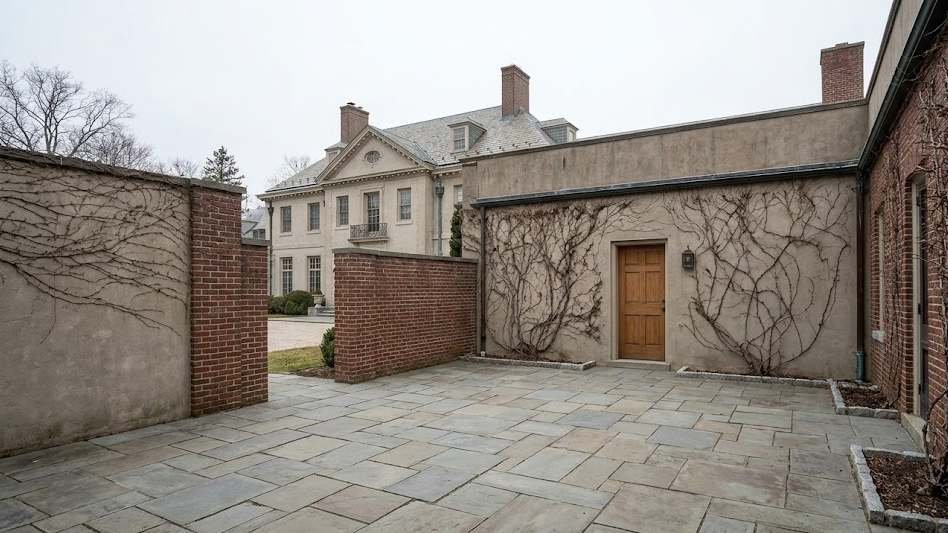
American Gilded Age architects absorbed this logic wholesale. When John Shaffer Phipps commissioned Westbury House in the early 1900s, designer George A. Crawley followed the English country house template precisely. And when the estate’s needs grew, society architect Horace Trumbauer added a large service wing in 1911 that extended east from the original house — complete with servants’ bedrooms on multiple floors, a back stair connecting them to a basement kitchen and servant hall, and twin dumbwaiters linking the prep pantry to the formal dining room above. The whole apparatus was designed to be useful and invisible simultaneously.
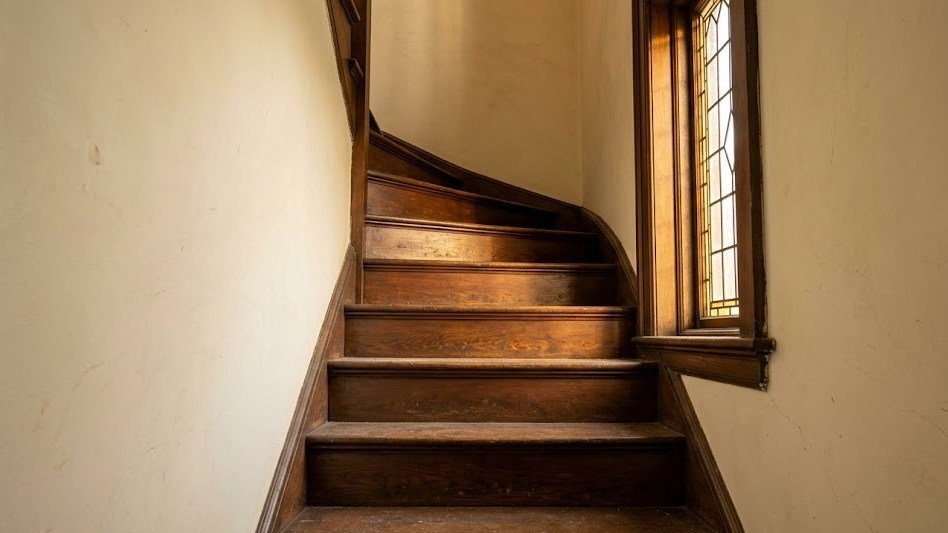
What Trumbauer built at Westbury House was not unusual. It was the standard. Across the Gold Coast — from the Phipps family’s own clustered estates in Old Westbury to the great houses of Cold Spring Harbor, Lloyd Neck, and Oyster Bay — the service wing was as essential as the library or the ballroom. The Society for the Preservation of Long Island Antiquities (SPLIA) has documented floor plans and estate surveys across the North Shore that show the same principle repeated at different scales: the formal rooms face the landscape; the working rooms face the service court. The family stair rises wide and ceremonial from the entry hall. The servant stair is narrow, steep, tucked into a corner, and connects everything from cellar to attic without a single formal landing.
The two staircases in the same house. The same house, two completely different relationships to space.
What the Back-of-House Actually Contains
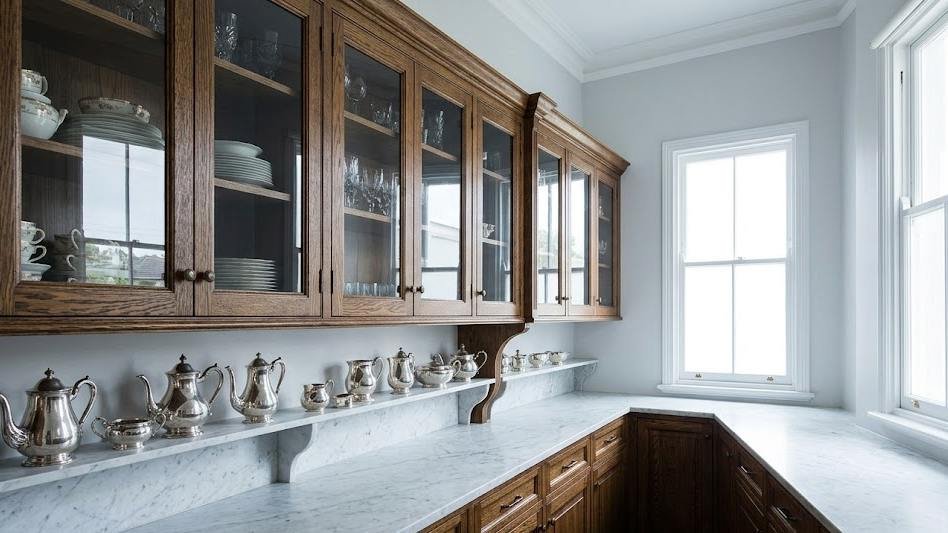
When a preservation team restored the service wing at Westbury House, they worked from historic floor plans and equipment inventories found in the archives — because there were almost no photographs. The spaces were not meant to be documented. What the records revealed was remarkable in its specificity: meat lockers, annunciators, specialty sinks, dishwashing apparatus, silver storage. All of it, according to the estate’s Director of Preservation Lorraine Gilligan, was of the highest quality — frequently intended for use in restaurants or hotels. The coachman’s quarters, the laundry house visible across the kitchen courtyard, the cook’s bedroom directly above the range — these were serious, purpose-built working spaces.
On the surviving Gold Coast estates that have transitioned to private ownership or institutional use, this back-of-house territory is extensive. A typical large estate service wing might contain: a full kitchen with separate prep and finishing areas; a butler’s pantry with dedicated silver storage; a servant hall (the staff dining room); multiple bedroom rooms on upper floors; a laundry; a separate entrance from the service court; and the back stair that ties it all together. In the grandest examples, a housekeeper’s room, a lamp room, a still room for preserves, and a flower-arranging room appear on the historic floor plans.
These are not marginal spaces. In a 10,000-square-foot estate, the service wing may account for 30 to 40 percent of total square footage — the majority of it habitable and structurally sound, the bones often better preserved than the formal rooms precisely because they were never subject to the same cycles of decorative renovation.
The Modern Reading of Service Space
Buyers looking at historic North Shore properties today encounter these spaces and read them in a completely different register than their original architects intended. What was designed for concealment is now marketed — and genuinely valued — as flexibility.
The back stair becomes the au pair stair. The butler’s pantry becomes a prep kitchen for catered events. The servant hall becomes a media room or a mudroom of serious proportions. The housekeeper’s suite becomes a private guest apartment with its own entrance. The laundry room, often located in a generously proportioned ground-floor wing, becomes a spa room or a home gym with natural light and exterior access. The service court becomes a motor court.
None of this is superficial. There is a reason buyers at the luxury end of the North Shore market respond to historic service architecture — and it is not nostalgia. It is function. These spaces were engineered to handle the logistics of a working house: deliveries, cleaning, cooking at volume, staff movement without disruption to the main rooms. That infrastructure, properly updated, handles the logistics of a modern family with equal efficiency. A house with a true butler’s pantry and a second kitchen entrance does not just show well — it works differently than a house without one.
The seller who understands this can present every square foot of a service wing with intention. The seller who does not will price those rooms as storage and lose the argument on value.
Presenting the Hidden Square Footage
What I tell sellers preparing a historic property for the North Shore market is this: the back-of-house is not a liability you need to explain away. It is a case you need to build.
Start with the stair. The servant stair is the spine of the service wing, and it tells buyers immediately that the house was built to a logic — that someone thought carefully about movement and function, not just aesthetics. A well-preserved back stair, with its original treads and tight risers, communicates craftsmanship as clearly as the formal stair does. Do not paint over the wood. Do not carpet it into submission.
Inventory the rooms with precision. Buyers at this level want to know dimensions, ceiling heights, the location of windows, the direction of light. A 280-square-foot butler’s pantry with north-facing windows and original cabinetry is a specific, valuable thing. Describe it as one.
Contextualize the history. The Phipps family lived at Westbury House for roughly fifty years and managed it through decades when domestic staff was plentiful, then scarce, then gone entirely. The service wing adapted. It always does. Buyers at historic properties are not intimidated by square footage with complicated origins — they are drawn to it. The house with a story about its back stair is more compelling than the house without one.
Consider the sequence. When staging or presenting a historic property, think about guiding buyers through the service wing as its own tour within the tour — not as an afterthought at the end, but as a deliberate revelation. The moment the door at the end of the corridor opens onto something unexpected is precisely the moment a buyer begins to feel the full size of what they are purchasing.
A Shift Worth Watching
The buyers coming to the North Shore for historic properties are not purchasing floor plans. They are purchasing the idea that a house can contain more than one way of living — the formal and the working, the visible and the functional, the ceremonial and the daily. The service wing is not what they expected to love. It usually turns out to be the room they talk about for years.
That is not something an architect could have predicted in 1911 when Trumbauer extended east from Westbury House. But it is something a seller on the North Shore should understand today.
The door at the end of the corridor is not a problem to be staged around. Open it.
This is for informational purposes only — consult a licensed attorney or financial advisor for your specific situation.
Real estate markets change. This post reflects conditions as of the publish date. For current listings and market data, contact Pawli at Maison Pawli.
Sources
- Old Westbury Gardens, “Secrets of the Service Wing” tour: oldwestburygardens.org/service-wing-tour
- Lorraine Gilligan, Director of Preservation, Old Westbury Gardens — on the service wing restoration: strollmag.com
- Robert Kerr, The Gentleman’s House (London, 1864) — architectural codification of servant/family separation
- Society for the Preservation of Long Island Antiquities (SPLIA): splia.org (verify current URL before publishing)
- Old Westbury Gardens on Wikipedia (for estate history baseline): en.wikipedia.org/wiki/Old_Westbury_Gardens
Part of the Gold Coast Series: This post is one of fifteen pieces in the Maison Pawli Gold Coast cluster. For the full guide — surviving estates, architectural history, legal sediment, and what buyers need to know — visit The Gold Coast of Long Island: Gilded Age Estates, Architectural Heritage, and What Survives.




3 Comments