
How Property Taxes Work in Suffolk County: What Buyers Need to Budget Before They Close
Nobody falls in love with a house because of its tax bill. But I’ve watched more than a few buyers fall out of love with one for exactly that reason — usually about two weeks before closing, when the real numbers land on the attorney’s desk and suddenly that charming Cape in Smithtown costs four hundred dollars a month more than the budget assumed.
Suffolk County’s property tax structure is not intuitive. It is not a single rate applied uniformly across the county. It is a layered system involving school districts, towns, fire districts, library districts, and special improvement zones — and understanding how those layers stack is the difference between a purchase that works financially and one that strains from day one.
The Basics: How the Bill Gets Built
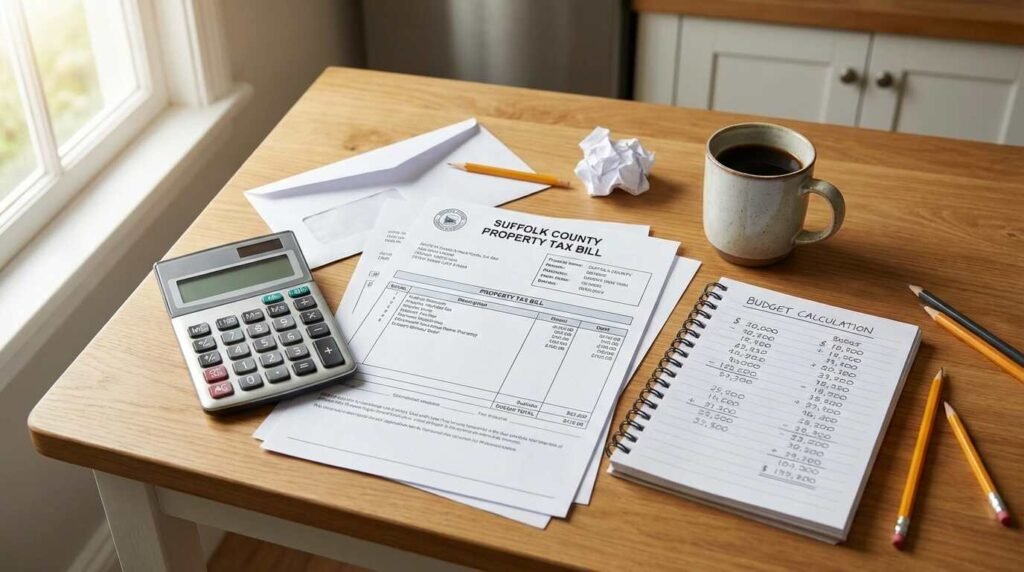
Your Suffolk County property tax bill is a composite of several separate levies. The formula is straightforward in theory: your property’s assessed value, multiplied by the combined tax rate of every taxing jurisdiction that covers your address.
In practice, that means three primary layers. The school district tax — which accounts for more than 60 percent of your total bill in most Suffolk County locations — is the largest single component. The town and county tax covers municipal services, road maintenance, and county-level infrastructure. And then there are special district taxes: fire protection, lighting, water, sewer, library, and sometimes others depending on your exact location.
Suffolk County’s overall effective tax rate sits at approximately 2.42 percent, which is noticeably higher than Nassau County’s roughly 1.79 percent and substantially above the national median. The county’s median annual property tax bill runs around $9,472 — nearly three times the national average of approximately $3,399. For a home valued at $500,000, you should budget roughly $12,100 per year in property taxes, though the actual figure depends heavily on your specific town, district, and exemption status.
The Suffolk County Legislature approved a $4.3 billion budget for 2026 that includes a 3.18 percent property tax increase, staying within New York’s tax cap limit of 3.25 percent. That increase alone signals the direction: property taxes on Long Island trend upward, and buyers need to build escalation into their long-term budget.
Why Your Neighbor’s Bill May Be Different From Yours
This is the part that catches relocating buyers off guard. Suffolk County has over 125 school districts, ten towns, sixty-four villages, and more than a hundred special taxing districts. Living one street over can mean a materially different tax bill — not because the houses are different, but because the district overlay is different.
School district boundaries are the most consequential variable. Two houses on the same block, identical in square footage and condition, will carry different tax obligations if they fall in different school districts. The school tax rate is set annually based on each district’s approved budget divided by the total assessed property value in that district. Districts with higher budgets or lower total assessed value generate higher per-property tax bills.
I’ve written before about how the assessed value differs from the market value and what that means for sellers. For buyers, the takeaway is simpler: ask for the actual tax bill, not an estimate. Every listed property in Suffolk County has a verifiable tax history through the Suffolk County Property Records Search. Use it before you make an offer.
The STAR Program: What Buyers Need to Register For
New York’s School Tax Relief program — STAR — provides a credit or exemption that reduces the school tax portion of your bill. Here’s what every buyer needs to understand about the current state of the program.
The STAR exemption — which appeared as a direct reduction on your school tax bill — is closed to new applicants. If you’re buying a home today, you are not eligible for the STAR exemption. What you are eligible for is the STAR credit, which works differently: instead of a reduction on your bill, the New York State Department of Taxation and Finance sends you a check or direct deposit that you apply toward your school taxes.
To receive the STAR credit, you must register through the state’s Homeowner Benefits Portal after you purchase your home. The income ceiling for Basic STAR is $500,000 in combined household income. Enhanced STAR — available to homeowners 65 and older — carries a lower income threshold (roughly $107,300 for the 2025–2026 school year, based on the 2023 tax return) and provides a larger benefit.
The STAR credit grows by up to two percent annually, which is one of its advantages over the legacy exemption. But you won’t receive it automatically — you have to register, and many first-time buyers on Long Island don’t learn this until they’ve already missed a cycle.
The Tax Grievance Option
Suffolk County homeowners have the right to challenge their property’s assessed value through the tax grievance process. The deadline for Suffolk County falls on the third Tuesday in May for most towns, though some towns — like Brookhaven — have different deadlines. For the 2026–2027 tax year, that means acting now if you believe your assessment doesn’t reflect current market conditions.
A successful grievance reduces your assessed value, which reduces your tax bill. Many Long Island homeowners file grievances regularly, and the process — while it can be handled independently — is also served by a network of tax grievance firms that work on contingency.
For buyers, the practical implication is this: if the home you’re purchasing has a high assessed value relative to your purchase price, you may have immediate grounds for a grievance. And if the seller recently won a grievance, their reduced assessment may transfer to you — but that’s not guaranteed, especially if the sale price triggers a reassessment.
I covered the seller’s perspective on this in The Assessed Value Is Not the Market Value. The buyer’s side is the mirror image: your purchase price becomes a data point that can work for or against you in the assessment record.

What to Budget: A Practical Framework
When I work with first-time buyers, I ask them to build their monthly budget using the actual prior-year tax bill for the specific property, not a percentage estimate. Here’s the framework.
Take the prior year’s total tax bill. Divide by twelve. That’s your monthly tax escrow baseline. Then add a five to eight percent cushion for annual increases — because between school budget votes, county budget changes, and the general direction of Long Island property taxes, flat is optimistic.
For a home with a $14,000 annual tax bill — which is common for mid-range properties on the North Shore — you’re looking at roughly $1,167 per month in taxes alone, before mortgage principal, interest, and insurance. With the cushion, budget $1,250. That number should sit alongside your mortgage payment, homeowners insurance, and any flood or windstorm coverage when you calculate whether the house fits.
If you’re buying in a district where school taxes run particularly high, ask your lender how the tax bill affects your debt-to-income ratio. I’ve seen preapprovals shrink when the actual tax number replaces the lender’s estimate, particularly with FHA and conventional loans that use conservative ratios. We covered this in detail in Beyond the 30-Year Fixed — the mortgage structure you choose interacts directly with how much room the tax bill leaves in your budget.
If you’re working through the full buyer’s process for the first time, I recommend reading our complete guide to buying a home on the North Shore for the step-by-step framework. Property taxes are one piece, but they connect to everything else — from what you can afford to how much equity you’re building.
The Bottom Line
Suffolk County property taxes are high by any national measure. That’s not going to change. What you can control is how well you understand the bill before you sign the contract — which district you’re in, what exemptions you qualify for, whether a grievance makes sense, and how the monthly number fits alongside everything else.
The buyers who get this right don’t just close with fewer surprises. They buy in the right district the first time, which means they build equity in a property that holds its value — partly because the same tax dollars funding those schools are the reason the next buyer will pay a premium to live there, too.
Real estate markets change. This post reflects conditions as of April 2026. For current listings and market data, contact Pawli at Maison Pawli.
This is for informational purposes only — consult a licensed attorney or financial advisor for your specific situation.
You Might Also Like
• What the Suffolk County Tax Grievance Deadline Actually Means for You
• Earnest Money Is Not a Deposit: The Legal Distinction That Determines Who Keeps It
Sources
• Suffolk County Legislature — 2026 Budget Approval ($4.3 billion, 3.18% tax increase): https://www.bfctaxgrievance.com/suffolk-county-property-tax-rates-are-going-up
• Arvy Realty — Suffolk County Property Tax Rate Guide (2.42% effective rate, $9,472 median): https://arvyestate.com/how-to-calculate-suffolk-county-property-tax-rate-a-sellers-step-by-step-guide-2025/
• Heller & Consultants — Complete Guide for 2026 Property Taxes in Suffolk County: https://hellertaxgrievance.com/complete-guide-for-2026-property-taxes-in-suffolk-county/
• New York State Department of Taxation and Finance — STAR Resource Center: https://www.tax.ny.gov/star/
• New York State Department of Taxation and Finance — STAR Eligibility: https://www.tax.ny.gov/pit/property/star/eligibility.htm
• Leave The Key Homebuyers — Long Island Property Tax Rates Guide: https://leavethekey.com/blog/long-island-property-tax-rates/