Sound vs. Bay vs. Harbor: What the Water Type Actually Means for Your Maintenance Budget and Resale Value
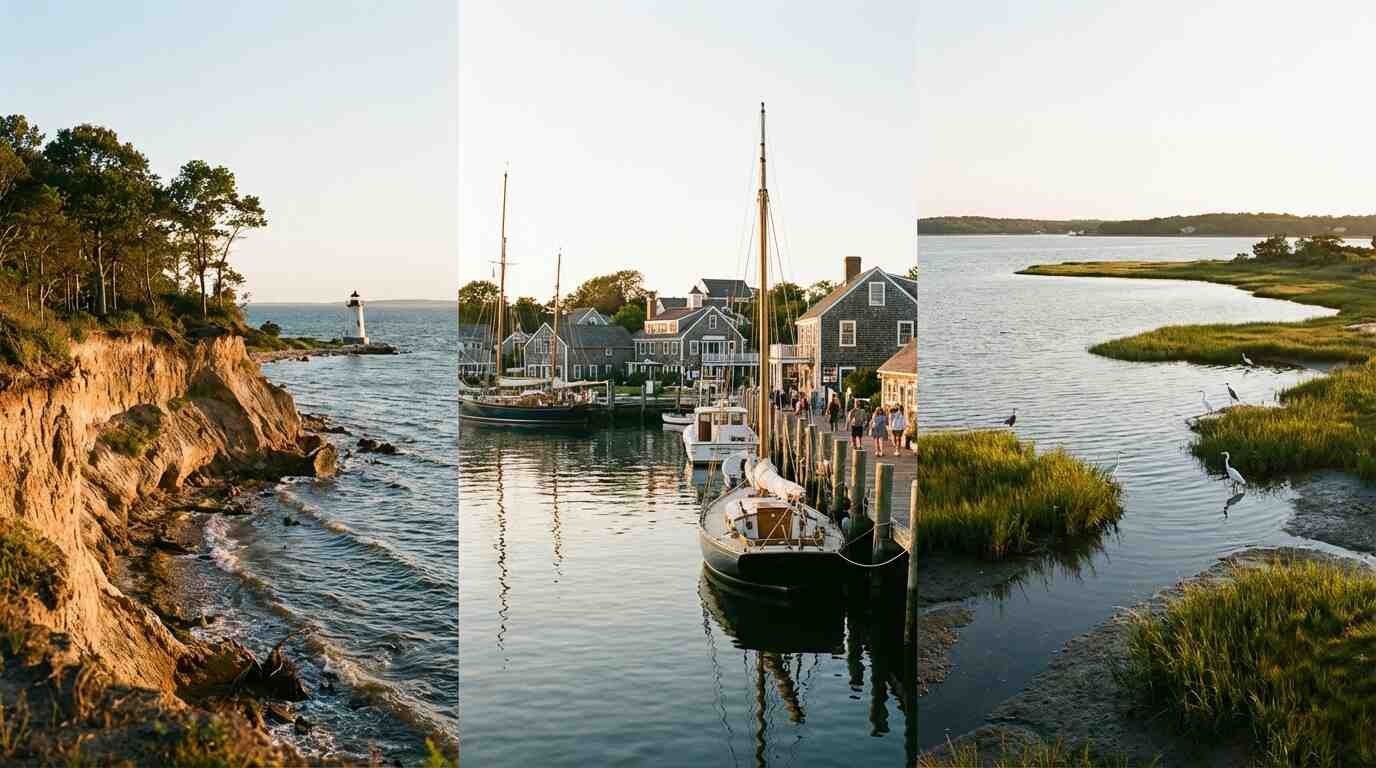
When buyers tell me they’re looking for waterfront, I ask them which kind. The answer matters more than most people realize, because on Long Island’s North Shore, the word “waterfront” describes at least three fundamentally different conditions — and each one carries its own maintenance arithmetic, insurance profile, and long-term cost structure. A Sound-facing bluff in Asharoken and a harbor-side lot in Cold Spring Harbor may both qualify as waterfront, but they age differently, cost differently to maintain, and sell differently when the time comes.
I’ve walked properties on all three water types for years, and the pattern is consistent: buyers who understand the distinction before they make an offer tend to negotiate better, budget more accurately, and avoid the renovation surprises that turn a dream house into a money pit. So here’s what the water type actually tells you.
Sound-Facing: The Beautiful Brute
Properties that face Long Island Sound directly — places like Asharoken, parts of Eatons Neck, the bluffs of Lloyd Neck, stretches of the Nissequogue shoreline — sit in the most exposed position on the North Shore. The Sound is not the open Atlantic, but it’s not gentle either. Its fetch — the distance over which wind can build waves — runs roughly twenty miles to the Connecticut shore, which is enough to generate significant wave action during nor’easters and storm events. Salt spray reaches farther inland than most buyers expect, and the combination of wind, salt, and humidity creates an accelerated corrosion environment that affects everything from exterior hardware to HVAC systems.
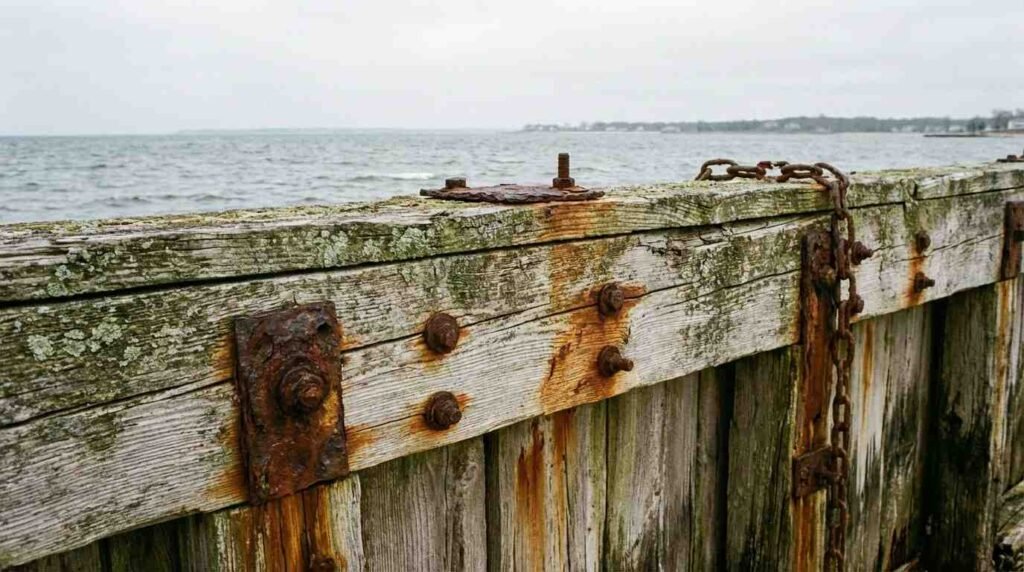
The maintenance implications are concrete. Exterior paint or stain on a Sound-facing home needs refreshing on a three-to-five-year cycle rather than the seven-to-ten years an inland home might expect. Metal fixtures — railings, hinges, light fixtures, even garage door hardware — corrode faster. Roofing materials take more punishment from wind-driven rain. Decks and outdoor structures built with conventional pressure-treated lumber deteriorate significantly faster than the same materials would perform even a quarter-mile from the water.
And then there’s the structural question. Many Sound-facing properties sit on or near bluffs that are actively eroding. I’ve written about the erosion question for North Shore bluff homes in detail, but the short version is this: bluff recession on the North Shore averages between six inches and two feet per year depending on geology, exposure, and whether a bulkhead or revetment is in place. That recession rate is a direct input to your property’s long-term value — and to the cost of maintaining or replacing the shoreline protection structure that slows it.
Resale dynamics for Sound-facing properties tend toward the dramatic. In a strong market, the views and the direct water access command premiums that make the maintenance costs feel manageable. In a soft market, the same maintenance exposure can make buyers cautious. The insurance profile is typically the most expensive of the three water types, particularly after FEMA’s Risk Rating 2.0 methodology began pricing individual properties based on proximity to flooding sources and replacement cost.
Bay-Sheltered: The Quiet Middle Ground
Properties on Long Island’s bay systems — the harbors and inlets along the South Shore, the bays of the East End, and the smaller embayments on the North Shore — occupy a different niche. Bay water is calmer. Wave action is reduced by the geometry of the enclosure. Salt spray is present but less aggressive than open-Sound exposure. The result is a waterfront property that costs less to maintain year over year, with a less punishing cycle of exterior deterioration.
The tradeoff is ecological. Enclosed bay systems are more sensitive to water quality issues — nutrient loading, algal blooms, eelgrass loss — that can affect both the livability of the property and its long-term value. I covered the eelgrass crisis in Peconic Bay in an earlier piece, and the takeaway is worth repeating: degraded water quality in a bay system doesn’t just affect swimming and shellfishing, it affects the narrative of the neighborhood. Buyers pay attention to what the water looks like, and a bay that’s visibly impaired is harder to sell on than a bay that’s clear.
Bay properties also face a specific insurance complication: storm surge in enclosed bays can behave counterintuitively. Water pushed into a bay by wind or storm has fewer places to go, and it can pile up against the shoreline in ways that exceed what an open-coast surge model would predict. The Hampton Bays stretch along Shinnecock Bay is a textbook example — modest storm events can produce disproportionate flooding because of the bay’s geometry and the choke points at its inlets. On the North Shore, Mount Sinai Harbor and Conscience Bay in Setauket exhibit similar dynamics on a smaller scale.
The maintenance budget for a bay-sheltered property is typically fifteen to twenty-five percent lower than a comparable Sound-facing home, depending on exposure. Bulkhead costs may be lower because wave loading is reduced, but they’re not eliminated — bay-side bulkheads still face tidal cycling and the freeze-thaw damage that comes with North Shore winters. The economics of North Shore bulkheads apply to both water types, though the numbers shift.
Harbor-Adjacent: Where the Infrastructure Premium Lives
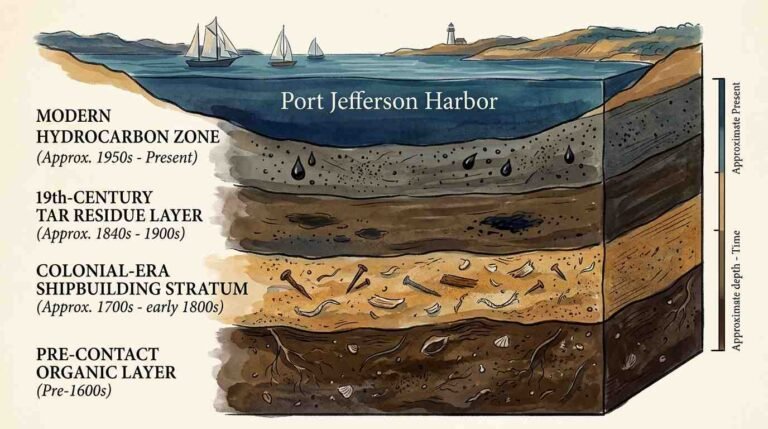
The third category is the harbor-side property — homes in villages like Cold Spring Harbor, Northport, Port Jefferson, Centerport, and Huntington Harbor where the water is not just a view but a working infrastructure. Marinas, mooring fields, launch ramps, ferry terminals, commercial fishing docks — these are the elements that define harbor waterfront, and they create a different value calculus entirely.
Harbor properties carry what I think of as an infrastructure premium. The proximity to docking, boat storage, fuel, and provisioning adds a functional dimension that open-water frontage doesn’t provide. In Port Jefferson, the ferry terminal to Bridgeport adds a transportation component that registers directly in property values — I’ve written about why the ferry terminal is the most undervalued selling point on the North Shore. In Northport and Centerport, the village marinas and mooring fields create an amenity layer that supports pricing even when the broader market softens.
The maintenance profile of a harbor property differs from both Sound and bay exposures. The water is typically calmer than either, and salt spray exposure is often minimal because the property faces an enclosed harbor rather than open water. But harbor properties face a different set of costs: dock maintenance, mooring fees, dinghy storage, and the regulatory complexity of operating structures in or near the water. Riparian rights — the question of where your property actually ends — become materially important when your lot borders a harbor, because those rights determine what you can build, what you can repair, and what permits you’ll need.
Harbor properties also face unique resale dynamics. The buyer pool is narrower — it’s people who specifically want harbor access, not just waterfront views — but within that pool, demand is persistent. Harbor-front inventory in the North Shore’s best-established harbors turns over infrequently, which supports pricing but can make comps difficult to find. When I work with sellers on harbor properties, the conversation is always about how to market the infrastructure access as a distinguishing feature rather than relying solely on the water view.
The Crossover Zones
Some North Shore properties sit at the intersection of these categories — a harbor that opens to the Sound, a bay with direct tidal exchange, a bluff lot above a protected cove. These crossover properties carry hybrid maintenance profiles, and they require more careful analysis than a simple “waterfront” label would suggest.
The most common crossover on the North Shore is the harbor-mouth property — a home at the point where a protected harbor opens to the Sound. These lots get the harbor’s infrastructure access and the Sound’s dramatic views, but they also inherit the Sound’s salt-spray exposure and the harbor’s regulatory complexity. They tend to carry the highest maintenance budgets of any waterfront type, but they also carry the highest per-square-foot premiums when they sell, because they’re genuinely rare.
Whatever the water type, the homework is the same: understand the exposure, budget for the maintenance cycle, verify the insurance cost before you make an offer, and ask the neighbors what the water does during a storm. That last question has saved more than one of my buyers from a costly surprise.
This is for informational purposes only — consult a licensed insurance professional and a qualified marine contractor for property-specific guidance.
Real estate markets change. This post reflects conditions as of April 2026. For current listings and market data, contact Pawli at Maison Pawli.
This post is part of my comprehensive guide to Buying Waterfront Property on Long Island’s North Shore: What Every Buyer Needs to Know — covering everything from flood insurance and DEC permits to bulkheads, riparian rights, and the waterfront buyer’s checklist.
You Might Also Like- The Eelgrass Crisis in Peconic Bay — and Why Every Bayfront Buyer Should Read the Water Quality Data
- Port Jefferson’s Second Act: How a Shipbuilding Ghost Town Became the North Shore’s Most Contested Market
- Salt, Spray, and Staging: Beating Coastal Wear and Tear Before You List
Sources
- NYS Department of State, Long Island Sound Coastal Management Program — https://dos.ny.gov/long-island-sound-coastal-management-program
- USGS, Saltwater-Interface Mapping, Long Island — https://www.usgs.gov/centers/new-york-water-science-center/science/saltwater-interface-mapping-long-island-new-york
- FEMA Risk Rating 2.0, Cost of Flood Insurance for Single-Family Homes — https://www.fema.gov/flood-insurance/work-with-nfip/risk-rating/single-family-home
- U.S. Army Corps of Engineers, North Shore of Long Island Bayville Coastal Storm Risk Management — https://www.nan.usace.army.mil