The Fishermen Who Became Hoteliers: Inside the Trulli Estates of the Puglia Interior
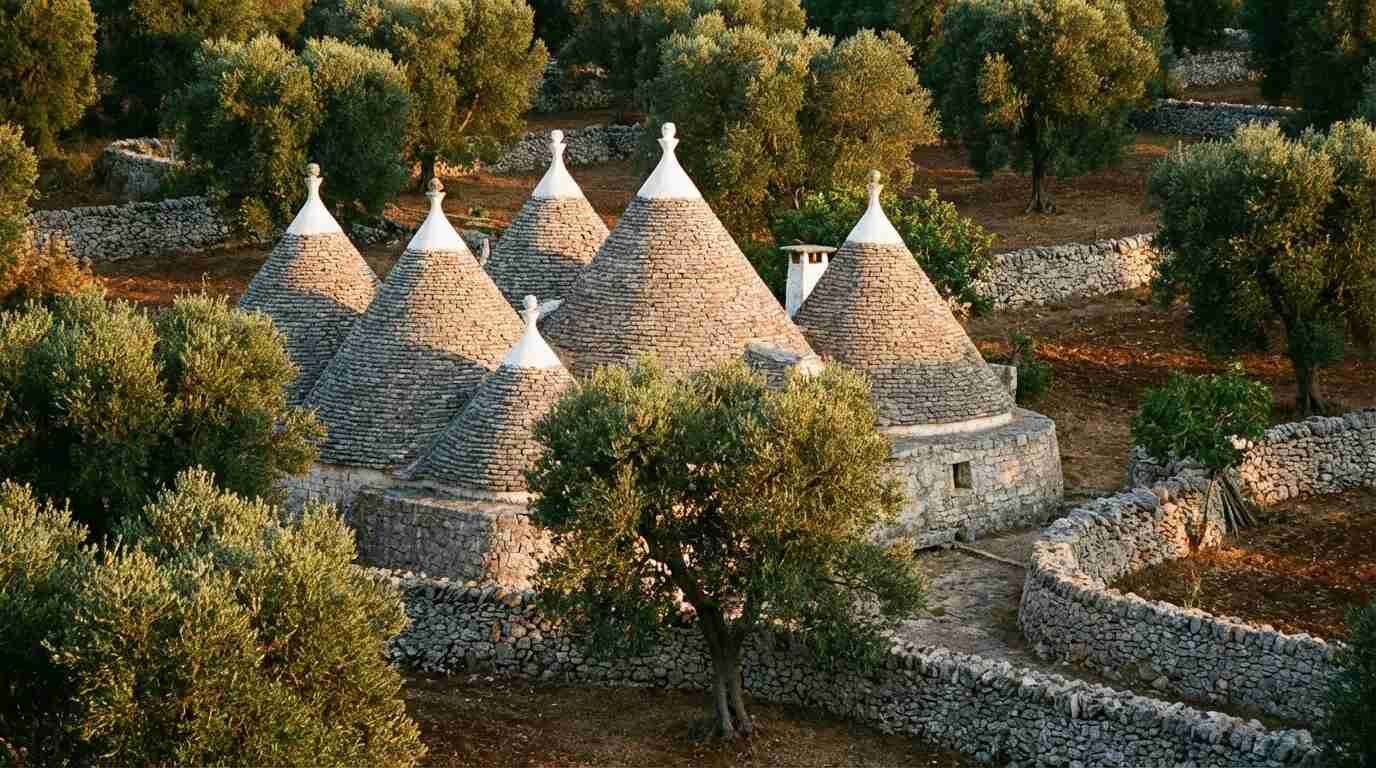
The cone-shaped stone roofs have always been here, built without mortar so they could be dismantled quickly to avoid taxation. The families who built them are still here too — and some of them have decided to let strangers sleep inside.
The Valle d’Itria lies in the heel of the Italian boot, roughly between Alberobello and Ostuni, a landscape of limestone karst covered in olive groves, cherry orchards, and dry-stone walls that divide the fields in patterns unchanged since the fifteenth century. The trulli rise through this landscape irregularly, in clusters and alone, their grey conical roofs dotted with whitewashed pinacles, their interiors cool even in July because the limestone walls are a meter thick and the design was figured out long before air conditioning. The UNESCO inscription came in 1996, confirming what regional Italians had always treated as obvious: the trulli of Alberobello are structurally and culturally unique. Nothing like them exists anywhere else.
The Architecture of Avoidance
The origin story most commonly told about trulli construction — that the walls were built without mortar so that the buildings could be quickly disassembled to demonstrate they were not permanent structures and therefore not subject to building taxes — is documented in regional records from the feudal period and has the ring of genuine folk engineering: an elegant solution to a specific political problem. Whether the tax avoidance story fully explains the structural method or whether the method predated the tax and was simply adapted to that purpose is a question that architectural historians have not fully resolved. What is certain is that trulli construction using dry-stone technique produced a remarkably durable building that handles the compressive load of the conical roof through a structural logic that required considerable accumulated knowledge to develop.
The limestone of the Puglia plateau — calcare, the local name — is the material of everything here: the trulli, the masserie, the farmhouse walls, the road borders, the towns. It is a material that reads differently in different lights: blue-white at noon in summer, warm gold at sunset, grey-green after rain. The builders who have worked with it for five centuries know its grain and its failure modes the way North Shore contractors know how to read glacial till. The material and the culture are inseparable.
Masseria Il Frantoio: Where the Olive Oil Is the Point
The masseria is the Puglia agricultural estate — a fortified farmhouse with outbuildings, olive press, cisterns, and the accumulated infrastructure of centuries of farming in a landscape that has always required self-sufficiency. Masseria Il Frantoio, outside Ostuni on the road toward the Adriatic, has been a working olive estate since the sixteenth century and has been operating as an agriturismo since the 1990s, when the Balestra family recognized that what they had was not merely a farm but a document.
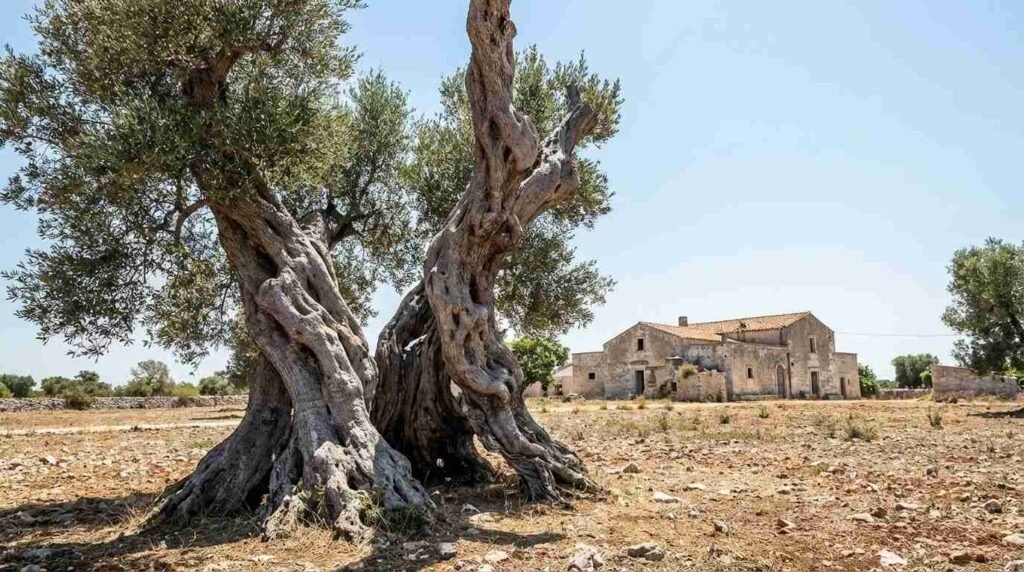
The estate presses its own oil. This is not a marketing claim; it is a structural fact of the operation, and the difference between the oil pressed here from their own trees in November and the olive oil you buy anywhere else is the difference between a category description and a specific thing. The trees on the property include some that have been producing for three hundred years, their trunks grown into the fantastical corded forms that old olive trees achieve — twisted, multiple-trunked, the bark silver-grey and deeply furrowed. The frantoio, the old stone olive press, is still on the property and still demonstrated, though the actual pressing now uses modern centrifugal equipment installed in an adjacent building.
Dinner at Il Frantoio changes with what the garden produces on the morning it is served, which sounds like a cliché until you eat it. The particular combination of grilled vegetables, aged ricotta, orecchiette with cime di rapa, and a lamb braised with local herbs that arrives on a given Tuesday in October is not a menu item; it is the outcome of specific conditions — that morning’s harvest, that morning’s market, the cook’s judgment about what is ready. The Condé Nast Traveler coverage of Puglia masserie has consistently placed this mode of operation above the more formally constructed agriturismo experience, and it is correct to do so.
The Design Economy of a Trullo
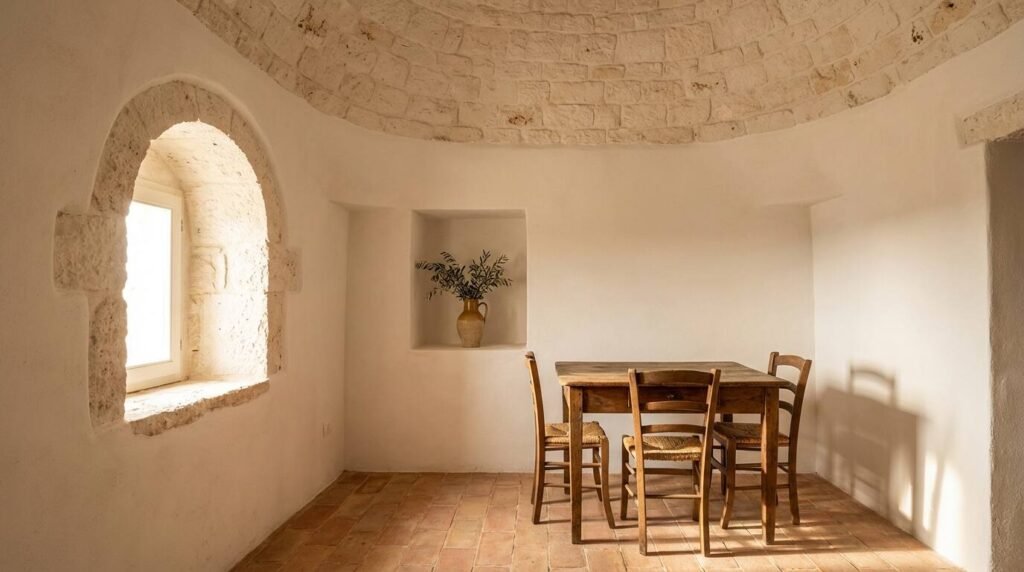
Sleeping in a trullo — converted for hospitality, equipped with plumbing and WiFi, heated in winter when the limestone’s thermal mass works against you rather than for you — is an experience of space that has a specific character. The cone of the roof creates a volume that is neither square nor round but something intermediate, the geometry of the structure determining the geometry of the interior without reference to any furniture catalog. The niches carved into the walls were not decorative; they were functional storage in a pre-shelf era, and they remain the most useful feature of the room for someone traveling with books or small objects.
The white plaster of the interior — renewed regularly, since it weathers and stains — reflects light in a way that the raw limestone does not. The effect in summer morning light is a room that seems to generate its own illumination from the walls outward. The sound quality inside a trullo is particular: the thick walls absorb external noise almost completely, and the stone cone above you creates a mild acoustic focus that you notice first as quiet and then as something stranger.
The Valle d’Itria by Bicycle
The roads between Alberobello, Locorotondo, Cisternino, and Ostuni are manageable by bicycle in a way that requires some honesty about the hills — the Valle d’Itria is not flat — and considerable reward at the level of what you can stop and look at from a bike that you cannot stop and look at from a car. The dry-stone walls run along the roads for kilometers, their construction a slow-motion argument for the value of patient work. The olive groves between them have the quality of groves that have not been planted but have accumulated, their irregularity the result of individual trees replacing individual trees over centuries rather than any single planting scheme.
The Italian National Tourist Board documents the Puglia interior as one of the country’s least visited major regions relative to its quality, a description that is increasingly less true as the agriturismo model has matured and the word has spread. Whether it remains a relatively quiet alternative to Tuscany — where the tourist infrastructure has entirely consumed the landscape’s ability to be encountered on its own terms — is the question that all Puglia travel writing circles without landing on a satisfying answer.
There is a quality in the old olive groves of the Valle d’Itria that I have found in only a few other places — a sense that the landscape contains its own timeline, that what you are walking through has not been arranged for your benefit but simply continues in your presence. The masserie that understand this are the ones worth seeking out: not the ones that perform rusticity but the ones that are still genuinely working, still making something, still organized around the olive and the grape and the grain. Those places ask something of you in return for what they offer. They ask you to pay attention.
Sources
– UNESCO World Heritage listing, Trulli of Alberobello (1996): whc.unesco.org/en/list/787 – Masseria Il Frantoio: masseriailfrantoio.it – Italian National Tourist Board (ENIT): italia.it – Condé Nast Traveler, Puglia masserie coverage: cntraveler.com