The Ebonized Cherry Problem: How Tiffany Studios’ Oyster Bay Workshop Finished Furniture to Deceive the Eye and What That Reveals About the Period’s Material Anxiety
There is a way of looking at a finished piece of furniture that most people never use: you look at it sideways. Not the front face, not the decorative surface presented to the room, but the edge, the end grain, the place where the maker’s material choices are exposed without the benefit of presentation. It was this angle — metaphorically if not always literally — that the Arts and Crafts movement demanded of its makers. Show the material as it is. Do not simulate. Do not substitute. The wood should read as wood, the joint as a joint, the honest structure of the thing as the thing’s meaning.
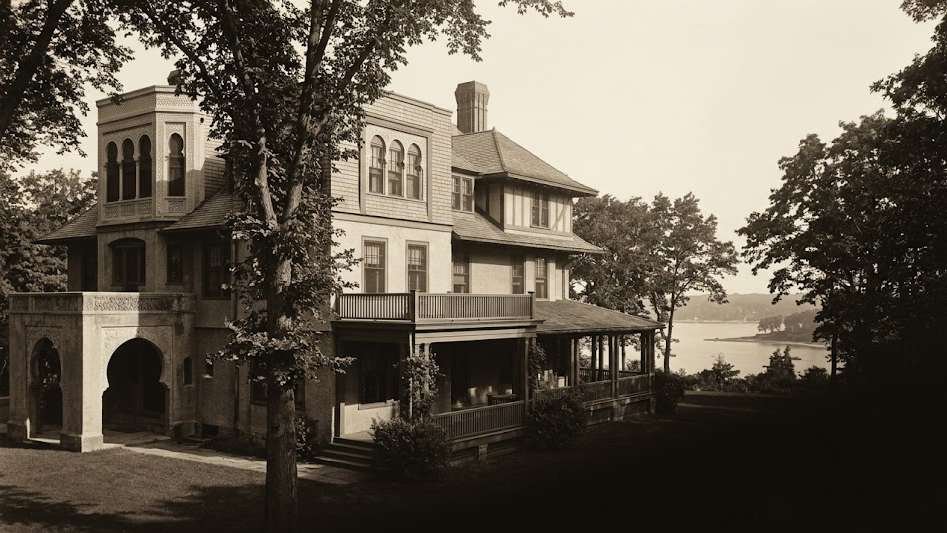
Louis Comfort Tiffany understood this argument perfectly. He had read Ruskin. He was present in the intellectual conversation that animated the period. And at Laurelton Hall — his 84-room estate on nearly 600 acres above Cold Spring Harbor on Long Island’s North Shore, completed between 1902 and 1905 — he made furniture using a surface treatment that did precisely what Ruskin and Morris had spent their careers condemning: he finished cherry wood to read as ebony.
This is the ebonized cherry problem. It is not primarily an aesthetic problem, though the aesthetics are interesting. It is a philosophical problem, and the place to examine it is Laurelton Hall — because Laurelton Hall was, more than any of Tiffany’s other projects, the space where his working theory of beauty was expressed without commercial constraint or client compromise. What he chose to do there was his own answer to questions the period was actively fighting over.
The Estate and Its Ambitions
Laurelton Hall is easy to sentimentalize because it is gone. A fire in 1957 destroyed most of the main structure; the Tiffany Foundation had already deeded the estate away, and the mansion had been unoccupied and vandalized before the fire finished it. What survived — including the extraordinary loggia columns topped with daffodil capitals and a remarkable collection of leaded glass and architectural elements — was salvaged primarily by Hugh and Jeannette McKean, whose Charles Hosmer Morse Museum of American Art in Winter Park, Florida, is today the largest repository of surviving Laurelton Hall material. The Metropolitan Museum of Art mounted a major retrospective in 2006: Louis Comfort Tiffany and Laurelton Hall: An Artist’s Country Estate.
Laurelton Hall, in Cold Spring Harbor, Long Island, was completed in 1904 — Tiffany’s last house, the one he designed in its entirety. It was designed by a man who had spent his career arguing — through his studios, his commissions, his public statements — that beauty was a moral imperative, that the decorative arts mattered, that making things well was not separate from making things meaningful.
Tiffany’s work reflects the efforts to resolve the conflicting ideals of the Arts and Crafts movement. William Morris, its English protagonist, had demanded: “What business have we with art at all unless all can share it?” Yet most companies could not produce affordable art for the home while retaining high standards and individual expression. That tension — between the movement’s democratic aspirations and the unavoidably elite reality of handcraft at scale — is the central drama of the period. Tiffany did not resolve it. He inhabited it.
Cherry and the Simulation of Ebony
Ebony — Diospyros ebenum — is among the densest and most dimensionally stable of all working hardwoods. Its deep, near-absolute black is not a color applied to the surface but the color of the wood itself, from heartwood to surface, with no differentiation in tone. It was used for the keys of keyboard instruments, for inlay work, for decorative turnings, for any application where absolute blackness and fine workability in a small compass were required. By the late 19th century, genuine African and Sri Lankan ebony had become both difficult to source and expensive. The demand for its aesthetic — that black — persisted long after the supply that could meet it had contracted.
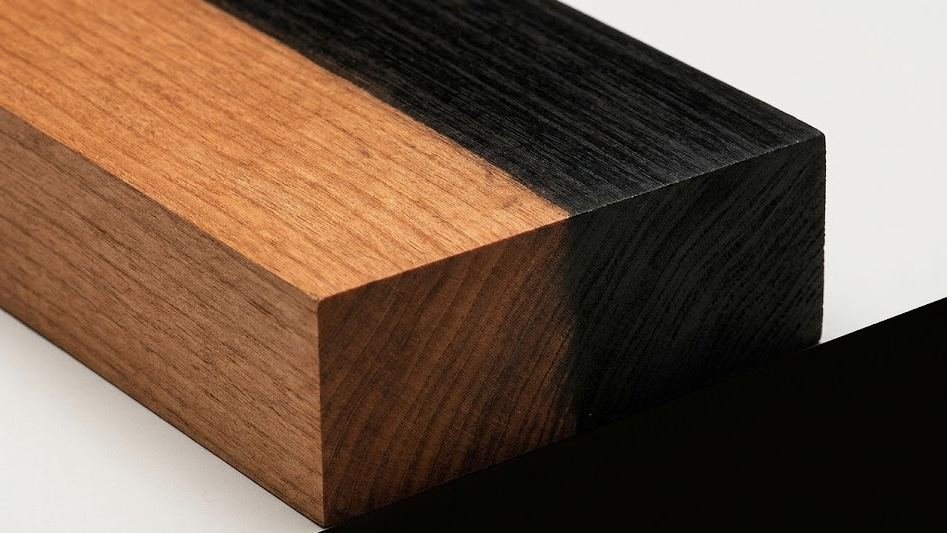
Ebonizing is the craft solution to this scarcity problem. In the craft of woodworking, ebonizing is the process of darkening wood — such as cherry and red oak — to make it appear as ebony. The chemistry is straightforward: iron in solution reacts with the tannins naturally present in the wood to form blue-black phenolate complexes that are not a surface coating but a change in the wood’s own fiber. The depth of the reaction — and therefore the intensity and permanence of the color — depends on the tannin concentration in the specific species being treated. High-tannin woods, including oak, walnut, cherry, and mahogany, respond well.
Ebonized finishes were in vogue during the Arts and Crafts period — which places them squarely within the vocabulary available to Tiffany’s workshops in the years when Laurelton Hall was being furnished. The traditional preparation involves dissolving steel wool in ordinary vinegar to produce an iron acetate solution, applied with a brush to prepared wood. Iron staining, or ebonizing, generally uses a reaction between iron oxide and the natural tannins in wood to create a natural-looking black that is created in the fibers of the wood rather than a stain sitting on top — which is why it is so durable. It is integral, not superficial.
Cherry — Prunus serotina, American black cherry — is among the better candidates for ebonizing precisely because of its tannin content and its fine, closed grain, which takes the iron solution evenly and produces a surface that, once the reaction is complete and a finish is applied, reads in color and sheen as very close to true ebony. It is not identical to ebony under close examination; the grain pattern differs, and the weight is substantially less. But at the scale of a room, viewed in the light conditions Tiffany controlled and arranged at Laurelton Hall, the simulation was effective.
Primarily known for his work in Favrile glass, Tiffany worked in virtually every artistic and decorative medium, including mosaics, lighting, pottery, metalwork, enamels, jewelry, and interiors. Laurelton Hall was truly Tiffany’s greatest achievement as he designed every aspect of the house and grounds. This total-design aspiration — the Gesamtkunstwerk of the North Shore — is why the choice of ebonized cherry matters beyond its technical interest. Every material decision at Laurelton Hall was made by or under the direction of a man who understood what he was choosing. The ebonized cherry was not an oversight or an economy measure. It was an argument.
The Arts and Crafts Problem with Surface Deception
John Ruskin’s position was absolute: the moral value of handcraft lay in its truthfulness to material. Painting stone to look like marble was not ornament; it was lie. The Gothic cathedrals he admired were admirable in part because every surface was what it appeared to be — stone cut by men who knew stone, who shaped it according to its nature, whose labor was legible in the material’s face.
William Morris extended this into the applied arts. The socialist implications of craft honesty were explicit in his thinking: if a chair pretended to be made of something it was not, the labor that made it was invisible, dishonest, complicit in a broader cultural deception about what things were and who made them. The Arts and Crafts movement that grew from Morris’s arguments in England and spread to the United States by the 1890s was, among other things, a movement in favor of surfaces that told the truth.
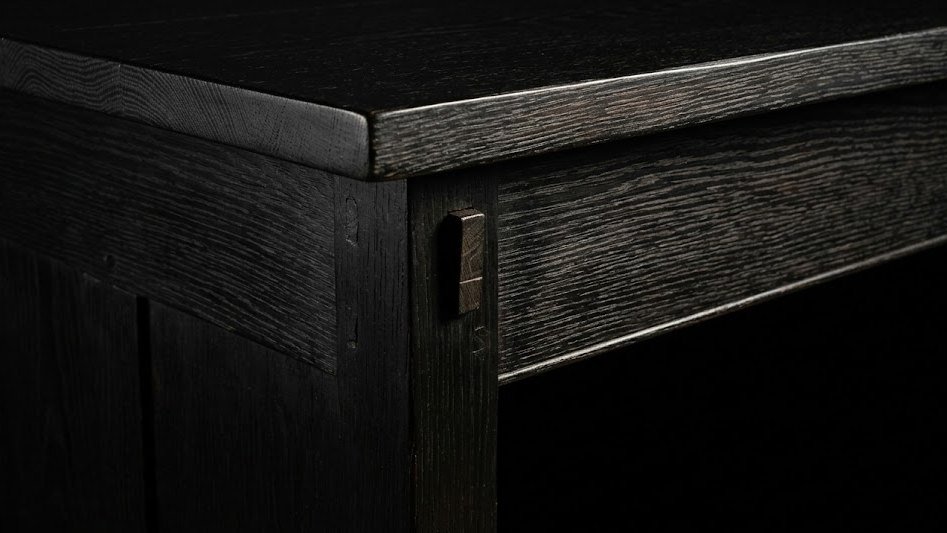
Tiffany inhabited this world intellectually. He did not reject it; he complicated it. The ebonized cherry at Laurelton Hall could be read two ways. The uncharitable reading is that it is precisely the kind of surface deception Ruskin condemned: cherry pretending to be ebony, a less-valuable material masquerading as a more-valuable one. But the charitable reading — and there is evidence that Tiffany would have offered it — is that the ebonizing process does not hide the wood’s nature but transforms it chemically, from within, using the wood’s own tannins as the medium of change. The surface that results is not a coating laid on top of a lie. It is the wood itself, reacted. The grain still shows. The material is still legible to an attentive hand. Only the color has changed, and color, in Tiffany’s universe, was the primary carrier of meaning.
This is not a frivolous argument. It is, in fact, the argument that separates a Tiffany ebonized piece from a piece of cherry painted black. The iron acetate treatment is integral, not applied; it does not build a surface layer over the wood but becomes part of the wood’s own structure. Whether this distinction satisfied a strict Ruskinian standard is debatable. That Tiffany thought it did — or at least that it was sufficiently interesting as a position to be worth taking — seems consistent with how he approached every other material decision at Laurelton Hall.
The Steinway Case and the Larger Furniture Practice
The Metropolitan Museum’s catalog for the 2006 Laurelton Hall retrospective documents specific furniture pieces with material notations that illuminate Tiffany’s working practice. Among the most telling is the case for a Steinway & Sons piano that Tiffany designed for his Madison Avenue apartment and later moved to Laurelton Hall: the piano case is attributed to cherry, described in the catalog as “Cherry (?)” — the question mark reflecting the difficulty of identifying a finished and likely treated surface without physical examination. The uncertainty itself is significant. The surface had been worked to the point where the underlying species was no longer immediately legible.
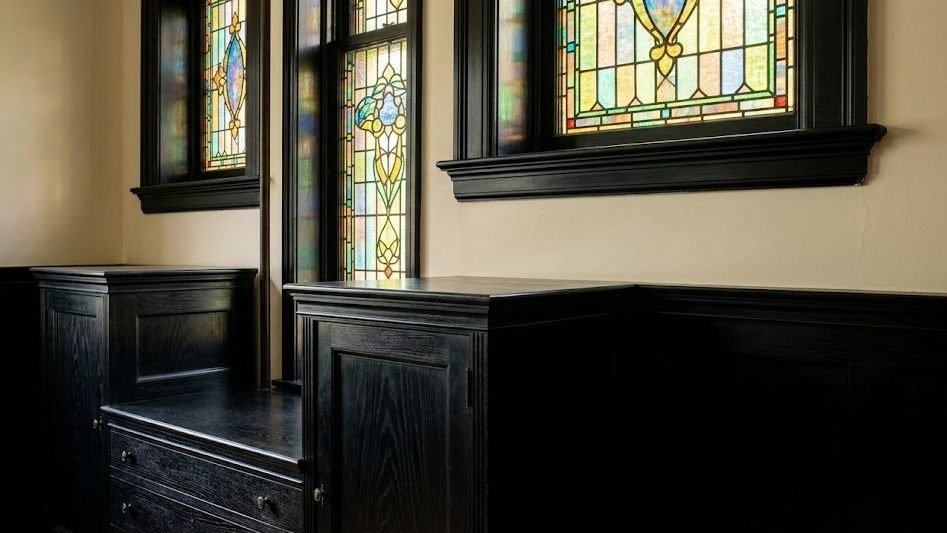
This is the practical meaning of the ebonized cherry problem: it produces a surface that defeats casual identification. A visitor to Laurelton Hall in 1910 would not have known, looking at a piece of ebonized cherry furniture, that the material was cherry. They would have seen a deep, lustrous black surface with the weight and presence of something valuable. Whether they were deceived in any meaningful moral sense depends entirely on whether you take Tiffany’s position or Ruskin’s.
The Morse Museum’s collection — the largest surviving concentration of Laurelton Hall material — includes furniture and architectural elements that display the range of Tiffany’s surface treatments. The ebonized pieces are distinguishable from the true-ebony pieces by their grain character under examination, though the distinction requires attention. What the collection as a whole demonstrates is that Tiffany was not a careless finisher. Every surface decision was made deliberately, in service of a specific visual result.
What the Choice Reveals
The Arts and Crafts movement’s internal tensions were not resolved at Laurelton Hall. They were dramatized there. Tiffany was simultaneously a maker of beautiful objects and the son of one of America’s most successful luxury brands; he understood that beauty had a market and that the market rewarded surfaces that looked expensive. His claim to the Arts and Crafts tradition was genuine — he cared about craft, he employed skilled makers, he understood materials — but his relationship to the movement’s anti-simulation ethics was always complicated by his willingness to push surface effect beyond what strict material honesty would permit.
The ebonized cherry was a position statement from a man who knew he was taking a position. It said: the color matters more than the species name. It said: a transformation achieved through chemistry is not a deception but a making. It said: beauty has its own logic, and that logic does not always run through the categories that Ruskin built.
Cold Spring Harbor is not what it was in 1905. The site of Laurelton Hall has been developed; the tower chimney is the most substantial remaining element of the main structure. But in the Morse Museum in Florida, and in the Metropolitan Museum’s permanent collection, the surviving pieces from Tiffany’s Long Island experiment persist. The ebonized cherry, examined under the right light, holds its argument still. You can disagree with the position. You cannot say it was not made.
Sources
- Charles Hosmer Morse Museum of American Art — Tiffany Collection: morsemuseum.org
- Metropolitan Museum of Art — Louis Comfort Tiffany and Laurelton Hall, 2006: metmuseum.org
- Incollect/Antiques and Fine Art — “Louis Comfort Tiffany and Laurelton Hall”: incollect.com
- Laurelton Hall, Wikipedia: wikipedia.org
- Brooklyn Rail — “The Louis Comfort Tiffany Foundation”: brooklynrail.org
- Journal of Wood Science — “Iron Acetate Solution Prepared from Steel Wool and Vinegar for Ebonizing Wood” (Thompson, 2023): link.springer.com
- Fine Woodworking — “Ebonizing Wood”: finewoodworking.com
- Popular Woodworking — “How to Ebonize Wood”: popularwoodworking.com