The Huntington Station Redevelopment That’s Been ‘Almost Done’ for 20 Years — and What It Means for Buyers Right Now

There’s a particular kind of house that stops me when I’m driving — the one with new windows on the top floor and a front door that’s still wrong, the paint still the color someone chose in 1987. You know the house. It’s in the middle of becoming something, and has been for longer than seems reasonable. Huntington Station is that house at urban scale.
I’ve been watching this neighborhood for years. Every time a buyer asks me about the station area — the walkable core around New York Avenue, the blocks between the LIRR platform and the main commercial strip — I give them the same honest answer: there is genuine upside here, and the timeline for realizing it has been frustratingly slow. What’s changed recently is that the “almost” may finally be turning into “actually.”
Here’s what you need to understand about the past two decades, and what it means if you’re thinking about getting in now.
The Renovation Project Nobody Could Finish
When people talk about Huntington Station’s revitalization, they tend to start around 2019, when the community submitted a formal application to the New York State Downtown Revitalization Initiative. But the real story goes back further. The Town of Huntington’s planning files on the station area stretch back to the early 2000s — rezoning proposals, mixed-use studies, transit-oriented development frameworks that got reviewed, modified, tabled, and revisited across multiple administrations.
This is not unique to Huntington Station. Long Island’s relationship with transit-oriented development has always been complicated — the political geography of towns, villages, and special districts makes the kind of coordinated planning that succeeded in places like Patchogue genuinely harder here. But the pattern in Huntington Station has been particular. Proposals that cleared one hurdle would stall at the next. Funding that seemed committed would dissolve in a state budget cycle. Private developers who announced projects would let their options expire.
What kept interrupting the reveal? A few structural problems worth naming.
The infrastructure gap. New York Avenue’s streetscape — overhead utilities, sidewalk conditions, the visual clutter of the commercial corridor — had deteriorated to the point where mixed-use residential development couldn’t pencil out for most developers without public subsidy. The bones were good: LIRR access, proximity to the broader Huntington village, a diverse commercial base. But the street itself needed work before private capital would follow.
The ownership puzzle. Key parcels near the station were held by multiple owners with different timelines and different price expectations. Assembling the kind of contiguous development sites that make mixed-use projects feasible required either patience or a public catalyst — and for years, neither came.
The funding carousel. State programs for downtown revitalization are competitive, and Huntington Station applied multiple times before making real progress. Each application cycle created momentum that then dissipated when the award went elsewhere.
What the DRI Actually Unlocked
When Huntington Station was selected for the New York State Downtown Revitalization Initiative — a program that has now allocated over a billion dollars across multiple rounds to transform Long Island and upstate communities — it wasn’t just a grant. It was a planning process. The DRI brought in a professional project manager (BJH Advisors served as the prime consultant for the state), convened a Local Planning Committee, held public engagement sessions, and produced a Strategic Action Plan with identified projects, cost estimates, and implementation timelines.
That kind of structured, publicly documented planning framework matters for buyers. It means the vision isn’t just a rendering someone put on a website. It’s a document with named projects, budget lines, and responsible parties. According to documentation from the Huntington Station DRI process, the focus area runs along the New York Avenue corridor immediately surrounding the LIRR station, with projects targeting mixed-use development on key sites, streetscape improvements including burying overhead utilities, broadband expansion, a centralized public gathering space, and a business façade program.
The total investment framework, between state DRI funding and leveraged private and local capital, was oriented around roughly $170 million in revitalization projects for the station area. That number is worth sitting with.
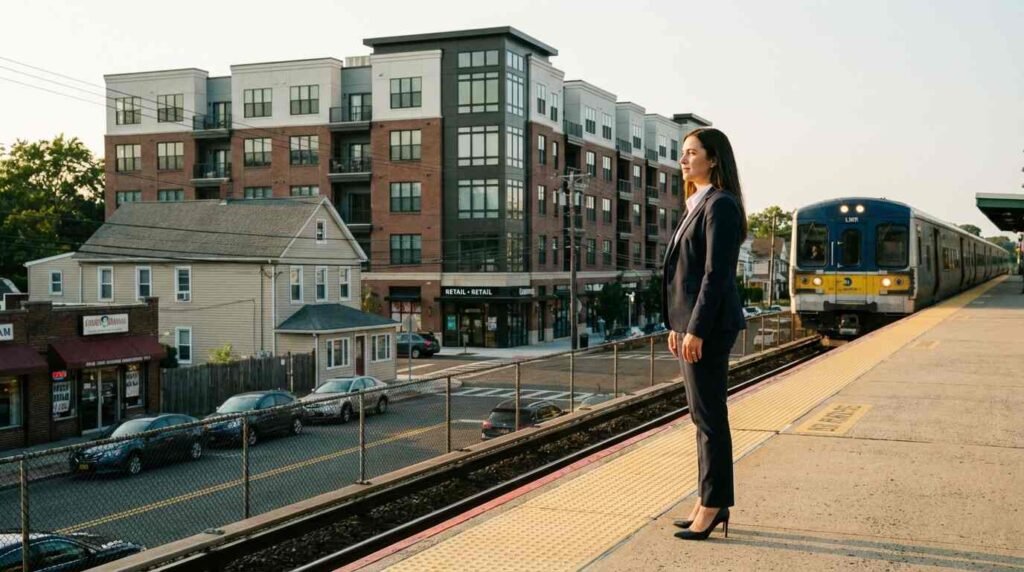
The Before-and-After That Matters to Buyers
I want to be direct about something: I am not predicting what Huntington Station home values will do. Markets are too complex, timelines too uncertain, and the honest broker doesn’t manufacture urgency. What I can tell you is what’s changed structurally, and why it changes the calculus.
Before: The station area had genuine assets — transit access, proximity to Huntington village’s strong amenity base, diversity of housing stock — but lacked the public-sector coordination and capital commitment to make private development viable. Buyers who got in early got in on speculation, with real uncertainty about whether the neighborhood would ever close the gap between its bones and its finish.
After (in progress): There is now a publicly documented, state-backed plan. There is a planning framework that didn’t exist before. There are identified project sites, infrastructure commitments, and a local organizing structure (the Local Planning Committee) that gives the community ongoing voice in implementation. The East Side Access project bringing direct Grand Central terminal access to Huntington station-area commuters has changed the commute calculus for buyers who work in midtown Manhattan.
What that means for buyers thinking about the neighborhood now is that the risk profile has shifted. You’re still early relative to the full build-out — and you’re buying before the finished house is on the market. But you’re no longer buying purely on faith. There’s a paper trail, a structure, and state money that’s already committed.
What to Actually Look At
If you’re evaluating Huntington Station as a buyer, here’s where I’d focus my attention:
The blocks closest to the LIRR station. The DRI’s focus area centers on the immediate station area for good reason — that’s where transit-oriented value accrues first. Properties within a short walk of the platform are the ones most directly positioned to benefit from both commuter access improvements and commercial corridor upgrades.
The residential stock south and east of New York Avenue. There’s a range of housing types in the surrounding blocks — including single-family homes that have been significantly underpriced relative to comparable neighborhoods with similar commute access. Some of that gap reflects legitimate neighborhood friction; some of it is the long shadow of the “almost” years. As the DRI projects deliver, that gap tends to close.
The permit and project pipeline. Before making any offer in the station area, I’d want to know which mixed-use projects have actually broken ground and which are still in the approval pipeline. The distinction between “approved” and “under construction” matters enormously to neighborhood trajectory and timeline.
This is not a neighborhood where I’d tell a buyer to rush in without doing their homework. The DRI is real, the money is committed, and the commute access is legitimately improving. But any buyer in Huntington Station needs to go in with open eyes about the timeline — and with a clear sense of which specific block they’re buying on, because they don’t all move at the same pace.
A Broker’s Honest Read
What I find interesting about Huntington Station right now is that it’s at the inflection point — the moment when the risk of being early shifts into the risk of being late. That’s not a prediction. That’s an observation about where the evidence points.
The before has been documented for twenty years. The after is now funded, planned, and in progress. The buyers who are going to look back and say they got in at the right time are probably getting in now — but they’re doing it with their homework done, their eyes open, and a broker who knows the difference between genuine momentum and a nice rendering.
If you’re thinking about Huntington Station, I’d love to walk the neighborhood with you. That conversation starts at maisonpawli.com/about/.
You Might Also Like
- The Block That Time-Locked: Why Port Jefferson Village’s Walking Culture Survived When Every Town Around It Didn’t
- The Stroad That Ate Jericho Turnpike: How One Road Fragmented Five North Shore Communities
- The Lock-In Effect: Why North Shore Inventory Is So Tight Right Now
Real estate markets change. For current listings and market data, contact Pawli at Maison Pawli.