
Mortgage Rates Moved Three Times in One Week — What That Volatility Signals for June

Weekly rate swings used to be a footnote. When they become the headline three times inside seven days, buyers and sellers are operating on different assumptions by Friday than they were on Monday.
The Freddie Mac Primary Mortgage Market Survey recorded the 30-year fixed-rate mortgage at 6.36% on May 14, 2026. The following week it jumped to 6.51% — a 15-basis-point move in seven days. Mortgage News Daily’s daily tracking showed additional intraweek movement in both directions during that same stretch, with rates touching different levels on consecutive business days before the Thursday PMMS average was published. That gap between what buyers lock on Monday and what the benchmark reads on Thursday is where real transactions get complicated.
Why Intraweek Movement Is a Different Kind of Signal
A sustained directional shift — rates moving from 6.3% to 6.8% over six weeks, or dropping from 7% to 6.5% over a quarter — is a market signal buyers can factor into their purchase math. It adjusts what they can qualify for, recalibrates the monthly payment comparison on homes they’ve been tracking, and sometimes triggers meaningful behavioral shifts: more buyers enter the market when rates fall, fewer when they rise and hold.
Intraweek volatility behaves differently. When a 30-year rate moves down Tuesday, up Thursday, and back down by the following Monday, the PMMS number captures only a slice of that range. A buyer who locked their rate on one of the higher days is locked to a number that may look worse than what the weekly headline reports. A buyer who hadn’t locked yet faces uncertainty about what they’ll actually pay when they get to the table.
The mechanism that matters is the spread between the survey average and the daily reality. Freddie Mac’s PMMS is now based on loan applications submitted from the prior Thursday through Wednesday — which means it captures a range of origination days, not a single moment. When rates are stable, that lag is invisible. When rates are moving sharply in opposite directions inside the survey window, the published average can look calmer than the week actually was.
What Happens to Contracts Already in Progress
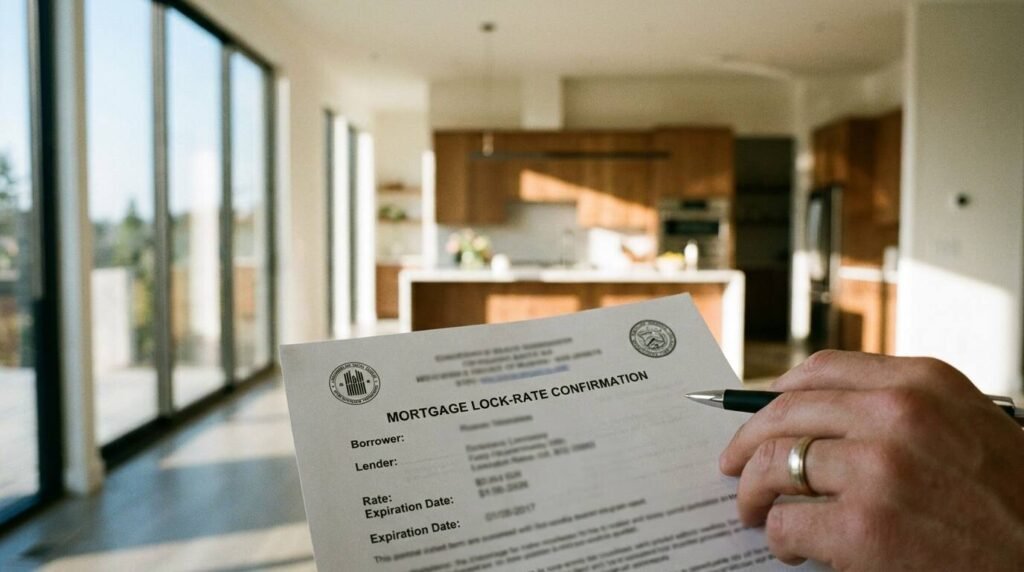
Purchase contracts on Long Island typically include a mortgage contingency with a defined rate lock period — often 30 to 60 days. During high-volatility weeks, the timing of that lock becomes a significant variable.
A buyer who signed a contract in late April and was planning to lock in the second week of May watched the 30-year rate bounce between different readings before settling at 6.51% on the May 21 PMMS. If they were working off a budget calibrated to rates in the low 6.30s from two weeks earlier, that difference — roughly $60 to $80 per month on a $500,000 loan — is enough to push some buyers back to their lenders for a revised pre-approval conversation.
For contracts already under attorney review or approaching inspection contingency deadlines, volatility like this rarely kills deals. But it does change the urgency around locking, and it can affect how buyers interpret the financial terms of any last-minute seller negotiations that might be ongoing.
Volatility vs. Direction: Reading the Right Signal
The question buyers on the North Shore should be asking right now isn’t only where rates are — it’s whether the movement is directional or oscillating.
A directional move has a cause: a Fed statement that changes market expectations about future policy, a major inflation print, a jobs report that shifts the yield curve. Those moves tend to hold for a week or more after the catalyst. Oscillating movement — the kind that produces multi-directional swings inside a single week — often reflects bond market uncertainty rather than a clear economic signal. Investors are repricing risk without consensus. Treasury yields, which mortgage rates closely follow, are moving on one piece of data and then partially reversing on another.
That distinction matters for purchase timing. A buyer who interprets a single week’s spike as a sustained directional shift may wait for a correction that doesn’t come. A buyer who treats oscillating movement as noise may miss a favorable lock window that exists for only a day or two.
What the current environment calls for is monitoring the daily rate environment — tools like Mortgage News Daily’s daily survey are publicly available and updated each morning — rather than checking rates once a week when the Thursday PMMS releases.

What Long Island Sellers Should Watch
Rate volatility doesn’t fall equally on buyers and sellers. On the seller side, the main exposure is to offer quality: when rates move sharply upward during a listing’s active period, some buyers who were pre-approved at a lower rate need to recalculate what they can afford. Offers that arrived during a calmer rate week may not be repeatable if the buyer comes back after a spike.
For sellers with active listings or homes about to go onto the market, understanding whether current volatility is producing buyer hesitation — or whether buyers are locking quickly to capture favorable windows — is worth a direct conversation with your agent. Days-on-market data during weeks of high rate volatility can look artificially extended simply because some buyers are waiting for a lower lock before committing.
The June Picture
Forecasters from Fannie Mae and the Mortgage Bankers Association have both projected 30-year rates to remain in the low-to-mid 6% range through summer 2026. The question is not so much where the floor is as how wide the band of daily fluctuation will be. As of late May, the 10-year Treasury yield remains sensitive to trade policy news, inflation readings, and any shift in Fed communication — all of which can move quickly and reverse within days.
For buyers on the North Shore entering the June market, the practical takeaway is mechanical: stay in close contact with your lender, understand the terms of your rate lock before you’re in the contingency period of a contract, and don’t assume the Thursday PMMS number reflects what you can actually lock today. Volatile markets reward preparation over reaction.
This post is for informational purposes only and does not constitute financial advice. Consult a licensed mortgage professional for guidance specific to your situation.
You Might Also Like
- The Fed Paused — Now What? A Realistic Translation for North Shore Buyers
- Why the Fed’s ‘Higher for Longer’ Pivot Is Reshaping Long Island’s Spring Buying Season
- Beyond the 30-Year Fixed: Mortgage Options First-Time Buyers on Long Island Rarely Hear About
Real estate markets change. For current listings and market data, contact Maison Pawli at maisonpawli.com/about/.
Sources
Freddie Mac Primary Mortgage Market Survey — May 14 and May 21, 2026