Why the Fed’s ‘Higher for Longer’ Pivot Is Reshaping Long Island’s Spring Buying Season
Every spring, buyers come to me with the same question dressed in different clothes. This year’s version goes something like: “Should I wait for rates to drop, or is that just wishful thinking at this point?”
It’s a fair question — and after the Fed’s third consecutive rate hold of 2026, it deserves a real answer.
What ‘Higher for Longer’ Actually Means for Mortgage Rates Right Now
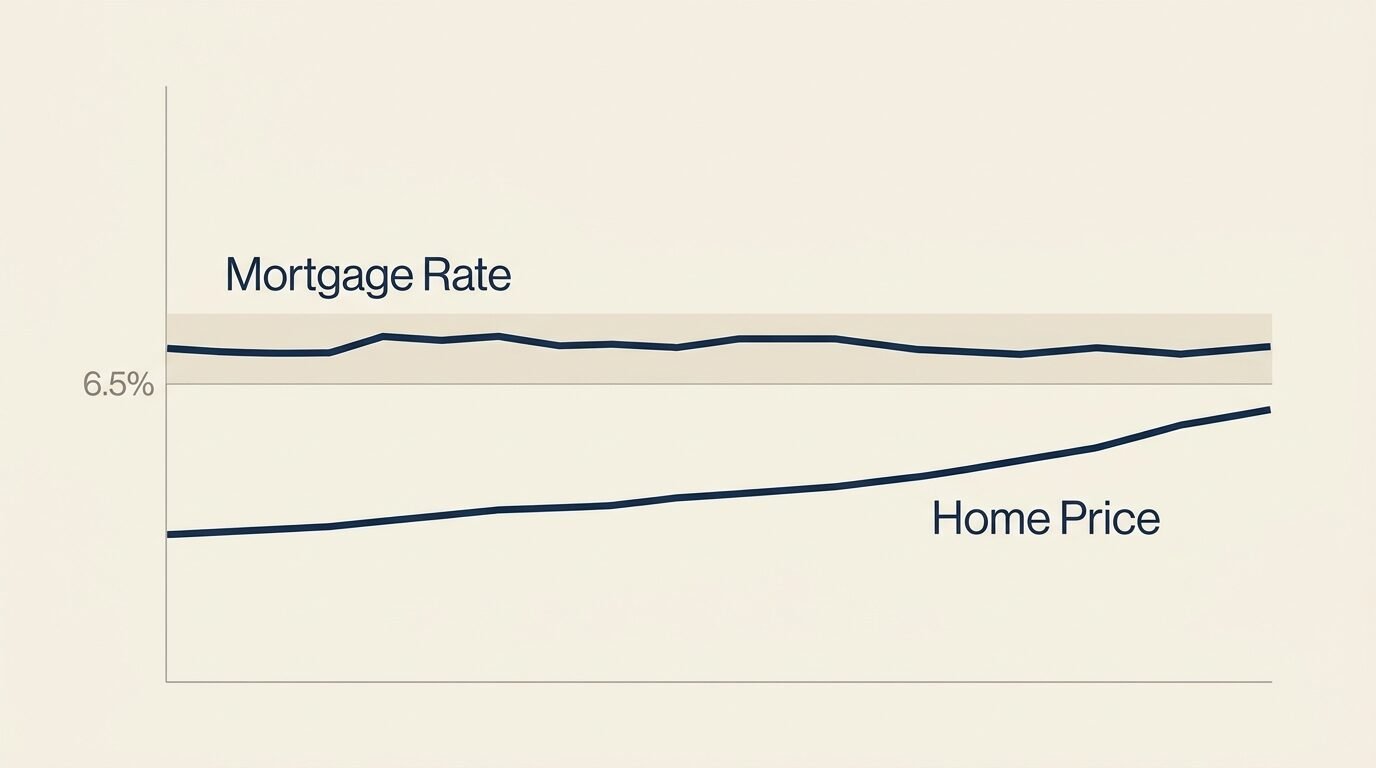
The Federal Reserve kept its benchmark rate unchanged at its May 6–7 meeting, the third freeze of the year. That decision doesn’t move mortgage rates directly — the 30-year fixed is tied more closely to the 10-year Treasury yield than to the federal funds rate — but it sends a clear signal about the broader climate we’re operating in.
As of May 7, 2026, Freddie Mac’s Primary Mortgage Market Survey put the average 30-year fixed-rate mortgage at 6.37%, up slightly from 6.30% the prior week. Bankrate’s daily survey had it at 6.45% as of May 11. A year ago, the same rate averaged 6.76% — so rates are meaningfully lower year-over-year, even if they don’t feel like relief after the sub-6% window that briefly opened in February.
That February window matters context-wise. Rates dipped to 5.87% on strong expectations of Fed movement, then climbed sharply when the Iran conflict drove oil prices and inflation fears higher. The 10-year Treasury yield responded, and mortgage rates followed. What we’re seeing now — rates in the 6.2% to 6.45% range — is the market pricing in a geopolitical risk premium on top of already-stubborn inflation.
Economists at CBS News and mortgage analysts at William Raveis and CoreLogic are broadly forecasting that rates will stay range-bound between 6.2% and 6.4% for May, with a slight downward bias if the Iran ceasefire holds and inflation data cooperates. A meaningful drop below 6% — and the buyer surge that would come with it — requires the 10-year Treasury yield to sustain below 4%, which hasn’t happened yet.
The “higher for longer” framing isn’t new, but what is new in 2026 is the acknowledgment that this may simply be the new normal. Wells Fargo projects rates bottoming at 6.14% this year and hovering near 6.19% in 2027. Fannie Mae is slightly more optimistic, projecting the Q2 average at 5.9%. The range of expert opinion is wide; what’s narrow is the consensus that a return to sub-5% rates is not a near-term story.
That’s the environment. Now let’s talk about what it means here.
How Long Island Inventory Is Responding to the Rate Environment
The lock-in effect is still real on the North Shore — I wrote about it in detail in The Lock-In Effect: Why North Shore Inventory Is So Tight Right Now. Sellers who locked 30-year mortgages at 2.5% or 3% in 2020 and 2021 have little financial incentive to move into a 6.4% world. That dynamic hasn’t resolved, and at current rates, it won’t resolve quickly.
The national picture from NAR’s April report (released May 11) shows total housing inventory at 1.47 million units — up 5.8% from March and 1.4% from a year ago. That represents a 4.4-month supply, which is healthier than where we were eighteen months ago but still below the 5 to 6 months that would constitute a balanced market.
On the North Shore, the inventory story is more compressed. We don’t have the Sun Belt’s new construction relief valve. What comes to market here tends to be driven by life events — estates, divorces, job relocations, downsizing — not by sellers trading up. Which means when something good hits a street in Mount Sinai or Miller Place or Setauket, buyers are still competing, even if the frenzy of 2021 is long gone.
Nationally, properties spent a median of 32 days on market in April, up from 29 days a year ago — a sign that buyers are moving more deliberately. I’m seeing that on the North Shore too: buyers are taking the time to look at a house twice, run the numbers carefully, push back on price when the condition warrants it. That’s actually healthy. It means we’re back to something resembling a normal negotiation.
Are Buyers Sitting Out — or Adjusting Their Strategy?
Some are sitting out. I won’t pretend otherwise. For buyers who are stretching to qualify at 6.4%, the math has gotten genuinely harder — and the window that opened in February when rates briefly touched 5.87% reminded everyone what sub-6% felt like. When it closed, some buyers retreated to the sidelines again.
But the buyers I’m working with right now aren’t waiting. They’re adjusting. Here’s what that looks like practically:
Buying down the rate. With sellers sometimes more willing to negotiate, buyers are asking for seller concessions to buy mortgage points at closing. Two points can drop a 6.4% rate to the mid-5% range, which translates to real monthly savings over the life of the loan. What Closing Costs Actually Look Like on Long Island has a full breakdown of how points factor into the closing math.
Right-sizing the purchase. Some buyers who were reaching for a larger home are finding satisfaction in a slightly smaller one — and discovering that the North Shore has excellent housing stock at prices that work better at current rates. A well-maintained 1,600-square-foot colonial in Miller Place or Mount Sinai often carries better bones than a 2,400-square-foot house that needs work in a more expensive ZIP.
Adjustable-rate mortgages. ARMs aren’t what they were in 2007 — they’re regulated, they come with caps, and for buyers who have a realistic plan to move or refinance within five to seven years, a 5/1 or 7/1 ARM at a rate a half-point or more below the 30-year fixed can make sense. Worth discussing seriously with a mortgage professional.
Locking now with a float-down option. Some lenders offer rate locks with float-down provisions — you lock at today’s rate but can capture a lower rate if the market moves before closing. Given the volatility we’ve seen in 2026, it’s worth asking for.
What Smart Sellers Are Doing Differently in This Market
The calculus for sellers has shifted, and the agents who aren’t adjusting are leaving money on the table for their clients.
Pricing discipline is back. In 2021 you could overprice by 10% and the market would bail you out. In this market, a house priced above what the comps can support will sit — and The House That Sits 90 Days Has Already Told the Market Something is not a comfortable position. Buyers are watching days-on-market data; it signals leverage.
The sellers who are closing cleanly right now are the ones who priced correctly from day one, invested in presentation — staging, photography, curb appeal — and came to the table willing to negotiate on terms even when they wouldn’t budge on price. Seller concessions for rate buydowns have become a real tool in closing deals that would otherwise stall when a buyer’s numbers don’t quite work at 6.4%.
If you’re thinking about listing this summer, now is the moment to have the honest conversation about price, not the optimistic one.
Pawli’s Take: Should You Wait or Move Now?
Waiting for rates to fall meaningfully before buying is a strategy that requires two things to align: rates actually falling, and prices not rising in the meantime. On the North Shore, I wouldn’t count on both happening simultaneously.
The Freddie Mac commentary released alongside their May 7 survey noted that new-home median prices are at their lowest level since July 2021 and inventory is higher than in recent years — trends that “could modestly ease affordability pressures through the spring homebuying season.” That’s the national picture. Long Island’s is different: prices here have not retreated. The North Shore’s median home price in the Northeast was $510,800 in the April NAR data — up 4.8% year-over-year. The supply constraints are structural, not cyclical.
What I tell buyers right now: the rate you get today is not the rate you’ll have forever. You buy a house; you can refinance the mortgage. What you can’t do is refinance the price you paid. If the home is right, the neighborhood is right, and the numbers work at today’s rates — this market rewards decisiveness.
That said, if the numbers genuinely don’t work, don’t force them. I’d rather lose a deal and keep a buyer’s financial health intact than close something that strains them for the next three years hoping for relief that may or may not arrive.
The question isn’t really whether rates are high. They are, relative to the pandemic era. The question is whether the house in front of you, at the price in front of you, builds equity and serves your life. If the answer is yes, the conversation about rates becomes a lot simpler.
Real estate markets change. This post reflects conditions as of May 2026. For current listings and market data, contact Pawli at Maison Pawli.
This post is for informational purposes only and does not constitute financial or legal advice. Consult a licensed mortgage professional and financial advisor for guidance specific to your situation.
You Might Also Like
- The Lock-In Effect: Why North Shore Inventory Is So Tight Right Now
- The Fed Paused — Now What? A Realistic Translation for North Shore Buyers Who’ve Been Waiting
- Mortgage Rates Are Well Below Last Year — What That Means If You’re Selling This Summer
- Beyond the 30-Year Fixed: Mortgage Options First-Time Buyers on Long Island Rarely Hear About
Sources
- Freddie Mac Primary Mortgage Market Survey, May 7, 2026
- Bankrate Mortgage Rate Survey, May 11, 2026
- CBS News: Mortgage Rate Forecast May 2026
- Norada Real Estate: Mortgage Rates Forecast May–July 2026
- NAR April 2026 Existing-Home Sales Report