St. James, NY — The North Shore Neighborhood Guide
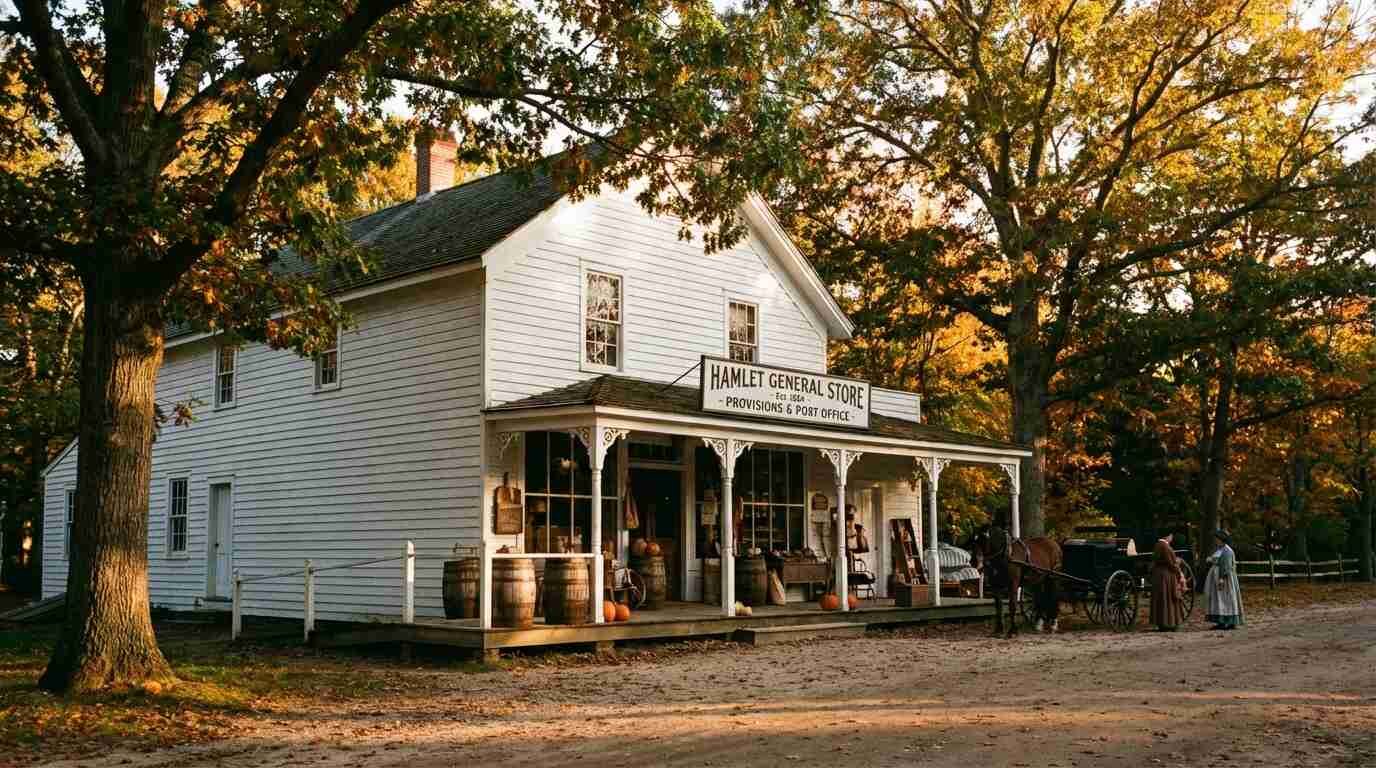
There’s a general store on the corner of Moriches and Harbor Hill Roads that has been open since 1857. The shelves still carry late-Victorian-era goods. Stanford White used the telephone there. Buster Keaton stopped in. The structure hasn’t changed materially since 1894. I’ve driven past it dozens of times on client tours, and every single time — without fail — whoever is sitting in the passenger seat turns to look at it and says nothing for a moment. That’s St. James. It produces that particular silence.
The hamlet sits in the Town of Smithtown, along the North Shore roughly between Stony Brook to the east and Smithtown proper to the west. It’s not a village with a formal boundary — it’s a hamlet, which in Long Island terms means it holds its identity through character rather than legal line. And St. James has character to spare. The rolling hills, the wooded lots, the old street names running off 25A — Moriches Road, Harbor Hill Road, Three Sisters Road — they carry the grammar of a place that was shaped by farmers and sailors before it was ever touched by suburbanization.
The Historic District and What It Preserved
The Saint James Historic District was listed on the National Register of Historic Places in 1973. The General Store — founded by Ebenezer Smith, a descendant of the town’s original settler — sits at its heart. It was purchased by the Suffolk County Department of Parks in 1990 and is dedicated to the Suffolk County Historical Trust. It continues to operate.
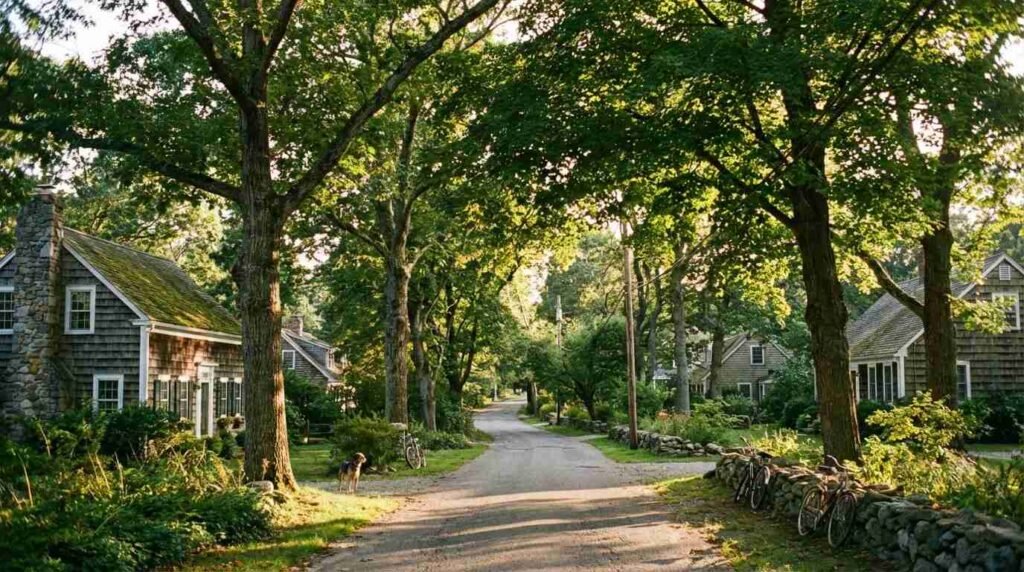
What the historic district designation actually did, practically speaking, was anchor the character of the streetscape along Moriches Road and the surrounding blocks at a moment when every other stretch of Long Island was being rezoned into strip malls and subdivisions. That anchor held. The houses along Harbor Hill Road still sit on generous wooded lots. The scale of the neighborhood still reads as something pre-suburban — which on the North Shore is genuinely rare.
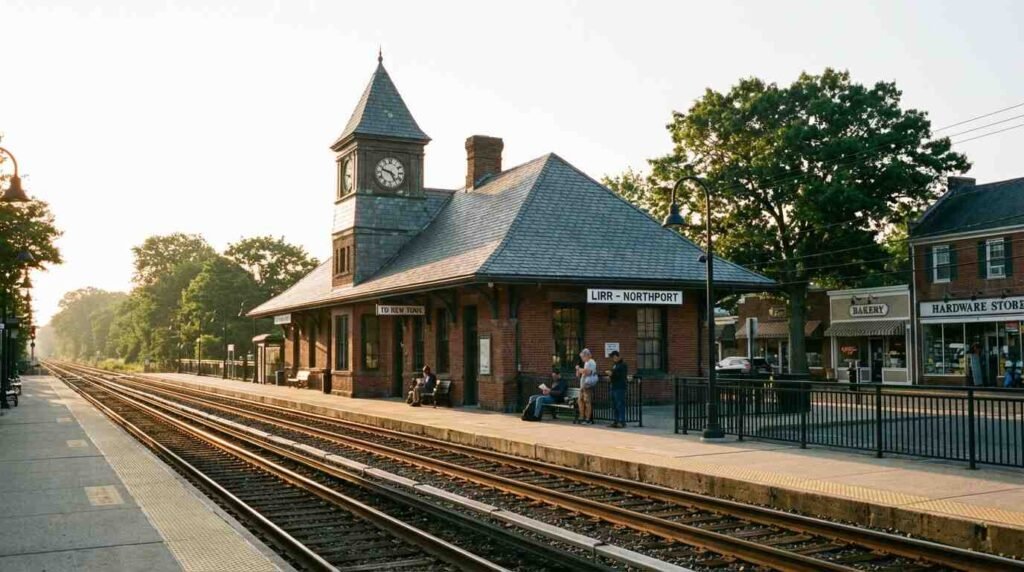
Lake Avenue forms the commercial spine that most residents interact with daily. It’s where the LIRR station sits, where local businesses have colonized the blocks on either side of the tracks, and where the hamlet’s modern civic identity takes shape. The Calderone Theater, undergoing transformation into a cultural arts center, anchors the block south of the station. The rhythm of Lake Avenue is modest — coffee, a few restaurants, local services — but it functions, which is more than can be said for a lot of North Shore commercial strips.
Smithtown Central School District
St. James is served by the Smithtown Central School District, one of the most consistently respected public school systems on the North Shore. The district runs seven elementary schools, three middle schools, and two high schools — Smithtown High School East and Smithtown High School West. Both high schools offer rigorous academics, advanced placement programs, and wide extracurricular rosters. The district’s graduation rates and college placement record are strong, and the schools consistently rank well above county averages.
For buyers with school-age children, the Smithtown district is frequently the deciding factor. I see it in conversations all the time — families casting a wide net across mid-Suffolk, then narrowing hard once they confirm which hamlet falls within the district. St. James sits comfortably inside it, which matters enormously to the long-term demand picture for these homes. As I wrote in detail on The Best School Districts in Suffolk County and What They Do to Home Prices, the relationship between district quality and price per square foot is not casual — it’s structural. St. James benefits from that dynamic without the premium you’d pay in some of the district’s more trafficked hamlets.
Commute and Location
The LIRR’s Port Jefferson Branch runs through St. James — the station on Lake Avenue offers direct service toward Penn Station, with a typical commute time ranging from roughly 75 to 90 minutes depending on transfers and connections. For remote or hybrid workers, that number changes the calculus considerably: the commute stops being a daily burden and becomes an occasional one, which reframes St. James from “outer suburbs” to “genuinely livable at a price that makes sense.”
Driving access is solid. Route 25A runs through the northern edge of the hamlet, connecting west toward Smithtown and east toward Stony Brook and Port Jefferson. The Long Island Expressway and the Northern State Parkway are both within reach. For anyone working at Stony Brook University or Stony Brook University Hospital — the North Shore’s largest institutional employers — St. James is a reasonable ten-to-fifteen minute drive, which makes it particularly attractive for medical and academic professionals who can’t always work remotely.
Landmarks and Streets Worth Knowing
Beyond the General Store and the historic district, St. James has a handful of anchors that give it texture beyond the residential streets.
Sunken Meadow State Park lies a few miles to the north — a major recreational draw with beach access, hiking trails, and a golf course on the Sound. Caleb Smith State Park Preserve, just south of the hamlet proper in Smithtown, offers hiking and freshwater fishing in a more contemplative setting. The Long Island Greenbelt Trail passes through, giving the area trail connectivity that most North Shore hamlets lack entirely.
The streets themselves reward a slow drive. Harbor Hill Road retains an older, more wooded character. Three Sisters Road, which figured in the hamlet’s earliest recorded history, winds through the rolling terrain that gives this part of Smithtown its topographic distinctiveness — this is not flat Long Island. The hills are real. The light through the trees in October is the kind of thing that makes buyers adjust their expectations upward on the spot.
The Market
St. James sits within a broader Smithtown market that has strengthened steadily. Median sale prices for St. James homes have tracked in the mid-to-upper $600,000s in recent data, with individual streets and lot sizes driving significant variation — a wooded half-acre Colonial on a quiet cul-de-sac will price differently than a smaller Cape closer to the commercial corridor. The market moves at a pace that reflects genuine demand rather than frenzy: homes spend an average of around 45 days on market before going under contract, which is roughly in line with the national average and slower than the frantic pace of the past few years.
What’s notable about St. James is the value proposition relative to what you actually get. Buyers accustomed to looking at comparable Smithtown school district properties closer to the commercial center of town sometimes find that St. James offers more lot, more character, and more architectural variety at a price that still makes sense. The historic district didn’t freeze the neighborhood in amber — it gave it permission to remain itself while everything around it changed. That’s not a small thing on the North Shore.
The buyer profile skews toward families prioritizing the school district, remote workers who have decoupled from the daily commute, and buyers who came to look at something in Port Jefferson or Stony Brook and found themselves, on the way back, pulling over on Harbor Hill Road to write down an address.
Who Lives Here and Why
St. James draws a particular kind of buyer — one who has done enough looking to understand that the North Shore’s most distinctive pockets are not always the ones with the highest profiles. It’s a hamlet where longtime residents are quiet about loving it, which is itself a kind of endorsement.
The mix is mostly families with school-age children, professionals who value the school district and the reasonable commute into the city, and a smaller cohort of people who came for the weekend once and started doing the math. The community runs through the usual rhythms of North Shore life — LIRR trains in the morning, soccer on Saturdays, arguments about which local spot has the best breakfast — but it does all of that against a backdrop that is genuinely historic. The General Store is still open. The hills are still there. The trees on Three Sisters Road have been there longer than anyone alive.
When I show a house in St. James, I always try to build a few minutes at the end of the tour to drive past the General Store. It’s not a gimmick. It’s context. A place that has held onto something for 170 years is telling you something about its future.
You Might Also Like
- Mount Sinai, NY — The North Shore Neighborhood Guide
- The Best School Districts in Suffolk County and What They Do to Home Prices
- Smithtown’s Bull Myth Is Covering Up the Real Estate Story
- How Property Taxes Work in Suffolk County
Real estate markets change. This post reflects conditions as of April 2026. For current listings and market data, contact Pawli at Maison Pawli.
Sources
- St. James General Store — Wikipedia
- A History of the Hamlet of St. James — stjamesny11780.org
- Saint James Historic District — National Register of Historic Places, 1973
- Suffolk County Department of Parks — St. James General Store
- Smithtown Central School District
- Homes.com — St. James, NY Market Data