The Comps Don’t Exist — How to Price a Fire Island Home When Nothing Around You Has Sold

There is a particular kind of silence that falls over a pricing conversation when the agent pulls the comp report and everything in it is either too old, the wrong community, or not remotely similar enough to defend.
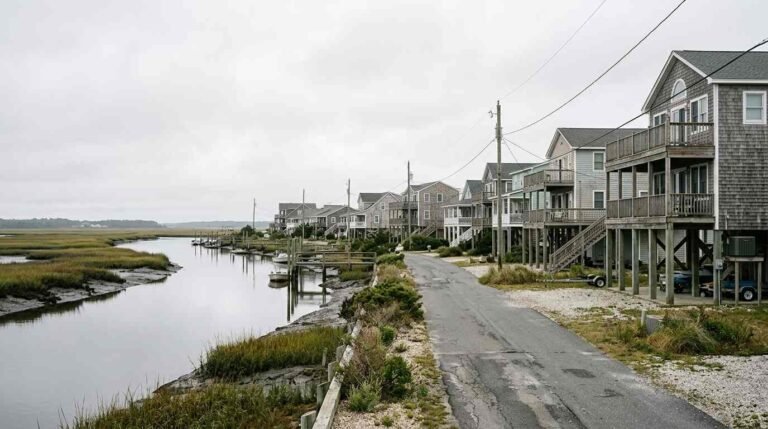
This happens on the North Shore. It happens in every thin market. But it happens with a specific intensity on Fire Island, where some communities — Dunewood, Lonelyville, Robbins Rest, Corneille Estates — might record three or four home sales in an entire calendar year. The homes are real. The buyers are real. The demand is real. But the comparable sales data is, at times, nearly fictional.
I want to walk through how pricing actually works in a market like this. Not the theory — the practice.
Why the Thin-Comp Problem Is Worse Than It Looks
In a normal residential market, appraisers and agents look for comparable sales within the last six months, ideally within a quarter mile, ideally of similar size and condition. Fire Island violates all three criteria simultaneously in most of its smaller communities.
Communities like Lonelyville and Dunewood have somewhere between 100 and 200 homes each. Total. Annual turnover in a community that size might produce four to six sales. When those sales happen to be on different sides of the island (bay-facing versus ocean-facing changes value dramatically), or involve a teardown-condition cottage versus a renovated modern, the comp pool becomes nearly useless as a pricing foundation.
The result: sellers in these communities often end up in one of two failure modes. They underprice because there’s no confidence in a higher number, or they overprice because a sale in Cherry Grove or Ocean Beach — a larger, more liquid community — gives them an inflated reference point. Neither failure mode serves the seller. Understanding the actual methodology gets you out of both.
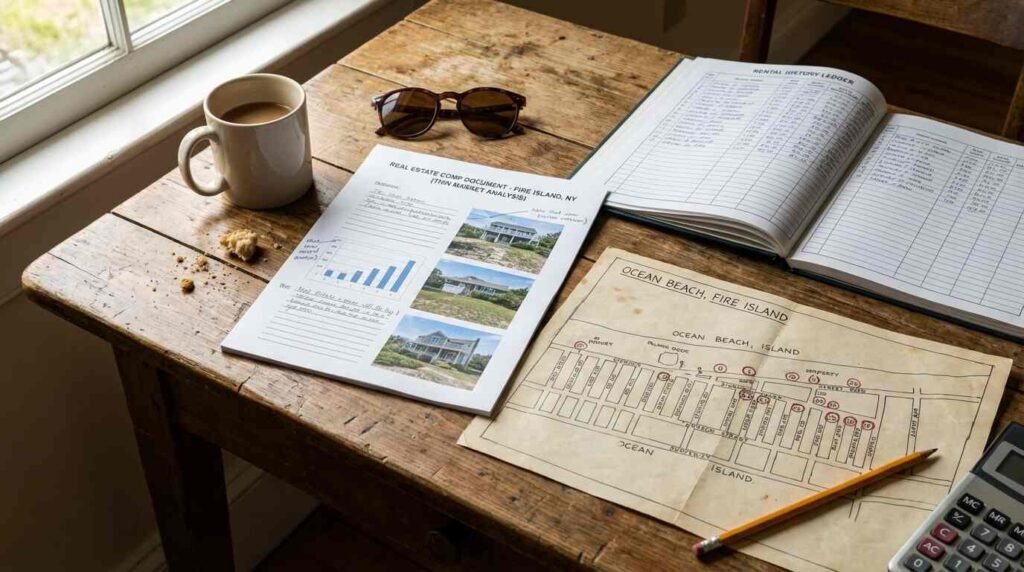
Method 1: Cross-Community Comparisons, Done Correctly
The most reliable starting point when your home community lacks data is cross-community analysis — but this requires knowing how to weight the adjustment.
Fire Island’s communities are not equivalent in value. Fire Island Pines and Cherry Grove command a premium driven by their established identity, infrastructure, and buyer demand. Ocean Beach is the island’s most liquid market and provides the most usable comp pool. Saltaire is restrained and high-quality. Fair Harbor, Kismet, and Dunewood occupy a middle range with strong family buyer demand. Lonelyville, Robbins Rest, and Corneille Estates are quieter and less liquid, which affects both pricing and days on market.
When doing cross-community analysis, a skilled agent will apply adjustments for community liquidity, bay versus ocean orientation, and walk position — the distance from the ferry dock and proximity to the beach. An agent quoting you a Fire Island Pines price as justification for a Lonelyville listing price is not doing this analysis. Push back and ask what adjustments were applied.
Method 2: Rental Income Capitalization
This is the method that mainland agents rarely use and Fire Island agents use routinely — because it works.
Fire Island properties generate substantial rental income. A four-bedroom cottage in Fair Harbor or Dunewood with ocean-side access can command $4,000–$8,000 per week during peak season (late June through August). A well-positioned bay-front property in Saltaire might generate more. This income is real, documented in rental histories, and it gives you a capitalized value floor that doesn’t depend on recent sales data.
The methodology: establish your property’s gross seasonal rental potential based on actual rental history or comparable rental listings in your community. Apply a gross rent multiplier or a cap rate appropriate to seasonal vacation properties. This gives you an income-based value that stands independently of the sparse sales record.
When used in combination with cross-community comp analysis, rental income capitalization creates a two-anchor approach to pricing: what similar properties have sold for (adjusted for community differences) and what this property could generate as an income asset. Where those two numbers converge is usually where a defensible list price lives.
This is for informational purposes only — consult a licensed real estate professional and appraiser for your specific situation.
Method 3: Lot Premium Analysis
On Fire Island, the lot is often the asset. The house on it — especially in communities where the housing stock skews older — may be a secondary consideration.
In micro-communities with very few homes, the value of the lot itself can be established more reliably than the value of the structure, because lot size and position are objective and don’t vary the way home condition does. An oceanside lot in Dunewood has a position premium that can be mapped even when no comparable homes have sold recently, because you can look at what oceanside lots in adjacent communities have sold for and apply a reasonable community discount.
This approach is particularly useful for sellers with older cottages in transitional condition — properties where a buyer might be purchasing with renovation or rebuilding in mind. In those cases, pricing from the lot value up and adding a reasonable improvement credit is often more defensible than trying to price the structure itself.
The Upgrades That Create Defensible Price Increases
When comps don’t exist to anchor a price, renovation improvements become more important as pricing justification — but only if they’re the right improvements.
Documented systems updates. New roof, updated electrical, new plumbing. These are not sexy but they are defensible. Buyers in a thin-comp market are often paying a premium for certainty, and a house that can document recent system updates removes the risk discount that otherwise applies to older stock.
Kitchen and bath modernization (moderate, not overbuilt). A kitchen that functions well and has been updated in the last 15 years commands a real premium over one that hasn’t been touched since 1988. Same with bathrooms: clean, functional, and not a renovation project.
Outdoor living expansion. Adding an upper deck, improving a bay-facing dock, or building a proper outdoor dining area are the kinds of improvements that translate directly into summer-use value — and therefore into price. These are the Fire Island equivalent of adding a finished basement on the North Shore.
CO/legal status. A property with clear certificate of occupancy and no open permits commands a meaningful premium in this market over one with legal ambiguity. If there are issues, resolve them before listing.
What to Tell an Appraiser
This is a conversation you should have before the listing, not after an offer comes in.
In a thin-comp market, the appraiser you work with matters as much as the agent. An appraiser without Fire Island-specific experience will struggle to support a non-standard price — and a failed appraisal on a sale in contract is an expensive problem.
Before listing, identify an appraiser with documented experience in barrier island or Fire Island properties. Provide your appraiser with: your rental history, the cross-community comp analysis your agent has prepared, any documentation of lot premium rationale, and the renovation documentation for any recent system updates. A well-prepared appraiser package, delivered proactively, can prevent the single biggest deal-killer in thin-comp coastal markets: an appraisal that can’t support the contract price.
Real estate markets change. For current listings and market data, contact Pawli at Maison Pawli.
The Bottom Line
Pricing in thin air is not guesswork. It’s methodology applied to a market that doesn’t play by standard rules. Cross-community analysis with proper adjustments, rental income capitalization, and lot premium weighting give you three independent anchors that, taken together, produce a price you can defend to a buyer, to an appraiser, and to yourself.
The sellers who struggle on Fire Island are the ones who either defer entirely to a mainland pricing framework or throw a number at the wall and hope. The sellers who do well are the ones who understand what their community’s data is actually telling them — and what it’s not.
If you’re thinking through a Fire Island listing, I’d suggest also reading how the pre-Memorial Day pricing window works and how assessed value and market value diverge in Suffolk County — both of which are directly relevant to how you build your number.
You Might Also Like
- Your Beach House Is Sitting on Gold — Here’s How to Price It Before Memorial Day
- The Assessed Value Is Not the Market Value: How Long Island’s Property Tax Grievance Process Can Reframe What a Seller Asks
- The Bridge That Determines Everything: How the Ponquogue Bridge Drawspan Choke Point Controls Real Estate Pricing on Dune Road
Sources
- Fire Island Pines 2024 real estate transactions: https://snaptroid.blog/2024-real-estate-transactions-fire-island-pines-ny/
- Kitty King Real Estate — Dunewood and Lonelyville sales: https://kittykingrealestate.com/
- Fire Island Living Real Estate (Fire Island-specific brokerage): https://www.fireislandfinder.com/fire-island-business-directory/wpbdp_category/home-sales-rentals/
- New York Department of State — Appraiser licensing: https://www.dos.ny.gov/licensing/appraisal/appraisal.html