
Georgia on No One’s Mind: The Caucasus Country That Changed Everything About What Wine Means
Eight thousand years before Burgundy, someone in a valley south of the Caucasus Mountains buried a clay vessel in the earth and filled it with crushed grapes. The method has not changed much since.
Tbilisi arrives as a series of layered surprises. The old city — Abanotubani, the sulfur bath district — sits in a gorge below the Narikala fortress, its wooden balconies overhanging the Mtkvari River, its hot springs feeding the bathhouses that have operated continuously for fifteen hundred years. The architecture is not one thing: Persian, Russian imperial, Ottoman, Soviet Modernist, and now a gleaming bridge of contemporary glass deposited by the Saakashvili-era urban ambition to assert that Georgia is not what the outside world thinks it is. The wine culture runs beneath all of this like a water table. You encounter it everywhere before you go looking for it.
6000 BC and What That Means
The 2017 study published in the Proceedings of the National Academy of Sciences, conducted by an international team including researchers from the University of Toronto and Georgian institutions, pushed documented evidence of winemaking in the South Caucasus back to approximately 6000 BC — older than any comparable evidence from the ancient Near East, the Mediterranean, or anywhere else. The evidence came from pottery fragments at two Neolithic village sites in eastern Georgia, Gadachrili Gora and Shulaveris Gora, where chemical residue analysis detected tartaric acid, malic acid, citric acid, and succinic acid — the signature of fermented grape juice on clay.
Six thousand BC is not a wine vintage. It is a horizon line: the point at which the evidence stops, not the point at which the practice began. Georgian scholars and winemakers are careful about this distinction. What the evidence says is that by 6000 BC, winemaking in this region was already a sophisticated enough technology to leave organized residue on specifically shaped and specifically sealed pottery. That is not a first attempt. That is a mature practice with a history we cannot see.
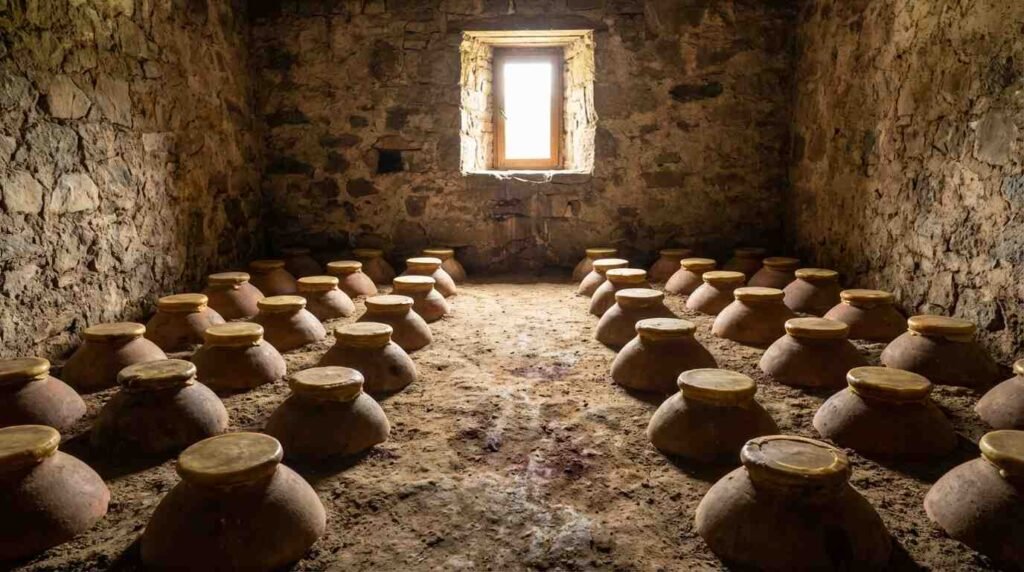
Georgian qvevri winemaking was inscribed on UNESCO’s Intangible Cultural Heritage List in 2013, the first wine-related practice to receive that designation. The qvevri — a clay amphora, beeswax-lined, ranging from fifty liters to several thousand — is buried in the earth up to its neck, where the constant ground temperature allows slow fermentation and aging without refrigeration. Grapes are crushed into the vessel with their skins, seeds, and stems — the whole cluster — and the skin contact that results produces the amber-colored, tannic, oxidative wines that have become, in the last decade, one of the most discussed categories in natural wine circles globally.
Kakheti: The Valley That Makes the Wine
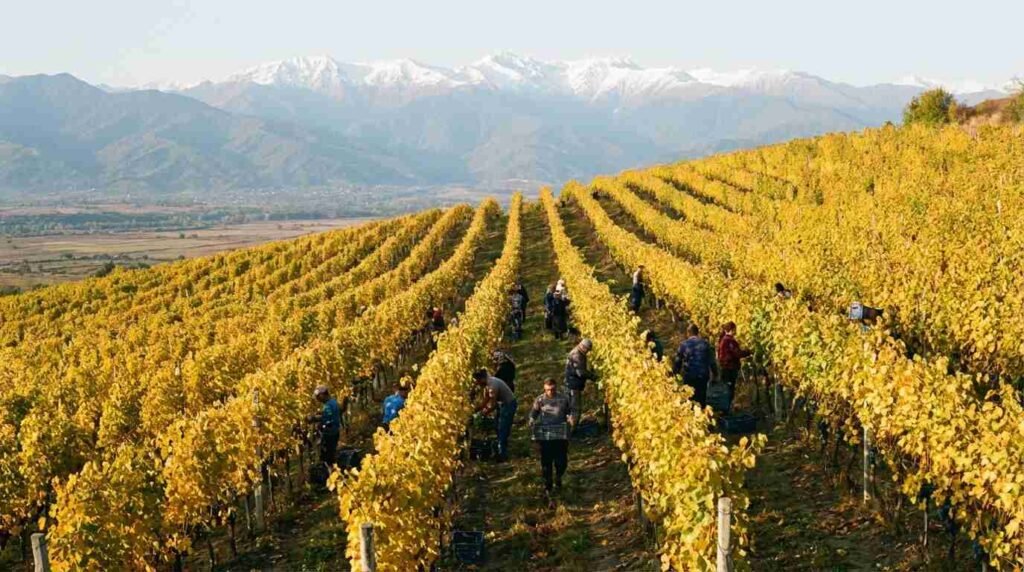
The Kakheti region lies east of Tbilisi, across the Gombori Pass, in a valley between the Greater Caucasus range to the north and the Lesser Caucasus to the south. The Alazani River runs through the valley floor, and the vineyards follow it — some of them on the valley floor, some climbing the lower slopes, some in the high-altitude villages where the mountain character enters the fruit. The light in Kakheti in September, during harvest, has a specific quality: golden and dry, the air clear with altitude, the vine rows golden-red with autumn color against the backdrop of the snow-capped Caucasus. It is among the more beautiful landscapes that wine is produced from.
Pheasant’s Tears, founded by American painter John Wurdeman and Georgian winemaker Gela Patalishvili in Sighnaghi, has become the most internationally visible face of the Georgian natural wine movement — not because it was first, but because Wurdeman’s unusual position as an outsider who went in deep made it legible to Western wine audiences who needed a translator. The winery produces from indigenous Georgian grape varieties — Rkatsiteli, Kisi, Mtsvane, Saperavi — varieties that predate any European wine tradition by thousands of years. The qvevri-produced amber wines age in vessels buried beneath the winery floor. The tannins from the extended skin contact give them a grip that white wine drinkers do not expect and that takes time to become something they look for.
Iago’s Wine, in the village of Chardakhi outside Tbilisi, represents a different kind of producer: small, family-run, farming a single ancient vineyard of Chinuri grapes with practices unchanged for generations. Iago Bitarishvili has never been much interested in the wine world’s attention, which has of course generated considerable wine world attention.
Soviet Collectivization and What Was Almost Lost
Between 1921 and 1991, Soviet collectivization reorganized Georgian viticulture along industrial lines — volume production, standardized varietals, centralized processing. Hundreds of indigenous Georgian grape varieties were abandoned or lost as collective farms planted what the central planning system prioritized. The qvevri tradition survived mostly in home production, in the villages where families had always made wine for themselves in the vessels buried beneath their houses, in a practice continuous enough with daily life that it could not be fully industrialized.
The recovery since independence has been extraordinary in its speed. Wine from Georgia trade authority figures show a rapidly expanding export market, dominated by Russia historically but diversifying significantly into Western Europe and the United States over the past decade. The interest in amber wines and natural wine production has accelerated this expansion. What is being sold is not nostalgia but genuinely ancient technology that produces wines unlike anything made anywhere else.
Getting There and Around
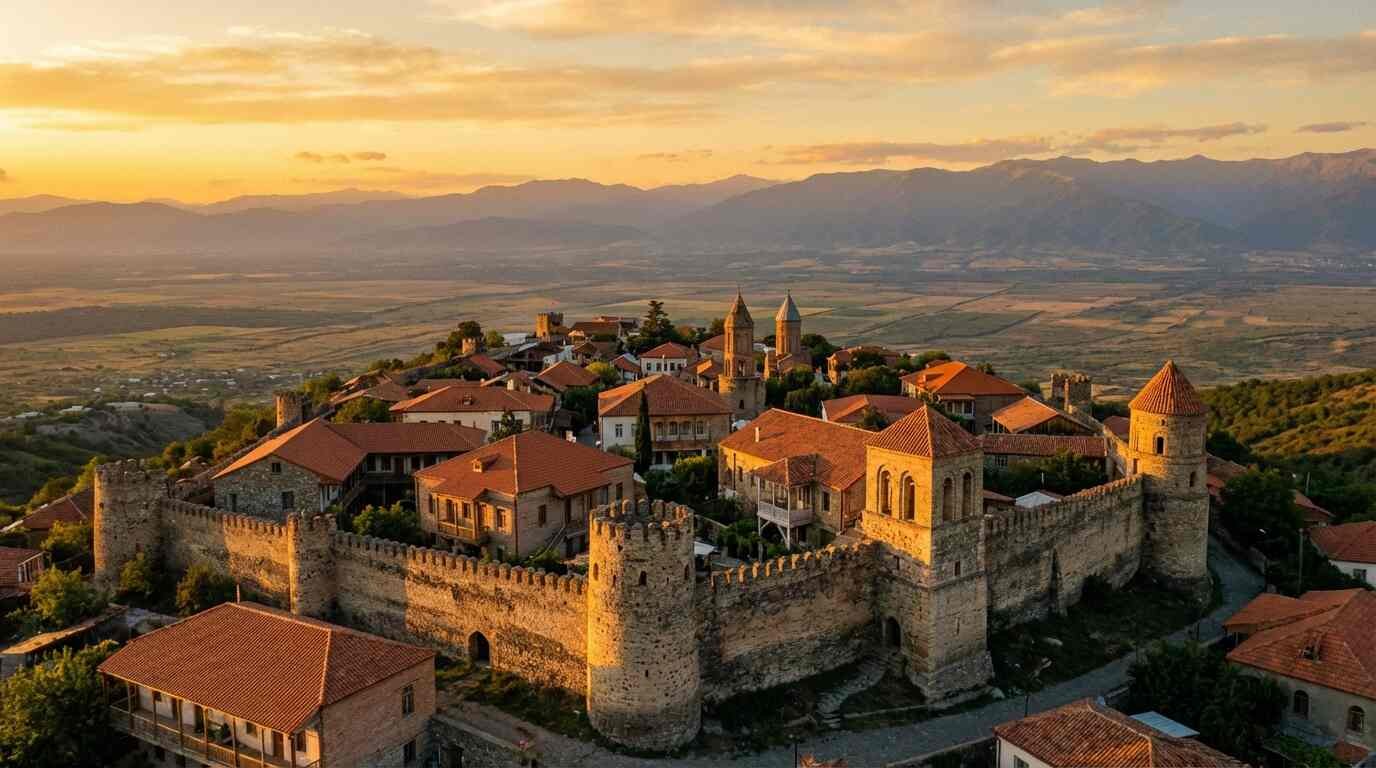
Tbilisi is surprisingly well served by direct flights from major European cities. The drive from Tbilisi to Sighnaghi, the wine tourism center of Kakheti, takes roughly two hours on roads that have improved significantly in the past decade. The town of Sighnaghi itself — walled, perched on a hillside above the Alazani valley, with views to the Caucasus — has developed a small hospitality infrastructure of guesthouses and small hotels that are specific to the place in the way that wine-country accommodation often is: slightly formal, very generous with the wine.
Harvest in Kakheti runs from mid-September to late October, which is the obvious time to visit if wine is the point. The rtveli — the communal harvest — remains a genuinely social event in Kakheti villages, not yet primarily a tourist spectacle, though the line is moving. The wine is pressed with feet in the traditional method, and the qvevri are sealed for fermentation, and the first of the new wine appears by late October in a form that is raw, fermenting, and unlike the finished product — and entirely worth drinking.
I’ve thought about what it means to taste something made by a method eight thousand years old and find it not only drinkable but genuinely better than most of what surrounds it. The qvevri wines of Kakheti are not impressive despite their antiquity. They are impressive because the technology was simply correct — figured out, held onto, nearly lost, and now available again. There is something instructive there, about what survives and what doesn’t, and why.
Sources
– PNAS study: McGovern et al., “Early Neolithic wine of Georgia in the South Caucasus” (2017): pnas.org – UNESCO Intangible Cultural Heritage Registry, Georgian qvevri winemaking (2013): ich.unesco.org – Pheasant’s Tears winery: pheasantstears.com – Wine from Georgia trade authority: winesfromgeorgia.com