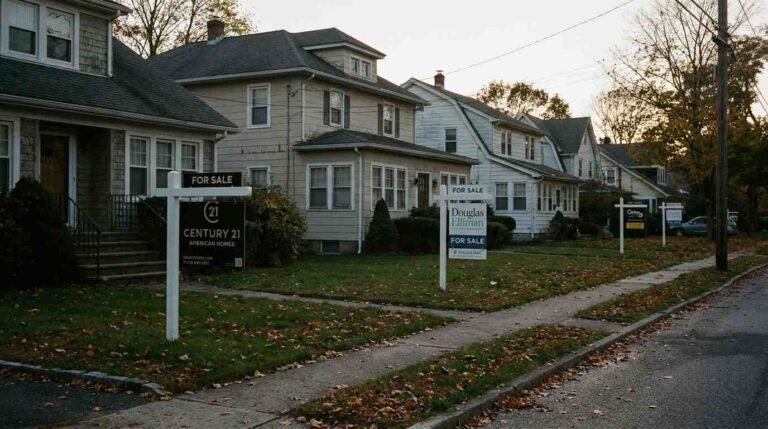
Long Island Home Prices Are Holding — But the Cracks Are Starting to Show

There’s a particular kind of quiet that falls over a listing around day forty-five. The open houses have come and gone, the photos have cycled through everyone’s Zillow alerts, and the price hasn’t moved. I’ve been in this market long enough to recognize that silence. It doesn’t mean the market is broken. But it does mean something has shifted — and the headline numbers aren’t the place you’re going to find it.
Long Island home prices, by most conventional measures, look fine. Median sale prices across Suffolk County have held steady compared to the same period in 2023. If you’re reading the top-line MLSLI reports, you might conclude that nothing has fundamentally changed. I’d push back on that. The median is a lagging indicator. What’s moving underneath it — inventory levels, days on market, the ratio of list price to sale price — tells a more nuanced story, and it’s one that both buyers and sellers need to understand before they make a move.

The Headline Number vs. the Real Number: What Median Prices Aren’t Telling You
Median sale price is the most-cited figure in real estate coverage, and it’s also one of the least useful for understanding where a market is headed. It tells you what the middle transaction looked like after it closed. It doesn’t tell you how long it took to get there, what concessions were made along the way, or how many listings fell apart before a deal was reached.
What median prices are masking right now on Long Island is a bifurcation. Well-priced, move-in-ready homes in strong school districts — think Smithtown, Hauppauge, Miller Place — are still moving with relative speed and receiving multiple offers. Properties that need work, carry deferred maintenance, or are priced according to what the seller needs rather than what the market will bear are sitting. The median stays stable because the strong half of the market keeps pulling the number up. But if you’re a seller whose home falls into the second category, that aggregate figure has essentially nothing to do with your reality.
Verify current median figures at mlsli.com before using any number here — market data shifts monthly, and the only figure that matters is the one current to your zip code and your closing date.
Inventory Is Creeping Up — and That Changes Everything for Sellers
For the past three years, sellers on Long Island have operated in a market defined by scarcity. Inventory was historically low — not just below pre-pandemic levels, but below anything most active agents had seen in their careers. That scarcity created pricing power that looked, from the outside, like the market could absorb almost anything. It mostly could.
That’s changing. Active listings in Suffolk County have been climbing incrementally, and while we’re not anywhere close to a buyer’s market by historical standards, the directional shift matters. When inventory was at its floor, sellers had almost no competition. A buyer who wanted a three-bedroom Colonial in a particular school district might have one or two realistic options. Now they might have four or five. That changes the psychology of the transaction, and it changes the negotiating dynamic.
For sellers, the implication is clear: positioning matters more than it did twelve months ago. The listing that gets the photography right, stages properly, and prices against actual recent comps — not aspirational ones — will still perform. The listing that comes to market tired and overpriced will find the silence I described at the start.
Days on Market: The Metric Most Agents Don’t Want You to Track
Days on market is the single most honest signal in any real estate market, and it’s also the one that agents are most likely to gloss over when it’s trending in the wrong direction. I’ve written about this before — The House That Sits 90 Days Has Already Told the Market Something is worth reading in full if you’re a seller currently evaluating your strategy.
The short version: average days on market in Long Island’s hotter submarkets have been ticking up. Not dramatically — we’re not talking about the 120-day averages that defined the post-2008 era. But the spread between fast-moving inventory and slow-moving inventory is widening. The fastest sales are still fast. The slowest sales are getting slower. And the longer a listing sits, the more the market assumes something is wrong with it, even when nothing is.
MLSLI publishes days-on-market data by zip code in its monthly reports. If you’re a seller, I’d encourage you to look at that figure for your specific area — not the county average — before you finalize a pricing strategy.
What Rate-Locked Sellers Are Waiting For (And What Happens When They Finally Move)
One of the least-discussed drivers of Long Island’s inventory constraint is the rate-lock effect. Roughly a third of homeowners with mortgages nationally are sitting on rates below four percent. On Long Island, where housing costs are already elevated and the monthly payment difference between a three-percent mortgage and a seven-percent mortgage can be three to four thousand dollars, the financial calculus for moving is brutal. Many sellers who would otherwise be listing are choosing to stay put.
I covered this in more detail in The Lock-In Effect: Why North Shore Inventory Is So Tight Right Now — the dynamic is structural, not seasonal, and it’s been the primary reason supply has stayed as constrained as it has. The question that has implications for everyone in the market right now is: what happens when rates come down enough to unlock some of that supply?
The answer is that inventory will rise faster than most buyers currently expect. Some of those sellers will be pricing into a market that has already softened, which could create a brief window of genuine leverage for buyers who’ve been waiting. The timing is uncertain — the Federal Reserve’s rate path has confounded most forecasters — but the mechanism is real.

How to Position Your Home If You’re Selling Into a Shifting Market
The playbook for selling into a strengthening market is relatively forgiving. Prices are rising, buyers are competing, and a motivated seller can absorb some pricing imprecision. The playbook for selling into a market that’s finding its equilibrium is less forgiving, and it’s the one that applies to Long Island right now.
Three things matter more than they did eighteen months ago. First, condition. Buyers who have more options become more discriminating. A home that presents well — genuinely staged, not just decluttered — has a measurable advantage over one that doesn’t. I go deep on this in The Staging Mistake That Costs Long Island Sellers $15,000 at the Table if you want the specifics.
Second, pricing precision. In a rising market, you can afford to be slightly optimistic about your ask. In a stable-to-softening market, overpricing costs you days on market, and days on market cost you negotiating leverage. The right price is the one that generates competitive interest in the first two weeks. If it doesn’t, something is wrong — and that something is almost always the price.
Third, representation. This is where I’ll be direct: the agent you choose affects your outcome. Not because different agents have magic, but because pricing strategy, negotiation approach, and marketing execution vary enormously. I wrote about how to evaluate this in How to Choose the Right Real Estate Agent on Long Island. The questions worth asking before you sign a listing agreement are specific, and most sellers don’t know to ask them.
The Long Island market is not in trouble. It’s normalizing — and normalization, after years of conditions that were frankly abnormal, is healthy. But it does require a different posture from sellers. The assumption that any listing will generate offers has been corrected. The sellers who understand that earliest are the ones who will close on the terms they need.
Real estate markets change. For current listings and market data, contact Pawli at Maison Pawli.
You Might Also Like: – The House That Sits 90 Days Has Already Told the Market Something – When to Walk Away From an Offer on Long Island – The Seller’s Timeline: From Decision to Closing on the North Shore
Sources: – MLSLI Monthly Market Reports — mlsli.com – OneKey MLS Market Data – NAR Existing Home Sales — Regional Data – Federal Reserve FRED — 30-Year Fixed Mortgage Rate