Sleeping in a Salt Flat: The Bolivian Hotel That Vanishes at Sunrise
At 3,656 meters above sea level, the horizon disappears and so does the line between sky and earth — and somewhere in that dissolving whiteness, there is a hotel built entirely from the ground beneath your feet.
The Salar de Uyuni covers 10,582 square kilometers of the Bolivian altiplano, making it the largest salt flat on earth by a considerable margin, and one of the flattest surfaces in the world. The flatness is not approximate. NASA has used the Salar to calibrate the altimeters of earth-observation satellites, because at its center the elevation varies by less than one meter across an area the size of Connecticut. You can see the curvature of the earth from the middle of it. This is not metaphor.
What Palacio de Sal Understood First
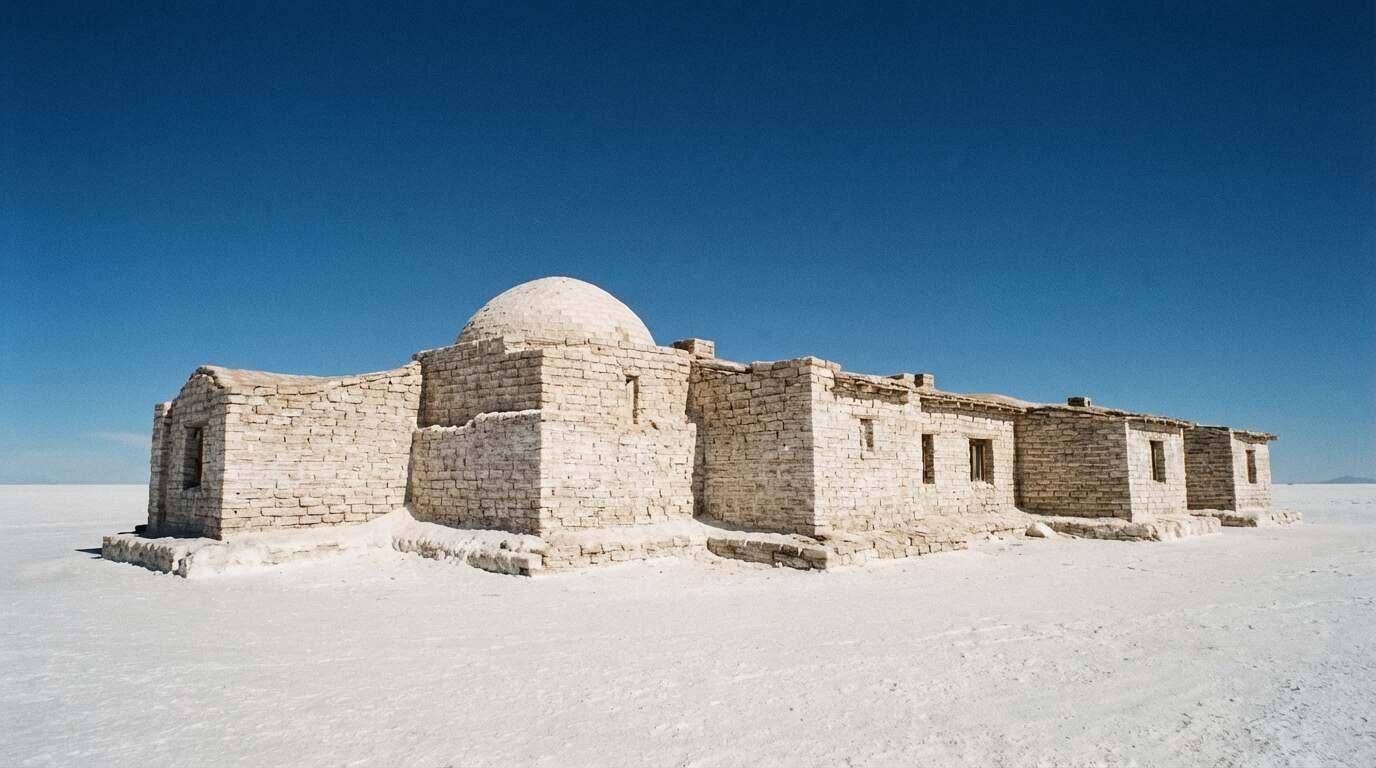
Palacio de Sal opened in 1995, built initially from blocks of salt cut from the flat itself — walls, floors, furniture, decorative elements, the beds. It was rebuilt in 2007 in a more considered form, incorporating salt throughout but with a structural sophistication that the original did not attempt. The point was never novelty, exactly. The point was that the material and the place were inseparable, that to build here from anything else would be to make a building that had nothing to do with where it stood.
The hotel now offers forty-five rooms with salt-block walls that maintain a constant temperature regardless of the dramatic swings the altiplano imposes — cold nights even in summer, midday sun that reflects off the white surface at an intensity that makes sunglasses feel inadequate. The thermal properties of salt construction are not incidental; they are what make the building livable at altitude. The spa uses mineral-rich brines extracted from the flat. The restaurant sources from the surrounding communities where potatoes of varieties unknown in Europe have been cultivated for thousands of years. The design is specific to its situation in a way that hotel design rarely achieves.
What Palacio de Sal began, others have followed. A cluster of high-design properties has established itself at the flat’s edge near Uyuni town, and more remote camps have opened at the flat’s center and at the various islands — isolated outcrops of ancient coral and cacti that rise from the white expanse like stranded geography. The design language varies: some lean into raw salt construction, others incorporate traditional Aymara textiles and earth tones. What none of them can avoid is the landscape itself, which is so visually extreme that any aesthetic decision feels provisional in relation to it.
The Physics of the Light
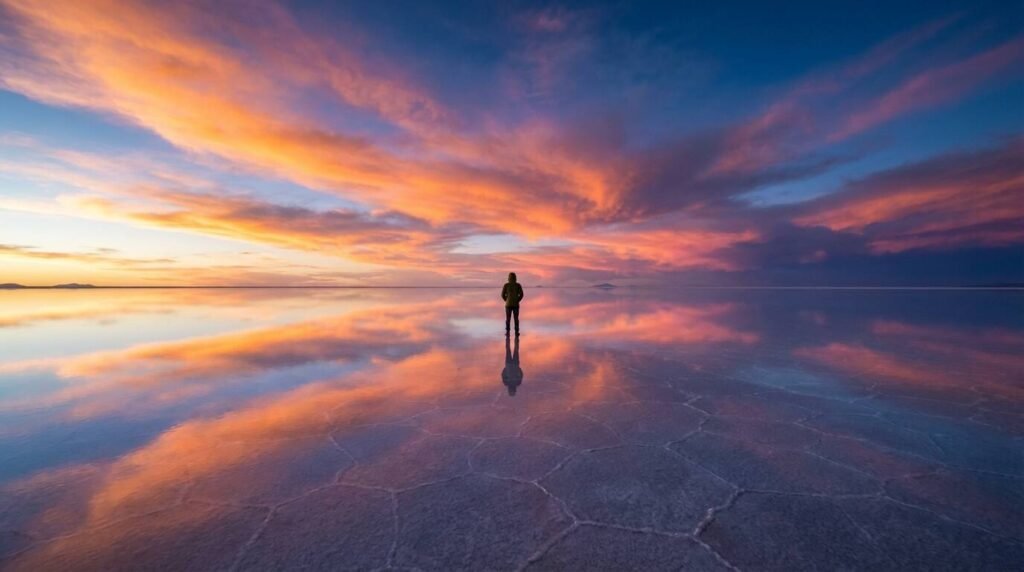
The phenomenon that draws photographers and has generated the viral imagery of the Salar — the perfect mirror reflection that appears after rain — depends on a thin layer of water covering the flat’s surface, usually between December and April. The salt crust below the water layer is white and nearly perfectly reflective, and the sky above is high and clear with the altitude-thinned quality unique to the altiplano, and the result is an image in which sky and ground are indistinguishable: the clouds appear below your feet and the horizon has no location. Photography tries to capture this and usually fails, not because the camera cannot record it but because the photograph cannot convey the sensation of standing inside it — the vertigo, the loss of directional reference, the peculiar feeling of being suspended in a volume of pure light.
In the dry season, the flat reverts to a hexagonal tiling pattern — the salt crystallizes in columns as the surface dries, and the tops of the columns, under the flat crust, push the crust up into a pattern of perfect hexagons that extends to the horizon in every direction. From above, by drone or satellite, it looks like a mathematical diagram. From the surface, it looks like the earth is trying to make a point about order.
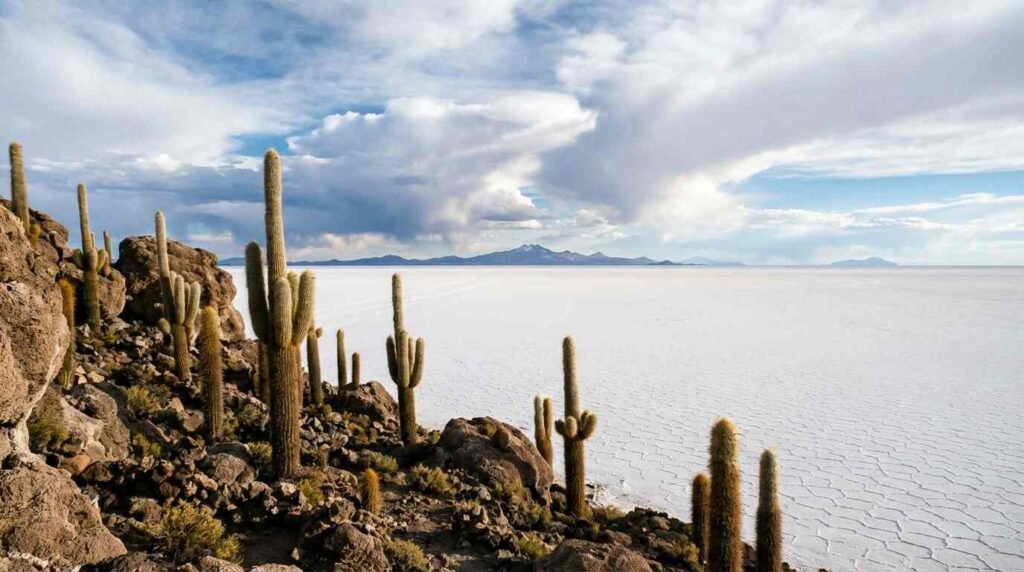
The islands — Incahuasi is the most visited, with its stands of centuries-old giant cacti rising to twelve meters — break the geometry and give the scale something to measure against. The cacti grow at roughly one centimeter per year. The tallest ones have been growing since before Columbus crossed the other ocean.
Altitude and Acclimatization
The Salar sits at an altitude that requires acclimatization. Uyuni town is at 3,670 meters; the flat itself is slightly lower. Arriving from sea level, the body takes two to three days to adjust, and the adjustment is not comfortable. The standard advice — ascend slowly, stay hydrated, avoid alcohol for the first forty-eight hours, accept coca tea from every Bolivian who offers it — is worth following. The altitude headache is real. The shortness of breath on any exertion is real. The way it passes, usually on the third day, is also real, replaced by a clarity of sensation that high altitude is famous for and that is difficult to describe to anyone who hasn’t experienced it.
The Bolivia Tourism Authority documents the Salar as the country’s most visited destination, and the tourist infrastructure in Uyuni — tour operators, jeep fleets, equipment rentals — is well developed relative to the rest of Bolivia’s altiplano. This is relative: the roads beyond the flat, toward the red lagoons and geysers of the Eduardo Avaroa Reserve further south, are high, cold, and sometimes impassable. The guides who have navigated this terrain their entire lives are the essential element of the experience, not the vehicles or the lodges.
The Silence
The silence of the Salar is noted by nearly everyone who visits it, and nearly everyone struggles to describe it accurately. It is not the silence of a room or a library or even a wilderness with ambient wildlife sound. It is the silence of an environment with no vertical surfaces to reflect sound, no vegetation to rustle, no water moving, and a sky too high and clean to generate wind noise at the surface. What remains when all of that is removed is something you do not have a name for because you have not experienced the category before. It registers, in the moment, as a physical sensation rather than an absence.
I keep thinking about what it means to sleep somewhere this geologically young — the salt flat is only about thirty thousand years old, the remnant of an ancient lake that evaporated slowly in the dry air of the altiplano. Thirty thousand years is nothing. The Azores are older. The North Shore of Long Island is older. There’s something clarifying about that — about staying somewhere that the earth made recently, casually, without particular care for what would happen next. It makes most categories feel provisional. Including, briefly, your own.
Sources
– Palacio de Sal: palaciodesal.com.bo – NASA Earth Observatory, Salar de Uyuni satellite calibration data: earthobservatory.nasa.gov – Bolivia Tourism Authority: bolivia.travel – National Geographic, Salar de Uyuni coverage: nationalgeographic.com