Vacancy as Inventory: The Architectural Case for Treating Long Island’s Obsolete Retail Strip Centers as Structural Raw Material
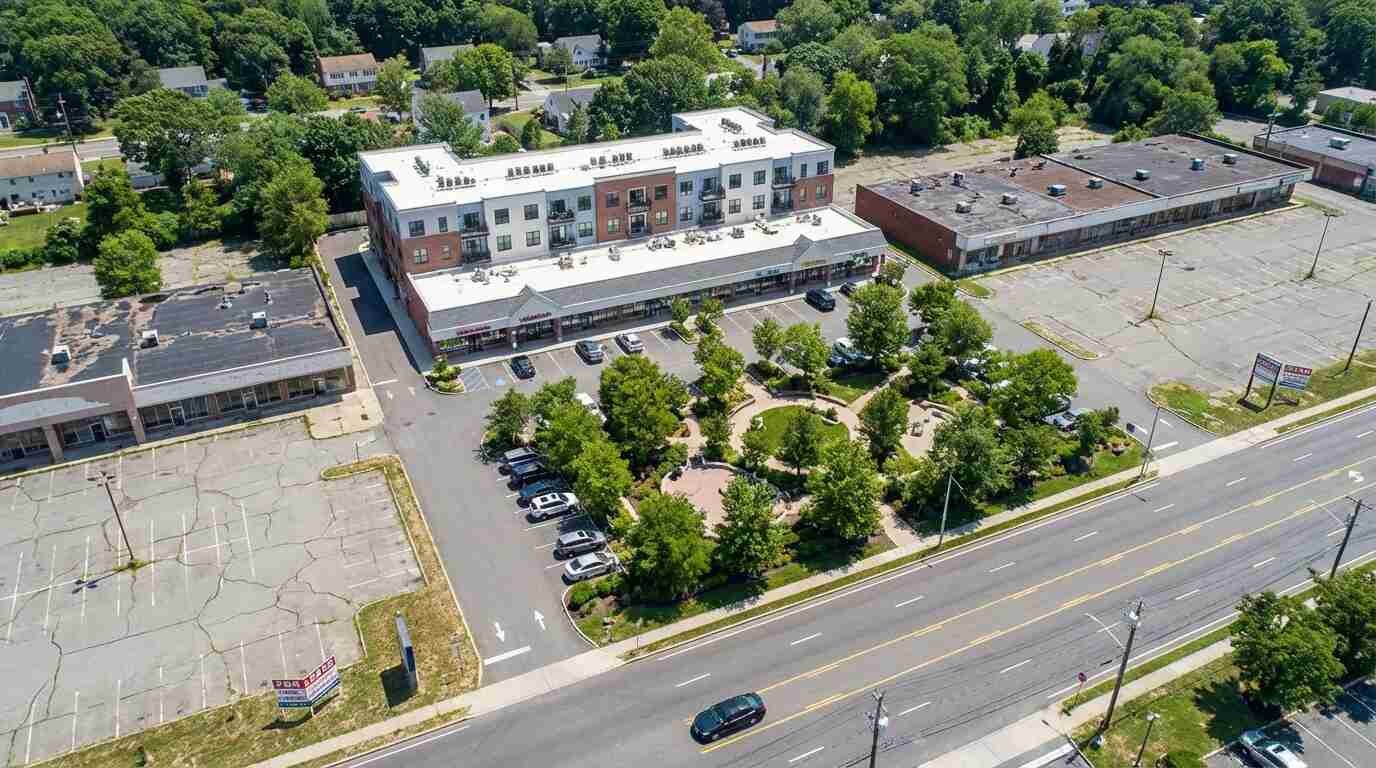
Drive almost any arterial on Long Island and you will pass one: the parking lot that is three-quarters empty on a Tuesday afternoon, the anchor tenant gone, the smaller storefronts behind brown paper or half-hearted “coming soon” signage, the flat roof with a mechanicals cluster that was never designed to be seen and is now the first thing you notice because there is nothing else to look at. The postwar retail strip center — that most American of building types, designed entirely around the automobile and the assumption of perpetual commercial expansion — is in the middle of a slow, necessary, and architecturally interesting crisis on Long Island.
The vacancy numbers have been building for years. The structural causes are well understood: the shift in consumer behavior toward online retail, the consolidation of grocery anchors, the inability of many strip center owners to replace big-box tenants with uses that generate comparable foot traffic. What is less discussed — and what I find myself thinking about with genuine interest, as someone who spends a lot of time considering the relationship between built form and property value — is the architectural question underneath the economic one. Because the crisis of the vacant strip center is also, if you look at it correctly, an opportunity that turns on the specific structural and material properties of the building type itself.
What the Slab Actually Offers
The postwar retail strip center was not designed with care for permanence in the way that the Victorian commercial block on a Port Jefferson main street was designed. It was designed for speed, flexibility, and low first cost. It was designed to be built quickly and occupied immediately, with minimal investment in detail or durability. And yet, those design priorities produced a structural system that turns out to be remarkably well-suited to adaptive reuse in ways that were entirely unintentional.
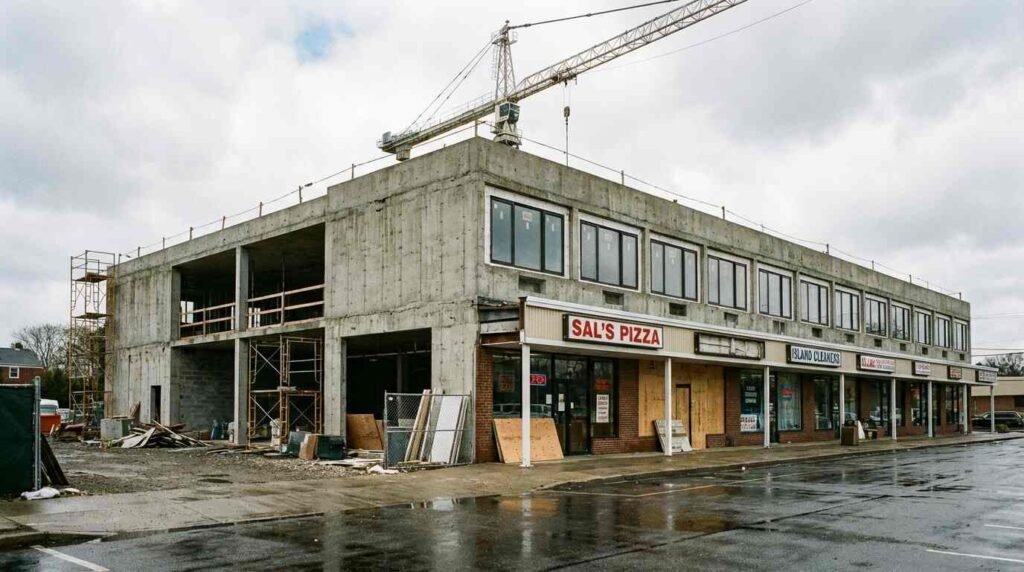
The typical Long Island strip center built between 1955 and 1985 rests on a flat-plate concrete slab — a structural system in which the floor plate is supported directly by columns without intermediate beams, allowing maximum flexibility in partition placement and maximum clear height throughout the floor plan. The column grids in these buildings are generous by residential standards: spans of twenty-five to thirty feet were common, because the retail program required open selling floor unobstructed by structure. The roof structure follows the same logic — long spans, minimal interior columns, flat profile that is cheap to re-clad and cheap to penetrate for new mechanical systems.
Architects and engineers working on adaptive reuse know what this means: you have a structural gift. The slab can carry residential loads without reinforcement in most cases. The column grid accommodates a wide range of unit layouts without requiring structural modification. The flat roof is a platform for mechanical equipment, photovoltaic panels, or roof decks depending on the program. The absence of load-bearing interior walls means that the entire interior can be redistributed according to whatever the new program demands. The building is, in structural terms, nearly infinitely flexible — which is the opposite of how it looks from the parking lot, and exactly why the gap between appearance and utility is so significant.
Where Long Island Is Actually Doing This
The adaptive reuse of Long Island retail has accelerated since 2020, driven by a combination of vacancy pressure, housing demand, and state-level policy intervention. The evidence on the ground is specific and verifiable, though projects are at varying stages of completion and approval.
In Bay Shore, a multi-phase revitalization effort on the South Shore replaced blighted commercial blocks with 118 new residential units, a project that sparked additional private investment in the surrounding district and demonstrated that mixed-use residential conversion of underperforming commercial stock was acceptable to local planning boards and marketable to buyers. In Hempstead Village, two mixed-use buildings by Conifer-LeChase Construction containing 258 affordable units are under development, part of a Downtown Revitalization Initiative award that specifically targeted the conversion and replacement of obsolete commercial structures. Huntington Station, named Long Island’s winner of the sixth round of the Downtown Revitalization Initiative in 2023, has approved a slate of projects along New York Avenue that include new mixed-use buildings combining workforce housing and ground-floor retail — projects explicitly designed to replace underperforming commercial structures with building forms that can generate both residential density and pedestrian activity.
The larger-scale evidence is at Ronkonkoma, where the Station Yards development — a transit-oriented master plan adjacent to the LIRR terminal — produced The Core, a 388-unit mixed-use complex with 83,500 square feet of office and retail space, completed in 2024 and refinanced at $166.2 million. Station Yards is not a strip center conversion in the traditional sense — it involved significant site clearing and new construction — but the planning logic that produced it is directly applicable to the strip center problem: the structural and locational assets of underperforming commercial sites can support residential density, and the residential density is what makes the ground-floor commercial viable.

The Architectural Honesty Question
Not all of these conversions are architecturally interesting, and I think it is worth being precise about the distinction between a conversion that is honest about what it is doing and one that is merely cosmetic.
The cosmetic recovery is easy to recognize: it involves a new skin — EIFS stucco, fiber cement panel, a fresh color scheme — applied over the original building envelope without any fundamental change to the building’s relationship to the street, the parking lot, or the pedestrian. The flat-plate slab becomes apartments, but the building still reads from the street as a strip center in disguise. The parking field remains as vast as it ever was. The ground-floor commercial space has no relationship to the sidewalk because there was never a sidewalk to relate to. The stucco is fresh but the spatial logic is the same: everything is organized around the car, and the pedestrian arrives as an afterthought.
The architecturally honest conversion engages the problem differently. It begins by asking what the original structural system actually offers — and then asks what spatial program would take best advantage of it. For residential conversion, that means accepting the column grid as an organizing geometry for unit layout rather than fighting it. It means treating the generous floor-to-floor heights of retail construction — often twelve to fourteen feet, compared to the eight or nine feet standard in residential — as an asset to be preserved rather than subdivided away with a suspended ceiling. It means acknowledging that the building sits in a sea of asphalt and asking whether some of that asphalt can become something — courtyard, planted buffer, reconfigured entry sequence — that gives the building a ground-plane relationship it never had.
For medical campus conversions, which have been among the more successful adaptive reuse programs on Long Island in the past decade, the structural logic is slightly different. Medical office and ambulatory care uses require column-free spans for imaging suites and procedure rooms, flexible partition grids for clinical layouts that change frequently, and generous floor-to-floor heights for ductwork and medical gas distribution. The flat-plate strip center slab provides all three. The conversion challenge is envelope — the original facade was designed for a single-story retail context, not for the institutional legibility that a medical occupancy requires — but this is an additive problem, not a structural one. You are dressing a building, not rebuilding it.
The Envelope Problem and Its Solutions
The facade of a Long Island strip center is, in almost all cases, an afterthought — a skin applied to a structural system that was designed to face a parking lot, not a public street or a residential neighborhood. The typical treatment is some combination of EIFS, face brick, and spandrel glass arranged according to whatever the leasing agent thought would read well from a car traveling at forty miles per hour. There is no meaningful ornamental language, no compositional logic, no interest in the relationship between the wall and what is behind it.
Adaptive reuse projects that take the envelope seriously are treating this as a starting condition, not a problem to be papered over. The most interesting approach — visible in several Long Island projects at various stages of approval — is to treat the original envelope as a datum and work from it: preserving the basic massing and column rhythm of the original building while introducing new facade elements — recessed balconies, punched window openings in a residential scale and rhythm, material changes that acknowledge the distinction between floors — that establish a new architectural character without pretending the building was something other than what it was.
This is the approach that the Urban Land Institute and comparable professional organizations have been advocating in their adaptive reuse case studies for over a decade — the argument that the most durable conversions are those that are honest about their origins, that find value in the industrial aesthetic of the original structure rather than concealing it under a residential cosmetic. On Long Island, where the pressure to produce housing quickly and inexpensively is significant, there is a tendency to reach for the cosmetic solution because it is faster and cheaper. The result is buildings that will look tired in fifteen years and generate no particular affection from the communities they land in.
The buildings that will matter in twenty years — the conversions that will have become genuine parts of their neighborhoods rather than expedient insertions — will be the ones where an architect sat down with the flat-plate slab and the column grid and asked: what does this building actually want to become?
Pawli’s Read on the Property Angle
I want to be direct about why this matters to buyers and sellers on Long Island, not just to architects and planners. The adaptive reuse of commercial strips is reshaping the land value equation in communities across Nassau and Suffolk in ways that are not yet fully legible in comparable sales data.
When a strip center is converted to housing — or approved for conversion — the value of the surrounding residential properties does not behave in a simple or predictable way. In communities where the conversion is well-designed, where it introduces pedestrian activity and retail that the neighborhood lacked, and where it is connected to transit or other amenity anchors, the effect on surrounding residential values has generally been positive. In communities where the conversion is cosmetic, where it adds density without adding amenity, and where it is simply a suburban parking lot with apartments on top of it, the effect is more complicated.
For buyers considering property near a commercial corridor — anywhere along Route 110, Route 25A, Merrick Road, Hempstead Turnpike — the question worth asking is not “what is there now” but “what has been approved, what is in the pipeline, and who is doing the architecture.” The structural case for treating Long Island’s obsolete retail as raw material is compelling. Whether the material gets made into something worth living near depends entirely on the quality of judgment being applied to it.
Real estate markets change. For current listings and market data, contact Pawli at Maison Pawli.
Sources
– Governor Hochul DRI and NY Forward Programs — Long Island Projects (HCR, May 2024): https://hcr.ny.gov/news/governor-hochul-announces-17-transformational-projects-long-island-part-downtown – Station Yards / The Core refinancing (Multi-Housing News, August 2025): https://www.multihousingnews.com/long-island-mixed-use-project-obtains-166m-refi/ – Long Island Housing Crisis coverage, Herald Community Newspapers (August 2025): https://www.amityvillerecord.com/articles/prices-stalled-growth-fuel-housing-crisis/ – Urban Land Institute, Adaptive Reuse Case Studies: https://knowledge.uli.org/ – New York State Empire State Development — Commercial Revitalization Grant Recipients: https://esd.ny.gov/