Stone That Tells Time: The Designers Using Fossiliferous Marble to Anchor a Room
The countertop stopped the conversation.
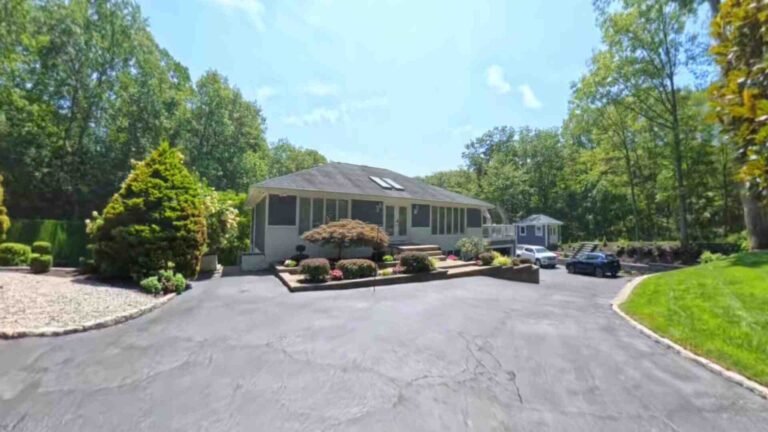
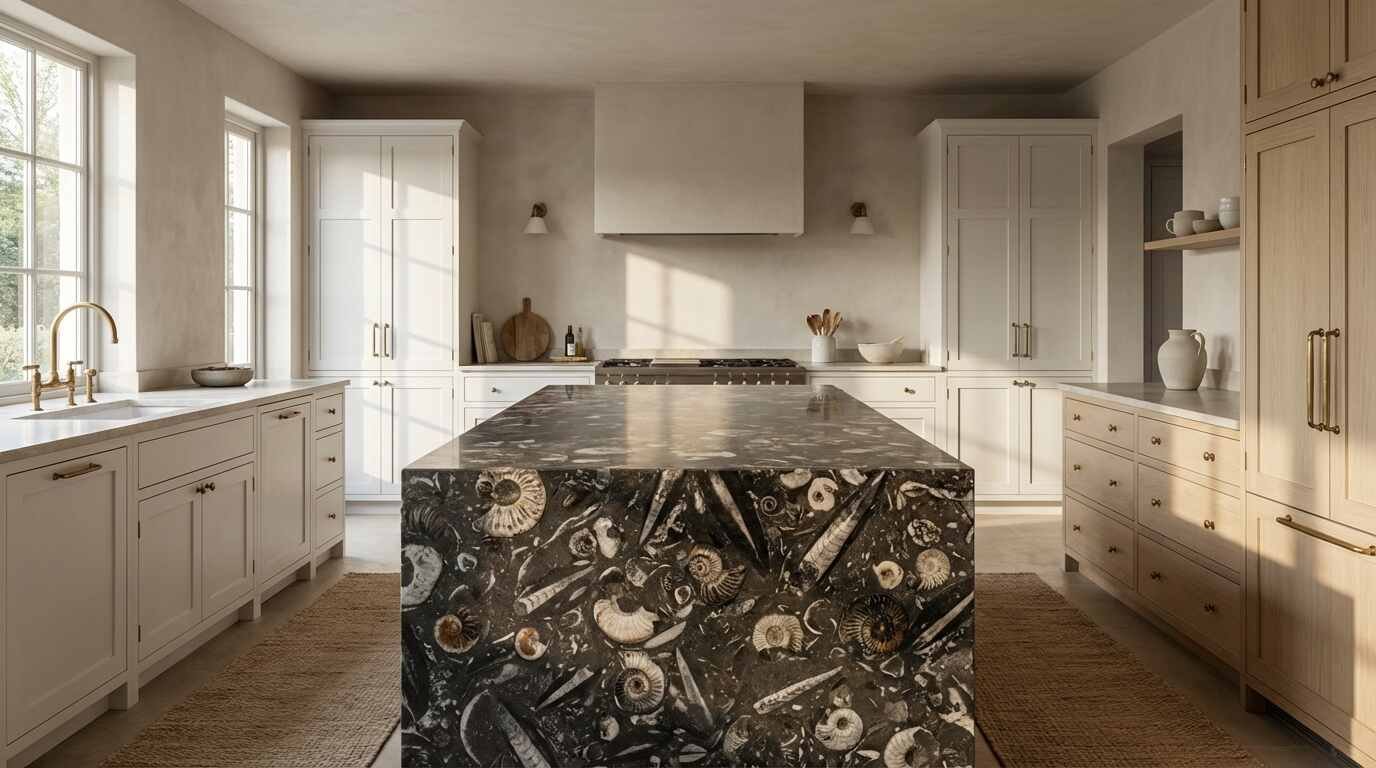
We were in a kitchen in Cold Spring Harbor — a thoughtful renovation of a mid-century house set back from the water, all clean sightlines and carefully chosen materials — and the clients I was with had been talking steadily since we pulled into the drive. The usual running commentary: good bones, nice light, what would you do with the cabinetry. Then they walked into the kitchen and went quiet. On the island was a slab of dark stone, almost black, crossed with the coiled spirals of ammonites. Dozens of them. Some the size of a thumbnail, some the size of a hand. They had been alive — or something like alive — 380 million years ago, in a shallow sea where Morocco now stands.
Nobody spoke for a moment. Then one of them said: “Is that real?”
It was. That is, almost always, the beginning of the conversation.
Geology as Design Material
Fossiliferous limestone and marble — stone that contains the visible, polished remains of ancient marine organisms — has been a building material for centuries. The great Gothic cathedrals of Europe used lumachelle, a limestone packed so densely with shell fragments that the cut surface appears to glow. Griotte Rouge, the deep red marble quarried in the Pyrenees and in Belgium, owes its baroque richness to the compressed remains of ancient corals and cephalopods. Portor, the dramatic black-and-gold marble favored by Napoleon’s architects for state interiors, achieves its distinctive veining partly through fossilized organic inclusions.
These stones were not chosen despite their fossils. They were chosen, at least in part, because of them — because the material carried within it an undeniable evidence of age, of depth, of a world that preceded human memory by orders of magnitude that the mind genuinely cannot hold.
Contemporary designers are returning to this understanding. What had been a material most associated with grand institutional interiors — museum lobbies, state buildings, high church — is finding its way into private residences, high-end kitchens, and thoughtfully designed baths. The appeal is not nostalgia. It is something more precise than that.
Erfoud and the Saharan Sea
The most dramatic source of fossiliferous marble currently reaching the design market is a quarrying region in southeastern Morocco, centered around the town of Erfoud.
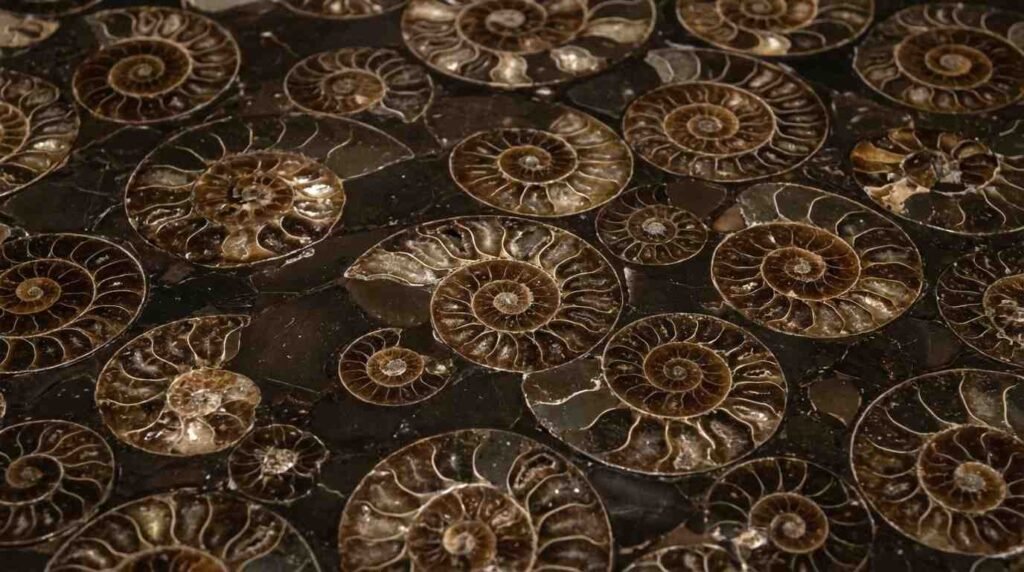
The geology here is extraordinary in its specificity. During the Devonian period — roughly 380 to 400 million years ago — the area that is now the Moroccan Sahara was the floor of a warm, shallow sea teeming with cephalopod life. Paleontological research confirms that the region around Erfoud and the nearby Tafilalt oasis was an ancient seabed dense with ammonites, orthoceras, goniatites, and trilobites. When the sea withdrew, the accumulated shells were buried under sediment and, over millions of years, mineralized into the limestone and marble deposits that quarry workers cut today from open-face operations on the desert’s edge.
The quarried stone — sometimes called Fossil Brown Marble, sometimes simply Erfoud fossil stone — is typically a dark gray to deep brown, crosscut with the compressed outlines of ammonite spirals and the elongated straight forms of orthoceras. The fossils are not incidental: in some slabs, the density of marine remains is such that the stone reads more as a record than a surface.
Moroccan craftsmen in Erfoud and the neighboring village of Rissani cut and polish the stone into countertops, basins, tabletops, and floor slabs. The stone is exported throughout Europe and, increasingly, into the American high-end design market, where specification for residential countertops and statement surfaces is growing. The process from quarry block to finished slab involves hand-cutting — the fossils require attention that automated processes cannot give — and polishing that reveals the full depth of the patterns.
The Older Tradition: Griotte Rouge and Lumachelle
The Moroccan stone is the newest chapter in a much longer story.
Griotte Rouge — the French name means “morello cherry” — is a fossiliferous limestone quarried for centuries in the Ardennes region of Belgium and in the Pyrenean foothills of southern France. Its base color runs from deep burgundy to near-black, and its surface, when cut and polished, reveals a matrix of fossil cephalopod fragments that catch light differently at different angles. The stone appears throughout the interiors of the French royal palaces, the great bourgeois houses of Antwerp and Brussels, and countless Baroque churches across the Catholic world.
Lumachelle — the name derives from the Italian lumaca, snail — is a broader category of shell-dense limestone found throughout the Alpine region, Belgium, and parts of central Europe. Belgian quarrying operations with centuries of documented history have supplied lumachelle and related fossiliferous stone to European architects and designers continuously since the early modern period.
Portor, the black marble with gold veining quarried near Portofino in Liguria, achieves its characteristic pattern partly through fossilized organic matter — the gold traces are mineral-filled voids left by ancient organisms. It was a favorite of Napoleonic-era architects and remains among the most sought-after marbles in high-end residential specification.
Why Now
The question worth asking is not why designers are using fossiliferous stone — the material’s appeal is self-evident, once seen. The question is why it is appearing with increasing frequency in residential interiors that not long ago would have specified white Calacatta or gray Quartzite without a second thought.
Part of the answer is the same one emerging in finishes, in furniture, in almost every corner of the high-end design conversation: a turn away from surfaces that perform their own newness. The fossiliferous stone does the opposite. It performs its age — its extreme, geological, inconceivable age. It puts 400 million years in a kitchen. It asks the room to reckon with time in a way that no manufactured surface, no matter how precisely engineered, can simulate.
There is also the matter of uniqueness. No two slabs of Erfoud fossil marble are identical. The distribution of ammonites within a given quarry block is unrepeatable. You cannot order two of the same. The designer who specifies it knows that the client will have, in the most literal sense, the only one.
For clients who have reached a point in their aesthetic evolution where the primary luxury is not expense but irreplaceability — where the question they’re asking is not “how much does this cost?” but “can I have two?” — fossiliferous stone answers definitively: no. There is only the one.
How Designers Are Using It
The most common residential applications are countertops and island surfaces — locations where the stone will be seen at close range, from the height of a standing person, and where the fossil inclusions become a kind of conversation held at the kitchen table.
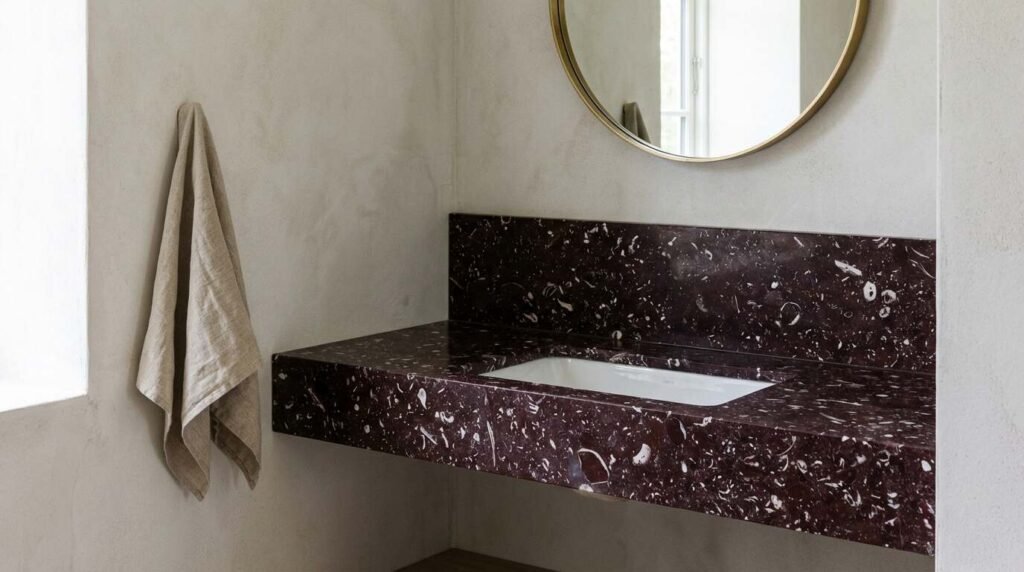
Bathroom vanity tops are a close second: the intimacy of a bath, the contemplative quality of morning or evening routines, makes fossiliferous stone feel particularly apt. The bathroom is already a room people stand in and think. A surface that is itself geological — that carries the compressed remains of creatures from before the dinosaurs — extends that contemplative quality into the material.
Floor applications are rarer but, when executed well, among the most arresting: an entry hall floored in Griotte Rouge or Erfoud fossil stone converts the threshold of a house into something approaching ceremony. You arrive. You look down. The floor has been here, in the sense that matters most, since before any of this.
The North Shore Context
The older North Shore houses — the Craftsman-period estates, the Gold Coast residences in their various states of renovation and re-life, the mid-century moderns on the water — have an existing relationship with geological materials. The fieldstone foundations, the slate roofs, the bluestone terraces: these are houses that were built to acknowledge the physical world they sit in. A fossiliferous marble countertop or bath top in a house like this is not a foreign intervention. It is a continuation.
I have been watching clients respond to these materials for long enough to know that the response is not entirely rational — it precedes the conversation, the way a very good piece of furniture in a well-made room announces itself before anyone starts talking about it. The stone makes a claim on the room. The room reorganizes itself around the claim.
That is the design goal. Everything else is specification.
You Might Also Like
- The Servant Stair and the Service Wing: What the Hidden Architecture of Gold Coast Estates Reveals About Today’s Luxury Floor Plans
- The Cold Spring Harbor Phoenix: Buying and Saving Gold Coast Ruins
- Matinecock’s Invisible Borders: How a Quaker Hamlet Kept Its Character While Everything Around It Changed
The clients in Cold Spring Harbor made an offer on the house. In the negotiation, they mentioned several times that they wanted to keep the island countertop as-is — that it was part of what they were buying. The seller’s attorney put it in writing.
I have never seen a countertop specified in a sales contract before. I have now.
Real estate markets change. For current listings and market data, contact Pawli at Maison Pawli.
Sources
- Pierre d’Erfoud — Erfoud fossil marble quarry production and paleontological history: pierrederfoud.com
- Fossils Erfoud Morocco — Ammonite quarrying and export, Devonian geological context: fossilserfoudmorocco.com
- The Lizzadro Museum of Lapidary Art — Erfoud fossil stone geological documentation: lizzadromuseum.org
- Stone Contact — Fossil Brown Marble quarry regions and geological formation: stonecontact.com
- Morocco Planet — Moroccan fossil marble production: moroccanplanet.com