
The Staging Mistake That Costs Long Island Sellers $15,000 at the Table: How Scent, Sound, and the First Eight Seconds Actually Work
Most sellers understand, in the abstract, that presentation matters. What they don’t understand — and what costs them money — is that the moment a buyer crosses the threshold, something very specific happens inside their brain, and it is measurable, documented, and not particularly subject to rational override.
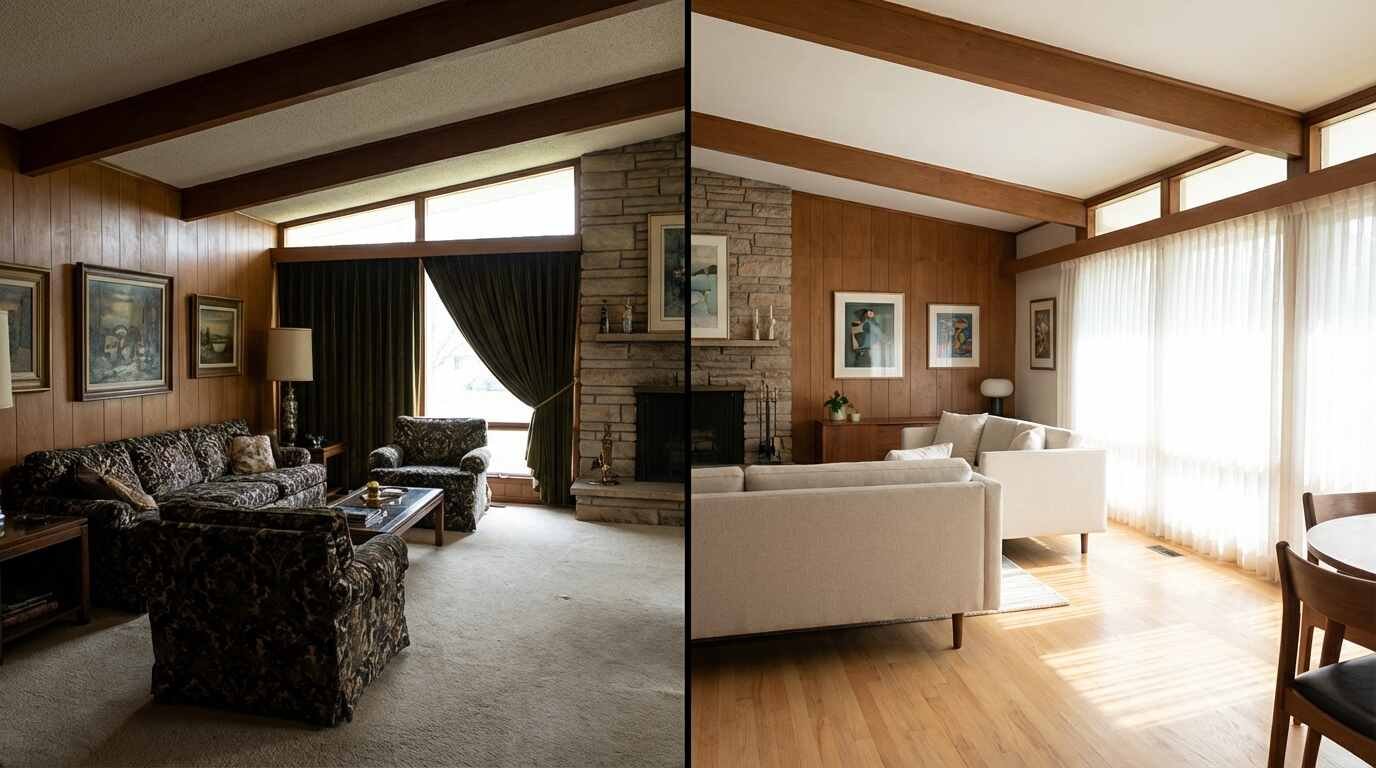
Environmental psychology research has been working on this for decades. The results are not subtle. And the typical North Shore home — the center-hall colonial with the dark entry, the mid-century ranch with low ceilings, the Port Jefferson Station colonial with the awkward first sightline — is failing buyers in the first eight seconds in ways that are entirely preventable.
Here is what the research actually says, and what it means for sellers preparing to list.

The Eight-Second Frame
The first eight seconds inside a property establish an emotional frame that buyers carry through the rest of the showing. This is not staging industry opinion — it is the conclusion that emerges from decades of environmental psychology research, including the foundational work of Roger Ulrich at Texas A&M, whose studies on environmental stress response established that the physical environment triggers immediate, largely pre-conscious emotional responses that shape subsequent evaluation.
What this means practically: the buyer who walks into your home and immediately perceives darkness, constriction, or an unclear sightline is forming a negative emotional frame before they have consciously evaluated a single feature of the property. That frame will color everything that follows — the size they perceive the rooms to be, the value they assign to finishes, the story they tell themselves about whether they can see their life here.
Sellers who understand this work backward from the threshold. They ask: what is the buyer’s first unobstructed sightline from the front door? What is the ambient light level at 10 a.m. on a Tuesday? What does this room smell like to someone who has never been inside it?
That last question is where most sellers make the most expensive mistake.
The Scent Problem (and What the Research Says)
The Journal of Marketing published a study by Spangenberg, Crowley, and Henderson in 1996 that established something real estate sellers should have been reading ever since: ambient scent in a retail environment significantly affects how shoppers evaluate merchandise and how long they stay. Subsequent research in retail settings has documented that the right ambient scent increases perceived value, extends dwell time, and improves purchase decisions. The wrong scent — or the absence of a considered one — does the opposite.
Real estate is not retail. But the underlying psychology is identical. A buyer touring a home is making a purchase evaluation, and their olfactory system is providing data that their conscious mind is not fully processing. What they register as “this house feels right” or “something feels off about this place” is often, in part, a scent response.
The most common mistakes I see in North Shore homes preparing to list:
Aggressive cover scents. Sellers who spray air freshener or light synthetic candles before a showing are not solving a scent problem. They are announcing that a scent problem exists and that they attempted to conceal it. Buyers detect this. It raises questions.
Pet and cooking odors that the seller has stopped noticing. This is the most common issue and the hardest for sellers to self-diagnose. When you live in a home, you habituate to its scent. You are not smelling it the way a buyer will smell it when they open the front door. A trusted third party — a neighbor, a friend, your agent — needs to do this assessment honestly.
Mismatched scents. A beach house staging that smells like vanilla and cinnamon is creating a dissonance that buyers feel without being able to name it. The scent should reinforce the property’s identity, not work against it.
The solution is not a particular fragrance. The solution is neutral with intentional notes: clean air, perhaps a faint hint of something that suggests freshness without announcing itself. Lemon, light cedar, fresh linen — these work because they register as clean and spacious, which is exactly what buyers want to feel. The goal is not to make the house smell like a product. The goal is to make it smell like a home that has been cared for.
The Sound Variable
Cornell University hospitality research has documented how background sound frequency affects consumer behavior, including dwell time and positive evaluation. The application to real estate is direct: silence in a showing is not neutral. A house that is completely silent can feel either serene or slightly eerie, depending on the buyer’s mood and the ambient conditions outside. The thin walls of a 1960s ranch in Port Jefferson Station can amplify road noise in ways that are particularly brutal in silence.
Low-frequency background sound — ambient music at a volume level that registers as presence rather than performance — can mask distracting exterior noise, make a space feel inhabited rather than vacant, and extend the time buyers spend in each room. The research suggests that tempo and volume matter more than genre. Slow, low-volume music in the 60–80 BPM range has been shown to increase dwell time. This is not complicated to execute. It requires a Bluetooth speaker and thirty minutes of playlist curation.
What doesn’t work: silence in a house where exterior noise is an issue, uptempo music that puts buyers in a mentally accelerated state and shortens their engagement, or music that dates the property or signals the seller’s personal taste rather than a neutral, welcoming environment.
The First Sightline Problem in North Shore Housing Stock
Here is where the local specificity matters.
The center-hall colonial — one of the most common formats in Miller Place, Port Jefferson Station, and Mount Sinai — typically greets buyers with a staircase and a wall. The first sightline from the front door is often the bottom treads of the staircase and the back wall of the hall. This is not an emotionally expansive opening. It does not suggest space. It suggests a corridor.
The standard fix — a mirror on the entry wall, a light source at the end of the hall, a clear visual draw toward the back of the house — is well-known but inconsistently executed. What I’ve seen work best is creating a terminal focal point: something visible from the front door that draws the eye through the house rather than stopping it at the entry wall. An open kitchen at the back, framed properly. A window with light beyond it. A piece of art placed at a sightline from the threshold.
The mid-century ranch, particularly prevalent in the 11776 and Miller Place zip codes, has a different problem: low ceilings. Environmental psychology research on vertical space is consistent — ceiling height affects how buyers perceive cognitive and physical freedom. Low-ceiling rooms test as more constrained, less valuable, and less desirable than identical rooms with higher ceilings. Sellers in these homes cannot change the ceiling. But they can manage what draws the eye downward versus what draws it upward.
Specific adjustments that work: raise art placement by 4–6 inches to pull the eye upward; maximize natural light with sheer curtains rather than heavy treatments; eliminate floor clutter entirely, since area rugs and low furniture create visual compression; use vertical line elements — tall bookshelves, floor-to-ceiling curtains — to create upward visual momentum that counteracts ceiling height deficits.
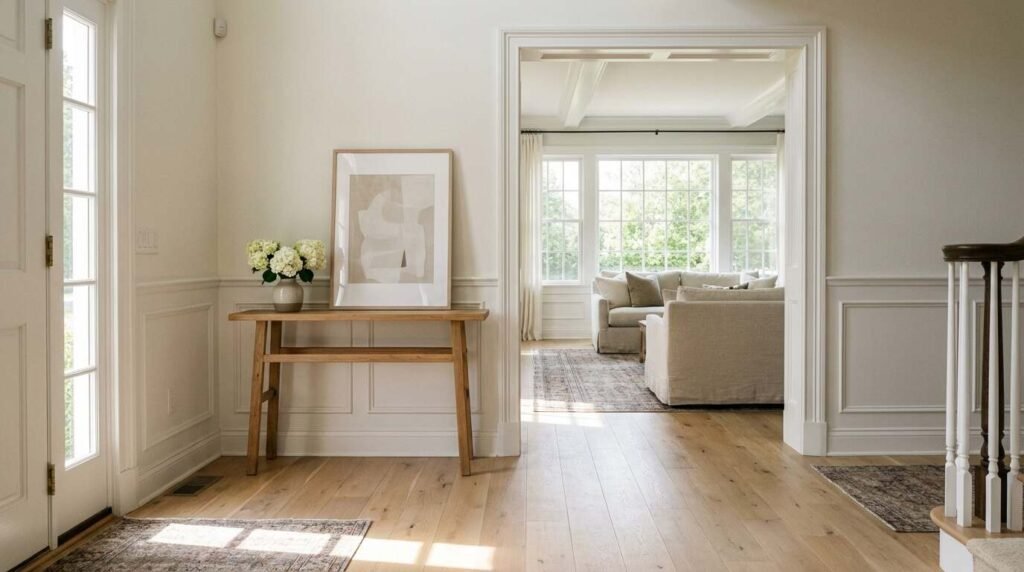
The awkward entry configurations common in Port Jefferson Station and Centereach-area housing stock — where the front door opens directly onto a living room without a defined entry transition — present their own issue. Buyers need a micro-moment of spatial adjustment between exterior and interior. Without it, the house can feel like it lacks a threshold. A small rug, a defined console, a lighting fixture that marks the entry zone — these create a psychological transition that buyers need and rarely consciously identify but definitely feel when it’s absent.
What the Numbers Look Like
The NAR’s 2025 Profile of Home Staging found that nearly one in three agents reported staging increased the dollar value offered by 1% to 10%. On a $750,000 North Shore listing — a reasonable midrange for this area — a 2% improvement in offer price is $15,000. The top of that range, 10%, is $75,000. The median cost of professional staging cited by NAR is $1,500. The math is not complicated.
The 2023 NAR Staging report found that 48% of sellers’ agents reported staging reduced time on market — and in a market like the North Shore’s, where days on market has been lengthening, that compression matters as much as price. A home that sits for 90 days acquires market stigma. Buyers start asking what’s wrong with it. A staged home that closes in 30 days never develops that stigma.
The Real Estate Staging Association’s data shows professionally staged homes sell 73% faster on average than unstaged homes. I have seen this in North Shore listings consistently. The home that shows well — that presents correctly from the threshold — does not linger. It moves.
The Hierarchy of What to Stage
Sellers with limited budgets should prioritize in this order:
1. The first sightline from the front door. This is non-negotiable. Whatever the buyer sees in the first eight seconds is the emotional frame for the entire showing. If this costs you $200 and an afternoon, spend it.
2. The living room. NAR data consistently shows this is the most important room to stage for buyers. 37% of buyers’ agents in the 2025 NAR report cited the living room as the most impactful room. This is where buyers imagine their daily life.
3. The primary bedroom. 34% of buyers’ agents cite this as the second most important room. Clean, calm, and generous: white or neutral bedding, uncluttered nightstands, nothing personal on the dresser.
4. The kitchen. Especially in mid-century North Shore homes where kitchens can be compact, the staging task is about maximizing perceived functionality. Clear the counters — all of them. Leave one coffee maker. The goal is to suggest that the kitchen is larger and more capable than its square footage suggests.
The Honest Assessment Your Agent Owes You
Before any stager sets foot in your home, someone needs to walk through the front door and tell you the truth about what they smell, what they see in the first eight seconds, and where the buyer’s eye goes and stops. This is a service your listing agent should provide without being asked. If they haven’t offered it, ask for it explicitly.
The North Shore market rewards sellers who do this work. The listings that move quickly and cleanly are not always the largest or the most recently renovated. They are the listings that present correctly — that give buyers an emotional yes before the buyers know they’ve decided.
At Maison Pawli, I walk every listing before we talk price. I want to know what the house smells like, what I see from the door, and where the first problem is. Because the buyers will notice. And they will price their offer accordingly.
Related: Salt, Spray, and Staging: Beating Coastal Wear and Tear Before You List — for coastal North Shore sellers preparing to list.
Real estate markets change. For current listings and market data, contact Pawli at Maison Pawli.
This is for informational purposes only — consult a licensed attorney or financial advisor for your specific situation.
You Might Also Like
- Salt, Spray, and Staging: Beating Coastal Wear and Tear Before You List
- Selling History: How to Price and Market North Shore Pre-War Details
- The Assessed Value Is Not the Market Value: How Long Island’s Property Tax Grievance Process Can Reframe What a Seller Asks
Sources
- Spangenberg, Crowley & Henderson, “Improving the Store Environment: Do Olfactory Cues Affect Evaluations and Behaviors?” Journal of Marketing 60 (1996): 67–80: https://journals.sagepub.com/doi/10.1177/002224299606000205
- NAR, 2025 Profile of Home Staging: https://www.nar.realtor/newsroom/nar-report-reveals-home-staging-boosts-sale-prices-and-reduces-time-on-market
- NAR, 2023 Profile of Home Staging: https://www.nar.realtor/sites/default/files/documents/2023-profile-of-home-staging-03-30-2023.pdf
- Real Estate Staging Association (RESA) staging impact data: https://ingvildbrown.com/blog/the-power-of-home-staging-how-it-pays-off-for-sellers
- Roger Ulrich, environmental psychology research overview: https://www.ncbi.nlm.nih.gov/pmc/articles/PMC1474924/
You Might Also Like: For a complete overview of everything involved in selling on the North Shore — pricing, staging, legal obligations, and closing — see The North Shore Seller’s Guide.