The Stucco Mirage: How a Single Developer Imported Spanish Mission Architecture to the South Shore in 1926 and Created a Block That Still Defies Its Surroundings
You could drive past it twenty times and not register what you were seeing.
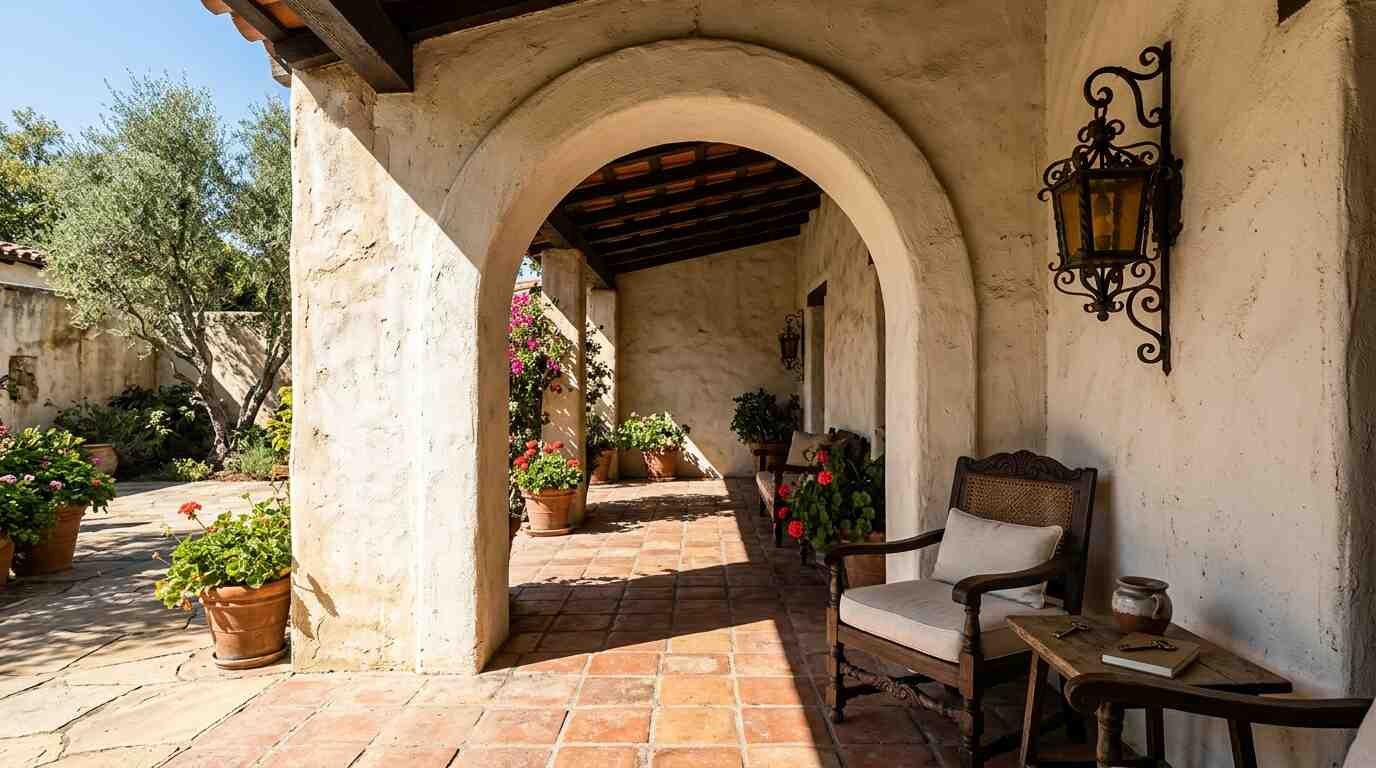
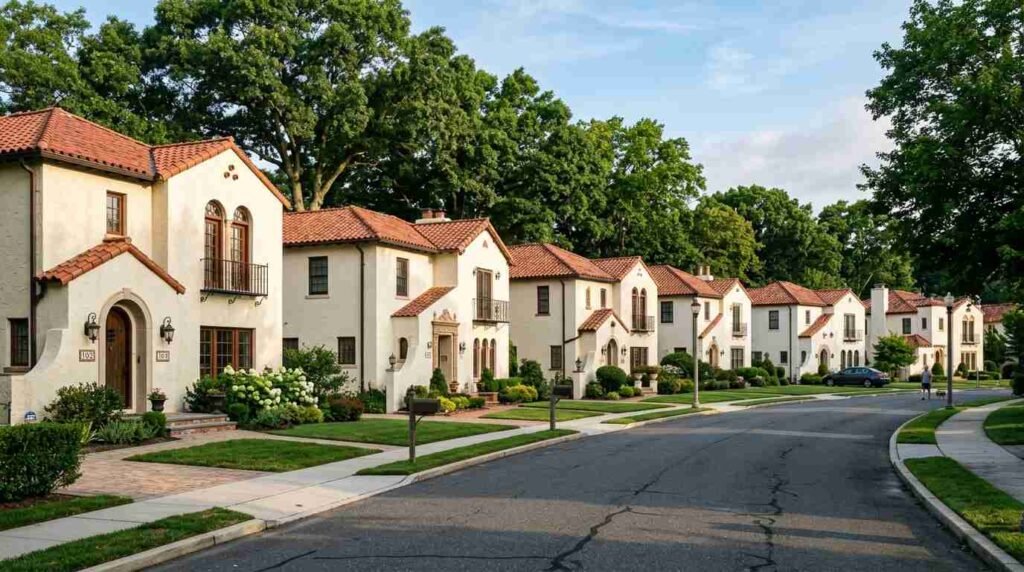
The houses on this block in Bay Shore don’t announce themselves as anomalies. They are residential buildings on a residential street, and the human eye is very good at normalizing what it encounters repeatedly. But if you slow down — if something about the roofline catches the light differently than it should, or if the shadow under an arched opening falls at an angle that doesn’t match what’s across the street — you start to see it. The cream stucco. The red clay tile, unbroken across eight consecutive properties. The wrought-iron grillework at the windows. The way the facades address the street through loggias rather than front doors.
This block is a minor Long Island mystery: eight houses built between 1925 and 1928 that share a complete architectural vocabulary — Spanish Colonial Revival, unmistakably — that has no predecessor or successor within fifteen miles in any direction, and that was the creation of a single developer’s singular, poorly documented obsession with Addison Mizner’s Palm Beach.
Palm Beach to the South Shore
The Florida land boom of the early 1920s was, among other things, a stylistic export operation. Addison Mizner — the architect, socialite, and master salesman who gave Palm Beach its architectural identity — created a version of Spanish Colonial Revival that was simultaneously historically grounded and completely invented: loggia arcades, Moorish tilework, rough stucco surfaces, coquina stone details, bougainvillea climbing white walls in the subtropical light.
Mizner’s style worked because it told a coherent story about leisure, warmth, and Mediterranean ease at a moment when the American professional class was newly mobile and newly aspirational. It traveled. It appeared in Palm Beach and Coral Gables and Boca Raton, and then — in diluted, adapted forms — it began appearing in speculative residential developments far from Florida, wherever a developer had paid attention and had the nerve to try.
The developer responsible for the Bay Shore block — named in Suffolk County deed records from the 1924–1928 period — was not Mizner, and the block was not a licensed reproduction of anything Mizner built. What it represents is the secondary dissemination of a style: a developer who had seen the Palm Beach product, or seen photographs of it, or encountered it through the real estate advertising that saturated New York newspapers during the Florida boom, and who decided that this aesthetic — translated to a Long Island lot pattern and a New York climate — could be made to sell to a specific kind of buyer.
The Block’s Architectural Logic
The Bay Shore Spanish Colonial Revival block is not a facsimile of anything built in Florida. It is an adaptation — and the intelligence of the adaptation is worth examining, because it reveals how the developer and the architect he hired understood both their source material and their market.
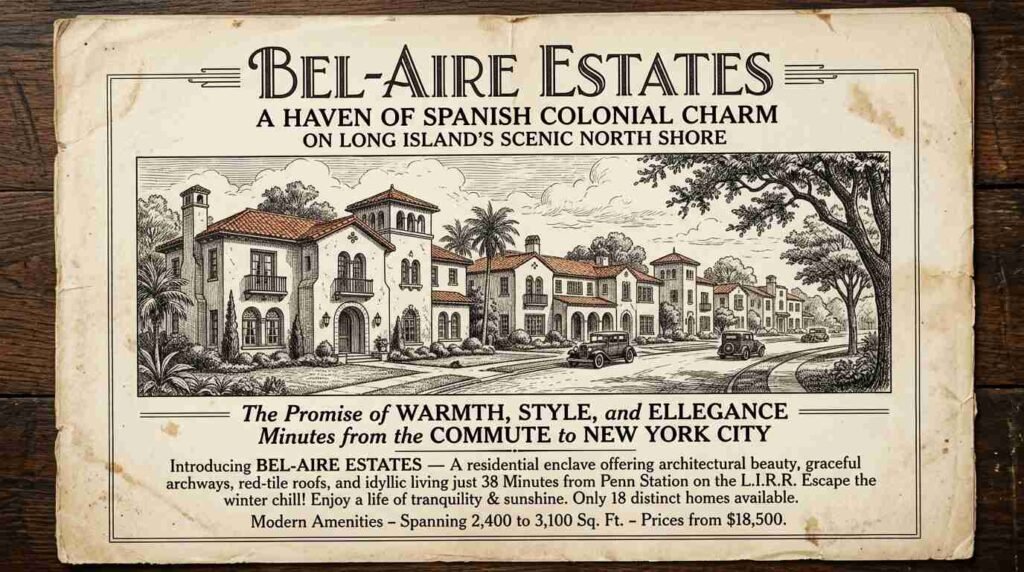
Mizner’s Via Mizner arcade in Palm Beach created a pedestrian commercial street with continuous arcaded storefronts — an explicitly Mediterranean urban form transplanted to a resort town. The Bay Shore developer took the arcade logic and redistributed it across individual residential lots, giving each house its own loggia rather than creating a continuous arcade. The result is architecturally coherent across the block without requiring shared-wall construction. Each house is independent. Each house also belongs, visually, to the group.
The specific architectural elements that have survived across most of the eight houses include the red clay tile roofing — low-pitched, with wide overhanging eaves that create a silhouette that reads as decisively non-northeastern. Tile roofing in a Long Island context in 1926 was a statement. It required specific structural support and regular maintenance that standard asphalt shingles did not, and it told the buyer, before they had crossed the threshold, that this was a house built to a different specification.
The cream stucco exterior is applied over wood-frame construction in the standard Long Island manner. The stucco surface has been refreshed by successive owners — some houses have gone slightly yellow, a few have been painted in off-white rather than true cream — but the texture and material remain consistent enough across the block that the visual unity holds.
The arched loggia openings are the defining element, and the one most vulnerable to mid-century alteration. Of the eight original houses, most retain their arched openings in some form; several have had the arches infilled with glass or screen as homeowners enclosed the loggia for year-round use. The infills are, architecturally, a loss — the loggia’s function as an intermediate zone between interior and exterior is partly what the design depends on. But the alterations are survivable. The arch is still there. The intention reads.
Who Was Supposed to Live Here
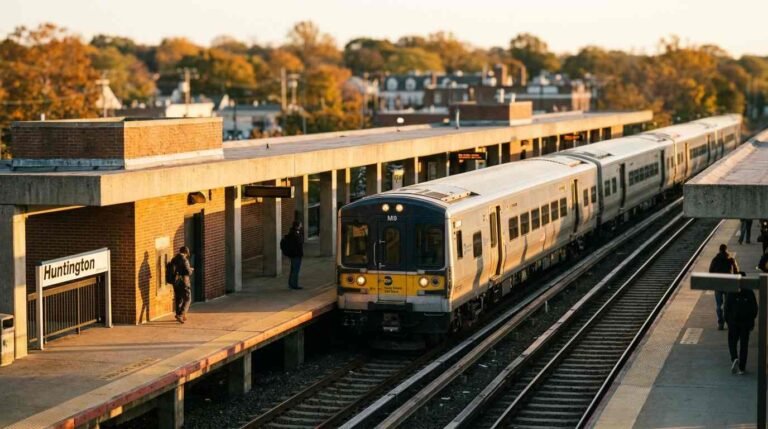
The marketing of the Bay Shore Spanish Colonial Revival block in contemporaneous Long Island real estate advertising positioned the development explicitly as commuter housing for the professional class. The Long Island Rail Road connection from Bay Shore to Manhattan Penn Station was the product’s underlying logic. The houses were sized and priced for families of moderate professional income — not the Gold Coast estates being built simultaneously for industrialists on the North Shore, but a comfortable middle register that included a certain amount of architectural ambition as part of the value proposition.
The timing was precise and precarious. The Florida land boom collapsed in 1926, partly under the weight of its own speculation and partly after a series of devastating hurricanes revealed the infrastructural inadequacy of what had been built so quickly. The Bay Shore block was completed just as the Florida market was imploding. The developer was selling Spanish Colonial Revival houses in Long Island in the same months that Florida Spanish Colonial Revival properties were going to foreclosure by the thousands.
This may explain why the Bay Shore block remains unique. Whatever plans existed for expanding the development — for replicating the concept along adjacent streets, for turning a single block into a neighborhood — did not materialize. One block is what was built. One block is what survived.
The Buyers Who Came
The original purchasers of the Bay Shore houses, as documented in Suffolk County deed records, were drawn from the professional class the developer had targeted: lawyers, physicians, insurance men, a newspaper editor. The commute to Manhattan was the practical argument. The architecture was something else — a signal of a certain kind of worldliness, or of a taste that aspired beyond the standard colonial.
What is striking, from a contemporary real estate perspective, is how stable the block has been. The houses have traded hands regularly — they are not historic monuments, they are lived-in family homes — but the turnovers have generally involved buyers who understood what they were buying and wanted it. The Spanish Colonial Revival identity of the block has functioned as a self-selecting filter. Buyers who want a Cape Cod buy a Cape Cod. Buyers who slow down on this street and wonder about the arches and the tile — those are the buyers who end up owning here.
This is a pattern I recognize from North Shore neighborhoods with strong architectural identity — from certain streets in Cold Spring Harbor, from blocks in Port Jefferson Village, from the stretches of Old Post Road where the setbacks and the tree canopy and the house proportions create a coherent visual environment that registers on the right kind of buyer as something worth paying for. The architectural coherence is not separable from the real estate value. It is the real estate value.
What the Block Argues For
The Spanish Colonial Revival block in Bay Shore is not a major work of American architecture. It was a speculative residential development, built to sell, designed by an architect whose name has not yet been recovered from the county records. It borrowed its aesthetic wholesale from a style that had already been borrowed wholesale from the Mediterranean world. It is, in the most precise sense, a copy of a copy.
And it is also, one hundred years later, genuinely beautiful on a morning when the light comes at the right angle off the Bay and the cream stucco and the red tile do the thing they were designed to do — which is to make the street feel like somewhere else, somewhere warm, somewhere that the constraints of the Long Island grid have briefly relaxed.
That is not nothing. The 1920s speculative real estate market was not, on the whole, good for the Long Island landscape. The period produced blocks of identical housing that have aged badly, neighborhoods with no coherent identity, streetscapes that have nothing to say about where they are. The Bay Shore block is an exception — and the exception matters not because it proves a rule but because it demonstrates that the speculative market, at its best, was capable of ambition.
Someone in 1925 or 1926 decided to build something that didn’t have to exist. A developer who could have built eight Colonials built eight Spanish Colonial Revivals instead. The choice was probably not only aesthetic — it was certainly a marketing decision, a speculation about what a certain buyer would pay for — but the result is a block that has survived its original purpose and become something the neighborhood didn’t know it needed.
When I drive it now, which I do occasionally when my work takes me to the South Shore, I think about what it would have meant to buy one of those houses in 1927, six months before the Florida market collapsed and took the style’s cultural cachet with it. You would have had the block to yourself — the only cluster of Spanish Colonial Revival on Long Island, before it became a relic and then a curiosity and then, eventually, a piece of history worth coming back to.
Some things are worth slowing down for.
You Might Also Like
- Matinecock’s Invisible Borders: How a Quaker Hamlet Kept Its Character While Everything Around It Changed
- The Covenant in the Deed: How Restrictive Covenants Shaped Long Island Neighborhoods — and What Buyers Find There Today
- The Cold Spring Harbor Phoenix: Buying and Saving Gold Coast Ruins
Sources
- Suffolk County Clerk’s Office, deed records 1924–1928: suffolkcountyny.gov
- Town of Islip Historic Preservation Commission, survey files: islipny.gov
- Addison Mizner Foundation archives: addison-mizner.org
- Smithtown Library Long Island Collection, historical real estate advertising: smithtownlibrary.org