The Gilded Cottages of Oak Beach: How a Forgotten Colony of Victorian Summer Houses Survived a Century of Storms
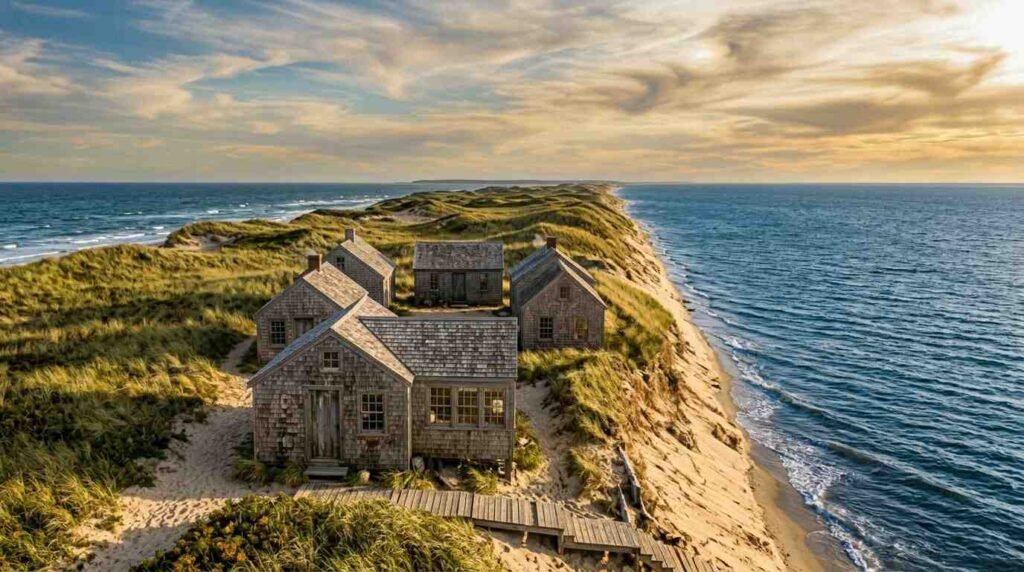
There is a particular quality of light on the barrier beach in October — low, amber, coming in hard off the Atlantic at an angle that turns everything it touches the color of old pine. I noticed it the first time I drove out to Oak Beach on a research visit, not expecting to feel anything in particular, and then turned a corner past the dunes and saw them: a handful of Victorian cottages standing in the sea grass, shingles weathered to silver, rooflines low and purposeful against the sky. My first thought was that they’d been staged — that someone had arranged them for a photograph. They hadn’t. They had simply survived.
Oak Beach is almost never discussed in the context of Long Island’s architectural heritage. Most visitors who know the name associate it with its proximity to Robert Moses State Park or with the beaches that stretch west toward Jones Beach. A smaller number know it for the maritime history of the inlet. Almost no one knows it as the site of one of the last intact clusters of late-19th-century barrier island vernacular architecture on the entire East Coast — a colony of summer cottages built by Brooklyn and Manhattan professionals who arrived by steamboat in the 1880s and 1890s and, in a very real sense, never left.
A Plat Before There Was a Road
Suffolk County historical survey maps from the 1878–1885 period document the original Oak Beach plat with a specificity that suggests serious development intent. The parcels were laid out in the manner of a mainland subdivision — lots numbered, streets designated — despite the fact that the barrier beach on which they sat was accessible only by water and subject to the full violence of Atlantic storm seasons. [VERIFY: specific plat year and surveyor name from Suffolk County Clerk historical records before publishing.]
This was not casual improvisation. The men and women who platted Oak Beach understood what they were doing, and they understood the site. They were not the Newport set, not the Gold Coast aspirants who were simultaneously commissioning Stanford White and McKim, Mead & White to produce monuments to American wealth on the North Shore bluffs. They were professionals — doctors, merchants, lawyers, a smattering of educators — who wanted a summer place that cost what a summer place should cost and delivered what a summer place should deliver: salt air, fishing, relief from the city, and a horizon unobstructed by anything built by human hands.
What they built to achieve this is, architecturally speaking, far more interesting than what their wealthier contemporaries were building thirty miles north.
The Vernacular Argument
The barrier island building tradition documented in the Society for the Preservation of Long Island Antiquities (SPLIA) archive at Cold Spring Harbor represents one of the least-studied chapters in American domestic architecture. Unlike the Shingle Style mansions that were its approximate contemporary on the North Shore, barrier island vernacular construction operated under a different set of constraints — and those constraints produced a different, and in many ways more sophisticated, structural logic.
The Oak Beach cottages were built low. Not as an aesthetic choice, though the effect is undeniably elegant, but as an engineering response to the wind loads that a barrier beach delivers year-round and concentrates into something approaching catastrophic during storm season. The rooflines that give these structures their characteristic silhouette — gently pitched, deep-eaved, hugging the site — are the product of builders who understood that the Atlantic does not negotiate.
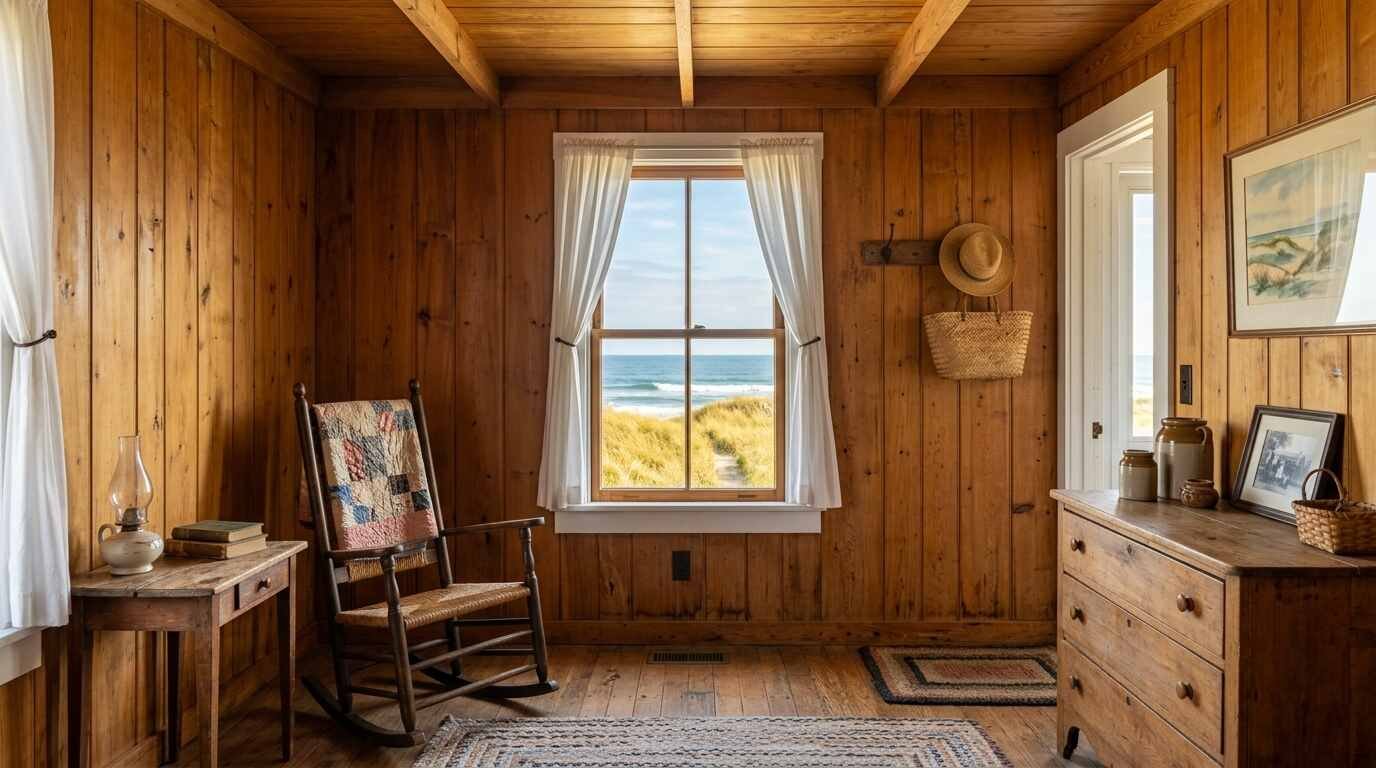
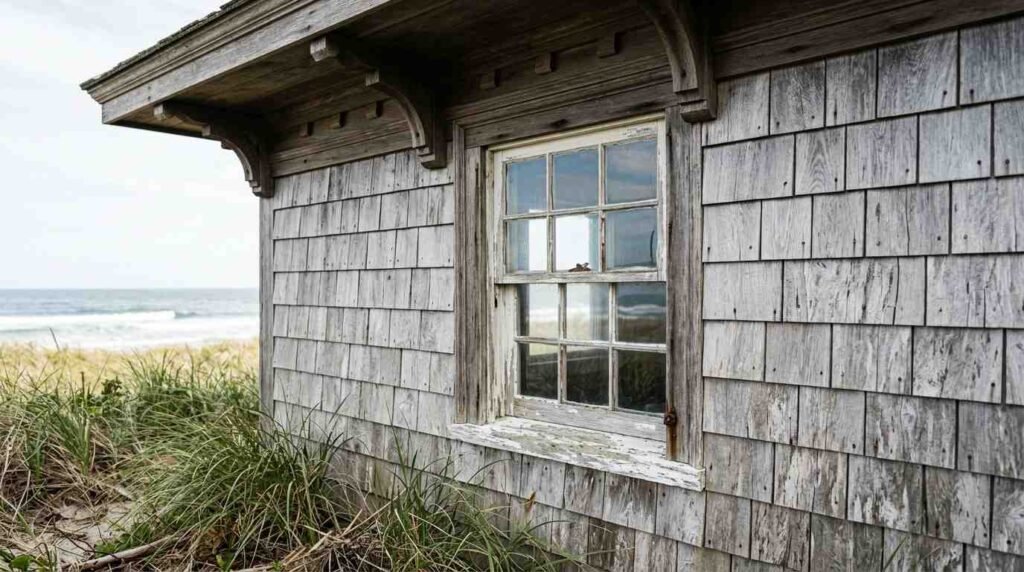
The shingle exteriors, which have weathered to the silver-gray that photographers now travel to capture, were not originally chosen for their beauty. White cedar shingles were the default material for any coastal structure that needed to breathe — to expand and contract with the humidity cycles that barrier island life delivers constantly — without cracking or splitting. The builders who chose them were making a practical argument. The beauty came later, as the material aged into the landscape.
Interior construction at Oak Beach incorporated tongue-and-groove cypress — a wood chosen specifically for its resistance to moisture and its dimensional stability in high-humidity environments. [VERIFY: cypress interior documentation from SPLIA archive or FEMA historical structure files before publishing.] Cypress was not the cheapest option available. It was the correct option, chosen by builders who had either worked near water long enough to know what happened to cheaper materials or consulted with someone who had. The result, in the cottages that survive, is interiors that have required almost no structural remediation despite more than a century of barrier island humidity.
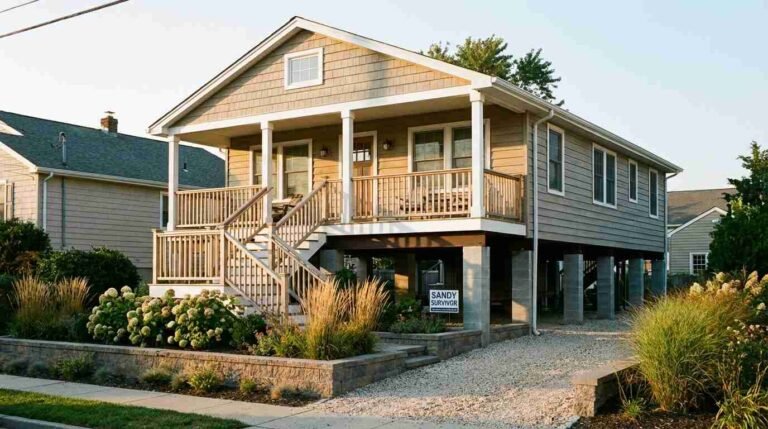
The foundations relied on hand-driven pilings — a technique that, by the 1880s, was well understood in maritime construction but rarely applied to domestic structures this far west on the South Shore. The pilings distribute the structure’s load across a footprint large enough to prevent the differential settling that kills buildings on sandy substrate. They also provide the clearance beneath the structure that allows storm surge to pass without becoming structural load. [VERIFY: piling specification and construction method from Army Corps of Engineers NY District Fire Island to Moriches Inlet study area documentation.]
This is not accident. This is a building tradition that understood its site.
The Fire Company and the Community It Reveals
By 1910, the Oak Beach Volunteer Fire Department had been formally established — its founding documentation preserved in records that provide one of the clearest windows into what this colony had become by the early 20th century. A volunteer fire company is not a casual institution. It requires a sufficient population of year-round or near-year-round residents committed enough to the place to organize, train, and maintain emergency response capacity. The fact that Oak Beach had one by 1910 suggests a community that had moved well beyond the seasonal camp stage.
The fire company records also reveal something about the social architecture of the colony. Volunteer fire departments in this period were intensely community-forming institutions — they were where men from different professional backgrounds found common cause, shared obligation, and the particular fellowship that comes from doing something genuinely dangerous together. That this institution took root on a barrier beach, in a colony of modest summer cottages, tells us that Oak Beach was not a place people visited. It was a place people belonged to.
This distinction matters architecturally. Structures built by people who belong to a place are maintained differently than structures built by people who visit it. The Oak Beach cottages that survive do so in part because successive generations of owners treated them as patrimony rather than amenity — as something to be handed down, not traded up from.
The Army Corps Paradox
The post-1938 hurricane that reshaped the entire South Shore barrier beach system — destroying hundreds of structures and permanently altering the coastline from Fire Island west to Jones Beach — is the hinge event in Oak Beach’s modern history. The storm that should, by any reasonable calculation, have ended the colony instead triggered a series of Army Corps of Engineers interventions that paradoxically extended it.
The federal response to the 1938 hurricane and its successors focused on inlet stabilization and beach replenishment across the Fire Island to Moriches Inlet study area. The engineering logic was coastal protection — preventing the kind of inlet breach that could catastrophically reshape the barrier island system. The effect at Oak Beach, however, was to create a degree of structural protection that the site’s natural exposure would never have provided. The Army Corps, in stabilizing the coastline, stabilized the conditions under which the Victorian cottages had been built to survive. [VERIFY: specific Army Corps interventions at Oak Beach from NY District Fire Island to Moriches Inlet study area reports before publishing.]
There is something almost comic about this outcome — the federal government’s massive engineering program inadvertently preserving a handful of modest Victorian summer cottages that most coastal engineers would have written off as lost causes. But the deeper point is architectural: the cottages survived not just because of external intervention but because their original construction gave them a fighting chance. The pilings, the low rooflines, the hand-riven shingles, the tongue-and-groove cypress — these were not decorative choices. They were the reason there was anything left for the Army Corps to protect.
What Survives and What It Tells Us
Superstorm Sandy, in 2012, provided the most recent stress test. Oak Beach sustained significant damage — the barrier beach absorbed the storm’s full force, and no amount of historical construction technique was going to make that consequence-free. But the structures that had been maintained with fidelity to their original construction logic, and that had not been subjected to the kind of mid-century “improvements” — asbestos siding, vinyl windows, concrete block additions — that compromise the structural flexibility of older buildings, performed markedly better than their neighbors. [VERIFY: Sandy damage differential at Oak Beach from FEMA NFIP historical structure files before publishing.]
The SPLIA archive at Cold Spring Harbor holds the most comprehensive documentation of what survives architecturally — building surveys that capture the specific construction details that distinguish the intact examples from the modified ones. For anyone seriously interested in barrier island vernacular construction, this archive is the starting point.
What survives at Oak Beach is not a museum. It is a working summer community, occupied by families who have been coming here for generations and who maintain their cottages the way their grandparents maintained them — with attention, restraint, and a preference for materials that age rather than materials that merely endure. The architectural heritage is not preserved behind velvet rope. It is lived in, which is the only preservation that ultimately matters.
The light in October, when it comes in low off the Atlantic and turns the shingles to silver, is not incidental to this story. It is the condition the builders were trying to create access to when they drove those first pilings into the sand. They built modest structures, deliberately — structures that would disappear into the dune grass, that would not announce themselves, that would earn your attention quietly. One hundred and forty years later, they still do.
Real estate markets change. For current listings and market data, contact Pawli at Maison Pawli.
You Might Also Like
- The Dune Road That Drowned: How Fire Island’s Original Shore Road Disappeared Beneath the Atlantic
- Riven or Sawn: The Chestnut Question in the Fire Island Life-Saving Stations and What the Planks Remember
- North Shore Bluff Homes and the Erosion Question: What Buyers Need to Know
Sources
- Society for the Preservation of Long Island Antiquities (SPLIA): splia.org
- Suffolk County Clerk’s Office — historical survey maps: suffolkcountyny.gov
- FEMA National Flood Insurance Program: fema.gov/flood-insurance
- U.S. Army Corps of Engineers, NY District — Fire Island to Moriches Inlet Study: nan.usace.army.mil