Cold Spring Harbor’s Fish Hatchery and the Block It Built: How a Federal Facility Shaped a Village’s Social Geography for 140 Years
Cold Spring Harbor has two faces, and they have been looking past each other for a long time. One face belongs to the summer people — the estate owners, the yacht club families, the weekenders who discovered the harbor’s particular beauty and built accordingly. The other belongs to the people who were here all year: the tradespeople, the teachers, the laboratory workers, and, for the better part of a century, the employees of the United States Fish Commission’s Cold Spring Harbor hatchery, which opened in 1883 and operated as a federal facility until 1982. That permanent working community — anchored by the hatchery’s stable, year-round employment — is the face of Cold Spring Harbor that most of its real estate marketing carefully omits. It is also, in Jane Jacobs’s terms, the face that made the village function.
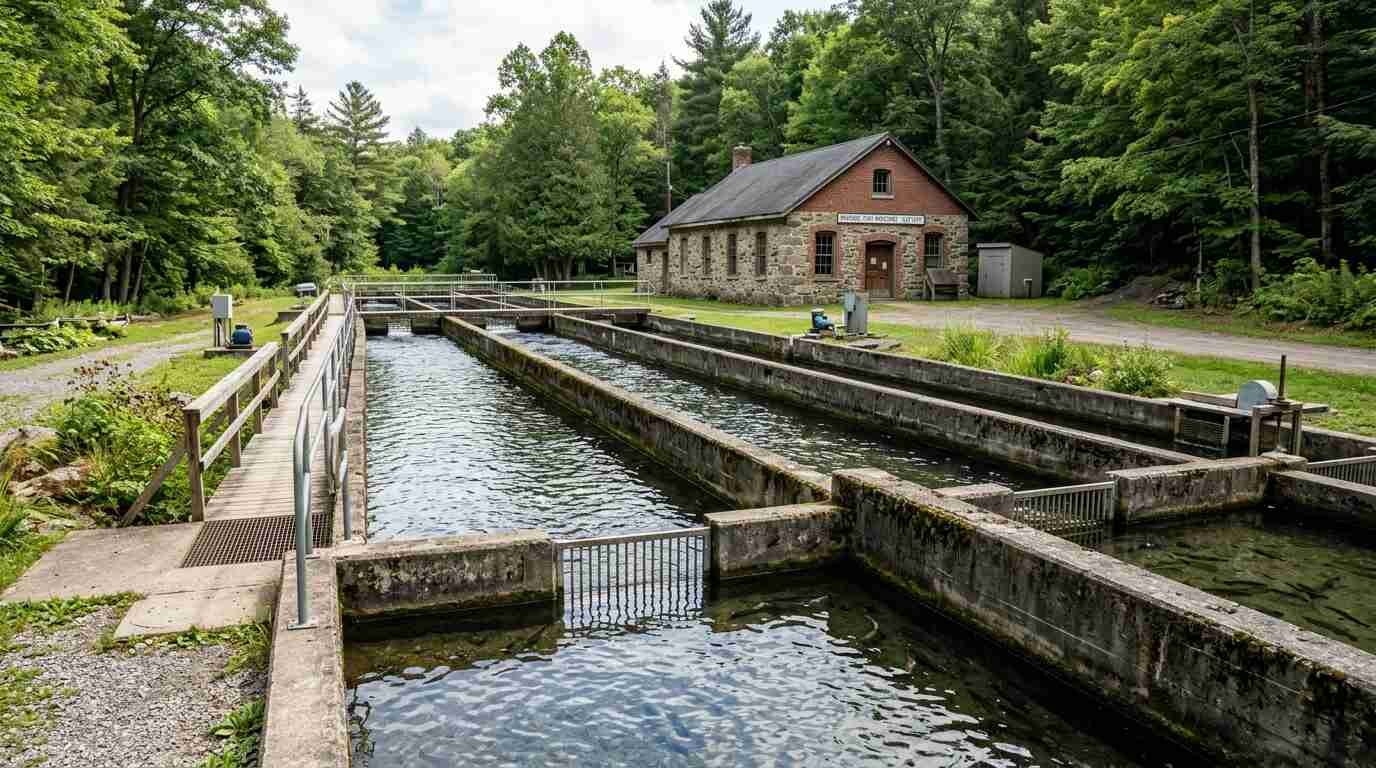
The hatchery is still there. It is now the Cold Spring Harbor Fish Hatchery and Aquarium, a nonprofit educational institution operating on the same site, stocking the same species — brook trout, brown trout, rainbow trout — into the same Long Island waterways it has served since the nineteenth century. It is the oldest operating fish hatchery in New York State. Its institutional records span the full sweep of its history, from the Bureau of Fisheries operational reports now held at the National Archives at College Park (Record Group 22) to the contemporary nonprofit’s own archive. That continuity of record is itself a kind of argument: some institutions outlast the circumstances that created them because they embed themselves in the life of a place deeply enough that the place cannot easily imagine being without them.
What a Federal Hatchery Actually Meant for a Neighborhood
To understand what the hatchery did for Cold Spring Harbor’s social geography, it helps to understand what federal employment meant in a North Shore village in the late nineteenth and early twentieth century. The estate economy that dominated communities like Cold Spring Harbor, Oyster Bay, and Lloyd Neck was inherently seasonal and hierarchical: wealth arrived in summer, departed in fall, and left behind a reduced, economically dependent permanent population whose year-round employment was often tied to maintaining properties for owners who weren’t there. This is not a stable community structure. It produces what Jacobs would recognize as a one-dimensional neighborhood — a place that exists to serve a single function for a single class of people, with none of the economic diversity that sustains genuine urban life.
The federal hatchery interrupted this dynamic. Its employees — hatchery superintendents, fish culturists, laborers responsible for the ponds, maintenance staff — were federal workers with federal salaries, federal job security, and no economic dependence on the estate families whose summer world surrounded them. USFWS historical publications document the facility’s staffing over its federal period: a small but stable workforce, typically between ten and twenty employees in any given decade, who lived year-round in and around the village and whose presence contributed to the kind of permanent, non-seasonal community life that Cold Spring Harbor’s estate economy alone could not generate.
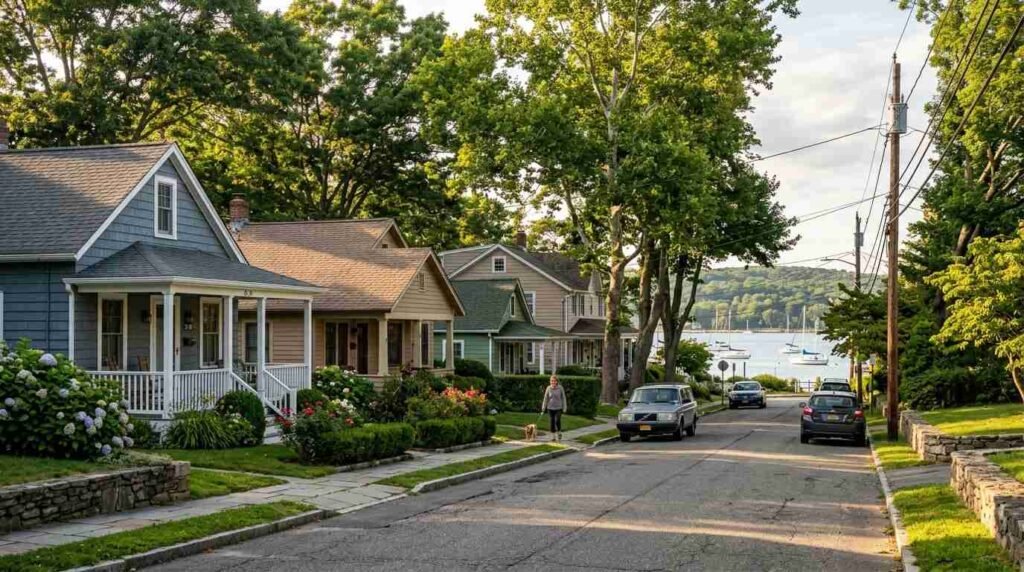
The worker housing that developed around the hatchery reflected this stability. Properties along Route 25A and the roads immediately adjacent to the hatchery site — now the Cold Spring Harbor Fish Hatchery and Aquarium on Fish Hatchery Road — show a building pattern distinct from both the estate architecture to the east and the later commuter-era development to the west. Modest, well-built, owner-occupied houses on modest lots, constructed across several decades of the early and mid-twentieth century: the physical record of a working community that was putting down roots rather than passing through. The Huntington Town Historian’s office and the Cold Spring Harbor Library’s local history collection hold the deed and building records that document this pattern in detail.
The 1982 Transition and What It Changed
When the federal government transferred the hatchery to nonprofit management in 1982, the practical community consequences were real, even if they unfolded gradually. Federal employment ended; the institution continued, but its workforce shrank and its economic relationship to the surrounding neighborhood changed. The stable federal salaries that had anchored the hatchery community for nearly a century were replaced by the more variable compensation structure of nonprofit work. Families whose presence in Cold Spring Harbor had been organized around that federal employment made different decisions about staying or going.
This is not a story of sudden displacement — the transition was managed carefully and the institution survived intact, which is the primary thing. But it is a story about what happens when an anchor institution changes its economic relationship to its surrounding community. The working-class neighborhood layer that the hatchery’s federal period had built did not disappear overnight. It thinned. The properties that hatchery families had owned were sold over the following decades into a market that was moving relentlessly toward higher values driven by Cold Spring Harbor’s proximity to New York City, its school district reputation, and the broader North Shore aesthetic that the real estate market had decided to price aggressively. The people who moved in were not hatchery families. They were, in most cases, exactly the kind of buyers who come to the North Shore for its beauty and its schools, who have no connection to the institutional history that created the neighborhood they’re purchasing, and who in many cases don’t know the hatchery is there until they see the sign on Route 25A.
The hatchery itself remains a Jacobs-ian anchor in the best sense: a place that generates daily pedestrian activity — school groups, families, local residents walking the grounds — that is open to the public, that creates genuine mixed-purpose presence in a neighborhood that might otherwise be purely residential. The Cold Spring Harbor Fish Hatchery and Aquarium now hosts educational programming and community events that continue the institution’s function as a gathering place even as its workforce community has changed. That continuity matters. Neighborhoods without anchors drift; Cold Spring Harbor has held its character partly because the hatchery has remained a reason to show up.
Two Communities, One Village
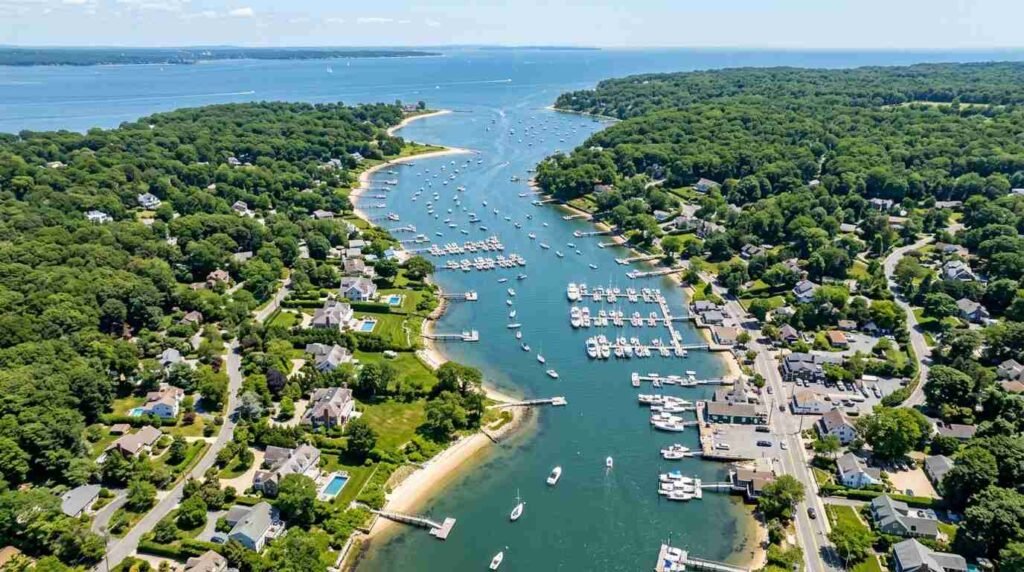
The tension between permanent working residents and seasonal wealthy ones that the hatchery history surfaces is not merely historical. It is present in Cold Spring Harbor today, in the particular way that all Long Island North Shore villages where that tension has never been resolved carry it — as a kind of social sediment that shapes neighborhood relationships in ways that rarely get named directly.
Cold Spring Harbor’s school district — the Cold Spring Harbor Central School District — has one of the strongest reputations on the North Shore, which drives significant buyer demand and keeps prices high across the village and its environs. The Cold Spring Harbor Laboratory, established in 1890 and now one of the world’s leading research institutions, provides a second anchor of a different kind: not the working-class stability of the hatchery, but the intellectual prestige and economic activity of a major research organization. Together, the laboratory and the hatchery represent two centuries of institutional life that have given Cold Spring Harbor a depth of community character most comparably priced North Shore villages lack.
For buyers, this translates into something specific and worth naming: Cold Spring Harbor is not a one-dimensional community. It has layers — the estate history, the laboratory history, the hatchery history, the commuter history — and those layers produce a neighborhood with more social complexity and more genuine community activity than its price point and its reputation for exclusivity might suggest. The hatchery grounds are public; anyone can walk them. The laboratory hosts public lectures. The village library and the various historical organizations maintain an active calendar. This is not the sealed, self-referential world of some Gold Coast communities. It is a place that has kept some of its civic porousness even as its real estate market has moved steadily upward.
I’ve worked with buyers who came to Cold Spring Harbor for the schools and the aesthetics and discovered, after a year or two, that what they valued most was something harder to quantify — the sense that the village had a history that preceded them and would continue after them, that they were joining something rather than simply purchasing a property. The hatchery is part of that. So is the laboratory. So are the deed records and the building histories and the families whose names appear across multiple generations in the town historian’s files. That accumulated presence is what the price is partly buying, even when the listing doesn’t say so.
If Cold Spring Harbor is on your list — or if you’re working through the broader Cold Spring Harbor–Lloyd Neck–Laurel Hollow corridor and want to understand how the communities compare — I’m glad to walk through it at Maison Pawli.
Cold Spring Harbor is one of the communities profiled in my North Shore Long Island Neighborhoods: The Insider’s Guide to Where to Live, where I cover the North Shore neighborhood by neighborhood — schools, commute dynamics, market positioning, and what each community actually feels like to live in.
Real estate markets change. For current listings and market data, contact Pawli at Maison Pawli. This is for informational purposes only — consult a licensed attorney or financial advisor for your specific situation.
You Might Also Like
- North Shore Bluff Homes and the Erosion Question: What Buyers Need to Know
- The Ebonized Cherry Problem: How Tiffany Studios’ Oyster Bay Workshop Finished Furniture to Deceive the Eye
- Building the Moon Buggy in Bethpage
Sources
- Cold Spring Harbor Fish Hatchery and Aquarium institutional archive: cshfha.org
- National Archives at College Park — Record Group 22, Bureau of Fisheries historical records: archives.gov/college-park
- Cold Spring Harbor Library local history collection: cshlibrary.org
- Huntington Town Historian’s Office: huntingtonny.gov
- USFWS historical publications via HathiTrust: hathitrust.org
- Cold Spring Harbor Laboratory history: cshl.edu/about/history
- Cold Spring Harbor Central School District: csh.k12.ny.us
- Jane Jacobs, The Death and Life of Great American Cities (Random House, 1961)
—