
Days on Market Is a Calculated Figure, Not a Raw Fact: What Sellers Need to Know Before Relisting
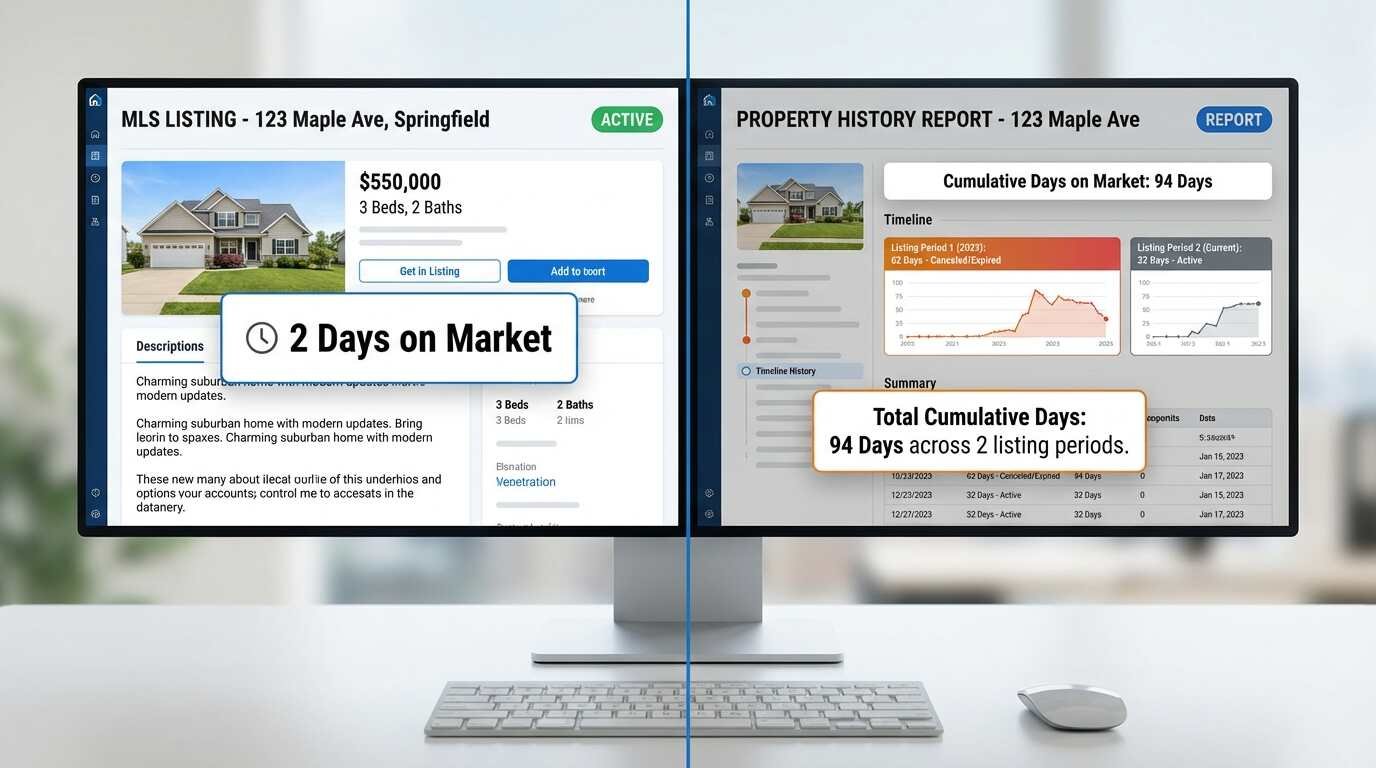
A property sits on the market for 90 days without an acceptable offer. The seller withdraws it, waits the required period under their MLS board’s rules, and relists at a reduced price. The MLS days-on-market counter resets to zero. The listing appears fresh.
The buyer’s agent opens Zillow, pulls the property history, and counts the actual days. The lender’s appraiser does the same — and is required by professional standards to do so. And the seller, who thought the reset had bought them a clean slate, is negotiating against a counterpart who knows exactly how long the property has been looking for a home.

DOM as Data, Not Display
Days on market is a performance metric before it is a marketing presentation. It measures the period between a property’s listing date and its contract date — or, in the case of relisting, the relationship between cumulative market exposure and ultimate sale terms. That relationship is not neutral. Extended market exposure is correlated with below-ask sale prices, and the correlation is documented in professional appraisal literature.
The Uniform Standards of Professional Appraisal Practice (USPAP), 2024-2025 Edition, Standards Rule 1-1, requires appraisers to identify and analyze all factors relevant to value — including market exposure. An appraiser working on a transaction involving a relisted property who fails to account for the property’s full market exposure history is producing an analysis that falls below USPAP’s competency standards. Appraisers know this. They look for cumulative DOM.
MLS Rules Vary — But Data Doesn’t Disappear
Every MLS board maintains specific rules governing when DOM resets. MRED (Midwest Real Estate Data), which serves the Chicago metro, has published reset criteria that require a minimum withdrawal period before a relist generates a clean DOM counter. CRMLS (California Regional MLS) has similar provisions, with documented history of adjustment after member complaints about DOM manipulation through withdrawal and relist cycles.
The NAR MLS Policy Handbook provides guidance but delegates the specific reset criteria to local boards. The result is a patchwork: what constitutes a permissible DOM reset in one market may not qualify in another. Sellers and their agents who relist specifically to reset DOM are operating within the rule in some jurisdictions — but they should understand that the reset affects only the MLS display, not the underlying data that survives in third-party aggregators and appraisal databases.
Zillow, Realtor.com, and Redfin all maintain independent price and listing history records that pull from MLS data at the time of original listing. Withdrawal and relist does not erase those records. Any buyer or buyer’s agent who looks — and the competent ones always look — can reconstruct the full market exposure history within minutes.

What Appraisers Are Required to Do With It
An appraisal produced for a conforming loan must meet Fannie Mae and Freddie Mac guidelines. Both agencies require appraisers to analyze market conditions, including typical marketing times for comparable properties. A property with 90 cumulative days on market in a market where the median DOM is 22 is a data point that belongs in the appraisal — regardless of what the current MLS listing’s DOM counter reads.
The Appraisal Institute has published case study guidance on market exposure in appraisal methodology. The consistent finding is that extended exposure, when adequately documented, can support adjustments to the appraised value — either because the property’s condition, location, or price is out of step with market expectations, or because the eventual sale price reflects the negotiating dynamic of a buyer who knew the property had been sitting.
This is the mechanism most sellers don’t model when they relist. The reset DOM counter affects the visual impression for buyers who don’t investigate. It does not affect the appraised value methodology that determines what the lender will finance.
What to Do Instead
If a property has accumulated significant DOM without a contract, the productive conversation is not about how to reset the counter — it is about why the property hasn’t sold. In my experience, the answer is almost always one of three things: price, condition, or marketing reach.
Price is the most common. Properties that are correctly priced in their micro-market sell. Properties that enter at aspirational pricing and sit accumulate DOM that no relist will erase from the buyer’s awareness. The pricing conversation, not the relist timing conversation, is the one that solves the problem.
Condition issues — deferred maintenance, dated kitchens, structural questions — require a different analysis. Sometimes the condition gap can be addressed before relisting. Sometimes the price needs to reflect it honestly. Staging and cosmetic updates that mask condition issues bring us back to the misrepresentation territory covered separately.
Marketing reach is occasionally the culprit, but less often than sellers hope. A well-priced, well-conditioned property that isn’t selling has a price problem, not a marketing problem. Sophisticated buyers in active markets find every listing.
The seller who understands that DOM is a permanent part of the transaction’s data record — not a counter that resets without consequence — is the seller who makes decisions that hold up under scrutiny.
This post is for informational purposes only and does not constitute legal or financial advice. MLS rules governing DOM vary by board. Consult your listing agent and a real estate attorney for guidance specific to your market.
Sources:
- USPAP 2024-2025 Edition, Standards Rule 1-1: https://www.appraisalfoundation.org/imis/TAF/Standards/Appraisal_Standards/USPAP.aspx
- NAR MLS Policy Handbook: https://www.nar.realtor/mls/mls-rules-and-regulations
- Appraisal Institute market exposure guidance: https://www.appraisalinstitute.org
- MRED MLS rules: https://www.mredllc.com/resources/mls-rules-and-regulations/
- CRMLS rules: https://www.crmls.org/about/mls-rules/
You Might Also Like: For a complete overview of everything involved in selling on the North Shore — pricing, staging, legal obligations, and closing — see The North Shore Seller’s Guide.