
LIRR’s Spring 2026 Service Changes: What Long Island Commuters and Homebuyers Need to Know

There‘s a version of the Long Island commute that people who’ve never done it tend to romanticize. You board at a quiet North Shore station, open a book, watch the light shift over the suburbs, and arrive at Penn Station or Grand Central Madison refreshed rather than depleted. For a lot of the buyers I work with — people genuinely considering the move from the city — the LIRR isn‘t just transportation. It’s a deciding factor. Which is why what’s happening with the railroad right now matters not just to current riders, but to anyone making a real estate decision on this side of the county line.
Several changes are underway. One of them is urgent.

What’s Actually Changing on the LIRR This Spring
Starting May 11, the Long Island Rail Road implemented a new round of schedule adjustments affecting midday weekday service across multiple branches. The changes were driven primarily by ongoing track maintenance and station accessibility upgrades — LIRR President Rob Free noted that they allow the railroad to continue critical infrastructure work while expanding service heading into the busy summer season.
Rush-hour service remains unchanged. What shifted are midday weekday departure times on several branches, with some trains departing earlier than their prior schedules. For the everyday commuter who runs on the peak trains, this may not register. For anyone building a schedule around midday flexibility — remote workers making occasional in-office trips, medical appointments in the city, parents running an irregular pattern — it’s worth double-checking the TrainTime app before assuming the old schedule still holds.
Summer service expansions begin May 18. Starting that date, the 5:13 p.m. train from Penn Station to Speonk will extend to Montauk Monday through Friday throughout the summer, rather than just on Thursdays and Fridays. Midday weekday service east of Ronkonkoma on the Greenport line resumed May 11 as well — meaningful for anyone considering a North Fork property who relies on the LIRR to make the math of city work plus East End living actually function.
Then there’s the larger, more pressing story.
The Strike Threat That Every Long Island Buyer Should Be Watching
As of this week, five unions representing approximately 3,500 LIRR workers — engineers, signalmen, trainmen, machinists, and electrical workers — have threatened to walk off the job on May 16, which would mark the first LIRR strike in more than 30 years. Negotiations are active. The sticking point is narrow: both sides have agreed to raises totaling 9.5% over three years, but remain divided over the fourth year — the LIRR has offered 4.5% with productivity gains, while the unions are seeking 5%.
The gap is small by percentage. The impact of a shutdown would not be. If a strike occurs, LIRR service would be forced to shut down entirely, affecting the nearly 300,000 passengers who depend on the railroad each day. The MTA‘s contingency plan involves free shuttle buses from a limited number of stations — Lakeview, Hicksville, Ronkonkoma, Mineola, and Huntington — connecting riders to the subway system. Riders’ advocates have noted that the contingency plan is thin for the volume of people it would need to absorb.
Negotiations are continuing, with a deadline of May 16. This is an evolving situation — check the MTA’s website and LIRR social accounts for updates as the deadline approaches.
How Transit Accessibility Drives (or Kills) Home Values on Long Island
Proximity to a functioning LIRR station — a station with reliable, frequent service to Penn Station or Grand Central Madison — adds measurable value to a home, and protects that value over time in a way that proximity to a highway or a commercial corridor does not.
Port Jefferson is a case study in this. I’ve written at length about why the village holds value the way it does, and transit is a central thread. The walkable village, the ferry, the LIRR branch terminus — together they create a built-in demand floor. When inventory tightens, Port Jefferson holds. When other markets soften, Port Jefferson holds. Transit is structural.
The same logic applies across the North Shore’s station communities. Huntington, Stony Brook, Smithtown — each has a transit premium baked into its pricing, and that premium is real and persistent. My complete guide to the LIRR commute from Long Island walks through the full picture, including branch-by-branch timing, for anyone doing the math on a specific town.
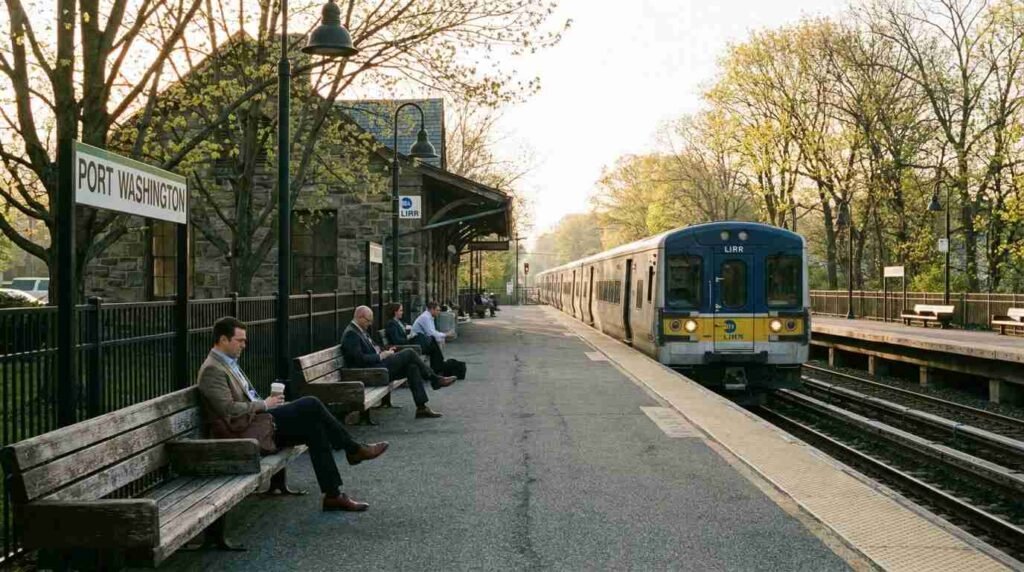
What Smart Buyers Should Ask About Commuter Access Before Going Under Contract
If you are actively searching — or about to start — here is the commuter access checklist I give clients before they go under contract on any property where the LIRR is part of the plan.
First, know which branch serves your target town, and know its frequency. Not all LIRR branches are created equal. The Port Jefferson Branch and the Ronkonkoma Branch serve very different schedules and very different populations. The number of peak trains per hour in each direction matters — and it affects resale.
Second, walk to the station. If the listing says “minutes to the LIRR,” walk it at the hour you’d actually be leaving for work. What Google Maps says at 2pm on a Tuesday is not what a December morning will feel like. The walk conditions, the parking situation, whether the lot has remaining capacity — these are real variables.
Third, consider what a LIRR disruption does to your commute. The strike threat unfolding right now is a useful forcing function for this question. If service were suspended for two weeks, is there a workable backup? Bus to a subway connection is doable from some locations and genuinely punishing from others. Build your contingency into the location decision, not the stress response.
Fourth, if you‘re buying for remote work flexibility, remember that the LIRR’s midday changes this month affect exactly the schedule pattern a remote worker would use for occasional office days. Check the updated timetables — available at mta.info — before assuming the midday option you’re counting on is still there.
Pawli’s Take: Why Train Access Is Still a Top-Three Buyer Priority
Every spring, I hear the same thing from buyers who‘ve been sitting on the fence: “We’re thinking of waiting to see what happens with the market.” What I‘ve learned, after a decade of watching this play out, is that the buyers who wait for certainty tend to end up competing harder for less. The market doesn’t reward patience — it rewards readiness.
Transit uncertainty is different. The LIRR situation this month is worth watching before committing to a station-dependent neighborhood if your timeline is flexible. Not because the railroad is going anywhere — it isn’t — but because a short-term disruption right now, during an active spring market, could affect your relocation timeline more than any interest rate movement would.
If you‘re planning to purchase in a North Shore community where LIRR access is central to your decision, call me before Memorial Day. The strike deadline, the new schedules, the summer service expansion — all of it changes the conversation about which neighborhoods perform best for your specific commuting pattern. These are the details that don’t show up on Zillow, and they’re exactly the kind of thing a local broker is for.
Real estate markets change. This post reflects conditions as of May 8, 2026. For current listings and market data, contact Pawli at Maison Pawli.