
NAR’s Latest Existing Home Sales Data Just Dropped — Here’s What It Means on Long Island
The report dropped yesterday morning, and by noon my phone had already picked up. Three buyers. Two sellers. One attorney who wanted to know if I thought the Northeast numbers were as bad as they looked.
The short answer is: they’re not bad. They’re complicated. And the difference between the national story and the Long Island story is wide enough to matter significantly to anyone making a move this spring.
NAR’s April 2026 Existing-Home Sales report was released May 11, 2026. Here’s what it actually says — and what it means on the ground here.
What the NAR April 2026 Report Actually Says
At the national level, existing-home sales rose 0.2% month-over-month in April to a seasonally adjusted annual rate of 4.02 million. That’s a modest bounce from March’s 3.6% decline, though it left sales essentially flat year-over-year — unchanged from April 2025.
NAR Chief Economist Dr. Lawrence Yun framed it this way: “Despite mixed macroeconomic signals — including a record-high stock market and historically low consumer confidence — home sales were modestly boosted by the continued improvement in housing affordability. Mortgage rates are lower from a year ago, and average income growth is outpacing home price gains.”
The headline numbers from the report:
- Median existing-home price: $417,700 for all housing types — up 0.9% from $414,000 a year ago, marking the 34th consecutive month of year-over-year price increases
- Housing inventory: 1.47 million units at end of April — up 5.8% from March and 1.4% from a year ago
- Months of supply: 4.4 months, up from 4.2 in March and 4.3 a year ago
- Days on market: Median of 32 days, up from 29 days in April 2025
- First-time buyers: 33% of April sales, up from 32% in March
- Cash transactions: 25% of sales, unchanged year-over-year
- 30-year fixed mortgage rate in April (Freddie Mac): 6.33%, up from 6.18% in March but down from 6.73% a year ago
- Housing Affordability Index: 110.6, up from 101.4 a year ago — the highest it’s been in some time
Yun added context on the inventory side, noting: “Inventory still remains tight. Multiple offers, though not as intense as a few years ago, are still occurring. At the same time, days on market are lengthening on average, implying that consumers are taking their time before making decisions.”
That last observation is key. The market is moving, but it’s moving deliberately.
National Trends vs. Long Island Reality: Where They Diverge
This is where buyers and sellers in our market need to pay careful attention.
Nationally, the regional breakdown showed month-over-month sales increased in the Midwest and South, were unchanged in the Northeast, and declined in the West. Year-over-year, sales in the Northeast fell — part of a broader pattern of underperformance that reflects affordability pressure specific to high-cost coastal markets.
But “Northeast” in NAR’s data is a blunt instrument. It bundles New York City, Boston, Providence, and Philadelphia metro dynamics with suburban and exurban markets that behave very differently. Long Island is not the Bronx, and the North Shore is not Queens. What matters here is what’s actually moving through OneKey MLS.
The median home price for the Northeast in April’s report was $510,800 — up 4.8% year-over-year. That’s the highest regional median in the country, and it’s a number that tracks with what I’m seeing on the North Shore. Strong homes in good school districts — Smithtown, Cold Spring Harbor, Port Jefferson — are not losing value. They are, however, sitting longer than they did in 2021 and 2022, and buyers are more deliberate.
Inventory on Long Island remains structurally constrained in ways the national 4.4-month supply figure doesn’t capture. I wrote about the mechanics of this in The Lock-In Effect: Why North Shore Inventory Is So Tight Right Now: sellers who locked 3% mortgages have no financial reason to trade into a 6.33% environment. That dynamic hasn’t shifted. New listings are coming, but slowly — driven by life circumstances, not by people chasing a market.
Inman’s coverage of the April report, published May 11, noted that the slight expansion in national inventory “could contribute to a more active summer market.” On Long Island, I’d temper that optimism. More listings nationally doesn’t mean more listings here.
Median Sale Prices: Are We Peaking or Plateauing?
The 34th consecutive month of year-over-year price increases nationally is a significant data point. At the same time, the pace of that appreciation — 0.9% year-over-year nationally — is meaningfully slower than the 5% to 8% increases we saw in 2022 and 2023. This is what a soft landing in home prices looks like.
On Long Island’s North Shore, the Northeast median of $510,800 is more instructive than the national figure. Suffolk County’s numbers skew lower — you can still find well-maintained colonials in the $550,000 to $750,000 range in Mount Sinai, Miller Place, and Smithtown — but the floor keeps rising.
What I’m watching: the single-family median in the Northeast was $422,300, up 1.0% year-over-year per the NAR report. That’s modest appreciation, but it’s appreciation. The buyers who have been waiting for prices to soften materially are still waiting — and accumulating opportunity cost in the process.
For context on where North Shore prices are relative to what buyers actually get for the money, Best School Districts in Suffolk County and What They Do to Price Per Square Foot is worth reading before making any offer.
Plateauing nationally does not mean declining locally. The North Shore inventory constraint means that prices here will continue to hold even as national appreciation moderates. The correction scenario that some buyers have been hoping for requires a level of new supply or demand destruction that simply isn’t present in this market.
Days on Market Nationally vs. Nassau and Suffolk County
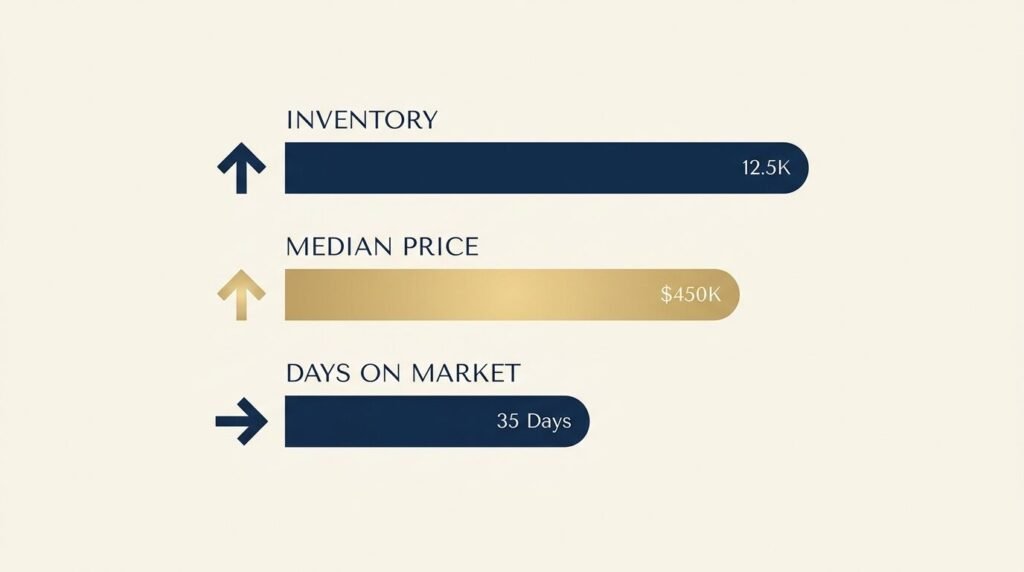
The national median of 32 days on market in April — up from 29 a year ago — reflects a market that has slowed but not stalled. Properties still sell. They just no longer sell in 72 hours with five offers above ask.
In Nassau and Suffolk, the picture is nuanced by price tier. Entry-level and mid-market homes — well-priced, in good condition, in strong school districts — are still moving within 30 to 45 days when they’re priced correctly. Homes that are priced aggressively, or that have deferred maintenance, are sitting longer. Some are sitting much longer.
This matters enormously for sellers. A listing that sits for 90 days on Long Island has told the market something — and that something is hard to unsay. I laid out the dynamics of this in The House That Sits 90 Days Has Already Told the Market Something. The April data reinforces it: the premium for correct pricing at day one is higher now than it was two years ago.
For buyers, lengthening days on market means more negotiating room — not unlimited room, but real room. A house that’s been on for 60 days without movement is a house where a thoughtful offer, structured with appropriate contingencies, will be taken seriously. The Buyer Who Walked Through an Open House Twice and Paid $40,000 Less is exactly the kind of opportunity the current market is creating for buyers who do their homework.
How to Use This Data If You’re Buying or Selling Right Now
If you’re buying: The April data confirms what I’ve been telling buyers for months — this is not a market where waiting produces a meaningfully better outcome. The affordability index is up year-over-year. Rates are lower than they were at this time last year. Prices are still rising, slowly but consistently. If the house works and the numbers work, the case for waiting is thinner than it looks.
What to focus on: the 32-day median days on market nationally is a benchmarking tool. If a listing has been sitting for 60-plus days in a price range where similar homes are moving in 30, ask why. The answer is either price or condition — and both are negotiating opportunities.
If you’re selling: The inventory expansion nationally is a signal that competition for buyers is increasing. Your listing is no longer the only option in front of your target buyer. This argues for doing the pre-listing work correctly — presentation, pricing discipline, disclosure hygiene — rather than testing the market optimistically and adjusting later.
The sellers who are closing fastest right now are the ones who came to market looking like they wanted to sell, not like they were doing buyers a favor by allowing them to look.
Maison Pawli’s Smart Seller tier exists precisely for this moment: professional listing support at a fraction of traditional commission costs, without cutting corners on the things that actually move a home. If you’re thinking about listing this summer, let’s talk before the market makes the decision for you.
Real estate markets change. This post reflects conditions as of May 2026. For current listings and market data, contact Pawli at Maison Pawli.
This post is for informational purposes only and does not constitute financial or legal advice. Consult a licensed real estate professional, attorney, or financial advisor for guidance specific to your situation.
You Might Also Like
- Long Island Home Prices Are Holding — But the Cracks Are Starting to Show
- The Lock-In Effect: Why North Shore Inventory Is So Tight Right Now
- Pending Home Sales Rose in March — But the Year-Over-Year Gap Tells the Real Story
- Gold Coast Mansions Are Sitting Longer — What the Days-on-Market Data Is Actually Telling Us
Sources
- NAR April 2026 Existing-Home Sales Report, May 11, 2026
- HousingWire: April Existing Home Sales Rise 0.2% as Inventory Grows, May 11, 2026
- Inman: Existing Home Sales Defy Consumer Gloom, May 11, 2026
- RISMedia: Existing Inventory Continues to Expand as Sales Remain Flat, May 11, 2026
- Freddie Mac PMMS, May 7, 2026