The Horseshoe Crab as Keystone: Why the Spawning Aggregations at Long Island’s Town Beaches Are a Critical Node in an Atlantic-Scale Migratory Web
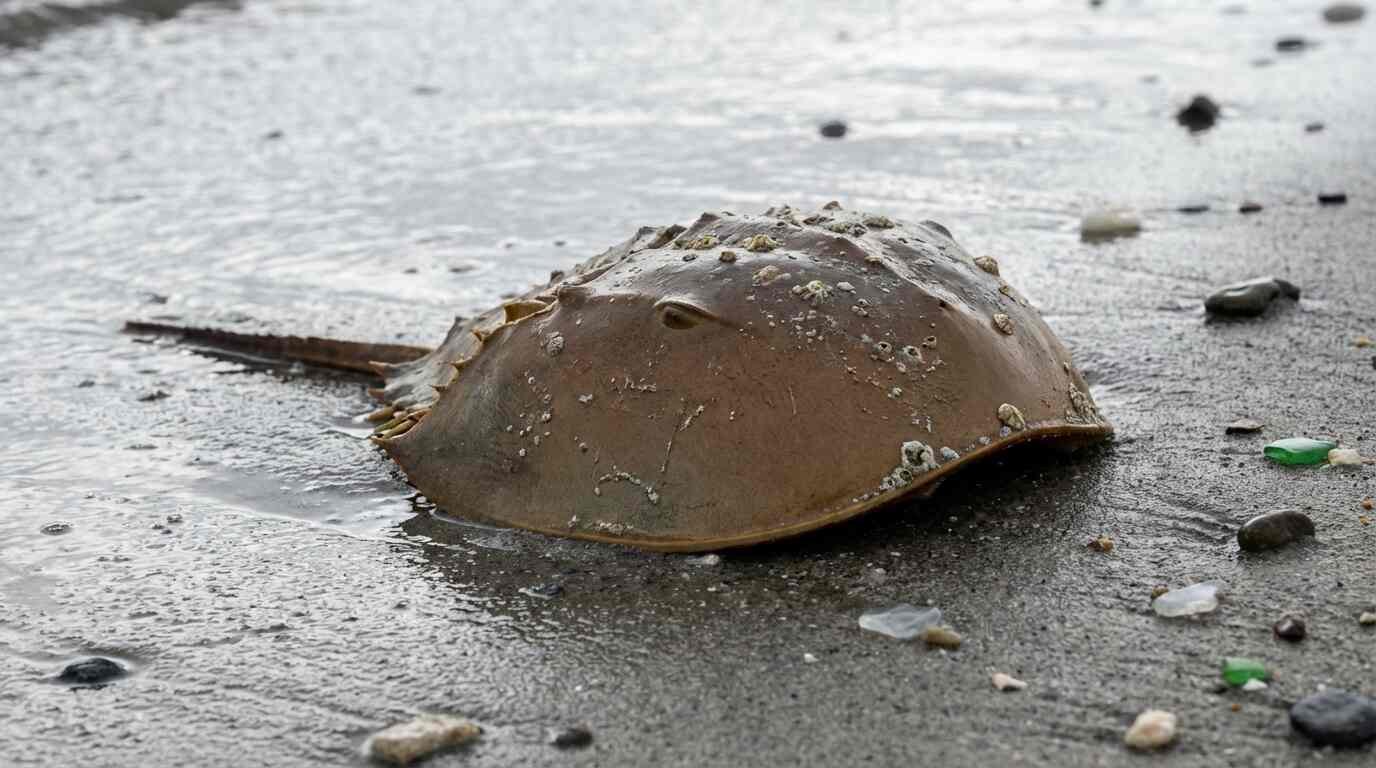
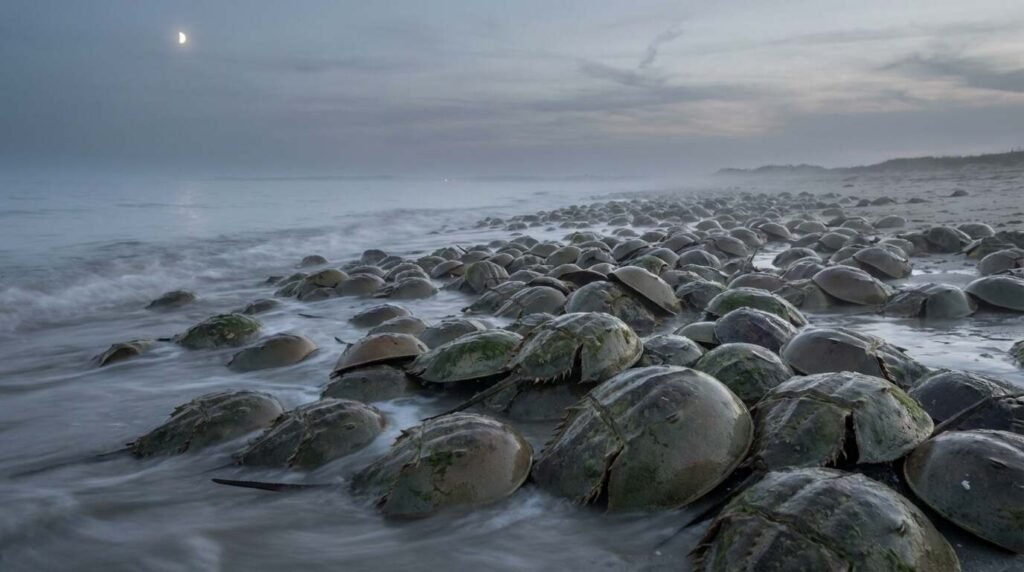
On certain May nights, when the moon is full and the water temperature has climbed into the low sixties, the beaches of Long Island’s North Shore bays fill with animals that have been performing this same act for 450 million years. Limulus polyphemus — the horseshoe crab, which is not a crab — hauls itself out of Long Island Sound and into the wrack zone in dense aggregations, the larger females each dragging one or several smaller males, to bury clutches of eggs in the wet sand above the tide line. The spectacle is quiet, ancient, and almost entirely unnoticed by the people who live within a mile of it.
The red knots flying 9,300 miles from Tierra del Fuego are counting on those eggs.
450 Million Years of Infrastructure
Limulus polyphemus belongs to the chelicerates — more closely related to spiders and scorpions than to true crabs — and it has not changed meaningfully in form since the Ordovician. What it has changed, across all those millions of years, is its relationship to the coastal systems it inhabits. Horseshoe crabs are bioturbators: their plowing movement through intertidal sediment aerates benthic habitats and releases nutrients. They are prey: loggerhead sea turtles, American eels, and multiple species of migratory shorebird all feed on either the adults or the eggs. They are hosts: more than twenty species of epibiont organisms — barnacles, flatworms, snails — colonize horseshoe crab shells as primary habitat. Remove Limulus from a northeastern estuary and you are not removing a crab. You are removing infrastructure.
The most visible expression of that infrastructure is the spawning aggregation. Adults prefer protected, sandy beach areas within bays and coves — exactly the kind of pocket beach geography that characterizes the town landings, county parks, and state preserves of Long Island Sound’s North Shore. Dr. Mark Botton of Fordham University, who has studied Long Island horseshoe crab populations for decades, has conducted research on spawning activity from Jamaica Bay to the shores of Long Island Sound, and his work establishes that Long Island’s populations are distinct management units from the famous Delaware Bay aggregations — smaller, more localized, and substantially less studied.
The Egg as Energy Currency
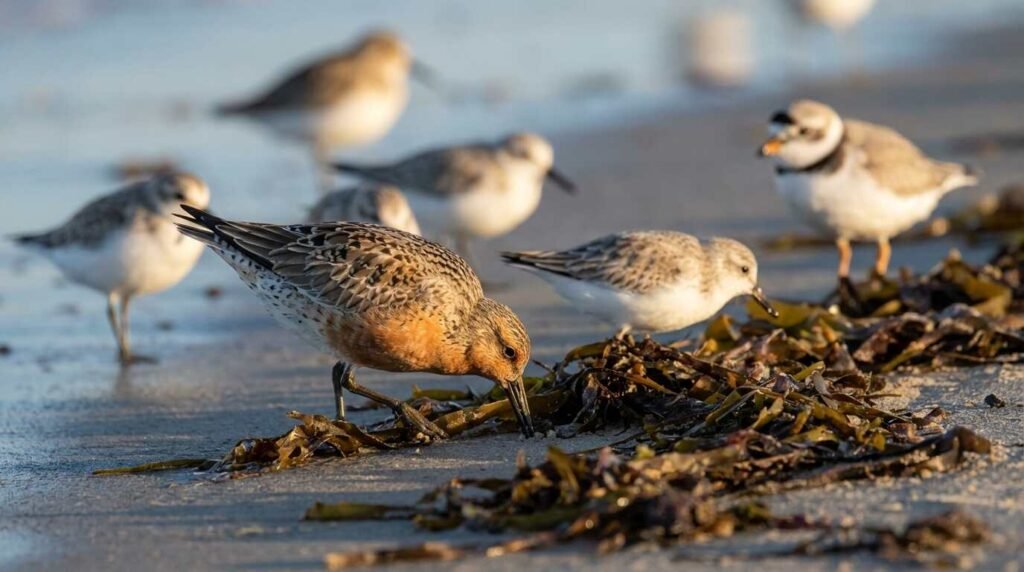
In Delaware Bay, where the famous confluence of horseshoe crab spawning and shorebird migration has been studied intensively since the 1980s, the mechanism is well understood: the crab eggs are not merely available protein. They are a hyperconcentrated lipid subsidy — a package of fat and energy so dense that a red knot (Calidris canutus rufa) can roughly double its body weight in the two weeks it spends on the Delaware Bay beaches, converting crab eggs into the fuel required for the final nonstop leg of its migration to Arctic breeding grounds. The Atlantic States Marine Fisheries Commission’s Adaptive Resource Management Framework, which governs horseshoe crab harvest in the Delaware Bay region, explicitly incorporates red knot population viability as a variable in setting harvest levels — a rare case of a migratory shorebird’s fate being written into fisheries management law.
The red knot was listed as threatened under the Endangered Species Act in 2014. The USFWS recovery plan for the rufa subspecies directly references horseshoe crab egg availability on stopover beaches as a population-limiting factor. The listing documents make explicit what the biology established: the bird’s survival is downstream of the crab’s survival.
What gets less attention is the role of secondary aggregation sites. Delaware Bay hosts the highest density of spawning horseshoe crabs on the Atlantic coast, but Limulus spawns across its entire range — including Long Island Sound, Jamaica Bay, and the North Shore’s protected coves and town beaches. Research cited in the ASMFC’s stock assessment framework has documented that Long Island Sound populations have faced pressure from a harvest structure that, at its peak between 2008 and 2013, averaged nearly 150,000 animals per year removed from New York waters — the second-largest average harvest among all coastal states outside the four Delaware Bay states. The bulk of that harvest came from Long Island’s South Shore.
The Long Island Population Under Pressure
The biomedical industry’s relationship with the horseshoe crab is one of the odder ecological stories of the twentieth century. Limulus blood contains amebocytes that coagulate in the presence of bacterial endotoxins — a reaction so precise and reliable that the pharmaceutical industry has used Limulus amebocyte lysate (LAL) to test the sterility of every injectable drug, vaccine, and medical device sold in the United States since the 1970s. The horseshoe crab that washed up at Caumsett State Park last May was not just an animal. It was a pharmaceutical input.
The biomedical harvest works by capturing adult crabs, bleeding approximately 30 percent of their blood volume, and returning them to the water. Industry estimates of post-bleeding mortality have ranged from 10 to 30 percent, a number that conservation biologists dispute as a significant undercount when stress and handling mortality are properly accounted for. The ASMFC’s 2022 revision to the ARM Framework — approved under Addendum VIII — incorporated biomedical mortality into the management model for the first time, acknowledging what researchers had documented for years: the bleed-and-release protocol is not ecologically neutral.
For Long Island Sound populations, which the research of Beekey and Mattei — published in the Springer volume Changing Global Perspectives on Horseshoe Crab Biology, Conservation and Management — characterizes as potentially mismanaged, the combination of bait harvest and biomedical extraction creates compounding pressure on a population that has no Delaware Bay-scale reserve to draw on. A 2012 ASMFC stock assessment indicated declining abundance in the New York region. That signal has not reversed in subsequent assessments.
What Secondary Sites Do
The ecology of the red knot’s migration is not simply Delaware Bay. The birds that stop in Delaware Bay are already depleted — they have been flying for days from South America, and the Delaware Bay stop is the emergency refueling that allows them to complete the migration. But not every bird in the flyway hits Delaware Bay on the same tide. Red knots also use Long Island Sound beaches as supplemental refueling sites during spring migration, and the presence or absence of horseshoe crab eggs at those secondary sites can determine whether birds arrive at their Arctic breeding grounds in condition to reproduce or not.
The scientific literature on shorebird-horseshoe crab trophic linkages — including work published in The Condor and other peer-reviewed journals — establishes that the fragility of the migration corridor is a function of its redundancy. Delaware Bay is the load-bearing beam, but the secondary sites are the structure that distributes the load. Degrade enough of them and the beam is carrying more than it was designed to hold.
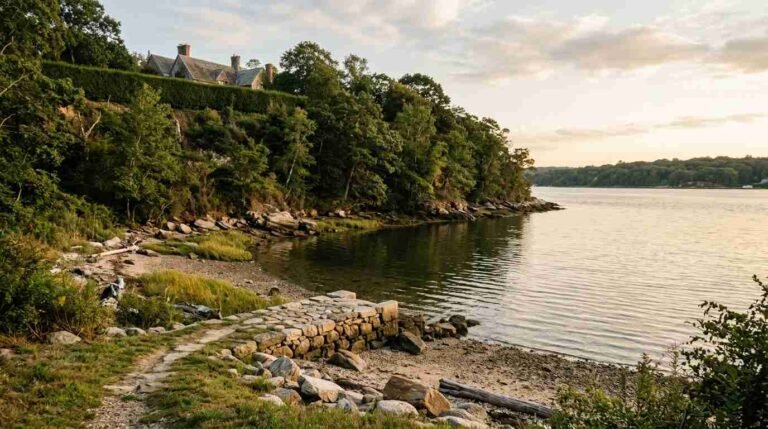
Long Island’s town beach landings, its county park shorelines, its state preserve beaches — the protected coves at Caumsett, the rocky shores along the Lloyd Neck peninsula, the sheltered bays behind the barrier islands — are not supplemental. They are structural. Their obscurity relative to Delaware Bay is not evidence of their insignificance. It is evidence that we haven’t been paying attention.
A Broker’s Observation
I’ve been watching the Sound shore for years — as someone who sells properties along it, walks it, sits above it on bluff-edge decks at twilight. I’ve stood at the water’s edge at Caumsett and felt the strange intimacy of watching an animal older than the Atlantic Ocean drag itself through two feet of water toward the same beach it has been coming to for ten thousand springs.
There is a real estate angle here, which I’ll name directly: waterfront property along the North Shore bays — the protected coves, the Sound-facing beaches, the tidal inlets — carries ecological value that no appraisal model currently captures. The spawning aggregations that happen on town beach landings and state park shorelines are part of what makes the Sound a living system rather than a recreational amenity. They are what the eelgrass depends on, what the shorebirds stop for, what the turtles follow north.
When I think about the North Shore waterfront as a market asset, I think about all of the things that make it worth having. The horseshoe crab spawning on the beach at 2 a.m. in May is one of them. Most people who own those properties don’t know it happens.
Sources
- ASMFC — Horseshoe Crab Species Management Page
- ASMFC — Horseshoe Crab Stock Assessment PDF
- Long Island Sound Partnership — Horseshoe Crab Abundance Indicator
- Botton, M.L. (2009). The ecological importance of horseshoe crabs in estuarine and coastal communities: A review. In Biology and Conservation of Horseshoe Crabs, Springer, New York.
- Botton, M.L., et al. (2018). Effects of a beach nourishment project in Jamaica Bay, New York, on horseshoe crab spawning activity. Estuaries and Coasts, 41(4), 974–987.
- Beekey, M.A. & Mattei, J.H. (2015). The mismanagement of Limulus polyphemus in Long Island Sound. In Changing Global Perspectives on Horseshoe Crab Biology, Conservation and Management, Springer. Sacred Heart University PDF
- Botton, M.L. et al. (2012). Horseshoe crab eggs: A rare resource for predators in Long Island Sound. Journal of Experimental Marine Biology and Ecology. ScienceDirect
- USFWS — Red Knot Recovery Plan documentation (via ASMFC ARM Framework)
- The Horseshoe Crab — Research and Conservation News Archive
You Might Also Like
- Bunker Fishing Off Montauk: The Industrial Menhaden Fleet That Worked These Waters for a Century
- The Eelgrass Crisis in Peconic Bay — and Why Every Bayfront Buyer in Southold and Shelter Island Should Read the Water Quality Data Before Closing
- North Shore Bluff Homes and the Erosion Question: What Buyers Need to Know