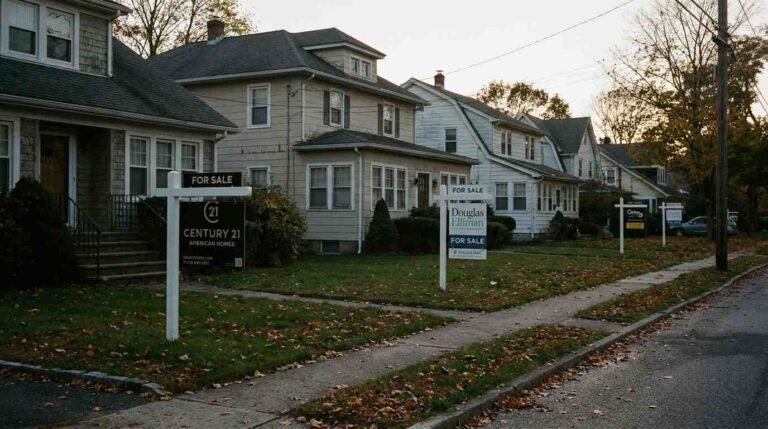
Smithtown’s Bull Myth Is Covering Up the Real Estate Story: How a Legend Drove Land Values for 350 Years
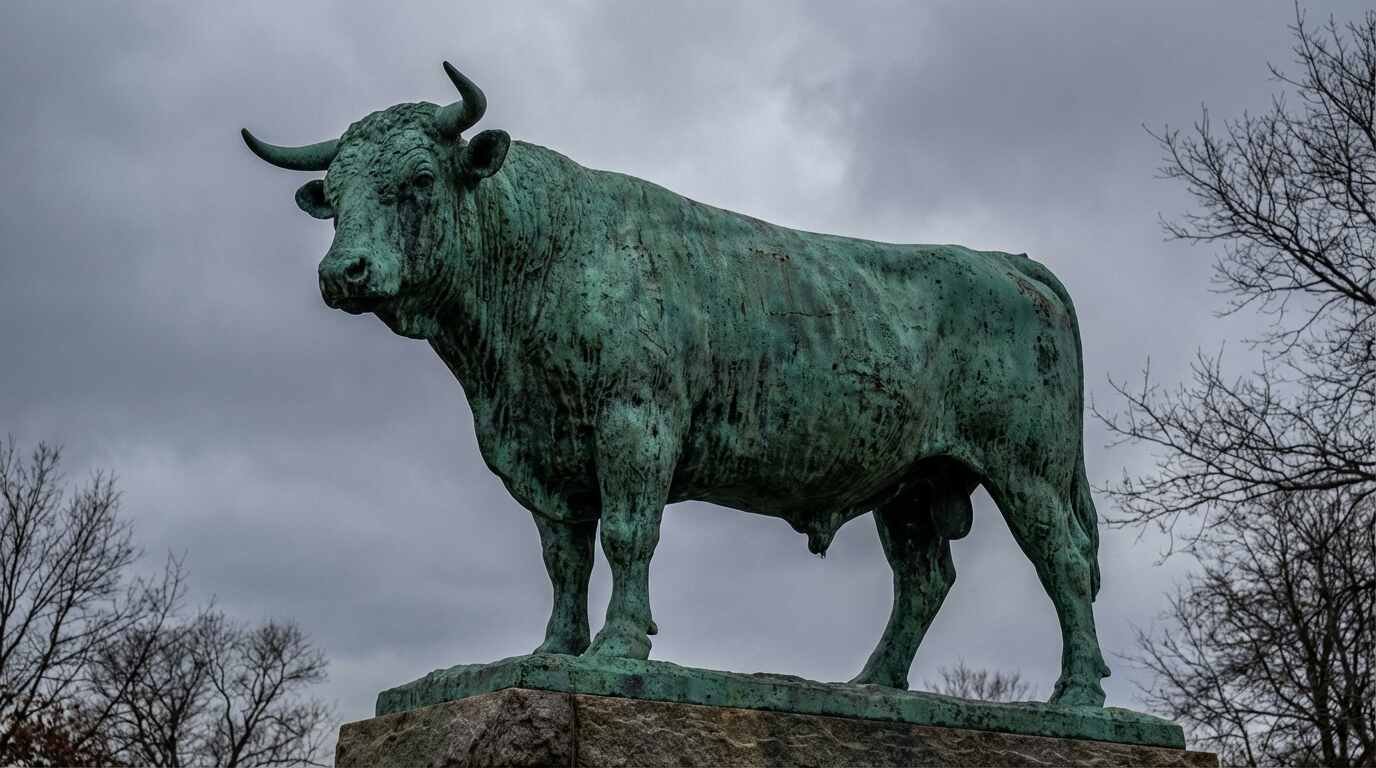
On Route 25, just west of the intersection with Hauppauge Road, there is a bronze bull. Life-sized, head slightly lowered, cast in 1941 and installed on a small triangle of grass where it has presided over Smithtown’s main corridor ever since. The statue is called Whisper. It commemorates a legend that most historians agree never happened, in honor of a land transaction that was considerably more interesting than the legend suggests.
And yet Whisper is on every piece of Smithtown tourism material, every welcome sign, every elementary school social studies packet in the district. The bull is Smithtown. The bull, at this point, is a branding decision.
I find this fascinating, and not just because I work in real estate. Understanding why a town commits this hard to a myth it knows isn’t true tells you something about how places understand their own value — and how that self-understanding eventually shows up in the price per square foot.
What the Legend Says
The story, as it has been handed down for roughly two centuries: Richard Smythe, an English settler who arrived on Long Island in the mid-seventeenth century, made a deal with local Native Americans. He could have whatever land he could encircle in a single day’s ride on a bull. Being a clever man, he waited for the longest day of the year — the summer solstice — and rode a trained bull named Whisper from dawn to dusk. At noon, he stopped in a hollow to eat bread and cheese, which is why that road is still called Bread and Cheese Hollow Road, marking what is today the town’s boundary with Huntington.
He completed the circuit and claimed roughly fifty square miles of central Long Island. Smithtown was his.
It’s a good story. It has an animal, a clever protagonist, a specific landscape detail that you can still drive to, and a clear moral about knowing which day to pick for your bull ride. The problem is that it almost certainly didn’t happen.
What the 1665 Patent Actually Says
The documented history of how Richard Smythe acquired the land that became Smithtown is less cinematic but considerably more interesting as a legal and real estate matter.
The land in question originally belonged to the Nesaquake Indians. In 1659, Grand Sachem Wyandanch — in an act of gratitude toward Englishman Lion Gardiner, who had helped rescue Wyandanch’s daughter from a Narragansett raid — transferred the Nissequogue River valley lands to Gardiner. The deed, witnessed by one Richard Smith, is held by the Long Island Historical Society in Brooklyn.
Gardiner died in 1663, and before his death transferred his rights to the land to Richard Smythe, who had been cultivating this relationship carefully for years. Smythe was, by all accounts, a shrewd businessman — he had been banished from Southampton in 1656 for, as the town records put it, “irreverent carriage towards the magistrates.” He landed in Setauket, befriended the right people, and spent the next nine years positioning himself to acquire a landholding that would make him independent of every town boundary he’d ever quarreled with.
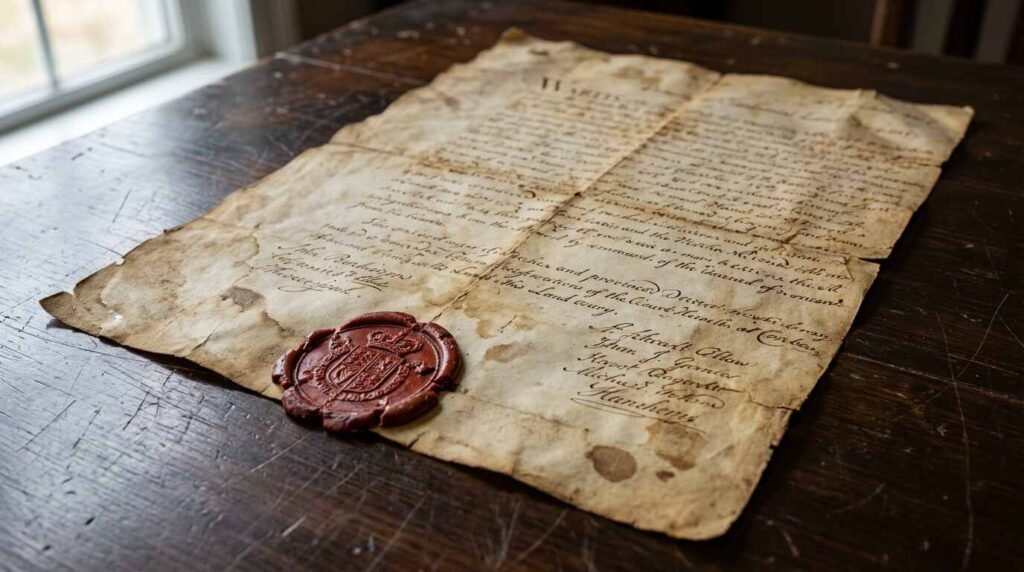
On March 3, 1665, the Royal Governor of the Colony of New York, Sir Richard Nicolls, granted Smythe a patent confirming his ownership. The Nicolls Patent required that Smythe settle ten families on the land within three years. It was a land grant in the colonial mode: political, transactional, and contested — Smythe spent the rest of his life in boundary disputes with Huntington, disputes that the courts eventually resolved in his favor.
The first written appearance of the bull legend appears in John Lawrence Smith’s History of Smithtown, published in 1882, more than two hundred years after the actual events. The book explicitly flagged the story as tradition, not record. The Smithtown Historical Society has been careful, for decades, to distinguish between what the documents show and what the legend claims. As the Society’s own director once put it: it’s a perfectly wonderful legend, and there’s not another town in the country that could match it. The question is what to do with it.
The Invention of Tradition
The bronze bull on Route 25 was installed in 1941 — 276 years after the Nicolls Patent was signed. That gap is the story.
There’s a concept in historical scholarship about how communities invent traditions: the deliberate creation or formalization of practices and symbols that feel ancient but are actually recent, designed to project continuity and identity backward through time. The Smithtown bull is a near-perfect case study. By 1941, the town was no longer a collection of Smith family farms. It was a growing suburban community with a real estate market, a commercial corridor, and new residents who needed a narrative. The statue gave them one.
It worked. Whisper became Smithtown’s identity in a way that the actual Nicolls Patent — a document in a state archive that nobody visits — never could. The bull is photogenic. The bull has a name. The bull has a hollow where a man ate lunch, and that hollow has a road named after it, and that road is still the town border. The legend colonized the landscape and made itself impossible to dislodge.
What This Has to Do With Real Estate
Here’s the question I actually care about: does any of this affect property values? The answer is yes, and in a specific way.
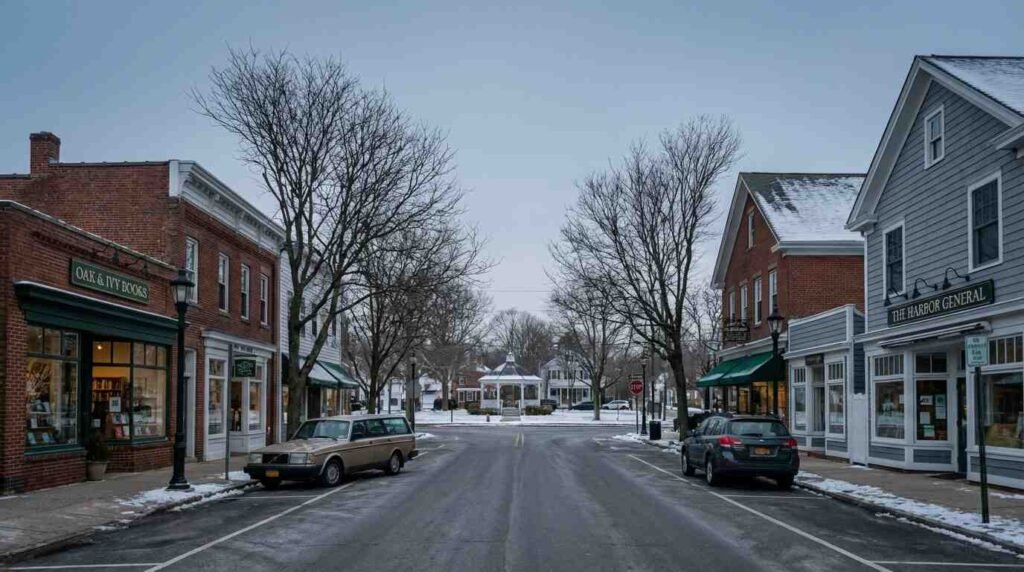
Smithtown has a historic district — the Smithtown Center Historic District, centered around the Main Street corridor near Smythe’s original settlement in what is now Nissequogue and the Village of the Branch. Proximity to the historic district has historically commanded a premium in the local market. Buyers in Smithtown, particularly buyers coming from elsewhere on Long Island or from outside the region entirely, consistently reference the town’s “historic character” as part of what they’re paying for.
That historic character is substantially constructed — not in the sense of being false, but in the sense of being curated and packaged. The Smithtown Historical Society maintains several historic properties, including the Epenetus Smith Tavern. The annual town events reference the founding story. The bull stands watch on Route 25. All of this creates a coherent narrative of place that makes buyers feel they are purchasing into something with depth and permanence — not just a postwar subdivision but a town with a story going back to 1665.
Whether Richard Smythe rode a bull or not has nothing to do with how good the school district is, how convenient the Long Island Rail Road connection is from Smithtown station, or whether the house at the end of a particular cul-de-sac has good bones and enough closet space. What the legend does is create a layer of identity that buyers are willing to pay a small premium to live inside. That’s not irrational. People have always paid to be part of stories.
What Buyers Should Actually Look At
For buyers considering Smithtown today, a few things matter more than the founding mythology:
The school district is consistently strong, drawing on a stable tax base from both residential and commercial properties along the Route 25A and Veterans Memorial Highway corridors. The hamlet breakdown within the town — Smithtown, Kings Park, Nesconset, St. James, Hauppauge — has real variation in price points, school building assignments, and neighborhood character. Don’t treat “Smithtown” as monolithic.
The LIRR’s Port Jefferson Branch serves Smithtown and Kings Park directly, with service to Penn Station and Atlantic Terminal in Brooklyn. For buyers who need a train, the line is manageable, though not as frequent as the Main Line.
The housing stock spans a wide range: Victorian-era homes in the historic district, postwar ranches and split-levels in the interior hamlets, some newer construction where infill development has occurred. Each requires a different inspection and renovation calculus.
And then there’s the question of what you’re buying into beyond the walls of the house. Every community has a story it tells about itself. Smithtown’s story involves a man on a bull on the longest day of the year, which turns out to be apocryphal but remarkably durable. It has shaped how this town presents itself for over a century, and how buyers experience it as a destination.
The real Richard Smythe was a shrewd, difficult, boundary-obsessed man who spent his life in litigation over land. In that sense, he may be the most honest patron saint a real estate market has ever had.
You Might Also Like:
The Forgotten Factory Town: How Hauppauge Industrial Park Rose From a Potato Field — the economic infrastructure that sits at Smithtown’s southern edge
The Covenant in the Deed: How Restrictive Covenants Shaped Long Island Neighborhoods — another look at how legal history lives inside property records
Real estate markets change. For current listings and market data, contact Pawli at Maison Pawli.
Sources
- Smithtown Matters — Dedication of Richard Smythe Statue — full text of 2015 Smithtown Historical Society address on the real history of Smythe’s land acquisition
- Smithtown Matters — Town Historian Bradley Harris on Richard Smythe — detailed historiography of the bull legend vs. the Nicolls Patent
- Brandon J Broderick — History of Smithtown NY — summary of the 1665 land grant and town development
- HMDB — Richard Smith Historical Marker — text of the 2015 historical marker at Smithtown
- LongIslandGenealogy.com — Richard Smith and the Bull Story — colonial land grant documentation and early history