Cold Spring Harbor Laboratory’s Visual Epistemology: How Scientific Illustration and Architectural Space at the Carnegie Institution Campus Codified a Eugenicist Way of Seeing
The first time I showed property near Cold Spring Harbor — a client from the city, a scientist, very interested in the research culture of the area — she said something that stayed with me. She said: “I know the lab’s history. The question is whether it knows itself.” That was several years ago. I have thought about it often since, because the question she was asking is precisely the one that the built environment of the Cold Spring Harbor Laboratory campus has never fully answered.
The Eugenics Record Office operated at Cold Spring Harbor from 1910 to 1939 under Charles Davenport and Harry Laughlin. Its work — the collection of family pedigree data, the production of hereditary “fitness” charts, the provision of scientific testimony to support immigration restriction and forced sterilization legislation — is documented in meticulous, damning detail in the Charles B. Davenport Papers at the American Philosophical Society in Philadelphia, and in the Cold Spring Harbor Laboratory’s own archives. None of this is contested. What is less often examined is the visual culture the ERO produced: the specific forms of illustration, diagramming, and spatial organization through which it made its claims legible, authoritative, and portable.
This matters because the history of eugenics at Cold Spring Harbor is not only a history of bad science. It is a history of a particular way of seeing — a visual epistemology, in the vocabulary of historians Lorraine Daston and Peter Galison — that used the tools of scientific illustration to produce the appearance of objectivity while encoding a profound ideological agenda. And that visual culture was housed in, and shaped by, a physical campus whose architectural grammar still structures the site today.
The Pedigree Chart as Visual Argument
Daston and Galison’s Objectivity (2007) traces the history of scientific image-making from the early modern period through the twentieth century, arguing that what scientists have meant by “objectivity” has changed dramatically across time — and that these changes are legible in the images scientists produced. The ideal of mechanical objectivity — the aspiration to suppress the observer’s subjectivity entirely, to let nature speak directly through the instrument — reached its apogee in the late nineteenth and early twentieth centuries. It is precisely this ideal that the Eugenics Record Office’s visual culture claimed to embody.
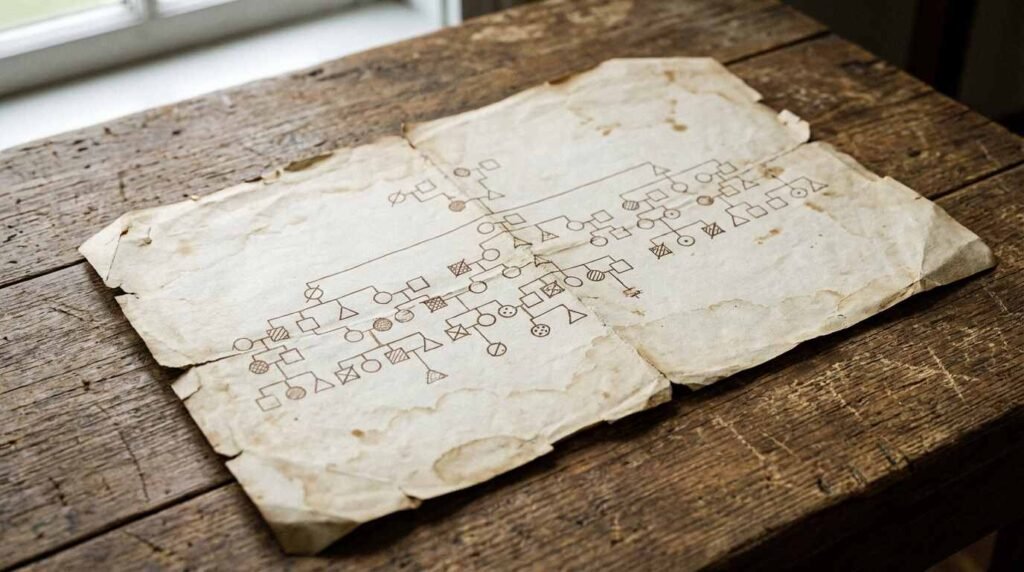
The pedigree charts the ERO produced are extraordinary documents. They trace family lineages across multiple generations, coding individuals with symbols for “feeblemindedness,” “criminality,” “pauperism,” “sexual deviance” — categories that were presented as biological facts, legible through the visual grammar of the chart just as metabolic pathways are legible through a biochemical diagram. The charts look scientific. They deploy the conventions of scientific illustration — the clean line, the standardized symbol, the hierarchical branching structure — in service of claims that had no scientific basis whatsoever.
What the visual form accomplished was the transformation of social judgment into biological classification. A family’s economic precarity, their encounters with the criminal justice system, their failure to conform to middle-class norms of behavior — all of this was re-encoded as heritable defect, made visible through a diagram that claimed the authority of objective observation. The form produced the content’s credibility.
Garland Allen’s scholarship on Davenport and the ERO — particularly his work tracing the relationship between the ERO’s data collection methods and its policy recommendations — makes clear that the science was never sound. But the visual culture was persuasive, and that persuasiveness was architectural in character: it depended on the appearance of systematic observation, of information organized according to neutral principles, of data that had been sorted from noise by a disinterested eye.
The Campus as Classification System
The Carnegie Institution’s Station for Experimental Evolution, established at Cold Spring Harbor in 1904, preceded the ERO. Its campus — the laboratory buildings, the residential structures, the grounds that organized the relationship between working space and natural landscape — was designed to embody the values of scientific modernity: order, transparency, the legibility of function. This was not incidental. The spatial organization of a research campus is itself a form of epistemological argument. It tells you how knowledge is produced, who produces it, and what counts as evidence.
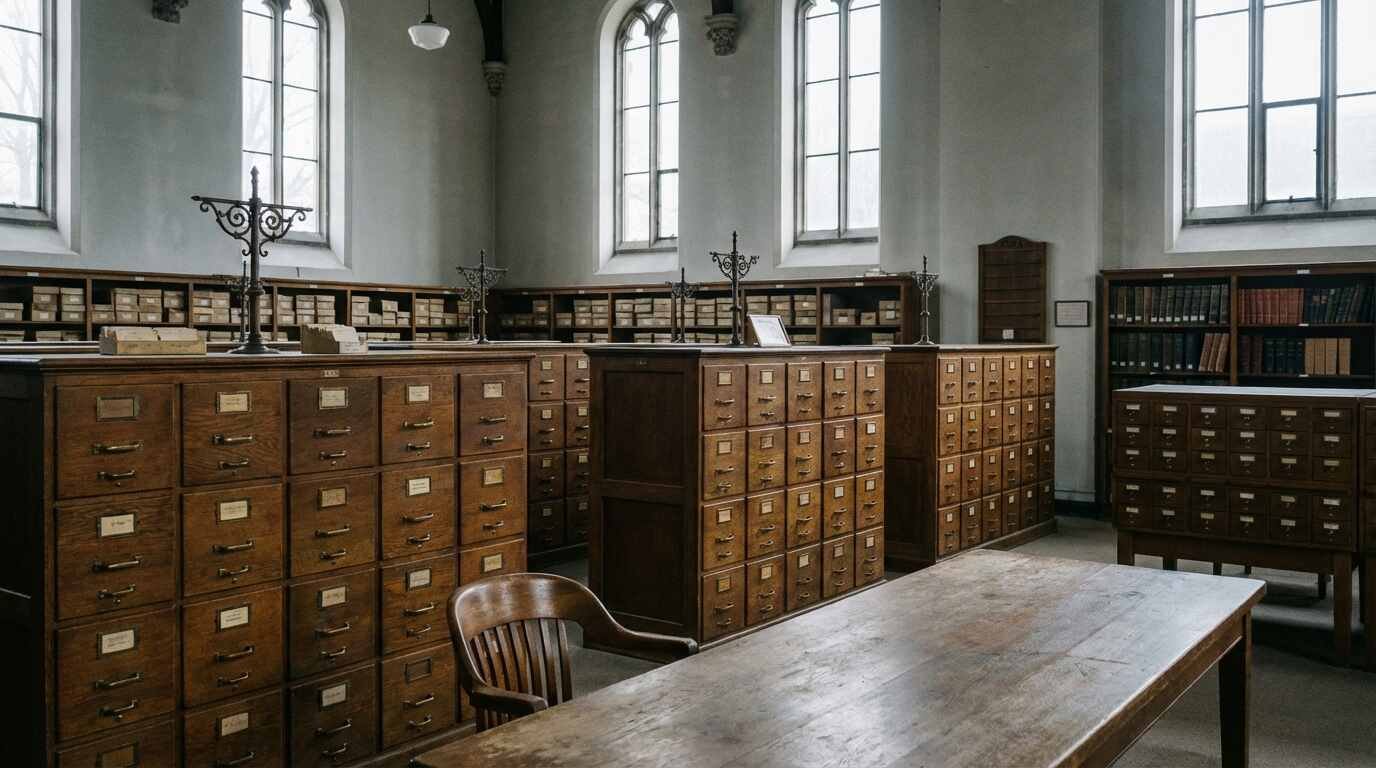
The ERO, housed on the same grounds beginning in 1910, inherited this spatial grammar and inflected it toward its own project. The archive building — purpose-built for the storage and retrieval of family record cards — was a classification machine in architectural form. Its organization of space reflected and reinforced the ERO’s organization of human bodies into categories of fitness and deficiency. To work in that building was to inhabit a spatial argument about the nature of human difference.
Daniel Kevles’s In the Name of Eugenics (1985) remains the definitive account of American eugenics as a social and political movement, and his chapter on Cold Spring Harbor is essential reading for anyone trying to understand how a research institution becomes complicit in state violence. What Kevles maps is the chain of legitimation: the ERO’s “scientific” authority was used to support the Immigration Restriction Act of 1924 and the sterilization laws that were eventually cited approvingly at Nuremberg. The visual culture — the charts, the photographs, the spatial organization of the archive — was the apparatus through which that authority was produced and communicated.
The Bruce Stillman Rebranding and the Aesthetics of Revision
The contemporary Cold Spring Harbor Laboratory — the institution that has trained Nobel laureates, that is associated with James Watson and Francis Crick’s work on DNA, that represents one of the most productive molecular biology research environments in the world — has a complicated relationship to the ERO period.
Watson himself, who served as CSHL’s director from 1968 to 2007, was forced to resign after making public statements that demonstrated he had not fully repudiated the eugenicist intellectual tradition he had worked alongside for decades. The institution distanced itself from him. The Bruce Stillman era’s rebranding of CSHL’s public identity — the emphasis on molecular biology, genomics, neuroscience, the Nobel Prize affiliations — is, among other things, an exercise in institutional aesthetics as historical management.
The campus today is beautiful. The restored Victorian buildings, the waterfront setting, the integration of historic and contemporary laboratory architecture — it is one of the most visually coherent research environments I have seen anywhere on Long Island. That coherence is itself a form of argument. It says: this place is ordered, rigorous, committed to truth. It does not say: this is the same ground on which pedigree charts encoding racial and class hierarchy were produced and archived and used to justify the forced sterilization of tens of thousands of Americans.
I am not suggesting that CSHL should be condemned for its history or that the current institution is culpable for what happened before most of its researchers were born. The science that happens there now is legitimate and important. But the aestheticization of the campus — the careful management of its visual identity — is worth naming as a form of institutional practice, because the question my client asked remains open: does the institution know itself?
What the Visual Record Holds
The American Philosophical Society holds the Davenport Papers, including thousands of ERO pedigree charts, photographs, and correspondence. These are primary documents of one of the most consequential failures of scientific culture in American history. They are also, in the most uncomfortable sense, remarkable visual artifacts — examples of how illustration systems can be weaponized, how the formal conventions of scientific credibility can be deployed in service of ideology so thoroughly that the ideology becomes invisible inside the form.
For anyone working in the history of visual culture on Long Island — and Huntington Town, which encompasses Cold Spring Harbor, has a visual culture history that extends from the ERO through the Heckscher Museum’s civic aesthetics to the contemporary gallery district — the ERO archive is an indispensable and largely unexamined resource. Not because its content should be celebrated, but because understanding how visual culture encodes power is part of understanding how places come to be the way they are.
The fish hatchery at Cold Spring Harbor, which I have written about in connection with the village’s social geography, shaped one kind of community — working-class, federal, oriented toward the harbor. The Carnegie Institution campus shaped another: professional, classificatory, certain of its own authority. Both are still present in the landscape. Both are worth reading.
For current listings and market data in Cold Spring Harbor and the surrounding North Shore, contact Pawli at Maison Pawli.
You Might Also Like
- Cold Spring Harbor’s Fish Hatchery and the Block It Built — how a federal facility shaped the village’s social geography across 140 years
- The Covenant in the Deed: How Restrictive Covenants Shaped Long Island Neighborhoods — another history of how ideology was encoded in the built environment
- Matinecock’s Invisible Borders — landscape and community identity on the North Shore
Sources
- American Philosophical Society, Charles B. Davenport Papers: https://diglib.amphilsoc.org/islandora/object/compound%3A44
- Cold Spring Harbor Laboratory Archives: https://www.cshl.edu/research/library-archives/
- Garland Allen, “The Eugenics Record Office at Cold Spring Harbor, 1910–1940,” Osiris 2 (1986): 225–264
- Lorraine Daston and Peter Galison, Objectivity (2007), Zone Books
- Daniel Kevles, In the Name of Eugenics (1985), Alfred A. Knopf
- Cold Spring Harbor Laboratory: https://www.cshl.edu/