Bunker Fishing Off Montauk: The Industrial Menhaden Fleet That Worked These Waters for a Century and Why Its Absence Is Reshaping the Entire Food Web
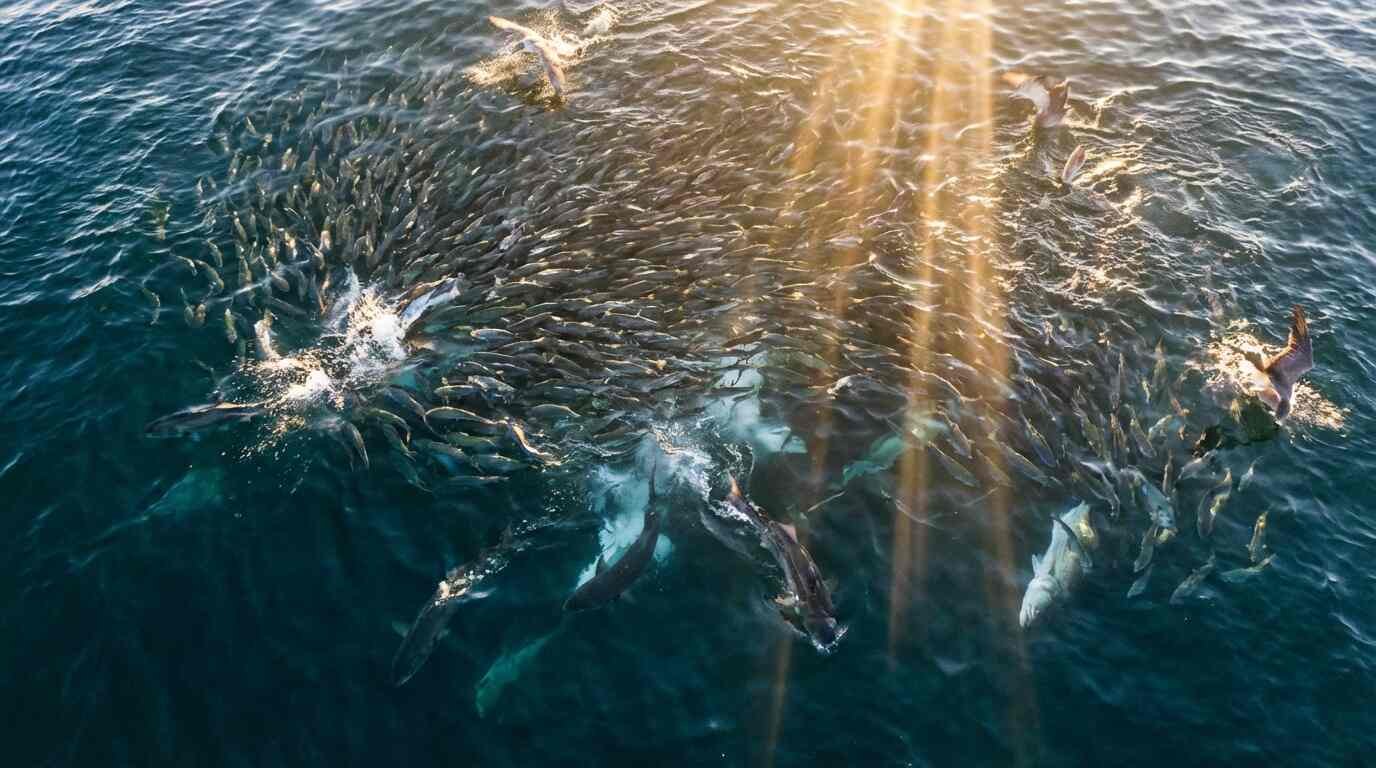
Every charter captain working out of Montauk knows the conversation. You’re an hour offshore, the water looks right, the temperature break is where it should be, and somebody asks why the stripers aren’t where the stripers used to be. The answer is complicated, and it involves a fish most people wouldn’t recognize if they held one in their hands.
Menhaden. Locally, and almost exclusively on Long Island, called bunker.
Bunker are oily, filter-feeding, schooling fish that don’t get eaten by humans in any significant quantity. They’re bony and intensely flavored — not the sort of thing you put on a plate. What they are is everything else in the Atlantic food web. Striped bass eat them. Bluefish eat them. Bluefin tuna eat them. Osprey, whales, and dolphins eat them. When bunker are abundant, the entire nearshore Atlantic ecosystem runs with a kind of productive energy that charter captains describe the same way every time: the water is alive. When bunker are absent, the silence is felt throughout the food chain.
The story of why bunker were depleted off the Long Island coast — and why their partial recovery since 2012 has changed what the fishing looks like — runs directly through one of the most industrially intensive, least-told chapters of the East End’s economic history.
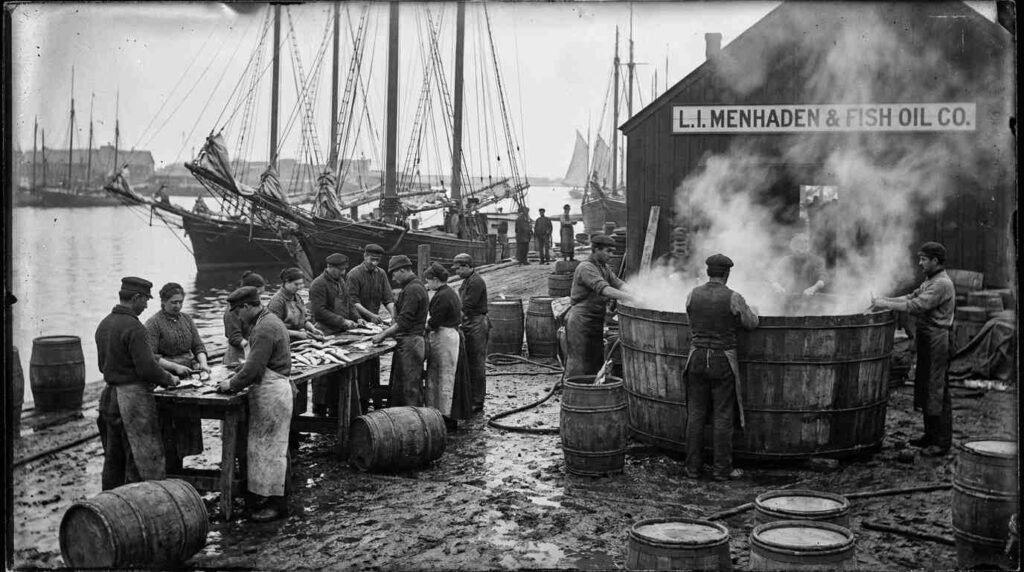
Promised Land
By the 1850s, the whale oil industry was collapsing. The whales were largely gone, the price of oil was being undercut by petroleum, and the ports that had built their economies around whaling needed something else. What they found — or rather, what found them — was menhaden.
Bunker oil turned out to be a useful industrial product: a lubricant, a paint additive, a cosmetics ingredient, an additive to soap and linoleum. The rendered fish meal left over after the oil was cooked out made excellent fertilizer and animal feed. The demand was real and growing, and the bunker were, at that point, seemingly inexhaustible — enormous schools moving up and down the Atlantic coast in volumes that early fishermen compared to a moving island.
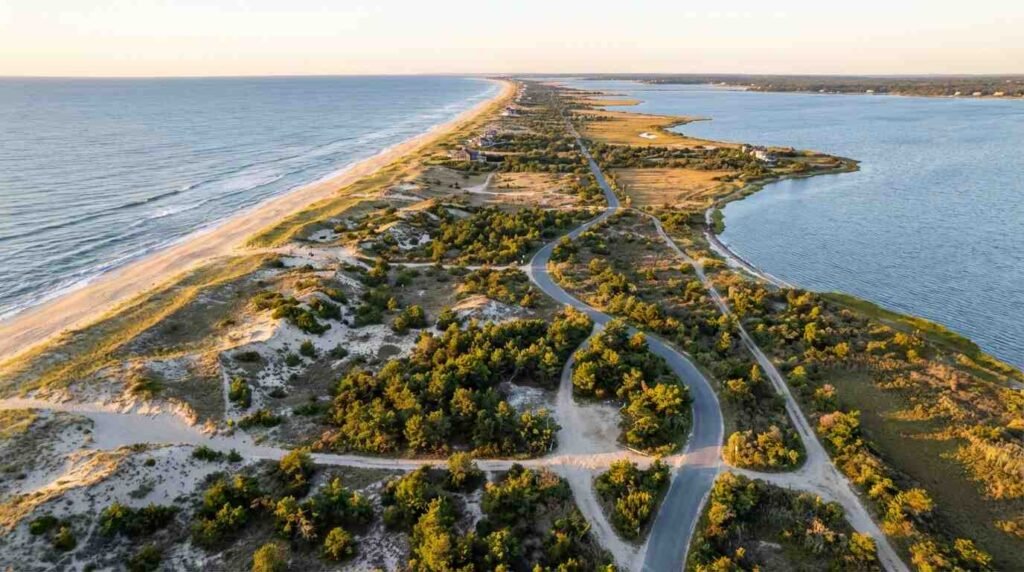
The reduction industry — so called because it “reduced” whole fish into oil and meal — took root along the Long Island coast with particular concentration on the South Fork. The area between Amagansett and Montauk, known as Napeague, hosted what would become one of the densest concentrations of fish processing plants on the entire Atlantic seaboard. The site was perfect: sandy, uninhabited land unsuitable for farming, with deep water access at Napeague Bay and proximity to the bunker migration routes.
By 1881, the scale of what had been built there was remarkable. The East End alone had more than 350 vessels supplying bunker to 97 fish factories, employing over 2,800 workers — a significant industrial workforce for a rural, agricultural region. The processing plants at the area that came to be called Promised Land — the name carrying its own irony — included operations with names like the Triton Oil and Fertilizer Company, the Atlantic Oil and Fertilizer Company, and the Smith Meal Company. The smell of the rendering vats could be detected for miles. The Long Island Rail Road built a freight spur to the site to handle the volume of oil tanks and meal boxcars moving west.
In 1898, a British-American consortium called the American Fisheries Company moved to consolidate the industry, buying up fish factories from Maine to the East End and establishing something close to a monopoly. At Promised Land alone, they acquired all seven factories operating on the site. The industrial logic was sound, at least in the short term. The ecological logic was not. By 1900, overfishing had already forced the American Fisheries Company to reorganize. Fires, bankruptcy, and the simple arithmetic of depleted stocks took most of the rest.
The Atlantic States Marine Fisheries Commission
The Promised Land factories eventually closed — the last significant operation, the Smith Meal plant owned by Otis Smith, shut down in 1968, ending what remained of the Long Island reduction industry after nearly a century. But the industry didn’t disappear from the Atlantic. It contracted south, to the Chesapeake Bay region, where Omega Protein Corporation became the last major industrial menhaden reduction operation on the Atlantic coast.
What didn’t contract was the ecological damage. The Atlantic States Marine Fisheries Commission, which manages menhaden throughout their range, has documented the stock’s history with uncomfortable clarity. The reduction fishery reached peak landings in 1956 at 712,100 metric tons. By the late 1960s, with stocks contracted and northern factories closing due to scarcity of fish, landings had dropped to 161,000 metric tons. The population partially recovered in the 1970s and 1980s, then contracted again. By the time ASMFC conducted a comprehensive stock assessment in 2012, the finding was stark: Atlantic menhaden had been systematically overfished for 32 of the previous 54 years, and the population was at its lowest recorded level.
What made 2012 significant was that the ASMFC finally acted. For the first time in the fishery’s modern management history, the commission adopted a hard quota — a total allowable catch that put a ceiling on what the reduction industry could take in a given year. Amendment 2 to the Atlantic Menhaden Management Plan was, in the words of those who fought for it, the moment the species got treated as a fish rather than a product.
The recovery that followed was not instant, but it was visible. Charter captains working Long Island waters began reporting larger concentrations of bunker by the mid-2010s. The blitz seasons — those late-summer and fall explosions of activity when bass and bluefish are driving bunker to the surface in visible chaos — became more frequent and more intense. The connection was not proven in a strict scientific sense, but no one who worked the water regularly doubted it: more bunker in the water meant better fishing, because bunker are what the fishing is built on.
H. Bruce Franklin’s book The Most Important Fish in the Sea (Island Press, 2007) is the most thorough account available of the menhaden’s industrial history and ecological significance. If you spend time fishing the waters off Montauk, it is worth reading. Franklin documents how the reduction industry operated for more than a century with effectively no regulatory constraint, and how the consequences of that unregulated extraction rippled through the entire Atlantic ecosystem in ways that are still being measured.
What This Means on the Water
The practical implications for anyone fishing out of Montauk today are direct.
Bunker population cycles explain the variability in bluefish and striper seasons more reliably than almost any other single factor. A year when bunker are abundant and well-distributed along the South Fork coast is a year when the predator fishing is excellent. The bait is there, the bass and blues stack up behind it, and the blitzes happen. A year when bunker are scarce — whether from natural population fluctuation, unfavorable migration, or management decisions that allowed too much extraction — is a year when the predator fishing goes quiet, and experienced captains adjust by running further, fishing deeper, and working harder for the same fish.
The ASMFC has continued to manage menhaden under ecosystem-based quotas since 2012, with the explicit recognition that leaving enough bunker in the water is not optional — it is the foundation of everything else. In October 2025, the commission voted to reduce the 2026 catch limit by 20 percent. Conservation advocates, including the Chesapeake Bay Foundation, had argued for a much deeper reduction — around 54 percent — based on the science. The political negotiation between conservation interests and the remaining reduction industry is ongoing. But the direction of management has shifted in a way that would have been difficult to imagine before 2012, when menhaden were, for practical purposes, an unmanaged species.
For the angler, the message is to pay attention to the bunker. When the reports come in of large schools off Montauk Point, of bunker stacked in Fort Pond Bay, of spotter-plane activity that suggests the industrial picture is moving — that intelligence matters as much as any sea surface temperature chart. The bunker tell you where the fish are going to be before the fish know where the fish are going to be.
The Industry That Shaped the Shore
There is a broader point worth making, particularly if you’re someone who cares about the East End as a place and not just a fishing destination.
The menhaden reduction industry that operated at Promised Land for nearly a century left physical marks on the landscape that are still visible if you know where to look — the remnants of the freight spur, the ruins of processing buildings on the bay shore at Napeague. It also left ecological marks that took decades to recognize. The depletion of a keystone forage species from a region’s coastal waters doesn’t announce itself dramatically. It happens gradually, season by season, in the conversations between captains who have been working the same water for thirty years and remember when things were different.
The recovery since 2012 is a genuine conservation success, imperfect and politically contested but real. The blitzes off Montauk in good bunker years are not nostalgia — they’re evidence that management, when it actually manages rather than simply monitors, changes outcomes.
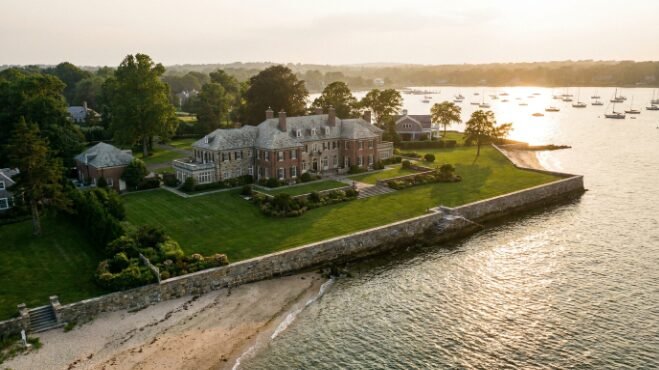
I think about this sometimes when I’m showing waterfront on the South Fork. The view from those properties includes water that once fed an industrial extraction operation employing thousands of people, that then went nearly silent ecologically, and that is now coming back to something closer to what it was. That arc is worth knowing. It’s part of what the East End actually is, beneath the surface you can see from the deck.
Real estate markets change. This post reflects conditions as of the publish date. For current listings and market data, contact Pawli at Maison Pawli.
Sources
– Atlantic States Marine Fisheries Commission — Atlantic Menhaden FAQs and stock assessment history: https://asmfc.org/news/fact-check/atlantic-menhaden-faqs/ – ASMFC Atlantic Menhaden Management Plan, Amendment 2 (2012): https://asmfc.org/species/atlantic-menhaden – H. Bruce Franklin, The Most Important Fish in the Sea: Menhaden and America (Island Press, 2007) – Hampton Bays Historical & Preservation Society — Menhaden / Bunker fishing history, Promised Land: https://www.hamptonbayshistoricalsociety.org/blog/debunking-the-hamptons/ – Montauk Library Archives — “Throwback Thursday: Menhaden and Men”: https://montauklibrary.org/throwback-thursday-menhaden-and-men/ – East Hampton Star — “The Mast-Head: Industrial Days”: https://www.easthamptonstar.com/opinion-columnists/2025116/mast-head-industrial-days – Chesapeake Bay Foundation — Atlantic Menhaden: https://www.cbf.org/about-the-bay/chesapeake-wildlife/menhaden/index.html – NOAA Fisheries — Atlantic Menhaden: https://www.fisheries.noaa.gov/species/atlantic-menhaden