The Landlord Nobody Remembers: How the Vanderbilt Estate Breakup Shaped Modern Centerport
There is a particular quality to neighborhoods that were assembled in a single event — a land rush, an estate breakup, a developer’s master plan — rather than grown incrementally over generations. Jane Jacobs called it grain: the texture of a place, the diversity of its building ages and lot sizes and uses, the evidence that many different people made many different decisions across many different years. Instant communities, assembled from a single source in a compressed window of time, often lack grain. They have consistency instead. Which is a different thing, and not always better.
Centerport, on the North Shore of Suffolk County, has a more complicated version of this story than most. Its relationship to the Vanderbilt name is real but often misunderstood — and getting it right matters for understanding the neighborhood’s character and, for buyers, understanding what they’re actually purchasing when they buy there.
The Estate and Its End
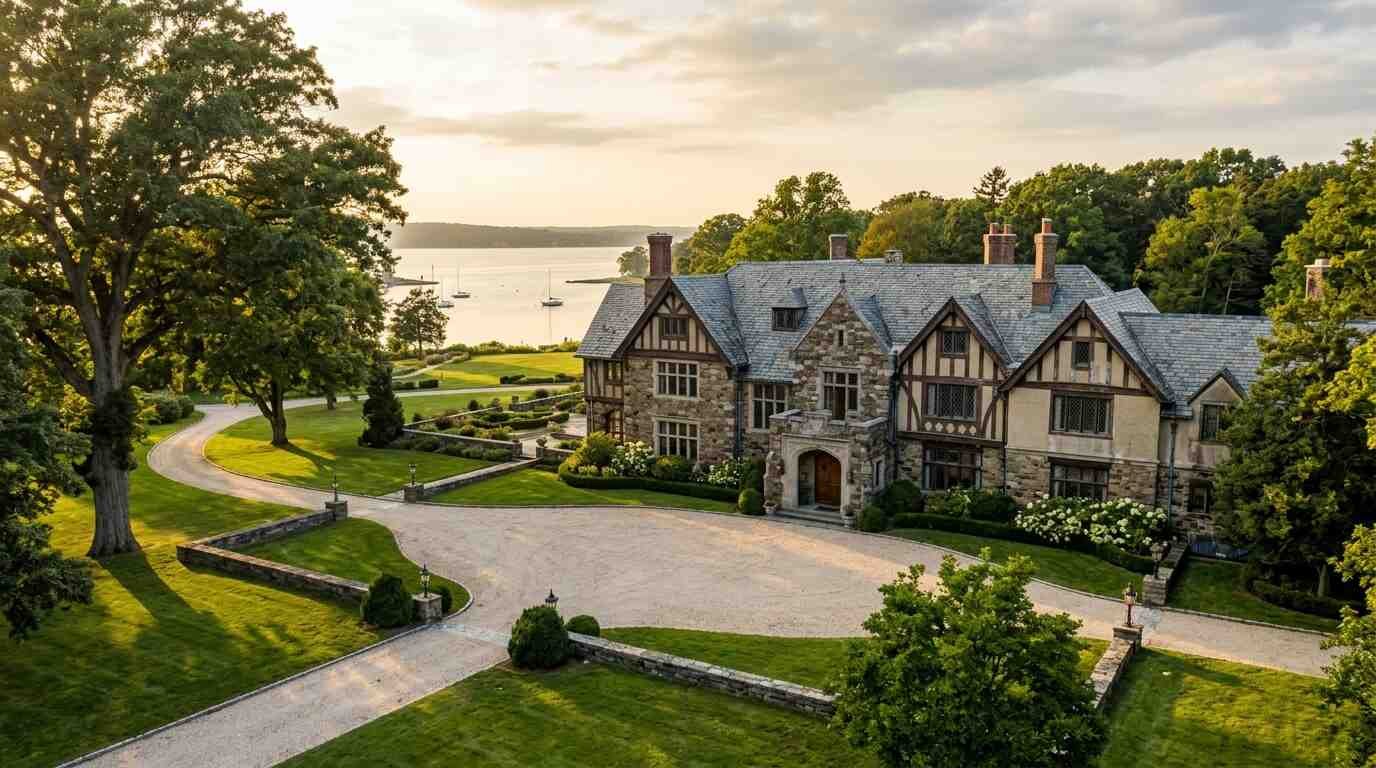
William Kissam Vanderbilt II acquired Eagle’s Nest — his North Shore estate on Little Neck Road in Centerport — in the early twentieth century, developing it over several decades into a compound that included the main house, a marine museum housing his yacht collection, and surrounding acreage on Centerport Harbor. He died in January 1944. His will directed that the estate and its contents be preserved for public benefit, and after a period of settlement the property passed to Suffolk County, which opened it as the Suffolk County Vanderbilt Museum and Planetarium — the institution it remains today.
What makes the Vanderbilt story useful for understanding Centerport today is not the specific parcel-by-parcel history of what the family held and when it sold — that level of detail lives in Suffolk County deed microfilm and requires primary research to get right. What matters is the broader pattern: the postwar years brought substantial residential development to the Centerport-Greenlawn corridor, arriving into a landscape that had been shaped by large-estate ownership for decades. The resulting neighborhood carries that history in its bones — in the relationship between harbor-adjacent properties and inland blocks, in the mix of pre-war estate-adjacent architecture and postwar residential construction, in the presence of the museum as a permanent public anchor on land that might otherwise have become another subdivision.
What an Instant Community Looks Like, Sixty Years Later
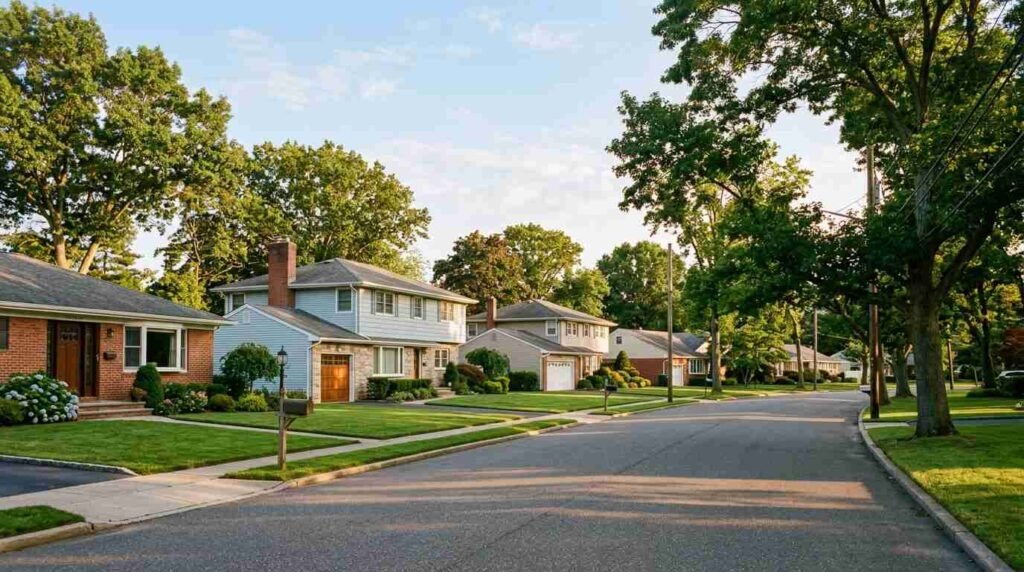
Jacobs was skeptical of neighborhoods assembled quickly from a single source, and her skepticism holds up well as a diagnostic tool even where it doesn’t produce a clean verdict. The question she would ask of Centerport is not whether it is pleasant — it is — but whether it has the complexity that sustains community health across generations: varied building ages, a mix of uses and densities, streets that feel inhabited rather than merely residential, the sense that the neighborhood grew from many decisions rather than one.
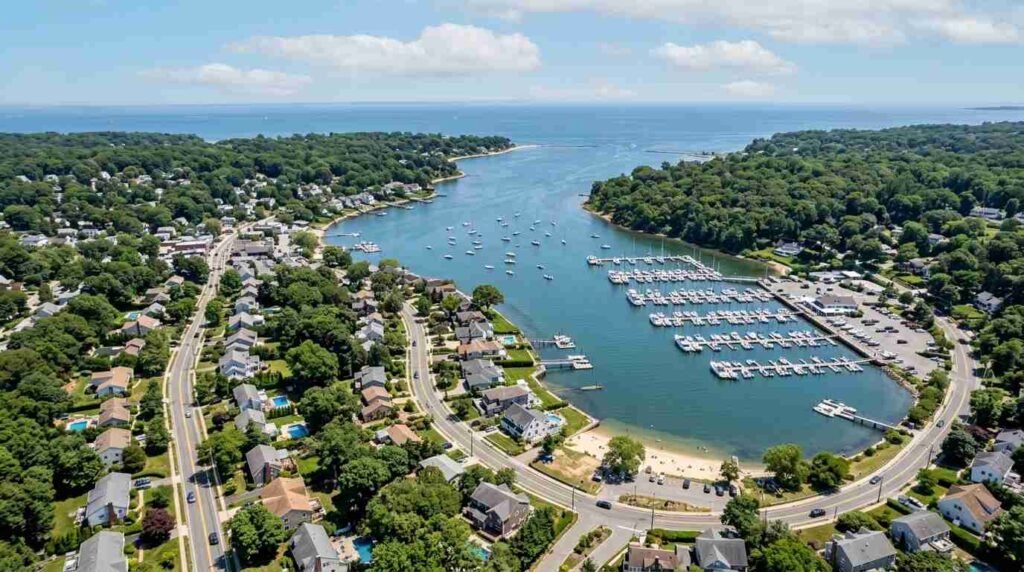
The answer in Centerport is mixed in interesting ways. The postwar residential blocks have the consistency Jacobs cautioned against — a uniformity of scale and period that reflects development arriving in waves rather than accreting slowly. But Centerport’s geography complicates this. The harbor is a genuine amenity that generates the kind of mixed activity — boating, fishing, the Centerport Yacht Club, the Vanderbilt Museum itself — that Jacobs would recognize as healthy: regular, varied, drawing people with different purposes to the same waterfront. And the presence of the museum as a permanent public institution has given the neighborhood an anchor that purely residential developments typically lack. Whatever Centerport’s grain problems may be, it has at least one institution that functions as Jacobs’s anchor: a place that generates daily activity, that connects the neighborhood to a broader public, that has accumulated community memory across generations.
Greenlawn, immediately to the north and west, has a somewhat different character — more commercial presence along Pulaski Road, a longer history of working-class and middle-class residential development that predates the postwar boom, and a different relationship to the estate history. The two communities are often bracketed together, but they feel different on the ground, and that difference has real estate implications. Centerport skews toward waterfront and estate-adjacent properties, with prices to match. Greenlawn offers more accessible price points and a more varied housing stock. Buyers who assume they’re interchangeable are usually surprised when they spend time in both.
Deed Restrictions and the Long Shadow of the Estate Era
One thing that consistently surprises buyers in neighborhoods assembled from large estate breakups is the persistence of deed restrictions from that original subdivision moment. When a single landowner divides a large parcel and sells lots, they frequently attach restrictions intended to maintain the character they’re selling — minimum lot sizes, setback requirements, limitations on commercial use, prohibitions on further subdivision. These restrictions run with the land, not with the owner who imposed them, and they can survive long after anyone remembers their origin.
In the Centerport area, restrictions attached to parcels transferred in the mid-century period are still surfacing in title searches. Some are legally enforceable and directly relevant to renovation or development plans; others are technically expired or unenforceable but still cloud titles in ways that require legal resolution. Any buyer in this area — particularly anyone considering significant renovation, addition, or any kind of accessory structure — should commission a full title search with specific attention to historic deed restrictions and should have a real estate attorney review what surfaces. This is not optional due diligence; it is the foundational step.
The Vanderbilt Museum as Neighborhood Asset
I want to make a specific point about the museum that I think matters for how buyers evaluate Centerport as a place to live. The Suffolk County Vanderbilt Museum — Eagle’s Nest itself, on Little Neck Road — is not just a historical curiosity. It is an active public institution, with programming, events, a planetarium, and grounds that draw visitors from across the region. For residents, this means a genuine cultural amenity within walking distance of homes in the immediate area. For the neighborhood’s long-term health, it means a permanent institutional presence that is unlikely to be redeveloped, that maintains and improves the grounds adjacent to residential property, and that contributes to the kind of varied public activity that sustains neighborhood vitality.
This is not nothing. A great deal of the North Shore’s charm comes from exactly this kind of institutional anchoring — the Vanderbilt Museum in Centerport, the Cold Spring Harbor Laboratory a few miles east, the various historical properties and land trusts that keep large portions of the landscape out of residential development permanently. Buyers who understand what those institutions contribute to neighborhood character tend to weight their proximity accordingly. Buyers who are simply looking at square footage and school district rankings sometimes miss it entirely, and then wonder, a few years in, why they feel so settled.
Centerport’s schools fall within the Harborfields Central School District, which has a strong academic reputation and contributes meaningfully to demand and price stability in the area. The commute to Manhattan is real — the Centerport area is served by the Cold Spring Harbor station on the LIRR’s Port Jefferson branch, and the combination of train and local driving adds time. For buyers for whom the North Shore lifestyle is the point rather than the commute minimization, the tradeoff is usually worth it.
If you’re evaluating Centerport or the broader Centerport-Greenlawn corridor and want to understand how the neighborhood’s particular history shapes what’s available and what it’s worth, I’m glad to work through that with you at Maison Pawli. The estate era left a complicated legacy here — mostly positive, occasionally encumbering — and knowing which you’re dealing with before you make an offer is the kind of thing that determines whether the purchase becomes the home you intended.
Real estate markets change. Specific parcel histories and deed restriction details should be verified against Suffolk County deed records and with a licensed real estate attorney before any transaction. For current listings and market data, contact Pawli at Maison Pawli. This is for informational purposes only — consult a licensed attorney or financial advisor for your specific situation.
You Might Also Like
- The Covenant in the Deed: How Restrictive Covenants Shaped Long Island Neighborhoods
- Coopered and Forgotten: The Barrel-Stave Furniture of Centerport’s Vanderbilt Marine Museum
- The Cold Spring Harbor Phoenix: Buying and Saving Gold Coast Ruins
Sources
- Suffolk County Vanderbilt Museum and Planetarium, Centerport: vanderbiltmuseum.org
- Suffolk County Clerk’s Office — historical deed records: suffolkcountyny.gov/Departments/County-Clerk
- Huntington Town Assessor: huntingtonny.gov
- Jane Jacobs, The Death and Life of Great American Cities (Random House, 1961)
- Harborfields Central School District: harborfields.k12.ny.us
—
Centerport is one of the communities profiled in my North Shore Long Island Neighborhoods: The Insider’s Guide to Where to Live, which covers the broader North Shore from Cold Spring Harbor to Port Jefferson — schools, commute times, market context, and the neighborhood details that determine daily life.
Part of the Gold Coast Series: This post is one of fifteen pieces in the Maison Pawli Gold Coast cluster. For the full guide — surviving estates, architectural history, legal sediment, and what buyers need to know — visit The Gold Coast of Long Island: Gilded Age Estates, Architectural Heritage, and What Survives.