The Bent Wood Secret of Sagamore Hill: How Roosevelt’s Craftsmen Steam-Curved White Ash for the North Room’s Hidden Chair Rail
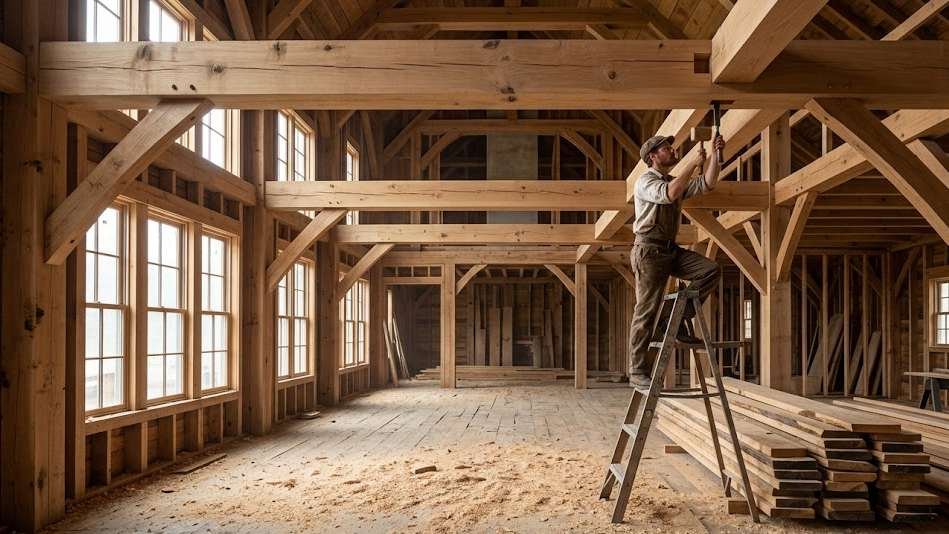
Every room in Sagamore Hill tells a story in objects. The mounted heads. The bear rugs. The gifts from foreign governments lined up along the walls like dispatches from a life too large for any single career. But there is another kind of story in that house, quieter than the taxidermy, embedded in the millwork itself — in the way the wood was cut, the species chosen, the method used to make it bend without breaking.
The North Room, added to Theodore Roosevelt’s Oyster Bay estate in 1905 to a design by architect C. Grant LaFarge, is the room everyone photographs. It cost $19,000 — roughly what the entire original house had cost twenty years earlier. Museum curator Susan Sarna has described its primary material as Philippine mahogany, flown in for a man who had just finished his first term as president and needed a room to match what he had become. The species mix documented in the room includes mahogany, black walnut, hazel, and swamp cypress — a selection that reads like a deliberate statement about reach and abundance, a president’s room built to receive emperors.
What interests me about the North Room is not the mahogany. It is what was done at the perimeter, at chair-rail height, where the grand volume of the room meets the human body.
The Chair Rail as Craft Document
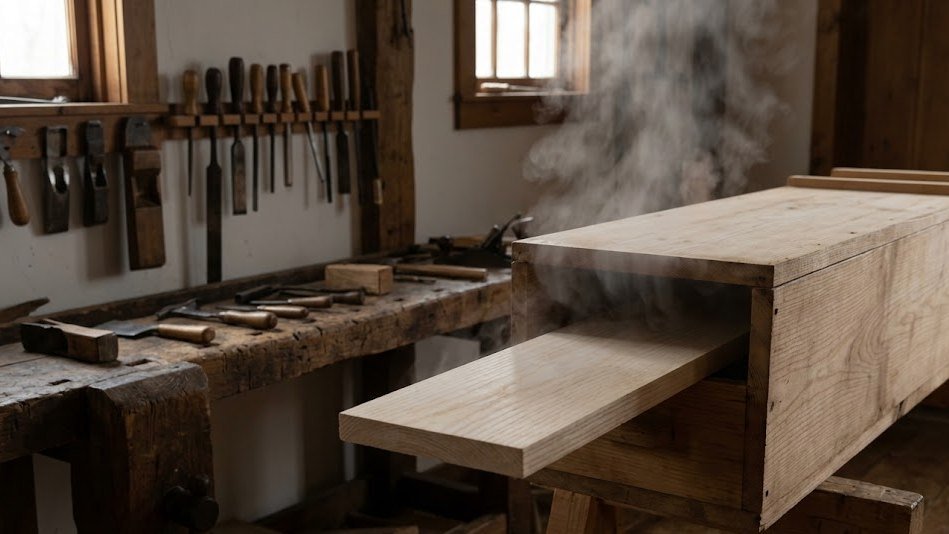
In a room of straight runs and rectangular proportions, a curved chair rail is a problem. You can solve it badly — kerf cuts on the back face, a series of short straight sections mitered together, the curve approximated rather than described — or you can solve it with steam. Steam bending is not the obvious choice for a millwork shop working in 1905. It is, however, the correct choice, and the choice that reveals something about which tradition the craftsmen came from.
Steam bending white ash for bent parts is not a Victorian mansion technique. It is a Windsor chair technique.
The connection is not romantic. It is material and geographic. Ring-porous species such as oak, ash, and hickory all rive and steam bend nicely — these woods are straight-grained and flexible and thus work well for slender parts. Windsor chair makers on Long Island and throughout the Northeast had been exploiting this property of ash for generations before the North Room was built. To achieve the distinct steam-bent back of a Windsor chair, furniture makers use a green log, freshly cut within six months — bent pieces and spindles are typically formed from ash, white oak, or hickory wood.
The steam-bending of ash for architectural millwork — as distinct from chair-making — is less thoroughly documented in period records, but the technique crosses over naturally. A journeyman who had spent years in a chair shop, or who had learned from someone who had, would reach for ash and steam before he reached for a saw.
The LaFarge Commission and What It Tells Us
The documented record of the North Room’s construction is unusually rich for a residential addition of its era. The Theodore Roosevelt Digital Library holds correspondence between Roosevelt and C. Grant LaFarge that covers material decisions in detail. In one exchange, William Loeb informs Hamilton Bell & Company that President Roosevelt desires wood to be substituted for plaster caps in the large room at Sagamore Hill in accordance with the estimate they sent. In another, LaFarge queries Roosevelt directly about the types of wood to be used — indicating that species selection was an active conversation, not a default.
The architect asked a number of questions regarding the types of wood to be used in the room, noting that some of the wood may be more expensive than Roosevelt could afford, but that if this were the case, LaFarge had other projects in which he could use it.
This is a useful window. LaFarge was not working from a fixed specification — he was working from a conversation with a client who had strong opinions and a budget. Wood choices were being made and negotiated in real time. The surviving records name the primary contractors: John V. Schaefer Jr. and Company received a $1,000 certificate of payment for the addition, and Fuller and Company received $205.60 for additional work. These are the firms whose craftsmen executed what LaFarge designed.
The chair rail itself does not appear by name in the correspondence I have been able to review. What the records establish is the context: this was a room built under active architect supervision, with documented contractor involvement, where material decisions were being made deliberately and at the client’s direction. A craftsman choosing to steam-bend ash for a curved run of chair rail in this context would not have been improvising — he would have been bringing a skill he already possessed.
The Windsor Chair Connection to Oyster Bay
Long Island had an active tradition of Windsor chair making centered in Hempstead and spreading north and east through Nassau County in the eighteenth and nineteenth centuries. Windsor chairs are, among other things, a laboratory of bent wood joinery. The back and sometimes the arm pieces of Windsor chairs are formed from steam-bent pieces of wood — ash, oak, and hickory all rive and steam bend nicely.
The craftsmen who built on the North Shore estates in the early twentieth century did not arrive from nowhere. Many came from local traditions — from shops that had been making furniture and architectural millwork in Nassau and western Suffolk County for generations. The techniques that worked for a Windsor bow-back translated, with adjustment, to a continuous curved run of chair rail. The material science is identical: you need a ring-porous species with long, straight grain, you need steam, you need a form, and you need time.
Ash was the common answer. Oak would work too, and may have been used in the straight runs — but oak is less forgiving on tight curves, more prone to spring-back without careful forming and drying. A craftsman who had worked with ash in a chair context would not forget that.
What the Grain Tells You
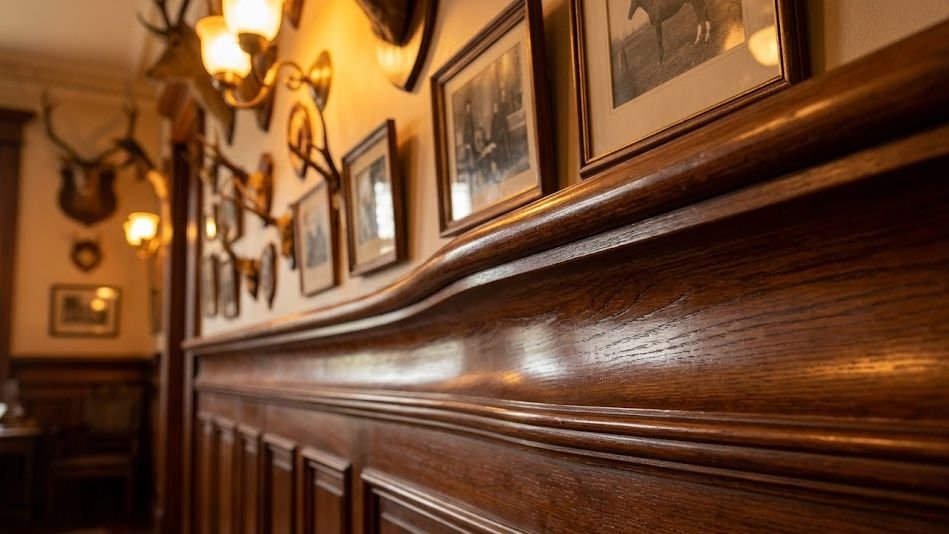
Steam bending leaves a signature. On the concave face of a bent piece — the inside of the curve — the wood fibers compress. Under finish, this compression can appear as a very slight difference in grain texture or, in some light conditions, as a faint regularity in the figure. On the convex face, the fibers stretch. This is where steam-bent pieces sometimes fail: the tension exceeds the wood’s capacity and the grain fractures, or checks. Ash tolerates this tension better than most species because its grain structure is long and elastic when green.
A kerf-cut approximation of a curve shows something different in the grain: the cuts interrupt it entirely. A short-sectioned mitered curve shows visible joints at the miter lines. A steam-bent run shows continuous grain following the curve — the wood bending the way wood bends when it is asked, not forced.
The North Room at Sagamore Hill is open to ticketed guided tours run by the National Park Service. It is one of the few presidential historic sites where, as curator Sarna has noted, nearly all of the furnishings and finishes are original — the exceptions being organic materials like curtains that have inevitably degraded. The woodwork you see in that room is the woodwork LaFarge’s contractors installed. It has been conserved, not replaced.
A Room Built to Last
The hand-crafted stone and woodwork and use of natural materials in Roosevelt’s addition borrows from the Craftsman and Arts and Crafts house plan styles — the simple but impressive woodwork on the walls, ceiling, and rail is influenced by those traditions. That Craftsman influence matters for understanding the chair rail. In Craftsman millwork, the logic of the material is not hidden — it is displayed. Wood that bends is expected to show that it was bent. The grain runs with the form. The making is part of the meaning.
A steam-bent ash chair rail in the North Room would not be an anomaly. It would be exactly consistent with the aesthetic commitments of the room’s architect and the craft traditions of the North Shore craftsmen who built it. It would be the decision of a journeyman who had learned to ask the wood a question before he asked the saw.
Sagamore Hill sits on Cove Neck Road in Oyster Bay, about twenty minutes from the Maison Pawli office. The grounds are free to visit; house tours require advance tickets through the National Park Service at nps.gov/sahi. If you go, stand in the North Room and look at the perimeter millwork. Look at the curve. Ask yourself how they did it.
This is for informational and historical purposes only.
Sources
- Theodore Roosevelt Digital Library — LaFarge correspondence and construction records: theodorerooseveltcenter.org
- Wikipedia, “Sagamore Hill”: en.wikipedia.org/wiki/Sagamore_Hill
- C&I Magazine, Susan Sarna interview: cowboysindians.com/2016/07/theodore-roosevelts-summer-white-house/
- Wikipedia, “Windsor Chair”: en.wikipedia.org/wiki/Windsor_chair
- Windsor Chair Shop of Lancaster County: pachairmaker.com/windsor-chair-styles
- NPS Historic Structure Report — Carden & Crisson, 1988: npshistory.com/publications/sahi/hsr-new-barn.pdf
- Library of Congress, North Room photographs: loc.gov/item/2006676020/
- The Plan Collection, Sagamore Hill Craftsman woodwork: theplancollection.com