Nassau County vs. Suffolk County: Which Should NYC Transplants Choose?
Everyone picks Long Island. Almost nobody thinks hard enough about which half.
I’ve been brokering across this island for over a decade, and the Nassau-versus-Suffolk question is one I navigate constantly — not just in buyer consultations but in the way people talk about “Long Island” as though it’s a single thing. It isn’t. The two counties have different tax structures, different price profiles, different commute geometries, and different daily textures. Making the wrong call for your lifestyle can mean years of a commute you resent, a budget stretched thinner than you planned, or a neighborhood that feels like it belongs to someone else’s idea of suburban living.
Here’s how I think about it.
The Core Difference Between Nassau and Suffolk
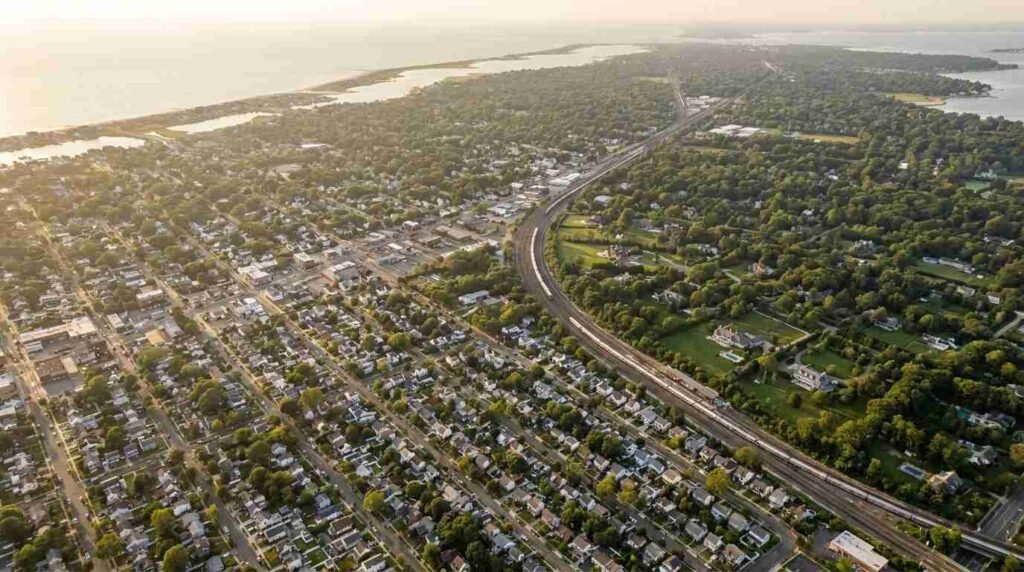
Nassau County is the western half — it begins where Queens ends and runs roughly 20 miles east to the county line near Bethpage and Farmingdale. It’s older, denser, and in many of its towns it still carries the walkable infrastructure of a pre-car suburb. Nassau is where Long Island’s post-war exodus from the boroughs first landed, and that legacy is visible in the tight blocks, the good train service, and the school districts that became famous before Suffolk’s were even built.
Suffolk County is everything east of that — a far larger footprint that runs from the Farmingdale/Bethpage line all the way to Montauk. It’s where the Island opens up: larger lots, more land between neighbors, more variation in character from town to town. The North Shore of Suffolk — my home market — runs along Long Island Sound from Lloyd Neck through Port Jefferson and beyond, and it has a particular quality that’s harder to quantify than a commute time but very easy to feel when you’re in it.
The simple version: Nassau is closer and denser. Suffolk is farther and more spacious. But the details are where the real decision lives.
Commute Times: Nassau Wins on Distance, Suffolk Wins on Space
If daily commuting to Manhattan is non-negotiable for you, Nassau has a structural advantage. The LIRR’s western Nassau branches — Port Washington, Great Neck, Garden City/Hempstead — put you at Penn Station in 30–50 minutes. That’s a commute that functions like a subway extension, not a long-distance journey.
Eastern Nassau and western Suffolk (Huntington, Smithtown, Ronkonkoma branches) stretch that to 65–90 minutes depending on the line and whether express service is running. From mid-to-eastern Suffolk — Stony Brook, Port Jefferson, Riverhead — you’re looking at 90–110 minutes on an express run, longer on a local.
The table that matters:
| Area | Approx. LIRR Time to Penn Station |
|---|---|
| Great Neck / Port Washington | 30–45 min |
| Garden City / Mineola | 35–45 min |
| Huntington | 65–80 min |
| Smithtown | 75–90 min |
| Stony Brook / Port Jefferson | 95–110 min |
What hybrid work has done to this calculation is significant. Buyers who commute two or three days a week routinely choose Suffolk towns with longer travel times because the commute is an event rather than a daily drain. At twice a week, 95 minutes on the LIRR is a book, a podcast, and a coffee — not a sentence. At five days a week, it’s a different life.
Home Prices: What Each County Gets You for Your Budget
Nassau is more expensive, particularly in its premium zip codes. Median sale prices in sought-after Nassau towns — Great Neck, Garden City, Manhasset, Port Washington — routinely run $800,000 to well over $1 million. You’re paying for proximity to the city and the density of amenities that comes with it.
That said, Nassau has value pockets. Towns like Mineola, New Hyde Park, and Elmont offer significantly lower price points — you can find solid three-bedroom homes in the $500,000s — though inventory is competitive and conditions move quickly.
Suffolk’s price profile is wider. The North Shore’s premium villages — Cold Spring Harbor, Lloyd Harbor, Nissequogue — run well into the millions, comparable to Nassau’s top markets. But mid-Suffolk towns like Smithtown, Setauket, Miller Place, and Sound Beach offer three- and four-bedroom homes in the $500,000–$750,000 range with considerably more land and space. For a buyer who wants the most house per dollar, mid-Suffolk consistently delivers.
OneKey MLS data from early 2026 shows Suffolk’s median sale price running roughly 10–15% below Nassau’s, though that gap narrows in premium North Shore locations. The more meaningful comparison is square footage and lot size per dollar — and Suffolk wins that calculation handily outside its own premium markets.
Property Taxes: A Side-by-Side Comparison
Both counties have high property taxes relative to the national average. Nassau’s are typically higher. Here’s the honest version:
Nassau County has some of the highest effective property tax rates in the United States. On a $750,000 home in a good school district, annual taxes can run $15,000–$22,000 or more. Nassau’s tax grievance process is both widely used and genuinely productive — many owners successfully reduce their assessments — but the baseline is real.
Suffolk County taxes are lower, though still well above national norms. On a comparable home in a strong Suffolk school district, expect $10,000–$14,000 annually, depending on the specific municipality and district. The variation between adjacent districts can be meaningful.
Both counties offer the STAR exemption for owner-occupied primary residences, which reduces school taxes. Apply for it immediately after closing — the deadline matters. For more on how Long Island property taxes actually work, How Property Taxes Work in Suffolk County: What Buyers Need to Budget Before They Close is a good reference.
Property tax amounts vary significantly by municipality and school district. Consult a tax professional for estimates specific to a property you’re considering.

School Districts Worth Knowing in Each County
Nassau: Great Neck, Manhasset, Jericho, Garden City, and Syosset consistently appear at the top of district rankings and anchor some of Nassau’s highest home prices. Port Washington and Herricks are strong without carrying the same premium. Plainview-Old Bethpage is a frequently overlooked district with good performance and somewhat lower prices than its neighbors.
Suffolk: Three Village Central (Setauket/East Setauket/Stony Brook area) and Cold Spring Harbor regularly rank among the strongest in the state. Northport-East Northport, Half Hollow Hills, and Smithtown Central are consistently well-regarded. For buyers considering the North Shore, Best School Districts in Suffolk County and What They Do to Price Per Square Foot gives a fuller picture of how district quality maps to home value.
The honest caveat: rankings aggregate a lot of factors that may or may not matter for your kids specifically. Use them as a starting point, not a final answer.
Lifestyle Vibe: Walkable Towns vs. More Land and Quiet
This is the dimension that price and commute data can’t capture, but it’s often what determines whether someone stays put or regrets the choice.
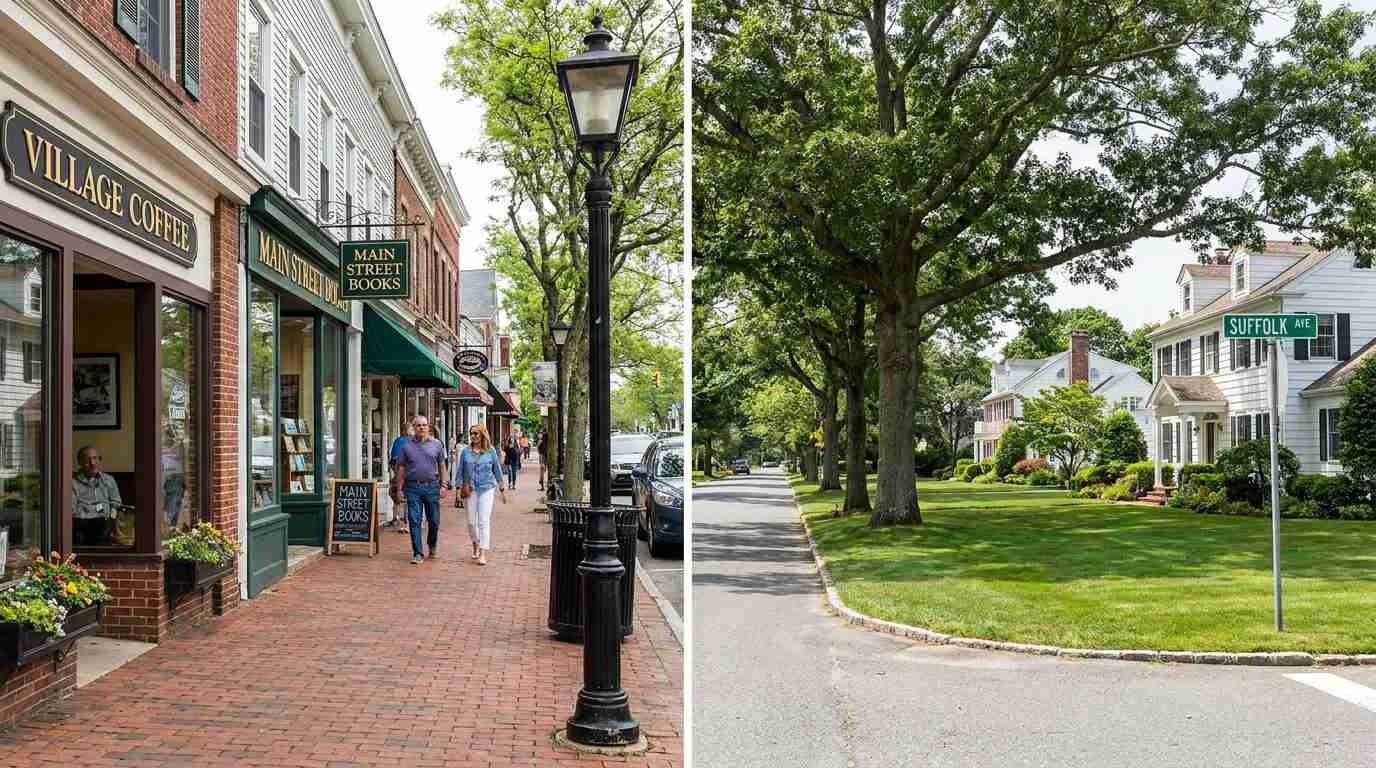
Nassau’s denser towns — Great Neck Village, Port Washington village center, Garden City’s commercial streets — have a walkability and a sidewalk-life energy that feels familiar to people coming from Brooklyn or Queens. There are coffee shops, restaurants, and errands accessible on foot. The neighborhoods feel lived-in and layered.
Suffolk’s character is different. Towns like Huntington Village and Port Jefferson have genuine walkable centers — main streets with restaurants, shops, a harbor or waterfront nearby — but the residential fabric around them is car-dependent. The farther east you go, the more the landscape opens: bigger lots, more trees, longer distances between things, a rhythm that’s quieter and more self-contained.
Neither is better. They’re different answers to different questions. If you’re someone who will go stir-crazy without foot traffic and spontaneous discovery, western Nassau is probably your place. If what you’re actually craving is space, privacy, and the ability to exist outside without being on a sidewalk, Suffolk’s offer is more genuine.
Which County Is Better for Families with Kids?
Both have excellent options, and the honest answer is that school district matters more than county.
For families who prioritize walkability and want their kids to be able to move through their neighborhood on foot or by bike — to friends’ houses, to town, to activities — Nassau’s denser towns have a structural advantage. The infrastructure for that kind of childhood is baked in.
For families who want land, outdoor space, and a slower pace — backyard summers, more room between households — Suffolk’s residential fabric delivers that more reliably at a lower price point. The trade-off is that most activities require driving, and that becomes a real scheduling factor once kids are in two or three activities simultaneously.
The families I’ve seen happiest on the North Shore are the ones who leaned into what Suffolk actually offers rather than looking for Nassau at a lower price. It’s a different life. For many people — including people who thought they wanted something else — it turns out to be exactly the right one.
The Verdict: How to Decide Based on Your Actual Priorities
If you’re commuting to Manhattan five days a week and walkability matters daily: Nassau, western towns.
If you’re commuting two or three days a week and space is more important than density: Suffolk, North Shore or mid-Island.
If budget is the primary constraint and you can tolerate a longer commute: mid-Suffolk, where the dollar stretches the furthest.
If schools are the non-negotiable variable and budget allows: run the specific district comparison before picking a county — the best districts exist in both, and the price premium follows the district, not the county line.
If you’ve never spent real time in Suffolk and are making this decision on paper: visit. Drive through Huntington on a Saturday morning, walk the harbor in Port Jefferson, find a spot on the Sound somewhere in Mount Sinai or Setauket and sit for a while. The North Shore has a quality that doesn’t photograph well and doesn’t appear in any ranking — but it’s the thing that keeps people here for decades once they find it.
Real estate markets change. For current listings and market data, contact Pawli at Maison Pawli.
Sources
- OneKey MLS median sale price data by county, 2026
- MTA Long Island Rail Road branch maps and timetables: new.mta.info/agency/long-island-rail-road
- Nassau County Department of Assessment: nassaucountyny.gov
- Suffolk County Comptroller property tax information: suffolkcountyny.gov
- NYS STAR exemption program: tax.ny.gov/pit/property/star/
- Niche school district rankings: niche.com
- New York State Education Department school report cards: data.nysed.gov