Above the Arctic Circle, a Hotel Made of Ice Begins Again Every November
Every spring it melts into the Torne River. Every winter, a crew of artists, engineers, and ice sculptors from twenty countries comes back to build it again from the beginning.
Jukkasjärvi is a village of approximately eight hundred people in Swedish Lapland, two hundred kilometers north of the Arctic Circle, on the bank of the Torne River. The river freezes in November and stays frozen until May. This is the source material. In 1990, a group of artists from Japan proposed installing an exhibition in a cylindrical structure built from ice and snow on the frozen river. Guests asked to sleep in it. The ICEHOTEL was not designed; it was discovered.
The Annual Reconstruction
The ICEHOTEL that exists each winter is not an iteration of the one that came before it. It is a new building, conceived from scratch by a rotating cohort of artists selected through a global open call that draws submissions from hundreds of designers, architects, and sculptors worldwide. Each year’s call is competitive; each year’s roster of accepted artists is different. The only structural continuity is the site, the river, and the accumulated knowledge of the construction team, which has developed over three decades a set of techniques for working with ice and snow at scale that has no equivalent anywhere else.
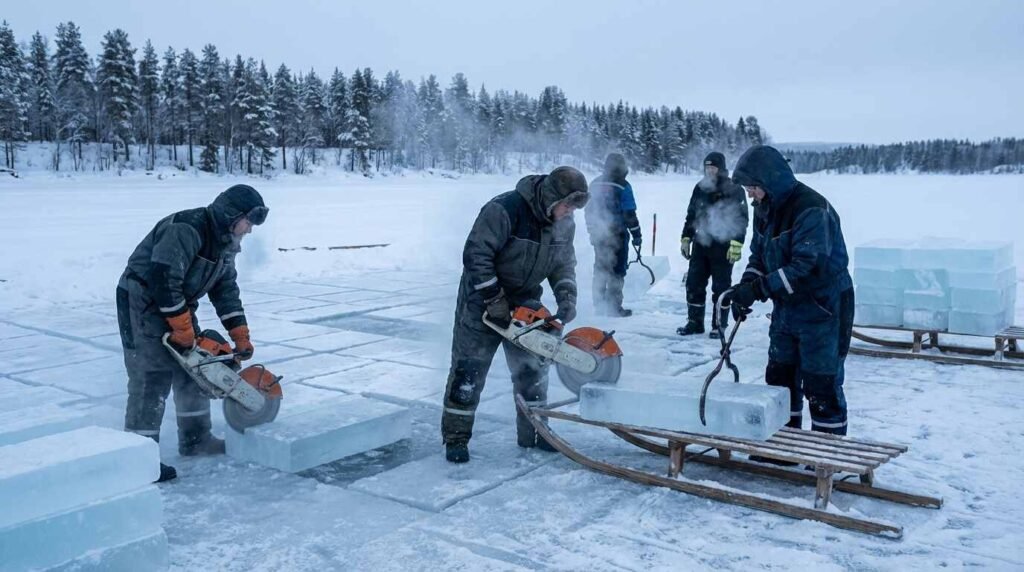
The building material is harvested from the Torne River in early spring of the preceding year — ice with particular properties, cut in blocks and stored in a facility on site. The Torne’s ice has qualities that distinguish it from other sources: the river runs from Swedish mountains, the water is clean, and the freeze is deep enough to produce blocks of the thickness required. The quality of the ice affects what is possible to carve: grain, opacity, the way light moves through different thicknesses. The artists who have worked multiple seasons develop preferences about which blocks suit which effects.
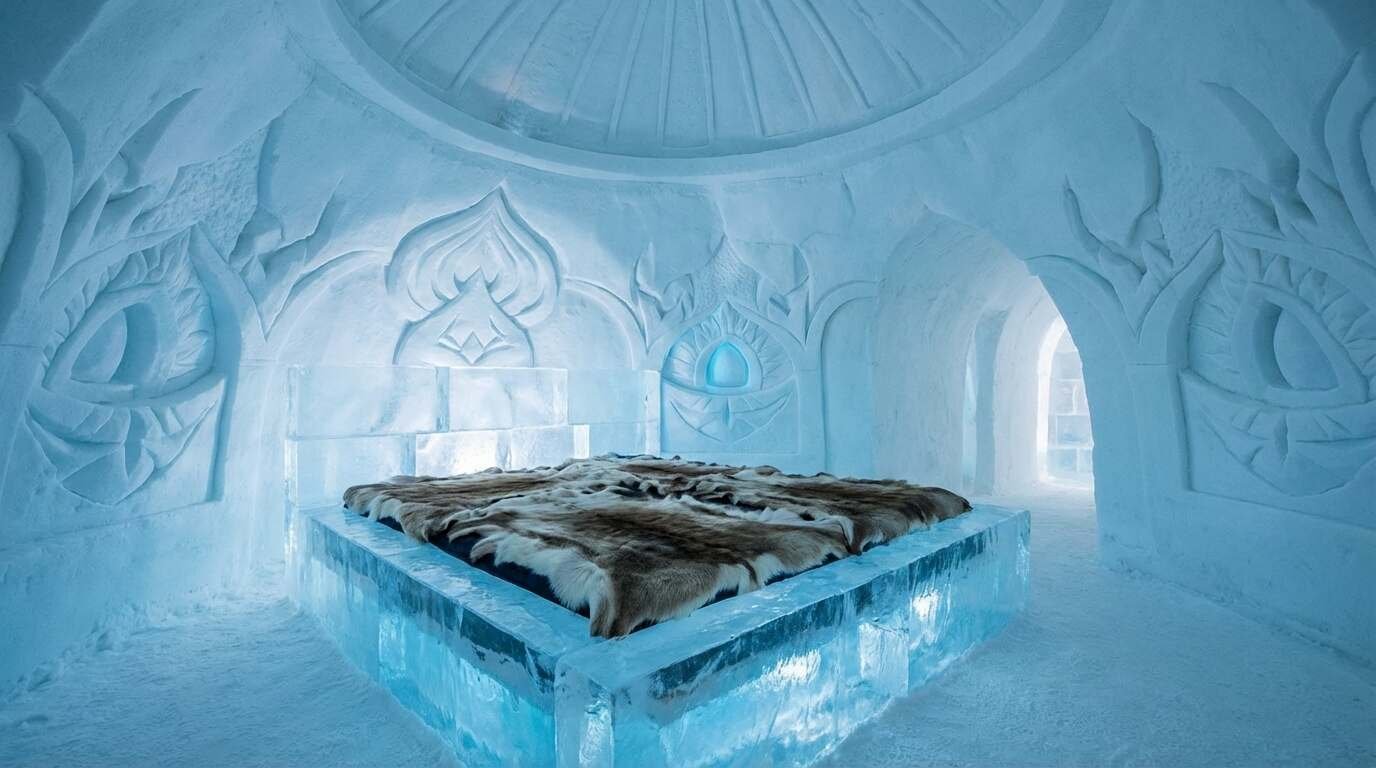
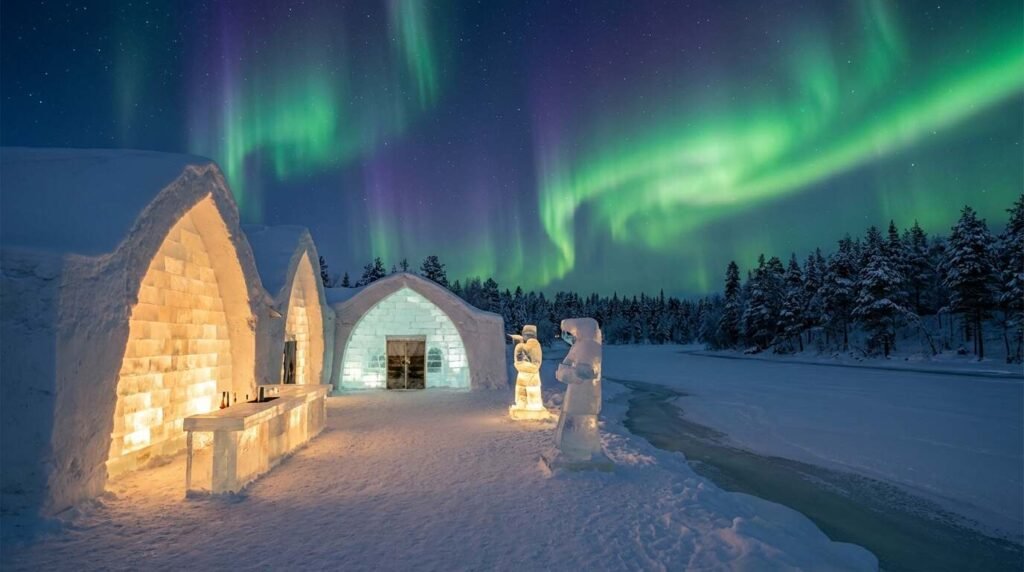
Construction begins in November. The exterior structure — the ICEHOTEL’s arched corridors and gallery spaces — is built first from snice, a compressed snow-ice mixture that can be formed over inflatable molds and removed when set. The artist rooms are built inside this structure, each one a separate installation: walls, ceiling, and furniture carved from clear river ice, the forms determined by the artist’s design and by what the material will permit. The ambient temperature inside the hotel is maintained at minus five degrees Celsius. Guests sleep under reindeer hides on beds carved from ice. The sleeping bag provided has a rating appropriate for the temperature, which sounds more uncomfortable than it is.
What the Rooms Have Been
The design archive of the ICEHOTEL — rooms built, photographed, and melted since 1990 — represents an unusual body of site-specific installation art. The constraints are absolute: the material is ice and snow, the temperature must stay below zero, and the room will not exist in four months. Within those constraints, the work has ranged from the straightforwardly beautiful — rooms that use ice’s light-refracting properties to produce effects of extraordinary delicacy — to the structurally ambitious: rooms carved to suggest cathedral vaults, undersea caverns, geological formations, abstract topographies.
Dezeen and Architectural Digest have covered the ICEHOTEL extensively over the years, and the coverage has the quality that good architectural writing acquires about genuinely strange buildings: a struggle to convey the three-dimensional experience of the work through images. The rooms photograph well, but the photographs cannot reproduce the quality of light inside them — diffuse, blue-white, filtered through ice walls that range from six inches to three feet thick. The light inside an ice room is a different substance from daylight. Artists have described working with it as working with a material that has no equivalent in any other medium.
In 2016, the ICEHOTEL introduced a permanent year-round section — ICEHOTEL 365 — maintained by solar-powered refrigeration. The year-round rooms are designed by a separate cohort of artists and are available in summer, when the surrounding landscape is green and the midnight sun operates through June and July. The experience of sleeping in ice rooms while daylight persists through the night is genuinely disorienting in a way that the advertising photographs suggest but do not adequately convey.
Jukkasjärvi Beyond the Hotel
The village exists in a relationship with the ICEHOTEL that is not uncomplicated — the hotel is the dominant economic fact of the community, and the community was here long before the hotel. The Sámi people have inhabited this region for centuries; their presence, their reindeer herding, and their relationship to this landscape predate every construction on the Torne’s banks. The ICEHOTEL has worked to incorporate Sámi cultural participation into its program, though the relationship between tourism, development, and indigenous land use in Lapland is a subject that the hotel’s promotional materials address less directly than the scholarship on it.
The activities available around Jukkasjärvi in winter — dog sledding, snowmobiling, reindeer safaris, northern lights viewing — are organized by a combination of ICEHOTEL-affiliated operators and independent guides, many of them Sámi-owned. The northern lights operate independently of all of them. This far north, in a dark winter sky without significant light pollution, auroral activity is frequent enough that a stay of three or four nights will usually produce at least one significant display. The phenomenon is not describable in advance. It requires darkness, cold, patience, and luck, and then it requires no description.
The Experience of Cold
Minus five degrees Celsius inside the hotel is an ambient temperature that the body adjusts to within minutes of entering from the outdoors, where January temperatures around Jukkasjärvi average minus fifteen to minus twenty. The physiology of cold acclimatization at this scale is well documented by cold-climate researchers: the body’s peripheral circulation adjusts, the sense of cold sharpens and then normalizes, and what was initially alarming becomes, over hours, simply the temperature. Guests who have stayed in the ice rooms consistently report that the cold is not the dominant sensation of the experience. What they remember is the light.
Cold does something specific to attention. It narrows the range of what seems important and clarifies what remains. The ICEHOTEL is extreme in the way that only a building scheduled for demolition by spring can be — everything about it is provisional, in a way that most buildings refuse to be. I find that clarifying. Most of what we build is an argument against impermanence. The ICEHOTEL is an argument for accepting it, and rebuilding anyway.
Sources
– ICEHOTEL official site: icehotel.com – Visit Sweden: visitsweden.com – Dezeen, ICEHOTEL architectural coverage: dezeen.com – Architectural Digest, ICEHOTEL features: architecturaldigest.com