Silk That Takes a Century to Fade: The Weavers of Varanasi and the Collectors Who Have Found Them
To understand what is happening in the narrow lanes of Varanasi’s Peeli Kothi district, you have to first accept a premise that runs counter to almost everything the contemporary market is built on: that some things improve with the passage of time not in spite of how they were made, but because of it. That the weave structure, the natural dyes, the silk threads drawn from cocoons by hands that have done it for generations — all of this produces something that accumulates rather than diminishes.
Banaras silk does not age gracefully. It ages magnificently. The distinction matters.
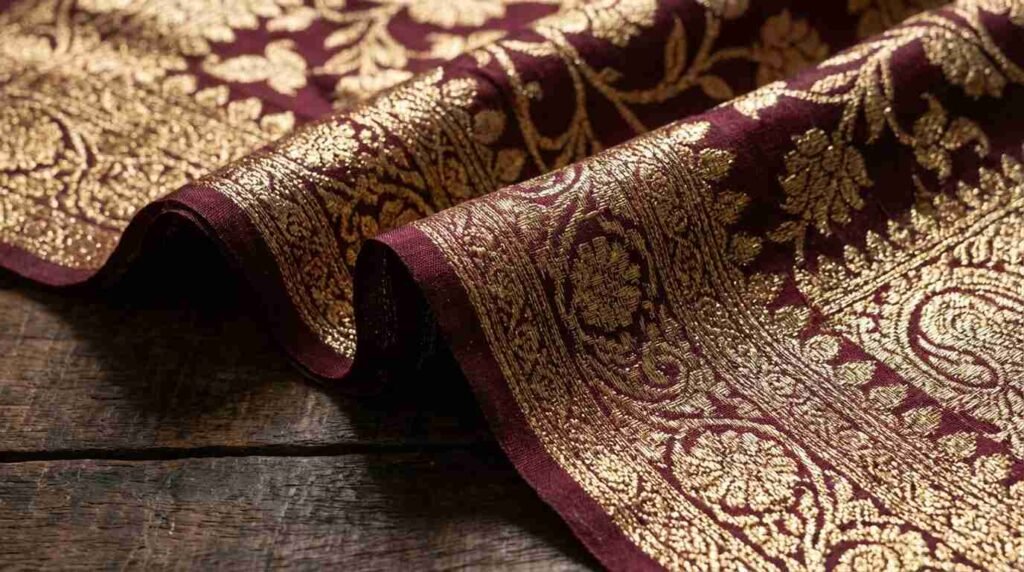
The Geography of the Loom
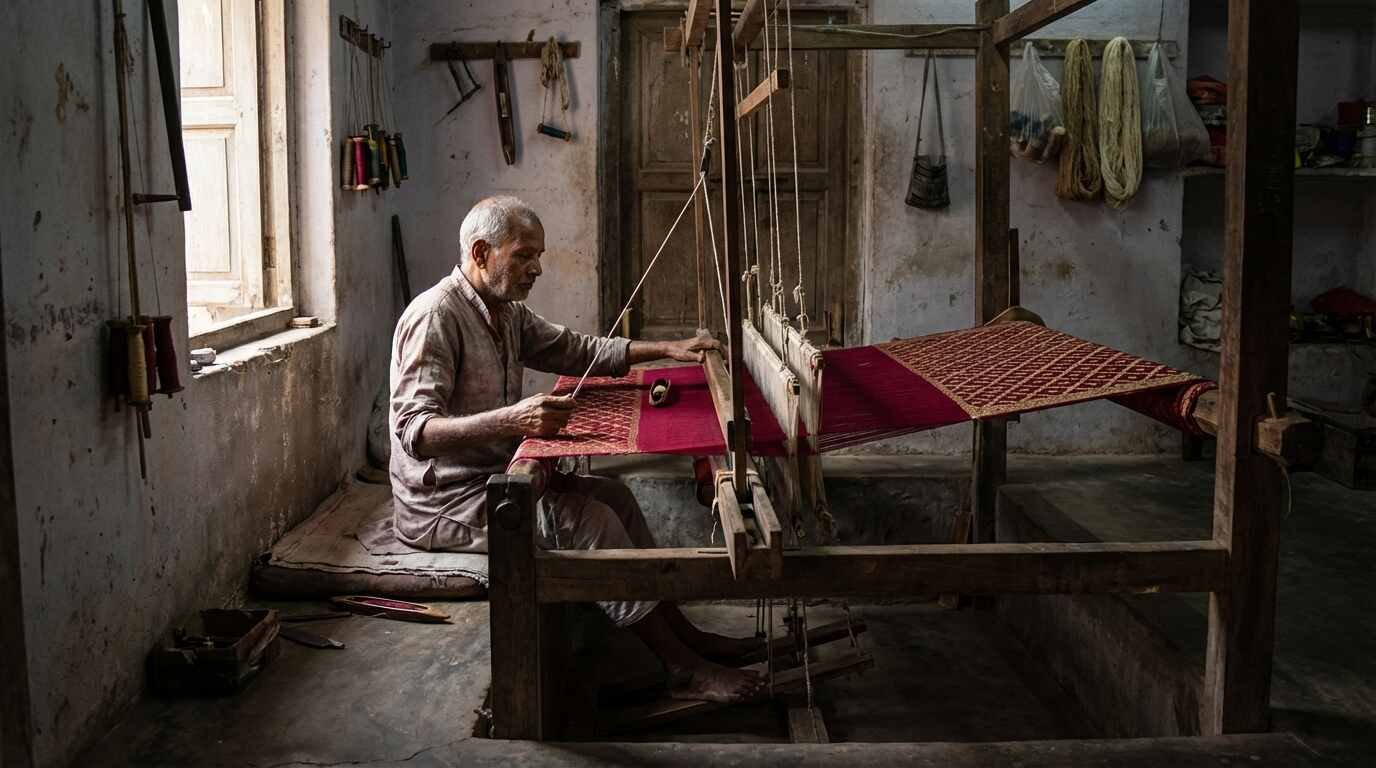
The pit looms of Varanasi sit below ground level — the weaver descends into a shallow trench to work the foot pedals — and the rhythm they produce is the ambient sound of the Peeli Kothi neighborhood. These are not museum objects. They are in active use in homes and attached workshops, producing fabric under a Geographical Indication tag registered under Indian law in 2009 (GI application No. 14), which legally defines what Banarasi fabric is and where it must be made.
The GI tag does what the Harris Tweed Act does in Scotland: it makes geography legally inseparable from the product. You cannot produce Banarasi silk outside Varanasi and call it Banarasi. The place is the credential.
The Weavers Service Centre in Varanasi maintains official records of registered master weavers. The numbers are not large. The skills required — the ability to read and execute a naksha card pattern, to manage the tension of multiple threads in a kinkhab or a tanchoi weave, to know by touch whether the zari work (the gold and silver thread inlay) is correctly integrated into the structure rather than merely applied to its surface — accumulate over decades. There is no shortcut to this knowledge, and the industrial alternatives that have proliferated in recent years — power-loom imitations that can produce a visual approximation at a fraction of the cost — have made the real thing easier to identify precisely because the imitations cannot replicate what happens to Banarasi silk over time.
What the Fashion Houses Understood
Tarun Tahiliani has presented internationally with Banarasi textiles, and the logic is the same logic Chanel applied to Harris Tweed: that the textile carries its own authority, that it does not need to be elevated by the design so much as met by it. Vogue India’s coverage of Tahiliani’s international presentations has consistently noted the way the fabric reads differently in person than in photograph — the way the zari catches light, the way the silk drapes with a weight and liquidity that synthetic alternatives cannot replicate.
Abu Jani Sandeep Khosla’s commissions for the Ambani wedding events in 2024 — documented by The New York Times among others — brought Banarasi weaves to an audience for whom provenance was already a primary consideration. These were not buyers who needed to be introduced to the concept of craft. They were buyers who had already arrived at the conclusion that only a handful of things in the world are still made the way they should be made, and that one of them comes from the pit looms of Varanasi.
The private collector market is quieter than the fashion coverage. There are people — on three continents, primarily — who have been commissioning directly from master weavers for years, bypassing both the retail fashion market and the souvenir-grade goods that crowd the Varanasi marketplace. These collectors are looking for specific things: particular weave structures, particular color relationships, particular gold weights in the zari. They correspond with weavers whose families have worked the same patterns for four or five generations. They understand that what they are acquiring is not a product but a document — a record of knowledge accumulated and transmitted across time.
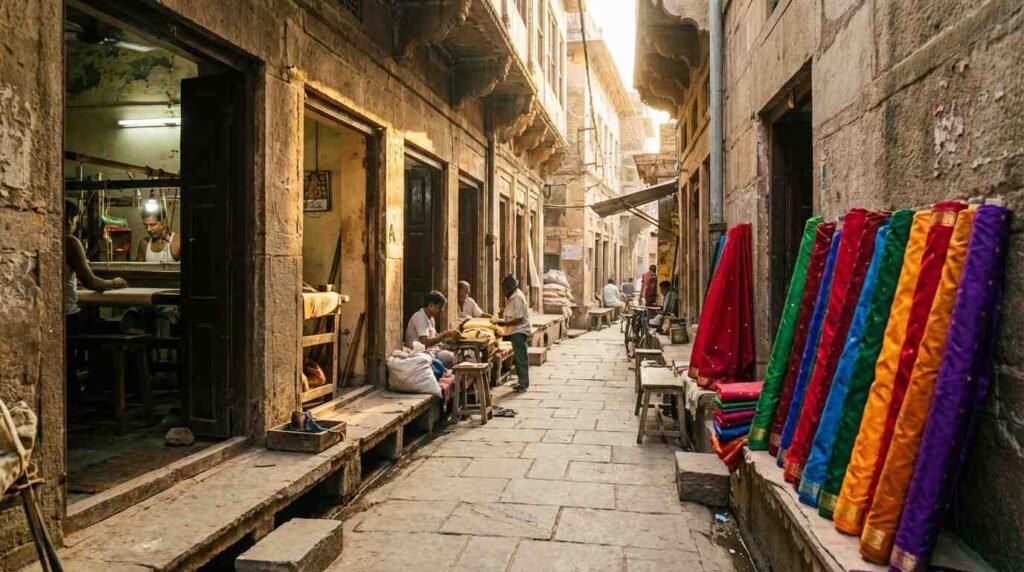
Savile Row, Facing East
I find myself drawn to the comparison the brief suggests and then leaves open: Varanasi as the Eastern equivalent of Savile Row. It is not a perfect analogy — the cultures of production are different, the traditions of bespoke commissioning operate under different social codes — but the underlying logic holds. Both are places where craft knowledge has resisted industrialization not through protectionism alone but through quality that industrial processes genuinely cannot replicate. Both produce objects that appreciate in the knowledge of the person holding them. Both have a private client culture that is more interesting than their public reputation.
What I recognize in the Varanasi collector community is something I see in the most serious buyers on the North Shore: the decision to pay for what lasts. Not for what looks impressive at the moment of acquisition, but for what will still be worth having in twenty years. The properties that hold value on the Sound are built the same way Banarasi silk is woven: slowly, with materials that improve under scrutiny, by people who understood that the work would outlast them.
A kinkhab woven in Peeli Kothi this year will, if properly cared for, be unwearable by one person but readable by many. The threads will not loosen. The colors — mordant-fixed, light-stable in ways that synthetic dyes are not — will shift toward amber and deep rust and gold, rather than bleaching toward nothing. A century from now, a collector who understands what she is looking at will understand exactly what it is.
This is not a small thing. In a market built on obsolescence, it is very nearly radical.
This post is for cultural and informational purposes. For questions about North Shore properties and the art of acquiring things that last, contact Pawli at Maison Pawli.