
Smith Point After Dark: The Loggerhead Sea Turtle Strandings That Are Quietly Rewriting What We Know About Cold-Stunning
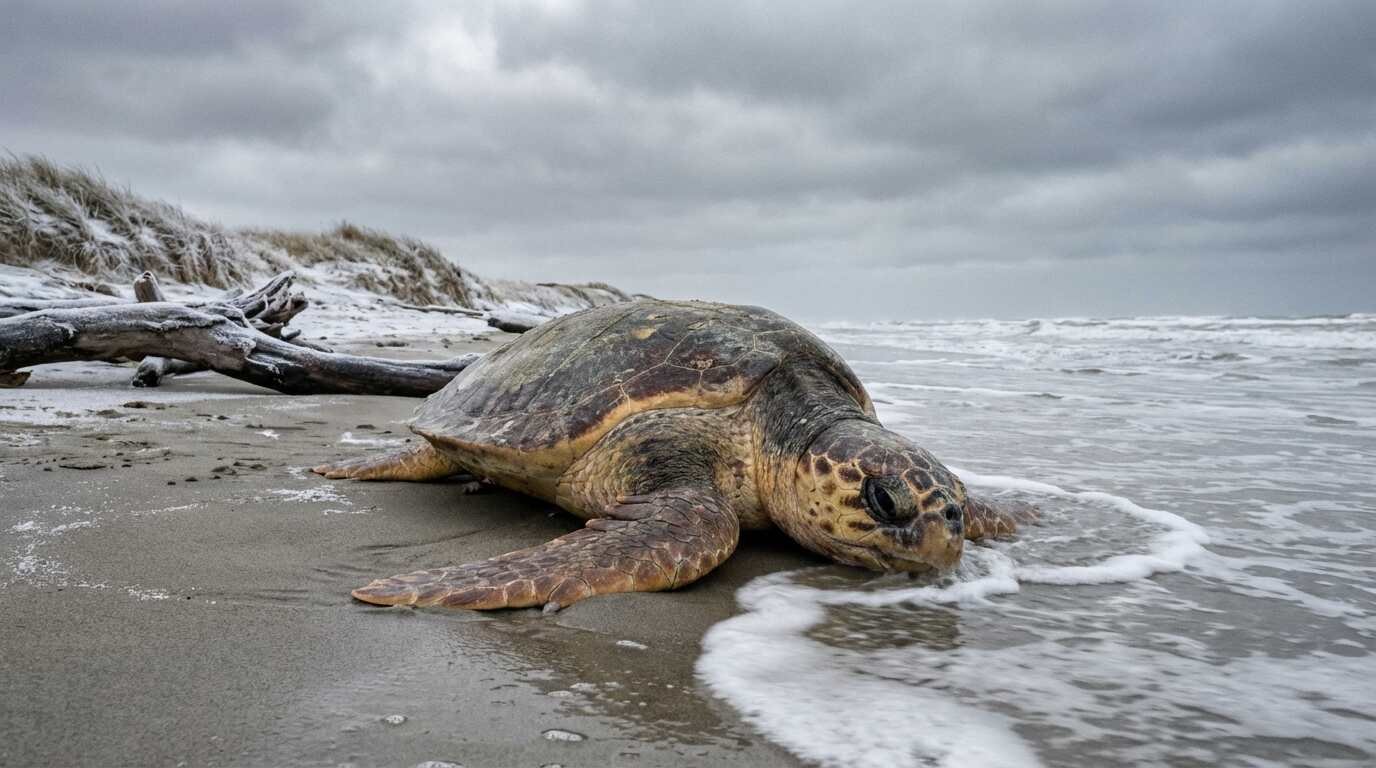
Each November, as water temperatures drop below 50°F in the waters off Fire Island, loggerhead sea turtles begin washing ashore at Smith Point Beach — alive, paralyzed, and fundamentally misunderstood by the models we use to predict their behavior.
I want to tell you what’s happening out there, because it’s one of the more extraordinary ecological events taking place on Long Island’s shoreline, and it’s largely invisible to the people who live closest to it. The beachgoers are gone by October. The park attendants are down to skeleton crew. And on the dark berm of Smith Point County Park, on the western edge of Fire Island National Seashore, a crisis is playing out on the sand — and a small team of researchers is waiting for it, every year, notebook in hand.
What Cold-Stunning Is
A loggerhead sea turtle (Caretta caretta) is an ectotherm — its body temperature tracks the temperature of the water around it. In the warm months, loggerheads range widely through the Atlantic, foraging on the benthic invertebrates of the continental shelf, moving north with warming waters in summer. They are capable of sustained open-ocean crossing but are not built for winter in the North Atlantic.
As autumn arrives and coastal waters begin to cool, healthy turtles are supposed to migrate south — following the 65°F isotherm as it retreats toward Florida and the Caribbean. Most do. Some don’t.
Cold-stunning occurs when a turtle fails to leave warm-water habitat before the temperature drops too fast for the animal to respond. Below approximately 50°F, metabolic function slows to the point of near-shutdown. The turtle becomes lethargic, loses its ability to swim, and eventually washes ashore in a state of hypothermic shock that presents, to an untrained eye, like death. The animal is alive. It is in crisis. And if it reaches the beach in time — before secondary pneumonia, shark predation, or boat strike finishes what the cold started — it can be recovered.
The mechanism has been understood in broad outline for decades. What has changed is the picture of where it happens and why — and that picture is being redrawn, in significant part, by data collected along the Smith Point shoreline.
The Riverhead Foundation’s Record
The Riverhead Foundation for Marine Research and Preservation, based in Riverhead at the headwaters of the Peconic River, operates one of the most extensive marine mammal and sea turtle rehabilitation programs on the northeast Atlantic coast. Their cold-stun response operation — which activates each autumn from roughly October through January — covers the entirety of Long Island’s South Shore beaches, with particular attention to Fire Island National Seashore, including Smith Point.
Their strandings database represents one of the longest continuous records of sea turtle cold-stunning in the Northeast — a longitudinal dataset that now spans decades and contains thousands of individual recovery events. This is not a small or anecdotal sample. It is a scientific record of considerable weight.
What that record has shown, increasingly clearly over the past two decades, is that the models built to predict cold-stun events were underestimating the role of the South Shore’s shallow bay systems as late-season foraging habitat.
The standard assumption was that loggerheads caught off New York in autumn were pelagic animals — open-water turtles that had simply failed to track the 65°F line south with sufficient urgency. The Riverhead Foundation data complicates this. A significant fraction of the turtles recovered from Smith Point and adjacent Fire Island beaches show signs of extended residence in the Great South Bay and adjacent barrier island waters — coastal, shallow-water habitat that warms faster than the open ocean in summer and cools faster in autumn. These animals were not just passing through. They were foraging in the bays, probably on blue crabs, spider crabs, and the benthic invertebrate communities of the bay bottom, and they were still there when the temperature crashed.
[VERIFY: Confirm current Riverhead Foundation stranding count figures and most recent annual cold-stun totals before publishing — their annual report should be publicly available on their website.]
Why Smith Point Specifically
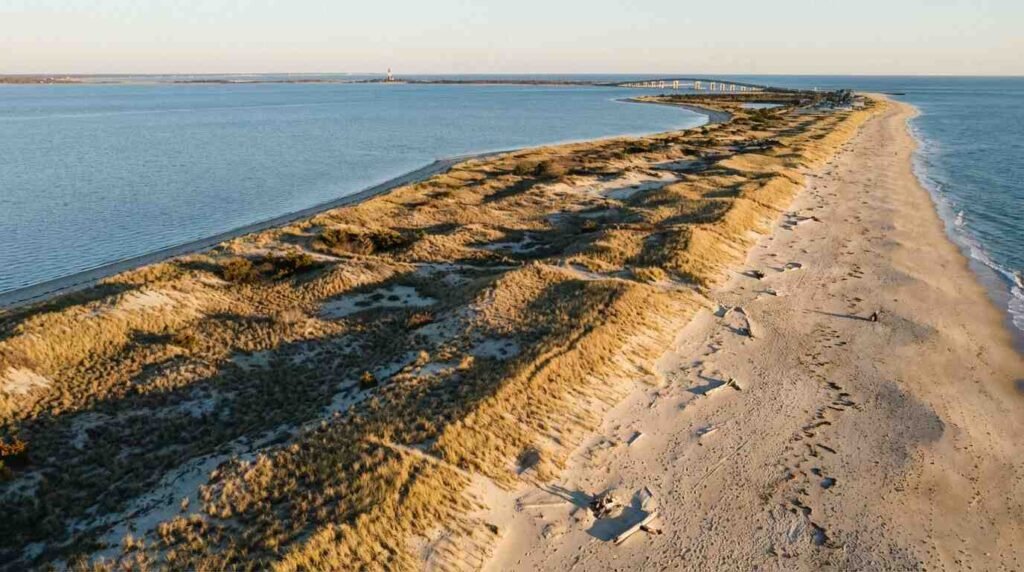
Smith Point Beach occupies a particular geographic position that concentrates cold-stunned turtles onto its shores with unusual efficiency. The beach forms the eastern end of Fire Island National Seashore’s western unit, at the Moriches Inlet — one of the major tidal exchange points between the Great South Bay and the Atlantic Ocean.
Tidal flow through Moriches Inlet is substantial. As bay water exits through the inlet during ebb tide, it carries with it anything that isn’t actively swimming — including a paralyzed loggerhead. The longshore drift along this section of the barrier beach then carries the animal westward, toward Smith Point’s broad beach face, where the relatively gentle bathymetry allows the turtle to ground before being dragged back into the surf.
This is not the only stretch of South Shore beach where cold-stunned turtles strand. The Riverhead Foundation documents recoveries along the full length of Fire Island and beyond, including on the North Shore when current patterns cooperate. But Smith Point has repeatedly emerged as a high-density recovery site — a natural concentration point created by the intersection of tidal mechanics, longshore drift geometry, and the foraging habitat that the adjacent bay system provides.
NOAA Fisheries’ Northeast Regional Office tracks these events as part of their broader Atlantic sea turtle monitoring program, and the Smith Point data has been incorporated into national cold-stun risk modeling.
What the Data Is Revising
The scientific literature on loggerhead cold-stunning — including work by Morreale and colleagues published in Marine Ecology Progress Series — established the foundational understanding that these events are driven by temperature drop rate, not just temperature threshold. A gradual autumn cooling allows behavioral thermoregulation: the turtle moves south incrementally. A rapid cold snap — the kind increasingly associated with atmospheric blocking events in the northeastern U.S. — compresses the departure window dramatically.
What the Riverhead Foundation’s longitudinal record adds to this picture is a spatial dimension that the earlier models lacked. By tracking the recovery locations, body condition, and (for animals large enough to accept them) satellite tags on rehabilitated turtles, researchers have been building a clearer map of where in the bay system these animals are foraging in the weeks before stranding — and how far they are from the open-ocean escape route that would allow them to head south.
The answer, in many cold-stun events, is: farther than we thought. Turtles are foraging deep into Moriches Bay, into the upper reaches of Great South Bay near the mainland shore, in waters that are essentially enclosed by the barrier island and accessible to the Atlantic only through the narrow tidal inlets. A rapid temperature event closes the trap before the animal can exit.
This has significant management implications. If loggerheads are consistently using South Shore bay systems as late-season foraging grounds rather than merely passing through the nearshore zone, then the protection of that habitat — its water quality, its benthic invertebrate communities, its accessibility through functioning tidal inlets — becomes a sea turtle conservation issue, not just a local water quality question.
The Peconic Bay eelgrass crisis and the Great South Bay’s ongoing nitrogen loading problems, which I’ve written about from a bayfront buyer’s perspective at The Eelgrass Crisis in Peconic Bay, are part of the same degradation trajectory. The bay systems that loggerheads depend on as autumn foraging grounds are the same systems absorbing decades of agricultural and residential nutrient loading from the mainland. The turtles are not incidental to this story. They are an indicator species for it.
The Night Recovery
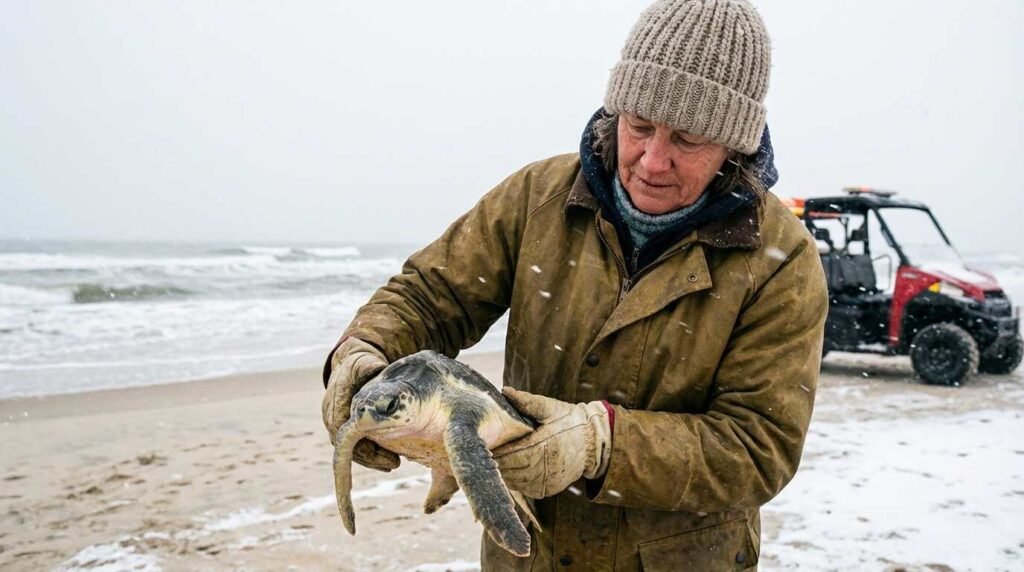
The Riverhead Foundation’s cold-stun response teams work at night, in October and November, in weather that most people have the sense to stay inside for.
A stranded cold-stunned loggerhead is a substantial animal — adults can exceed 300 pounds, though the animals most commonly recovered at Smith Point are juveniles in the 10–80 pound range, smaller and more vulnerable to hypothermia onset. The recovery protocol involves warming the animal gradually — rapid rewarming is itself dangerous, causing circulatory complications — monitoring for secondary infections, treating any injuries sustained in the stranding, and eventually releasing the animal farther south, where water temperatures support recovery.
Survival rates for animals recovered early enough are high. The bottleneck is time. A cold-stunned turtle on the beach is not yet dead. A cold-stunned turtle that has been on the beach overnight, exposed to air temperatures well below the water temperature that paralyzed it, may not recover.
The Riverhead Foundation has publicly documented hundreds of successful rehabilitations and releases. The animals that don’t survive — those that strand too late, that sustain too much secondary damage — contribute to the mortality record that researchers use to model cold-stun mortality as a conservation pressure on the western Atlantic loggerhead population.
What the South Shore Knows About Itself
There is something particular about this stretch of Long Island — the barrier island system, the shallow bays, the hard-working tidal inlets — that reveals the complexity of what we’ve built here and what we’ve inherited.
Robert Moses built the causeway and the parkway and the magnificent impossible infrastructure of this coast. He also, in doing so, altered the tidal exchange through the inlets in ways that coastal geomorphologists are still mapping. The South Shore today is a system under multiple simultaneous pressures: rising sea level, storm intensification, nutrient loading, sediment starvation, and the slow degradation of the shallow-water habitats that make it productive.
The loggerheads are part of this system. They are not visiting it. They are depending on it — on the crab populations, on the water quality, on the tidal exchange that lets them in and, when things go wrong, keeps them trapped.
When I think about waterfront real estate on the South Shore — the question of what you’re actually buying when you buy close to the bay — I think about this: you are buying into a system. A functioning one, in many ways. But one that is under pressure in ways that the listing sheet will not tell you, and that the ecosystem is documenting through the bodies of cold-stunned sea turtles on November beaches.
The Riverhead Foundation is reading that documentation. The rest of us could stand to pay more attention to what they find.
For current listings and market data along Long Island’s South Shore waterfront communities, contact Pawli at Maison Pawli.
Sources
- Riverhead Foundation for Marine Research and Preservation — https://www.riverheadfoundation.org/
- NOAA Fisheries Northeast Regional Office — Sea Turtle Cold-Stun Monitoring — https://www.fisheries.noaa.gov/new-england-mid-atlantic/endangered-species-conservation/cold-stunned-sea-turtles
- Fire Island National Seashore — Natural Resources — https://www.nps.gov/fiis/learn/nature/index.htm
- Morreale, S.J., Meylan, A.B., Sadove, S.S. & Standora, E.A. (1992). Annual occurrence and winter mortality of marine turtles in New York waters. Journal of Herpetology, 26(3), 301–308. [VERIFY URL before publishing]
- NOAA Office of Response and Restoration — Stranding Network — https://response.restoration.noaa.gov/wildlife-response
- Related: The Eelgrass Crisis in Peconic Bay
- Related: The Dune Road That Drowned