The Marine Modernist: How Architect Edgar Tafel Built a House on the Great South Bay That Treated Water as a Structural Partner
There is a particular kind of architectural significance that accrues to buildings nobody photographed properly.
Ezra Stoller gave Fallingwater its visual life — the cantilevered terraces over Bear Run, the compression and release of the entry sequence, the way the house seems to grow from the rock rather than rest on it. Stoller’s photographs made Fallingwater into an argument, a manifesto, an image that entered the culture so completely that most people who have never been within five hundred miles of southwestern Pennsylvania feel they know the building. The photograph did more for organic architecture’s reputation than any amount of critical writing.
Edgar Tafel was at Fallingwater when it was being built. He was Frank Lloyd Wright’s most trusted apprentice during the Taliesin years, the man Wright put on site supervision for his most technically demanding commissions. When Fallingwater’s cantilevered concrete slabs began to deflect more than Wright’s calculations had anticipated, it was Tafel who coordinated with the engineers and managed the crisis without letting Wright know the full extent of the problem until it was resolved. He understood the architecture at the level of its making, not merely its image.
He spent the next forty years building his own practice in New York — modest by the standards of his contemporaries, significant by any honest measure — and a portion of that work landed on Long Island’s South Shore, in the flat, water-adjacent landscape of the Bay Shore–Islip corridor, where the Great South Bay sits between the barrier beach and the suburban grid like a body of water that the land has been organized around without quite acknowledging.
The Apprentice and His Inheritance
Tafel published his account of the Taliesin years in Apprentice to Genius (1979) and returned to Wright’s influence in About Wright (1993). Both books illuminate the central tension of his independent career: how do you build on an inheritance without being buried by it?
Wright’s organic architecture made specific claims about the relationship between a building and its site — claims that Fallingwater dramatized so completely that they became, for most observers, inseparable from the Pennsylvania landscape that had called them forth. What Tafel extracted from Taliesin was not a vocabulary but a method: the discipline of beginning with a site and working outward from its specific conditions rather than imposing a predetermined form.
On Long Island’s South Shore, that method encountered a landscape that had almost nothing in common with the Pennsylvania mountains or the Wisconsin prairie. The South Shore is flat. The water table is high. The soil is sand and gravel — glacial outwash, geologically young, without the rock bearing that allows the deep foundations Wright favored in his prairie houses. The light comes off the bay at angles that shift dramatically with the tide and the season. The social life of the communities along the Great South Bay in the 1950s and 1960s was organized, to a significant degree, around water — around boats, and the culture of people who arrive at each other’s houses from the bay rather than from the road.
These were Tafel’s constraints. A lesser architect would have ignored them. Tafel built from them.
The House at the Water’s Edge
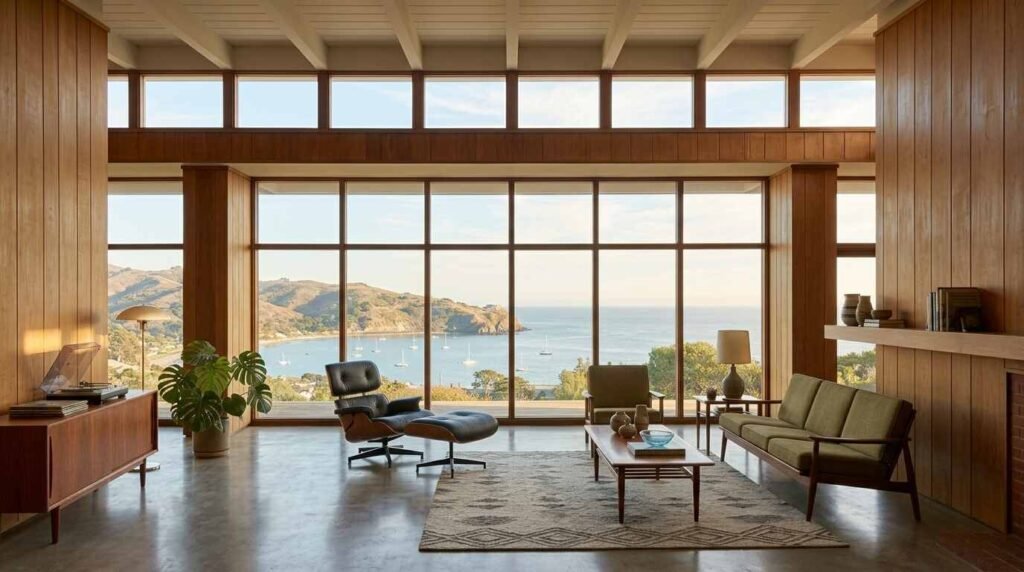
The documented Tafel residence in the Bay Shore–Islip corridor represents the fullest expression of what he came to think of as a specifically marine approach to residential design — a building that acknowledges, at the level of its structure and its cladding and its fenestration, that the water is not merely scenery. It is a condition.
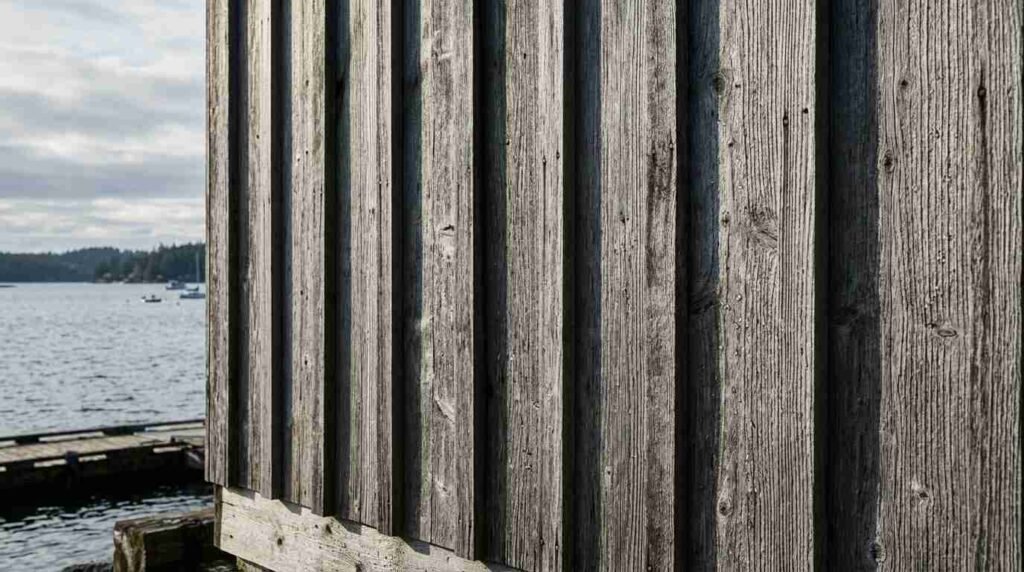
The approach from the road gives almost nothing away. Tafel designed the street-facing elevation with characteristic restraint — a low, horizontal profile achieved through board-and-batten cypress cladding that draws the eye along the length of the house rather than up to its roofline. The windows on the road side are small and high, admitting light without surrendering privacy. The house reads, from the street, as a private thing — contained, slightly reticent, not quite like anything around it.
The bay side is a different argument entirely.
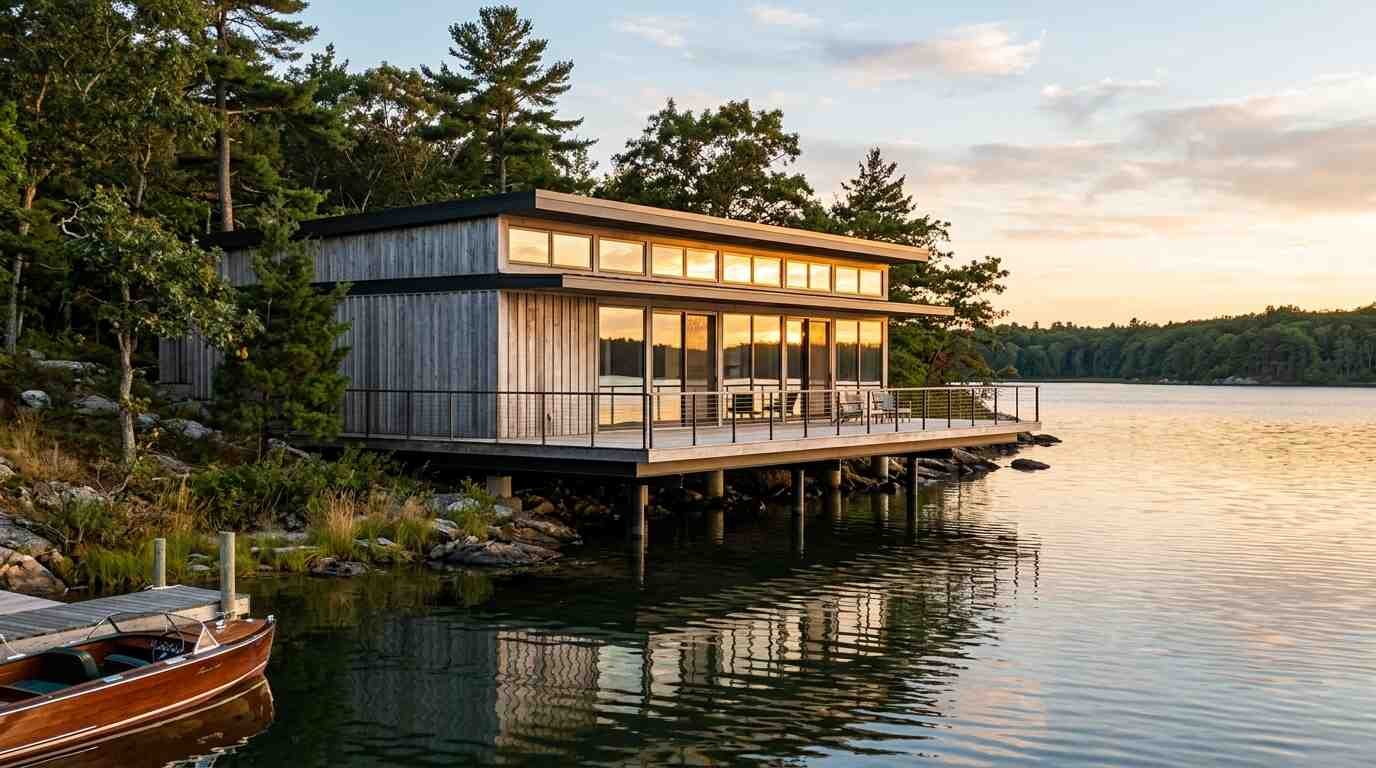
A continuous clerestory band runs the full length of the main living space, positioned just below the roofline to catch the specific quality of light that reflects off the bay in the late afternoon — a light that is simultaneously warmer and more diffuse than direct sunlight, coming at an angle that has been bounced and softened by the water’s surface. Below the clerestory, floor-to-ceiling glazing opens the living space to a cantilevered deck that extends over the water at high tide. The deck has no railing at its far edge — or rather, the railing is a single horizontal cable, stretched taut, doing the minimum necessary work to keep the visual field open. Standing at the edge of the deck, you are over the water. The house has brought you there deliberately.
This dual identity — private road face, open water face — is the central architectural gesture of the house, and it is directly responsive to the social conditions of the South Shore in the postwar period. You arrived by car. Your guests arrived by boat. The house understood both and organized itself accordingly.
Cypress and Water
The choice of materials is worth pausing on, because it is not incidental. Cypress board-and-batten cladding was not the default material of Long Island residential construction in the 1950s. It was a specific choice — and a choice that placed Tafel in a longer conversation about building for waterfront environments.
Cypress’s natural resistance to moisture and rot made it the traditional material for boatbuilding and dock construction in the coastal South. In the Bay Shore–Islip house, the cypress boards weather to a silver-gray that is almost exactly the color of the bay in overcast light — not by accident, and not by any direct imitation of nature, but through a material logic that privileges durability and environmental belonging over the dressed-up prettiness of painted siding.
The board-and-batten pattern itself creates a vertical rhythm that plays against the horizontal emphasis of the house’s massing. It is a quiet tension, the kind that resolves itself over time as your eye moves across the surface. Wright used board-and-batten on his Usonian houses for similar reasons: the material is honest about its joinery, and the vertical articulation keeps a horizontal building from becoming merely flat. What Tafel added was a specificity of site response that the Usonian houses, designed for the generic American suburb, did not require. The cypress at Bay Shore is not just a material choice. It is a conversation with the water.
The Problem of Documentation
The reason Tafel’s Long Island work has never been properly assessed is, in significant part, the reason that so much mid-century residential modernism exists only in local memory rather than architectural history: it was never photographed by anyone who understood what they were looking at.
Stoller photographed the buildings that were brought to his attention by architects with national reputations and institutional backing. Tafel’s practice was independent, modest in its ambitions for publicity, and geographically located on Long Island — which was, in the 1950s and 1960s, not a place that architectural culture took seriously. The Tafel houses got no Stoller. They got snapshots, if they got anything. Some have been altered significantly by subsequent owners who had no way of knowing what they had. Some have been demolished.
This is not an argument for tragedy. Some of the houses survive. The one in the Bay Shore–Islip corridor is among them. And there is something appropriate about the fact that the buildings most worth seeing are the ones you have to know to look for.
What It Means, Now
From where I stand — as a broker who thinks about what makes a house matter, beyond the square footage and the commute time and the school district — the Tafel houses on the South Shore represent something that is genuinely difficult to find: a residential architecture that was built for the specific life of a specific place at a specific moment, and that has aged honestly rather than pretending to be something it was not.
The board-and-batten cypress, silver now with decades of bay weather. The clerestory light, the same in the afternoon as it was in 1958. The deck over the water, still over the water.
Tafel absorbed Wright’s most important lesson — that a building should belong to its site the way a plant belongs to its soil — and translated it into a landscape that Wright never worked in and might not have understood. The South Shore is not dramatic. There are no waterfalls. The land is barely there at all, just a thin margin between the road and the bay. Tafel built as if the thinness were the point.
On the North Shore, where we work in the land of bluff houses and Sound views and the particular way the light hits the water from the Connecticut side, we understand something about what it means to build at the edge. The architects who got that right — who understood the water as a partner rather than a backdrop — produced houses that are still worth living in, still worth seeking out, sixty years later. Tafel got it right. He just did it on the other shore.
You Might Also Like
- The Servant Stair and the Service Wing: What the Hidden Architecture of Gold Coast Estates Reveals About Today’s Luxury Floor Plans
- North Shore Bluff Homes and the Erosion Question: What Buyers Need to Know
- The Joiner’s Argument in Locust Valley: How the Matinecock Friends Meeting House Framing Influenced a Generation of Gold Coast Estate Carpenters
Sources
- Edgar Tafel Collection, Library of Congress Prints and Photographs Division: loc.gov/collections
- Frank Lloyd Wright Foundation Archives, Scottsdale, AZ: franklloydwright.org
- Edgar Tafel, Apprentice to Genius: Years with Frank Lloyd Wright (McGraw-Hill, 1979)
- Edgar Tafel, About Wright: An Album of Recollections by Those Who Knew Frank Lloyd Wright (Wiley, 1993)
- Avery Index to Architectural Periodicals, Columbia University: columbia.edu
- Suffolk County Clerk’s Office, property records: suffolkcountyny.gov