What the Carriage House Knows: How Long Island’s Converted Outbuildings Are Commanding Prices That Challenge the Main House
What Was Built, and Why It Was Built That Way
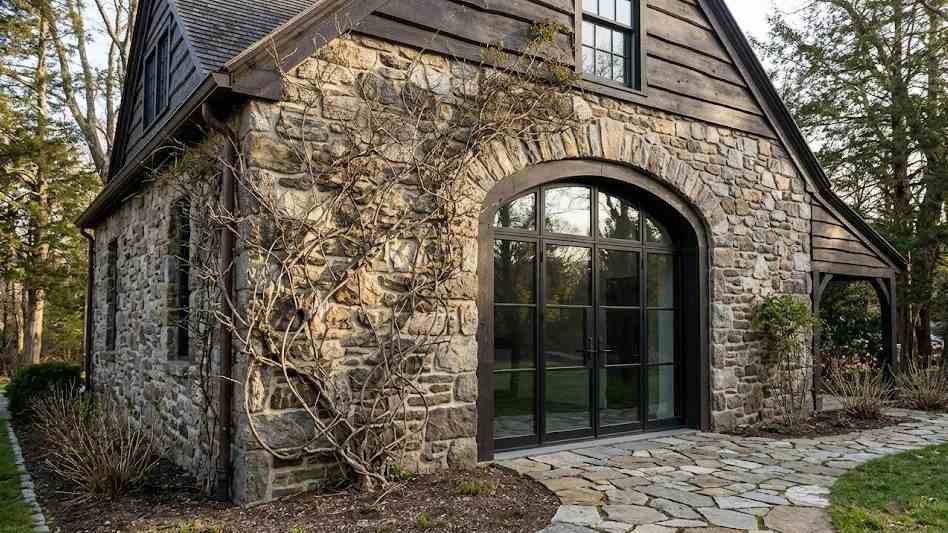
The carriage house on a Gold Coast estate was not an afterthought. It was a working structure built to the same standards as the main house — often by the same craftsmen, using the same materials — because the family’s transportation and the men who managed it were as central to estate life as the butler or the cook.
The Society for the Preservation of Long Island Antiquities (SPLIA) has catalogued outbuilding structures across the North Shore, and the typology is consistent: load-bearing masonry or heavy timber framing; wide-plank floors in the loft; high ceilings designed for the volume of horses and coaches; generous window openings for light and ventilation. On the larger estates of Old Brookville, Oyster Bay, and Lloyd Neck, carriage houses were multi-bay structures that might accommodate four to six coaches, the horses that pulled them, a harness room, a wash bay, and living quarters above for the coachman and his family. On the more modest North Shore properties, a two-bay carriage house with a loft above and a small attached stable was the standard.
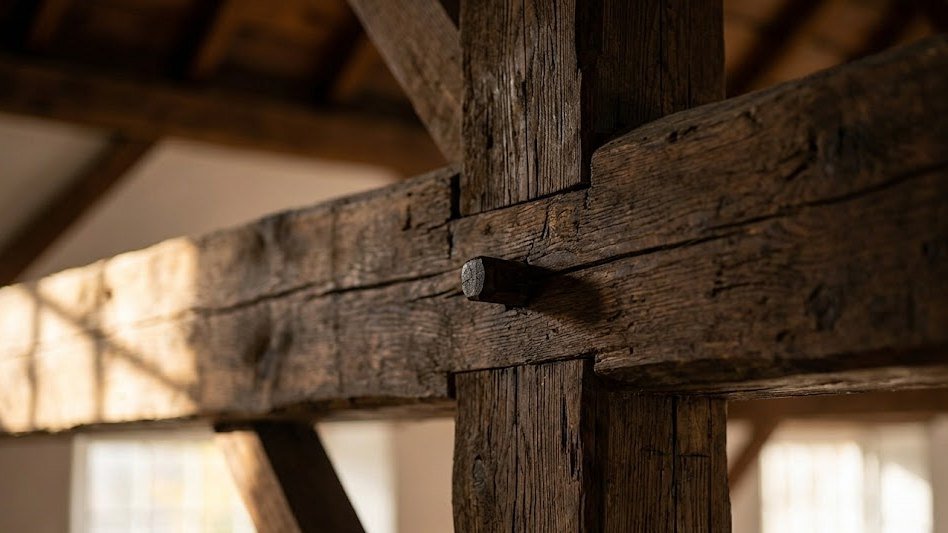
What all of them share is structure. The stone walls, where they exist, were laid by masons working in a tradition that treated the material as permanent. The timber frames were joined with mortise and tenon and pegged with hardwood — a system that distributes load without relying on fasteners that corrode and fail. These buildings were built to last because they housed animals and equipment that the family’s daily life depended on. A failing roof over the parlor was an embarrassment. A failing roof over the carriage house was a crisis.
The result, a century later, is that many North Shore carriage houses have outlasted every cosmetic layer that has been applied to the main house. Strip the paint and the paneling and the dropped ceilings from the average mid-century renovation, and you find the bones the original builders laid. That is what the buyers are responding to.
The Conversion History
The first conversions happened by necessity. As automobiles replaced horses through the 1910s and 1920s, the carriage house became a garage — often without significant structural change, because the bay width and ceiling height designed for coaches translated reasonably well to early motorcars. The loft became storage. The coachman’s quarters were typically abandoned or used informally.
The second wave of conversions, from the 1960s onward, reflected a different set of pressures. The large Gold Coast estates were being subdivided, sold, and reinvented. Guest cottages were needed. Studio space was needed. Income-producing rental units were needed. The carriage house, with its self-contained footprint and separate entrance, was the obvious candidate. Some of these conversions were done with care — preserving the original framing, keeping the stone, installing mechanical systems without destroying the character. Others were not.
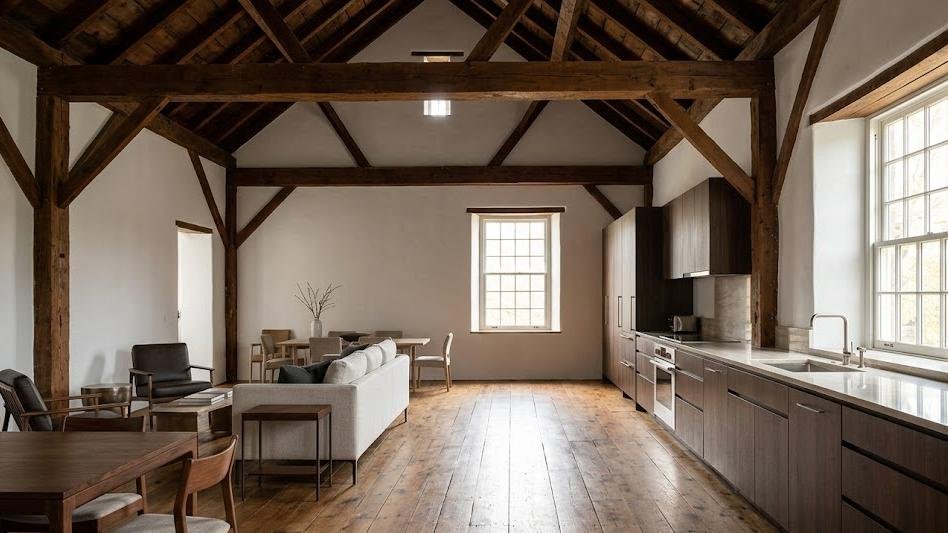
What the market rewards today is the conversion that respected the original material. A carriage house where someone replaced the timber frame with steel columns to gain an open floor plan is a different — and lesser — thing than one where the frame is exposed, the stone is pointed, and the radiant heat runs through a floor poured over the original slab. Buyers at the upper end of the North Shore market have seen enough renovated houses to know the difference between a structure that was improved and one that was merely updated.
The best carriage house conversions on Long Island today read as complete. They have the proportions of a serious house — high ceilings, generous windows, rooms that feel permanent — because they were built with serious structural intention before any of the residential thinking was applied.
What New York State Is Doing About Outbuildings
The policy environment around converted outbuildings has been shifting in a direction that benefits North Shore property owners.
New York State’s 2022–2023 capital budget allocated $85 million for the Plus One ADU Program — an initiative administered through New York Homes and Community Renewal that provides grants to local governments and nonprofits committed to supporting accessory dwelling unit creation. This program is specifically designed to help property owners bring existing structures — including detached outbuildings — into compliance with local and state code requirements as habitable dwelling units. The program prioritizes low- and middle-income homeowners, but its existence has accelerated municipal attention to how outbuildings can be legally classified and permitted.
At the local level, the picture varies by town. Nassau and Suffolk counties contain municipalities with widely different approaches to accessory dwelling units. Some North Shore towns have moved toward streamlined ADU permitting; others retain more restrictive zoning that requires variances or special permits. Before presenting a converted carriage house as an income-producing accessory dwelling, a seller’s attorney should confirm current zoning classification, whether the structure has an existing certificate of occupancy for residential use, and whether the town’s current code permits the intended use as-of-right or by variance. These are not obstacles — they are disclosures, and buyers at this level expect them.
What has changed is the direction. The regulatory momentum in New York State is toward expanding legal ADU pathways, not restricting them. A carriage house that does not yet have ADU status may be significantly closer to achieving it than it was five years ago.
Note to Pawli/editor: The original brief cited “New York State’s ADU legislation (signed 2022, Chapter 897)” — I could not verify this specific chapter number, and statewide as-of-right ADU reform has not been enacted as of this writing. The Plus One ADU Program is real and verifiable (hcr.ny.gov/adu). Recommend confirming with a real estate attorney familiar with current NYS/local zoning before publishing any specific statutory claim about ADU rights.
The Valuation Question
The question buyers and sellers both struggle to answer is this: how does the carriage house affect total property value, and how should it be priced when the main house and the outbuilding are offered as a package?
There is no universal formula, but the logic is consistent. A converted carriage house that functions as a legal, code-compliant dwelling — with its own kitchen, bath, and separate entrance — adds value in proportion to its rental income potential, its additional living square footage, and its independence from the main house. A buyer purchasing an estate with a fully converted carriage house is not just buying more square footage. They are buying optionality: the ability to house extended family, generate rental income, accommodate guests, or establish a home office or studio with full separation from the main residence.
At the upper end of the North Shore market, that optionality commands a premium that does not always map neatly onto a price-per-square-foot analysis. I have seen carriage houses listed independently — on parcels that were subdivided from original estate land — at prices that would have seemed impossible for a structure of that size if it were a conventional house. The buyers are not paying for square footage. They are paying for the material, the age, the craft, and the story.
For sellers offering a main house and carriage house together, the presentation strategy matters. The worst approach is to treat the carriage house as a footnote in the listing — a few lines after the main house description, an afterthought in the photography. The best approach treats it as a second lead: its own photography, its own floor plan, its own narrative that establishes what it is, what condition it is in, what its current and potential uses are, and what the regulatory status is.
Buyers who fall in love with the carriage house will buy the main house. It happens more than sellers expect.

What to Do Before You List
For a North Shore seller with an original carriage house or estate outbuilding, the pre-listing work has three components.
Establish the legal status. Confirm with your attorney what the current certificate of occupancy covers, what use is permitted under the town’s zoning code, and what steps would be required to convert the structure to a legal accessory dwelling if it is not already. This is disclosure work, and doing it in advance of the listing eliminates the most common due-diligence friction point.
Document the structure. Commission a structural report if one does not exist. Photograph the framing, the masonry, the original elements. Buyers purchasing historic structures want to know what they are getting, and professional documentation of the original material — a SPLIA survey, an architectural historian’s assessment, a structural engineer’s report — adds credibility and reduces buyer uncertainty.
Tell the story with care. The carriage house on a North Shore property carries decades or more of history before it carries a price. The listing that simply says “detached garage/apartment potential” is leaving money on the table. The listing that names the original construction date, describes the structural system, documents the conversion history, and establishes the regulatory status is doing something different. It is making an argument — the same argument the building makes in person when a buyer steps through the door and looks up at the timber frame.
That first look upward is the moment the carriage house sells itself. The seller’s job is to make sure the buyer gets to it.
This is for informational purposes only — consult a licensed attorney or financial advisor for your specific situation. Zoning regulations, ADU permitting requirements, and property tax implications vary by municipality and are subject to change.
Real estate markets change. This post reflects conditions as of the publish date. For current listings and market data, contact Pawli at Maison Pawli.
Sources
- Society for the Preservation of Long Island Antiquities (SPLIA): splia.org (verify current URL before publishing)
- New York State Plus One ADU Program, NYS Homes and Community Renewal: hcr.ny.gov/adu
- Regional Planning Association — NYS ADU Legislation Fact Sheets: rpa.org/news/lab/new-york-state-adu-legalization-fact-sheets
- Maxable — Are ADUs Legal in New York? (current legislative status): maxablespace.com/are-adus-legal-in-new-york
- Nassau County and Town of Oyster Bay zoning records — contact respective planning departments directly for current ADU regulations (do not link without verified URL)
Part of the Gold Coast Series: This post is one of fifteen pieces in the Maison Pawli Gold Coast cluster. For the full guide — surviving estates, architectural history, legal sediment, and what buyers need to know — visit The Gold Coast of Long Island: Gilded Age Estates, Architectural Heritage, and What Survives.
This post is part of my comprehensive guide to Buying Waterfront Property on Long Island’s North Shore: What Every Buyer Needs to Know — covering everything from flood insurance and DEC permits to bulkheads, riparian rights, and the waterfront buyer’s checklist.