Virtual Tour Fatigue Is Real — and the Listing That Cracks It in Port Jeff Will Win the Out-of-State Buyer

Here is a number worth sitting with: according to Matterport’s survey data, 89% of buyers stated that virtual property tours were an important part of their purchase decision. And yet listings with virtual tours are failing to convert out-of-area buyers at a rate that should concern every seller in the Port Jefferson market.
The problem is not the technology. The problem is the sequence, the camera choices, and a fundamental misunderstanding of what the buyer the Port Jeff seller most needs to reach is actually looking for when they open that link at 9 p.m. from a desk in Westport or a couch in Astoria.
Let me tell you what’s going wrong, and how to fix it.
The Buyer You’re Trying to Reach
Before we get to tour structure, you need to know who you’re selling to — because the Port Jefferson and Port Jefferson Station market has a defined out-of-area buyer profile that differs meaningfully from the generic long-distance relocator.
The ferry-to-Connecticut corridor creates a specific demographic: professionals commuting to Bridgeport, New Haven, and Hartford who are price-sensitive to Fairfield County real estate, aware that the Cross Sound Ferry makes the trip manageable, and actively searching for North Shore properties within range of the Port Jefferson terminal. These buyers are doing their first serious evaluation of your listing at night, on a laptop, from Connecticut. They are not going to make a showing appointment until the virtual tour has done enough work to justify a day trip.
The Stony Brook University Hospital and SBU campus cluster creates a second out-of-area buyer type: incoming faculty, physicians, and researchers who are relocating from other academic medical markets — often from outside the New York metro entirely — and are making a first decision about whether Port Jefferson or the surrounding communities are worth visiting based entirely on digital presentation.
Both of these buyers share a critical characteristic: they are highly information-motivated. They are not casual scrollers. They will spend real time with a well-constructed tour. And they will abandon a poorly constructed one in under two minutes, never to return.
According to Matterport’s data, 31% of buyers spent more time viewing listings with virtual tours, and 30% of respondents made an offer on a property sight unseen in recent years. For the Port Jeff market, those sight-unseen offers are coming from Connecticut and from out-of-state academic hires. If your tour is not built to convert them, you are leaving those buyers on the table.

What Virtual Tour Fatigue Actually Is
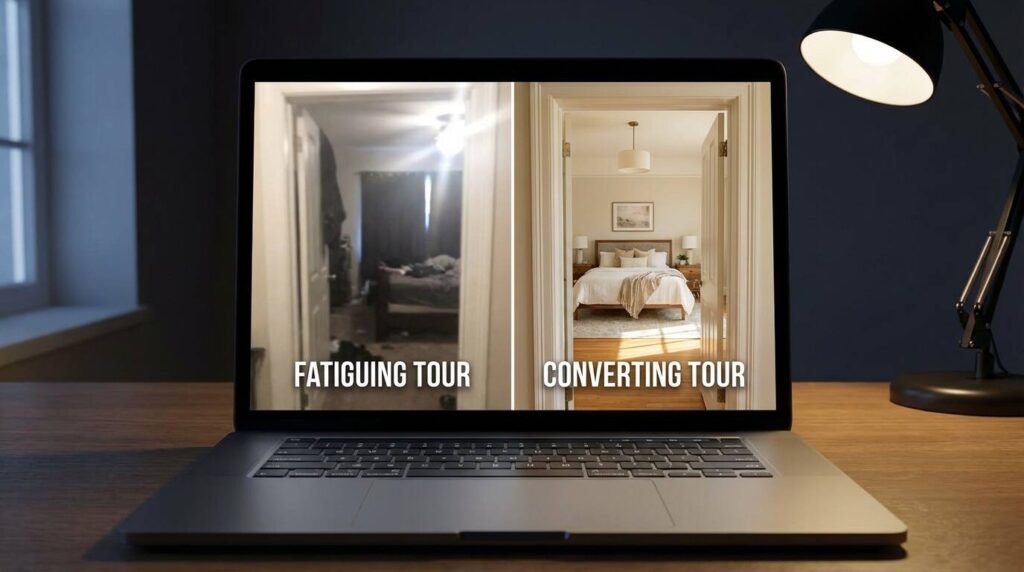
Virtual tour fatigue is not a generalized exhaustion with virtual tours as a format. Buyers are not tired of good virtual tours. They are tired of the specific structural failures that repeat across listing after listing, creating a scroll experience that feels identical regardless of the property.
The symptoms that trigger abandonment:
Tours that open in the wrong room. The most common structural error in North Shore virtual tours is starting in the primary bedroom or a secondary room because the videographer started at the top of the stairs. A buyer’s first frame of a home tour should be the same frame they’d get standing at the front door looking in. The emotional arc of a showing begins at the threshold. A tour that begins in a bedroom disorients buyers before they’ve had a chance to orient.
Drone footage in the wrong position in the sequence. Drone footage is one of the most powerful tools in a listing video — and one of the most frequently misplaced. When drone footage appears at the opening of a video, before a buyer has established any emotional connection to the property, it reads as generic. A neighborhood aerial at the start of a tour could belong to any listing in that zip code. It does not differentiate. Drone footage works best mid-sequence, after the buyer has developed an interior connection to the property and is ready to understand it in its landscape context. Placed there, it answers the question the buyer has already started asking: where does this house sit? What’s around it? How close is the water?
Photo-slideshow tours masquerading as immersive tours. These are the tours that lost the market for buyers. A series of DSLR stills with a slow pan-and-zoom effect is not a virtual tour. It is a photo gallery with motion sickness. Buyers, particularly the high-information buyers the Port Jeff market attracts, distinguish between an actual Matterport-style 3D walkthrough and a stitched-together slideshow within approximately fifteen seconds. The slideshow signals that the seller did not invest in the presentation. That signal is absorbed and it affects offer behavior.
Tours that show every room with equal weight. This is a prioritization failure. Buyers do not evaluate every room equally. According to NAR staging research, the living room, primary bedroom, and kitchen are the decisive spaces in the buyer’s evaluation. A tour that gives equivalent screen time to a utility room, a powder bath, and the primary bedroom is not serving the buyer — it is wasting their attention and signaling that the seller doesn’t understand what the buyer needs to decide.
The Camera Sequence That Converts
For a typical Port Jefferson area colonial or ranch listing targeted at the Connecticut or city relocator, here is the sequence structure that outperforms:
1. Threshold opening. The tour begins at the front door, looking in. Not from the street — the street shot belongs in the static photography — but from the doorstep, giving the buyer the same first sightline they’d have at a showing. This is the moment the buyer steps in, virtually.
2. Living room anchor. Two to three minutes in the living room. This is the longest dwell in the interior sequence. It is where the buyer decides if this is a home they want to inhabit, not just inspect. Light source, furniture scale, and the sightline to adjacent spaces all matter here.
3. Kitchen and dining connection. For open-plan layouts, this is one continuous sequence. For closed kitchens, the transition between kitchen and dining should be shown explicitly — buyers need to understand how these spaces relate during the daily routines they’re imagining.
4. Primary bedroom, primary bath. Presented as a suite. The bathroom should be lit correctly — this is where North Shore listings routinely fail. Bathrooms in mid-century and 1970s-era housing stock are often small and dark. A videographer who does not stage and light a bathroom correctly before filming it has handed the buyer a problem to solve rather than a feature to desire.
5. Secondary spaces, efficient. Supporting bedrooms and baths in approximately half the time of primary spaces. The buyer is building a mental floor plan at this point, not making emotional decisions.
6. Drone sequence. Now, mid-tour or transitioning to exterior. The buyer knows the house. Now they want to understand it in its setting. Show them the lot, the neighbors, the proximity to water if applicable, the neighborhood context. For Port Jefferson listings with any Sound proximity — and the ferry terminal’s presence means many listings benefit from this — the aerial tells a story that no interior shot can.
7. Closing exterior. Ground-level exterior from the street and backyard. This is the image that will live in the buyer’s memory as they discuss the property with a spouse or partner. Make it the best-light, best-angle version of the home.
The Port Jefferson Specific Advantage to Sell
For out-of-state buyers specifically, the Port Jefferson listing has a locational argument that most North Shore listings do not. The ferry terminal connection to Bridgeport, Connecticut — a 90-minute crossing — is a commuting option that a significant number of buyers in Connecticut’s finance and insurance corridor are already aware of and actively factoring into their housing search.
This context belongs in the virtual tour. Not as a narrated sales pitch, but as an aerial sequence that shows the ferry terminal’s location relative to the listing, establishes the water presence, and gives a buyer from Westport or Fairfield the spatial orientation they need to understand that this house is viable as a commute base. Buyers from Connecticut making first contact with a Port Jefferson listing are often doing a mental commute calculation in parallel with their property evaluation. A tour that does not help them complete that calculation is working against its own conversion.
The Block That Time-Locked: Why Port Jefferson Village’s Walking Culture Survived When Every Town Around It Didn’t is worth reading alongside any Port Jefferson listing preparation — the walkability and village character of the area are features that transfer well to video and that out-of-area buyers respond to strongly.
The Technical Floor You Must Meet
Listings with Matterport-quality 3D tours get clicked on 40% more than listings without them, per Matterport’s published data. The same data shows that properties with virtual tours receive 95% more phone inquiries and 65% more email inquiries than listings without. For the out-of-state buyer who will not call before they have done their own digital research, this inquiry rate differential is the difference between being in consideration and being invisible.
The technical floor for a competitive North Shore listing targeting the Connecticut or city relocator is: a full Matterport-style 3D walkthrough or equivalent immersive format; professional interior photography with correct lighting in every room, including bathrooms; drone footage at minimum 4K resolution from a licensed operator at late-afternoon or golden-hour timing; and tour duration of 3–5 minutes for a standard listing, extended only for homes above $1.5M where the feature count warrants it.
Listings that fall below this floor are being outcompeted in the digital-first evaluation environment regardless of the property’s actual quality. A house that shows well in person but presents poorly online has a ceiling on its buyer pool that is real and measurable.
What Your Listing Agent Should Be Providing
A seller in the Port Jefferson market preparing to attract out-of-area buyers should be asking their agent several specific questions before the listing goes live: Where does the tour open? Where is the drone footage placed in the sequence? Has the primary bathroom been professionally lit and staged before being filmed? Is there a plan for the ferry corridor buyers specifically — meaning tour materials that include the terminal in the aerial sequence and listing copy that makes the Bridgeport commute option explicit? What is the expected out-of-area buyer profile for this listing, and is the tour built to address their specific information needs?
A listing agent who can answer these questions specifically — not generically — is operating at the level this market demands.
At Maison Pawli, I produce listings for the buyer who is deciding from a desk in another state. That means the tour is built to answer their questions before they have to ask. It means the drone sequence shows the ferry terminal because I know that buyer is calculating the commute. It means the primary bathroom is lit correctly because I know a buyer in Westport comparing three North Shore listings is going to make a judgment in that room.
The listing that cracks virtual tour fatigue is not the one with the best house. It’s the one built for the buyer who’s watching at 9 p.m. from somewhere else.
Real estate markets change. For current listings and market data, contact Pawli at Maison Pawli.
This is for informational purposes only — consult a licensed attorney or financial advisor for your specific situation.
You Might Also Like
- The Block That Time-Locked: Why Port Jefferson Village’s Walking Culture Survived When Every Town Around It Didn’t
- Tonnage and Tenon: The Shipwright Crossover in Port Jefferson’s Furniture Trade
- The Lock-In Effect: Why North Shore Inventory Is So Tight Right Now
Sources
- Matterport, buyer preference study: https://matterport.com/news/new-study-shows-property-buyers-and-sellers-overwhelmingly-prefer-listings-3d-tours
- Matterport, virtual tour benefits: https://matterport.com/blog/why-home-sellers-and-buyers-love-3d-virtual-tours
- Matterport, 3D tours sell faster: https://matterport.com/blog/3d-tours-properties-sell-31-faster-and-higher-price
- Matterport, U.S. residential buying trends survey: https://matterport.com/blog/matterport-releases-survey-results-of-u-s-residential-real-estate-buying
- NAR, 2025 Profile of Home Staging: https://www.nar.realtor/newsroom/nar-report-reveals-home-staging-boosts-sale-prices-and-reduces-time-on-market
- Cross Sound Ferry: https://www.longislandferry.com