The Joiner’s Argument in Locust Valley: How the Matinecock Friends Meeting House Framing Influenced a Generation of Gold Coast Estate Carpenters
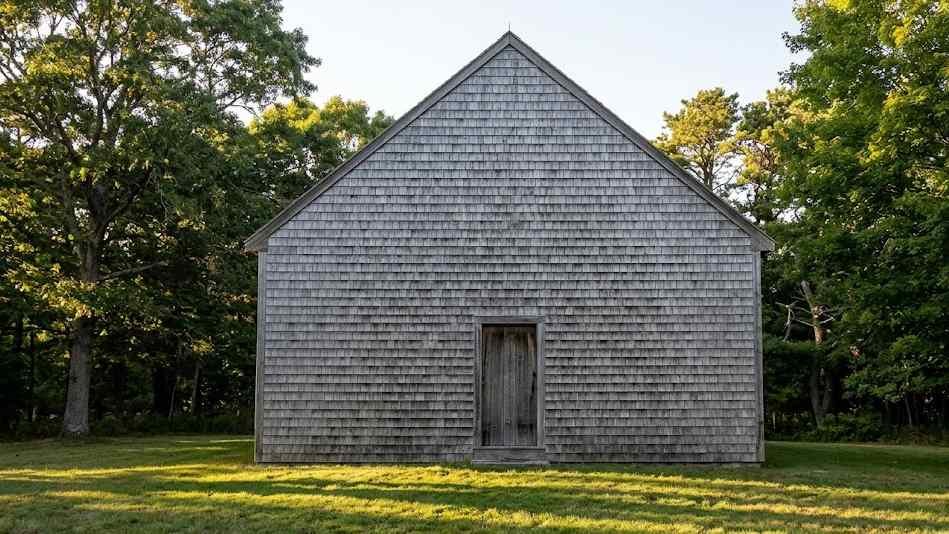
At the corner of Duck Pond Road and Piping Rock Road in what is now technically Glen Cove — though Locust Valley claims it in spirit, and always has — sits a wooden structure that has been, in one form or another, on this ground since 1725. The Matinecock Friends Meeting House does not look like an argument. It looks like what it is: a modest, steeply gabled wooden building of the kind the English settlers of the North Shore built before they had much money or much ambition beyond the immediate need of shelter and worship.
But the building is an argument. It has been making one, quietly, for three centuries.
The argument is about joinery — about what it means to connect two pieces of wood so that the connection is stronger than either piece alone, and about why that mattered more to the Friends who built this structure than it would have mattered to their contemporaries building in the fashionable styles of the era. And it is an argument that local craftsmen were still having, implicitly, when they went to work on the Gold Coast estates rising around Locust Valley and Oyster Bay two hundred years later.
What 1725 Looks Like in Wood
The Matinecock Meeting House was built in 1725 by the Religious Society of Friends. The Quaker meeting in this part of Long Island dates to 1671 — George Fox himself visited Long Island in 1672, and the first documented minutes of a Quaker proceeding reference the Oyster Bay, Matinecock, and Westbury meetings. The current meeting house replaced decades of worship in homes and barns. It is now recognized as the oldest officially organized Friends meeting in the United States.
There is an important material fact about this building that any piece of writing must address honestly: the original 1725 structure was destroyed by fire in 1985. It was rebuilt the following year, incorporating some original materials salvaged from the fire. The building on Duck Pond Road today is not the 1725 timber — it is a 1986 reconstruction built to match the original, using traditional methods and whatever salvaged stock could be incorporated.
This changes what can be claimed about the specific timbers. It does not change what can be claimed about the tradition.
The 1986 reconstruction was undertaken precisely because the community understood the building’s architectural and historical significance. The techniques used in the reconstruction were not modern — they were chosen to replicate what the original structure had been. That means drawbore mortise-and-tenon joinery. That means riven stock where possible. That means the absence of iron fasteners in the structural connections wherever the original would have used none.
The argument the building was making in 1725 is the argument the reconstruction was required to repeat in 1986. The medium changed; the text stayed the same.
The Drawbore as Moral Geometry
Drawboring is a technique, not a philosophy — but it is a technique that carries a set of values embedded in it so thoroughly that the two are hard to separate.
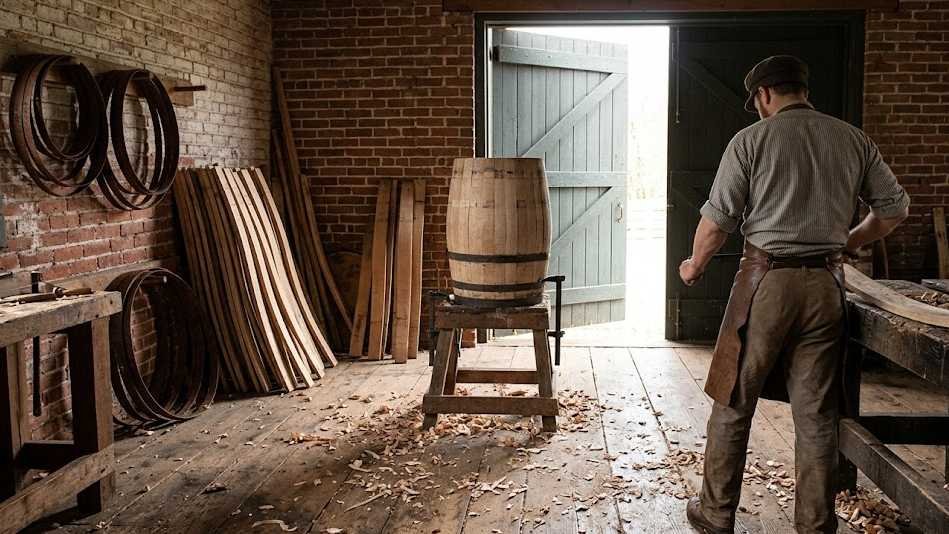
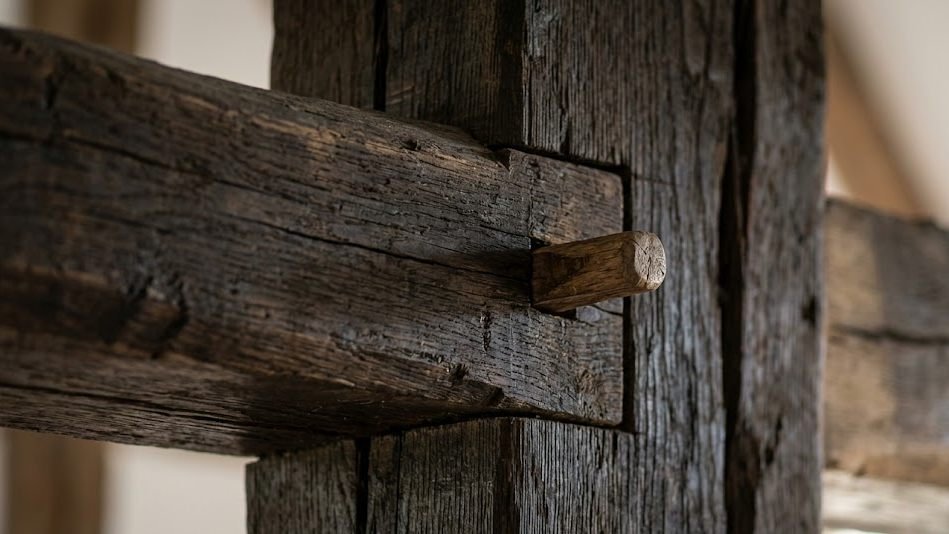
In a drawbored mortise-and-tenon joint, the mortise is cut into one timber and the tenon shaped on the other. A hole is drilled through the mortise cheeks at the alignment point. Then, before the tenon is inserted, a corresponding hole is drilled through the tenon — offset slightly, deliberately, toward the shoulder of the tenon. When a tapered hardwood peg is driven through the assembled joint, the offset forces the tenon to draw tight into the mortise. The friction is enormous. The joint does not need glue, and in the absence of glue it does not fail in the ways glued joints fail — it can be disassembled, in theory, though in practice the peg swells with moisture and the joint becomes permanent.
The Quaker aesthetic preference for drawboring over iron fasteners in structural work was not purely theological, but it was not purely practical either. Iron was expensive, difficult to produce locally, and subject to corrosion. Oak pegs were cheap, abundant, and strong. But there was also something in the Friends’ sensibility that distrusted ornament and complexity in favor of what worked simply and well. A drawbored mortise-and-tenon in a meeting house frame is a visible argument: this building will stand because of its own internal logic, not because of metal imported from somewhere else.
Local carpenter-builders who worked in or adjacent to the Matinecock community would have encountered this argument at the scale of a building. Not in a textbook. Not in a magazine. In the structure itself — in the way the timbers sat on each other, in the way the pegs were driven, in the sound a finished frame makes when it settles.
The Geography of Craft Transmission
The Locust Valley area was settled around 1667 and known as Matinecock after the Native American group that inhabited this stretch of the North Shore. By 1730 the English settlers had renamed it Buckram. By 1856 it had become Locust Valley. Through all of these renamings, the same families lived and worked here — English Quaker families, in many cases, who maintained the meeting through revolution and restoration and kept the building repaired.
The NYPL’s 1922 photographic record of the meeting house notes it was “Repaired 1768 and 1776” — significant dates, both. Repair in 1776, during the British occupation of Long Island, required craftsmen to work on a Quaker structure at a moment of considerable political tension. The men who did that work knew what they were maintaining. They knew the joinery. They were passing on a direct understanding of the structure and its methods, not a theoretical one.
By the time the Gold Coast estate boom reached full velocity — roughly 1890 through 1930 — this region had carpenter families with deep, continuous knowledge of pre-industrial joinery methods. The estates at Locust Valley, Oyster Bay, Old Westbury, and Matinecock hired locally. The craftsmen who framed and finished rooms at the grand houses along Piping Rock Road and Duck Pond Road were men whose grandfathers had repaired the meeting house. Some of the same surnames appear in estate construction records and in Quaker meeting records from the same period.
What the Estates Inherited
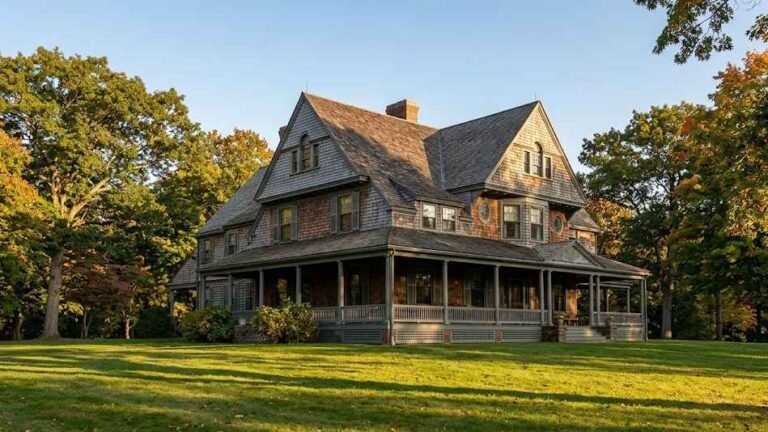
The Gold Coast estates of the early twentieth century are understood primarily in terms of their architects: McKim, Mead & White; Carrière & Hastings; Delano & Aldrich; Bertram Goodhue. These were New York firms working at the height of the Beaux-Arts tradition, and their drawings specified materials and finishes in considerable detail.
But drawings do not execute themselves. The craftsmen who worked from those drawings brought their own knowledge to the site. A framing carpenter working on a Locust Valley estate in 1910 was not implementing instructions from scratch — he was interpreting them through a body of knowledge he had accumulated over decades. When an architect’s drawing called for mortise-and-tenon framing in a stable building or a service wing, the local carpenter did not go looking for information about how to cut a mortise. He already knew. He knew from having cut mortises in buildings that were, in some cases, already 150 years old.
The pre-industrial joinery of the meeting house tradition — the reliance on wood pegs over iron, the preference for drawbored connections, the use of riven rather than sawn stock where structural integrity mattered — all of these practices remained available to North Shore craftsmen long after industrial methods made them technically unnecessary. They persisted as knowledge, carried in hands rather than books, and they reappeared in estate construction when the work called for them.
This is not romantic continuity. It is demonstrable geography. The same landscape that held the meeting house held the estates. The craftsmen who worked on both were, in many cases, from the same families, in the same trades, with the same local training. The building at Duck Pond Road was not a museum piece to them. It was a reference.
A Living Example
The Matinecock Meeting House celebrated its 300th anniversary in 2025. As the meeting’s clerk, Tom Jaske, noted for the occasion, Quakers have been worshipping in Oyster Bay and Matinecock and the local area since about 1670. The meeting is the oldest religious organization on the North Shore, and one of the oldest on Long Island.
The anniversary drew attention to a building whose significance is usually understood in religious and historical terms. What I find equally worth marking is its significance as a craft document — as evidence that a specific approach to wood joinery was practiced, transmitted, maintained, and repaired on this ground continuously from the early eighteenth century through the early twentieth, exactly the period when the Gold Coast estates were being built all around it.
You can visit the meeting house at 267 Duck Pond Road in Locust Valley. The grounds are accessible; the building itself is used for worship each Sunday at 10 a.m. If you go at another time, stand at the exterior and look at the framing where it is visible — the structure of the gable ends, the way the timbers sit. What you are looking at is a 1986 reconstruction of a 1725 argument about what wood should do, and how, and why. The argument has not changed.
The Gold Coast estates nearby are, many of them, still standing too — as museums, as private schools, as subdivisions, as institutions. Their framing and their millwork are the answers local craftsmen gave to that argument, over two centuries, in building after building. The question the meeting house was asking, they were answering in the only language they knew: the joint, the peg, the grain of the wood.
This is for informational and historical purposes only. For current listings and market data, contact Pawli at Maison Pawli.
Sources
- Wikipedia, “Matinecock Friends Meetinghouse”: en.wikipedia.org/wiki/Matinecock_Friends_Meetinghouse
- LI Herald, “Celebrating 300 years of Quaker worship” (2025): liherald.com
- Matinecock Monthly Meeting: matinecockquaker.org/history
- Old Long Island, “Matinecock Meeting House”: oldlongisland.com
- NYPL Digital Collections, Armbruster Collection — 1922 photograph: digitalcollections.nypl.org/items/94ef31d0-6ab4-013c-d1b9-0242ac110002
- Locust Valley Library, Community History Archives: communityhistoryarchives.com
- Locust Valley Historical Society: locustvalleyhistory.org