The Return of Aged Brass: Why Designers Are Ditching Chrome for Something Warmer
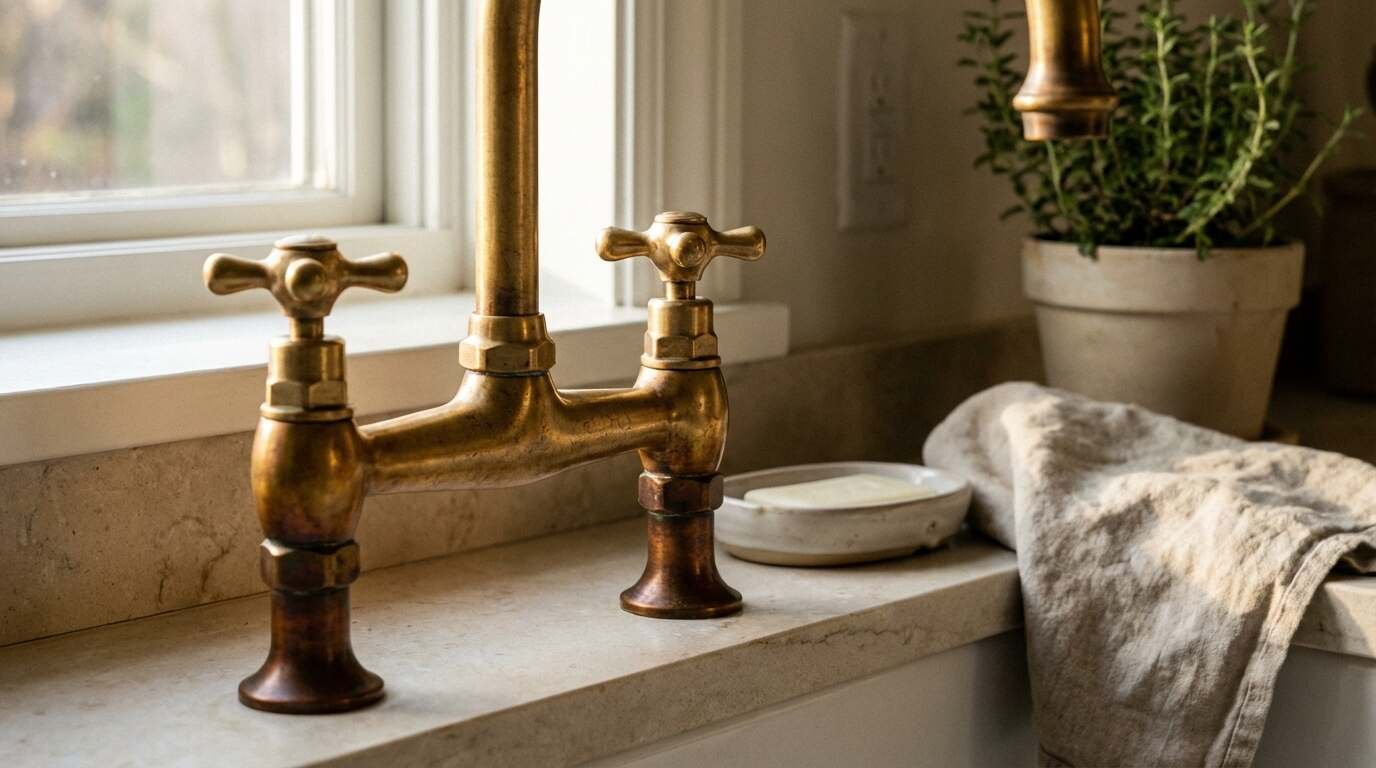
There is a faucet in a house I showed last spring — a gut-reno on a 1928 Colonial in St. James — that stopped me cold before I’d even cleared the kitchen doorway. The buyer with me kept moving toward the countertops, toward the appliances, doing the mental math buyers do. I stayed put. The bridge faucet was unlacquered brass, and it had been there long enough to begin its slow conversation with the air. The knobs were already deepening. The neck had a faint warmth the color of autumn light at four in the afternoon. Nobody had installed it to be trendy. They’d installed it because it was right.
That is, it turns out, exactly the moment we’re in.
The Long Exile of Brass
Brass ruled American kitchens and bathrooms through much of the twentieth century — a warm, durable, deeply traditional material with a pedigree stretching back to Roman plumbing. Then the 1980s happened. Polished brass went mass-market, and with it came a particular kind of garish shine: too gold, too uniform, too associated with the builder-grade bathroom of the Reagan era. By the early 2000s, chrome and brushed nickel had swept the field. They felt modern. They felt clean. They felt, for a long time, like the right answer.
The problem with the right answer is that it can become a tyranny. Walk through enough kitchens finished in the 2010s and something registers: a kind of relentless same-ness. Bright fixtures, cool tones, surfaces that reject age on principle. Interiors that feel designed to look good in photographs and less studied in how they feel to live in.
The countermovement was already forming at the edges of the design world before most people noticed.
What the Leaders Saw First
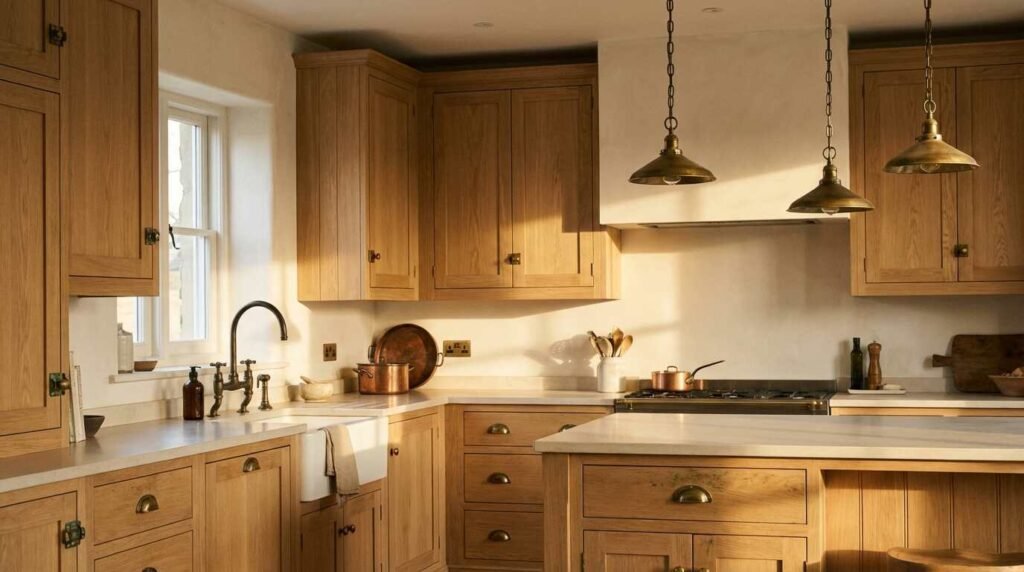
Robin Standefer and Stephen Alesch — the husband-and-wife team behind the New York firm Roman and Williams, winners of the 2017 WSJ Design Innovator Award — built their practice on a philosophy that treats every surface as a record of time. They describe their aesthetic as rooted in “inquiry, tradition, craft, and a modern sensibility.” Their SoHo shop and design studio, RW Guild, presents original furniture and objects made with natural materials and heritage craft. Alesch has described the underlying aesthetic as “modern farmer” or “caveman modern” — robust, warm, tactile, made to last and to change.
In that philosophy, an unlacquered brass fixture is not a design accent. It is a material choice that acknowledges time. It will not look the same in ten years as it does today. That is precisely the point.
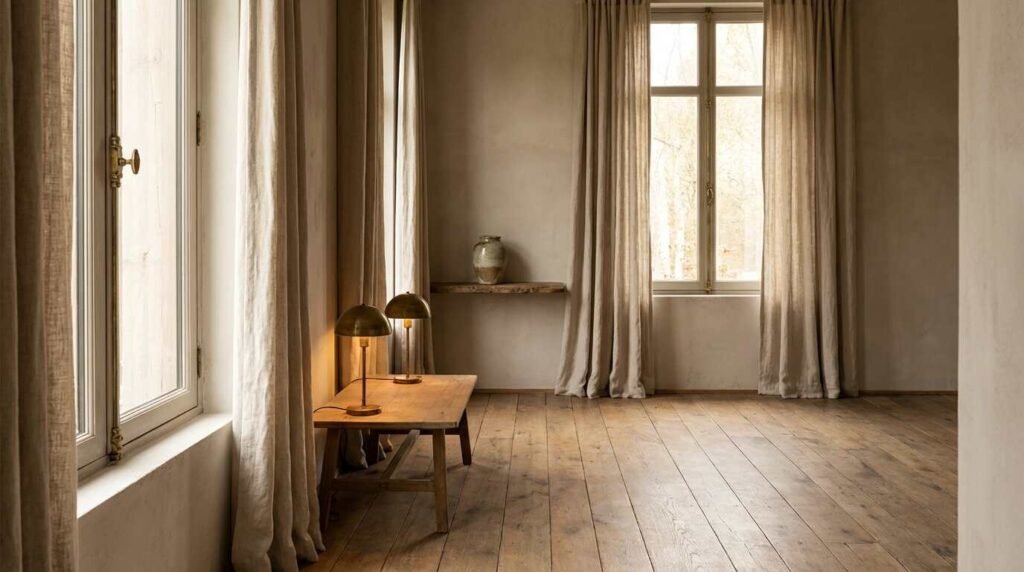
Across the Atlantic, Axel Vervoordt arrived at a similar conclusion through an entirely different path. The Belgian antiques dealer, collector, and interior designer — whose Kanaal complex in Wijnegem, a converted nineteenth-century distillery on the outskirts of Antwerp, functions as gallery, showroom, studio, and residential campus — spent decades developing a Western interpretation of wabi-sabi, the Japanese philosophy of beauty-in-imperfection. His own articulation: “With age, things soften; they meld with the air and get a new skin, a new use.” In Vervoordt’s world, a material that patinas is not aging poorly. It is aging honestly.
Vervoordt’s client list — Robert De Niro, Sting and Trudie Styler, Calvin Klein — signals something important: the appetite for imperfection at the highest levels of the market. These are not clients who chose aged brass because they couldn’t afford chrome. They chose it because they understood that it means something chrome cannot.
The Living Finish
The technical term the industry uses is “living finish” — and it is an unusually apt one for a descriptor borrowed from engineering.
Unlacquered brass has no protective coating. Left exposed, it reacts with oxygen and sulfur in the air, with the oils and acids left by hands, with water and humidity and the particular chemistry of a specific house in a specific place. The result is a patina that is never quite the same twice. A faucet in a kitchen used hard every morning develops differently from one in a half bath touched twice a day. The finish is, in a literal sense, a record of the life lived around it.
Lacquered brass, by contrast, is sealed — it stays bright, it stays uniform, and in doing so it stays static. It documents nothing.
Waterworks, the high-end plumbing and bath fixture brand whose products appear in some of the most carefully finished kitchens and bathrooms in the country, offers unlacquered brass across much of its line. Their Easton collection — a bridge faucet with clean period detailing — has become a signature specification for designers working in older homes where the architecture itself has already done the work of aging gracefully. The fixture meets the house where the house already is.
Rejuvenation, whose hardware and lighting catalog tracks the intersection of heritage design and contemporary demand, has built a significant unlacquered brass offering across its plumbing, cabinet hardware, and lighting lines. Its Beaux Arts solid brass door knob is available in both lacquered and unlacquered finishes — a choice the brand makes explicit, because the distinction matters.
What the Shift Tells Us
There is a cultural argument buried inside the design argument, and it is worth naming.
The dominance of chrome and polished nickel in the 2000s and 2010s coincided with an era of surfaces that performed their own cleanliness — that rejected, on principle, the visible evidence of use. Kitchens looked like operating theaters. Baths looked like showrooms. Everything gleamed, and gleaming meant new, and new meant good.
What unlacquered brass asks for is a different relationship with time. It asks the homeowner to accept — to want, even — a surface that will change. That will not look the same next year. That will carry the particular marks of this house, these hands, this life. It is the opposite of the spec-sheet surface, the material chosen because it photographs well and wipes clean.
I find this compelling for reasons that extend past aesthetics. When I sit with buyers in older North Shore homes — the Colonials and Craftsmans and Capes that make up so much of what people actually want when they come to this stretch of Long Island — they respond to the evidence of time. The worn thresholds. The window hardware that has been touched a thousand times. They are not looking for a house that looks new. They are looking for a house that has been lived in.
Aged brass speaks that language.
The Practical Questions
A living finish demands different maintenance than a sealed one. Unlacquered brass will tarnish — quickly in humid environments, more slowly in dry ones. Whether you want a brighter, more polished appearance or a deeper, darker patina is a matter of how often you clean it. Soap and water regularly applied will slow the process. Left alone, the brass will go darker and richer over time, developing what dealers call “honest color.”
The decision is partly philosophical and partly practical. Busy households with children, hard water, and little appetite for surface maintenance may find unlacquered brass more demanding than they anticipated. Households that understand the material — that have made peace with change as a feature rather than a bug — tend to love it without reservation.
For sellers preparing North Shore homes for market: unlacquered brass in a well-finished kitchen or primary bath reads immediately as a considered choice. It signals intention. It says: someone who knew what they were doing made decisions here. That is worth something to the right buyer. On the hardware questions that come up when preparing a home for sale, our piece on selling pre-war architectural details covers the broader conversation.
You Might Also Like
- The Servant Stair and the Service Wing: What the Hidden Architecture of Gold Coast Estates Reveals About Today’s Luxury Floor Plans
- Salt, Spray, and Staging: Beating Coastal Wear and Tear Before You List
- Selling History: How to Price and Market North Shore Pre-War Details
I keep thinking about that faucet in St. James. The house sold, quickly, to buyers who noticed the same thing I did. They didn’t mention the countertops or the appliances in their offer letter. They mentioned how the kitchen felt — like it had always been there, like it was waiting for someone to move in and let it keep becoming what it already was.
That is what aged brass does, when it’s done right. It doesn’t decorate the room. It takes its place in it.
Real estate markets change. For current listings and market data, contact Pawli at Maison Pawli.
Sources
- Roman and Williams — Design studio and RW Guild: romanandwilliams.com / rwguild.com
- Axel Vervoordt — Design philosophy and Kanaal complex: axel-vervoordt.com
- Waterworks — Unlacquered brass plumbing fixtures, Easton collection: waterworks.com
- Rejuvenation — Hardware and lighting catalog, unlacquered brass offerings: rejuvenation.com
- Wikipedia — Roman and Williams studio history: en.wikipedia.org/wiki/Roman_and_Williams
- Galerie Magazine — Roman and Williams Montauk home and design philosophy: galeriemagazine.com
- Wallpaper* — Axel Vervoordt and Kanaal profile: wallpaper.com