Lynette Yiadom-Boakye Paints People Who Don’t Exist. The Absence Is Entirely the Point.
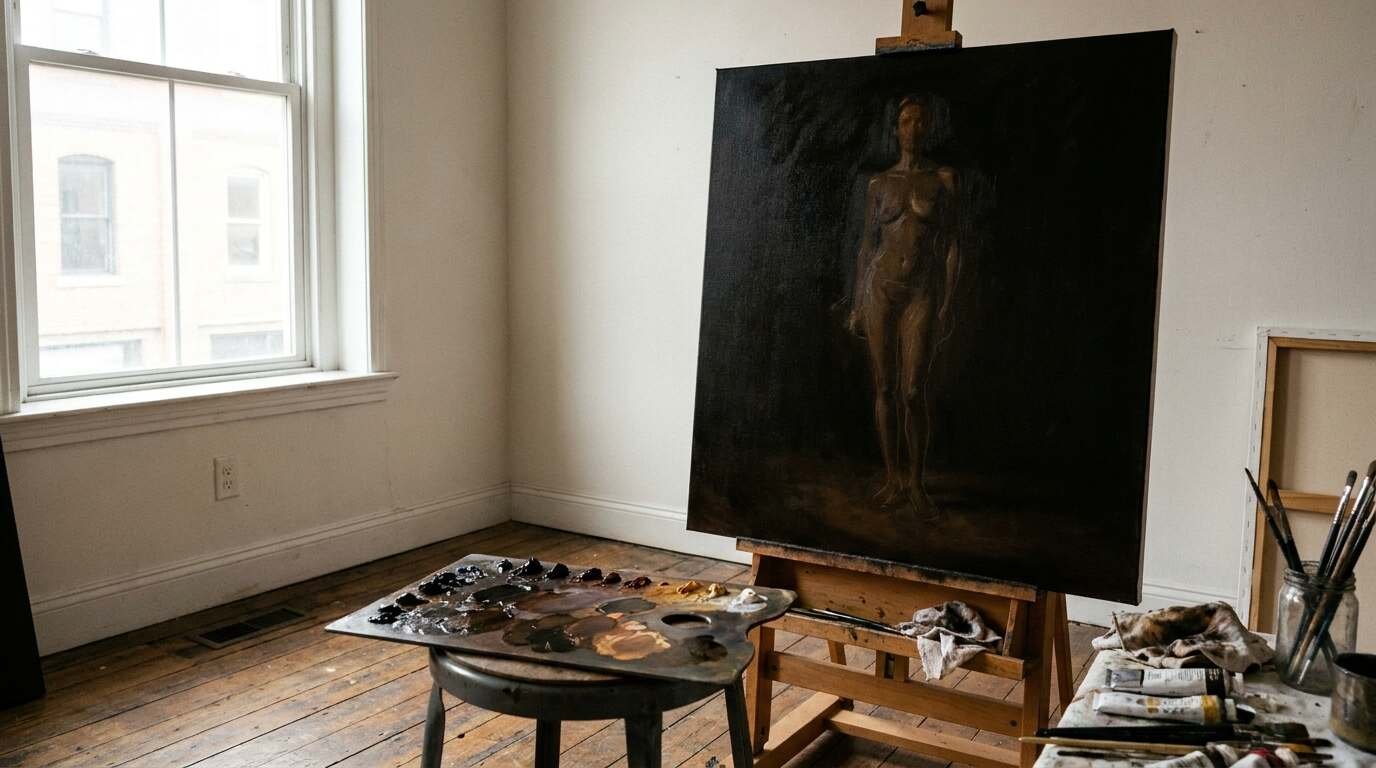
There is a painting by Lynette Yiadom-Boakye — I don’t remember the exact title, because her titles operate like a second painting, separately — in which a man in dark clothing leans back slightly, arms loose at his sides, looking at nothing in particular with the complete ease of someone who has no reason to perform attention. He is utterly convincing as a person. He does not exist.
That tension, between the authority of the painted figure and the knowledge that the figure is entirely invented, is where Yiadom-Boakye works. Most portraiture tells you something about its subject. Her paintings tell you something about what portraiture has historically excluded, and what it costs to fill that absence with intention.
Who Lynette Yiadom-Boakye Is and Why the Art World Moved Fast on Her
Yiadom-Boakye is a British painter born in 1977 to Ghanaian parents, trained at Falmouth College of Arts and then the Royal Academy Schools in London. She was shortlisted for the Turner Prize in 2013 — the shortlist itself a signal, in the British art world, that critical consensus had formed around something — and her major retrospective at Tate Modern in 2020–2021, titled Fly In League With The Night, confirmed what collectors and curators had been saying for a decade. This is significant work, and it is significant in ways that are not reducible to trend.
Her paintings are held in the permanent collections of the Museum of Modern Art in New York and the Tate in London, among others. Auction results at Christie’s and Sotheby’s have shown consistent market growth across primary and secondary markets — collectors who moved early have watched the work appreciate with the kind of trajectory that comes when institutional validation and market demand arrive at the same time and point in the same direction.
The Deliberate Decision to Paint Nobody Real
Yiadom-Boakye does not work from photographic reference, and she does not paint real people. Her subjects are assembled from imagination — composite figures drawn from her own visual thinking rather than from life. This is a considered methodology, not an absence of resources.
What it does, practically, is release both painter and subject from the obligations of portraiture. The traditional portrait is a commissioned relationship: someone pays to be represented, the artist represents them, and the resulting painting carries the weight of that transaction and that person’s actual history. Yiadom-Boakye’s figures carry none of that freight. They have no biography to live up to or down from. They exist entirely on their own terms, which are the terms she gives them — a posture, a quality of attention or inattention, a piece of clothing, a moment whose context she declines to specify.
The effect is that the viewer is invited to project. Not to identify the subject, but to recognize something. That recognition — and the speed with which it happens, the way these figures read as fully inhabited people within seconds of looking at them — is the argument the paintings are making.
How Old Master Technique Serves a Radically Contemporary Argument
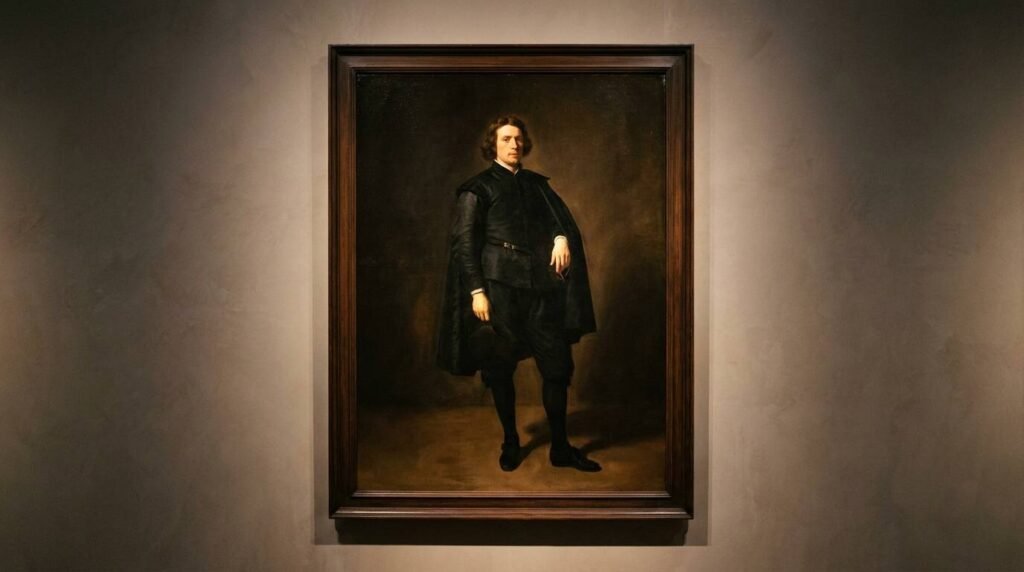
The paintings are made quickly — Yiadom-Boakye works in a single day on each canvas, a constraint she has spoken about publicly as generative rather than limiting. The speed is visible in the paint surface: there is looseness in the handling, a quality of decision rather than revision. But the compositional intelligence is Old Master in its orientation. The dark backgrounds, the way figures are lit from a single implied source, the use of shadow to give form authority — these are Velázquez’s tools, Sargent’s tools, tools that Western painting developed over centuries specifically to make a human figure command a room.
She is using them to paint people who would not have been painted by the tradition that developed those tools. The technique carries the authority; the subject reframes what that authority is being used for. The collision between those two things is not incidental. It is the work.
What Her Titles Do That the Paintings Don’t
Yiadom-Boakye’s titles deserve their own attention. They are not descriptive — she does not title paintings by the figure’s pose or the compositional elements. They are literary in a different way: phrases that feel mid-thought, fragments that suggest a larger sentence the painting declined to finish. A Culmination or Condor and the Mole or Tie The Whole Day Up. They come from her writing practice, which runs parallel to the painting practice, and they function as a kind of annotation that refuses to annotate.
What the titles do is confirm that the figures have inner lives — not described, but implied by the existence of a title that gestures toward something other than what’s visible. The painting shows you the person; the title suggests the person was thinking about something. Together they produce the sensation of having encountered someone briefly, deeply, without learning anything you could report afterward.
Her Market Trajectory and Why Collectors Paid Attention Early
The collectors who moved on Yiadom-Boakye’s work in the mid-2000s and early 2010s were making a particular kind of bet — not on a trend, but on the durability of the conceptual and technical case she was making. That case has held. The Tate Modern retrospective, the MoMA acquisition, the Turner shortlist, the consistency of secondary market performance at Christie’s and Sotheby’s — these are the markers of a career that has moved from critical interest to institutional permanence.
What tends to sustain that kind of trajectory is the same thing that makes a North Shore property hold value when the market shifts around it: the underlying logic is sound, and the things that make it sound are not the things that can be replicated quickly by someone trying to occupy the same territory. Yiadom-Boakye’s work is not a style that can be picked up and moved. It is a position that took years to develop and will take years more to fully understand.
I find myself drawn to artists who work that way — who build an argument slowly, in the open, and let the market come to them. I think about that sometimes when I’m talking with buyers who are looking for the kind of long North Shore address that doesn’t need to announce itself. The right choice tends to be the one that reads well in thirty years, not just this quarter.
If that kind of thinking resonates in your real estate search — patient, considered, not chasing — I’m at Maison Pawli and happy to talk through what it looks like for your specific situation.
You Might Also Like:
- Cold Spring Harbor Laboratory’s Visual Epistemology: How Scientific Illustration at the Carnegie Institution Campus Codified a Eugenicist Way of Seeing
- The Huntington Arts District’s Invisible Infrastructure: How the Heckscher Museum’s 1920 Beaux-Arts Program Structured a Century of Aesthetic Legitimation
- Lloyd Neck’s Cadastral Uncanny: How the Marshall Field III Estate’s Boundary Geometries Produced a Landscape of Deliberate Inaccessibility
Sources:
- Turner Prize 2013 Shortlist — Tate — Turner Prize shortlist records
- Fly In League With The Night — Tate Modern, 2020–2021 — retrospective exhibition records
- Lynette Yiadom-Boakye — MoMA Collection — MoMA permanent collection database
- Christie’s — Lynette Yiadom-Boakye auction results — secondary market performance records
- Sotheby’s — Lynette Yiadom-Boakye — secondary market auction records