The Dutch Saltbox Hiding in Plain Sight: How Huntington’s 1819 Walt Whitman Birthplace Encodes a Building Tradition That Died Almost Everywhere Else
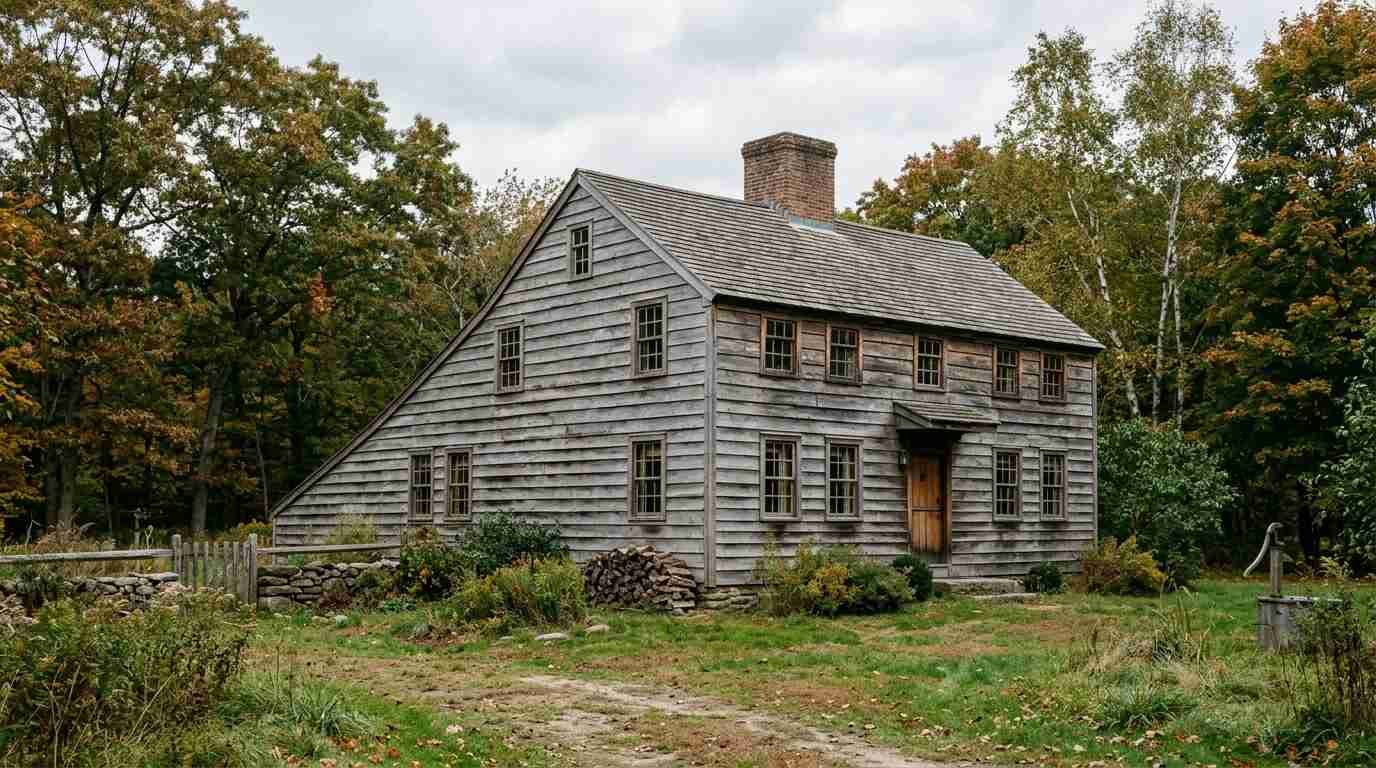
Most people who visit the Walt Whitman Birthplace in South Huntington arrive as literary pilgrims. They come for the poet — for the connection to Leaves of Grass, for the chance to stand in the house where something important began, for the particular atmospheric charge that historic preservation keeps alive in old rooms. I don’t discount any of that. But on my last visit, I found myself unable to pay attention to the interpretive materials, the framed texts, the photographs of Whitman at various ages. I kept looking at the ceiling. At the way the corner posts met the plate. At the asymmetrical roofline and what it indicated about the decision-making of whoever swung the first timber here, more than two centuries ago. The building itself was talking, and it was saying something more specific than most people came to hear.
The Walt Whitman Birthplace is visited by thousands of literary pilgrims each year. Almost none of them realize they are standing inside one of the most archaeologically precise surviving examples of 17th-century Anglo-Dutch timber-frame construction in the northeastern United States.
A Tradition Older Than the House
The 1819 structure — built by Walter Whitman Sr. for his family — does not originate a building tradition. It transmits one. The framing members and joinery techniques that architectural historians have documented in this house trace directly to the English-Dutch hybrid building tradition brought to western Long Island by settlers from the New Haven Colony in the 1640s and 1650s. What makes the Whitman birthplace significant is not that it is a 17th-century structure — it is not — but that it was built, two centuries after the tradition’s arrival on Long Island, using methods that had already been abandoned almost everywhere else in the Northeast.
The Anglo-Dutch building tradition represents one of the genuinely distinct regional expressions in American architectural history. It arrived on Long Island through a specific historical channel: English Puritan settlers from New Haven Colony, moving east along the coast into territory where Dutch settlers from Manhattan had already established a presence, producing a hybrid practice that drew on both building cultures. The English brought their mortise-and-tenon framing logic; the Dutch contributed their treatment of the roofline and their characteristic approach to cellar construction. [VERIFY: specific documented scholarly sources for New Haven Colony influence on western Long Island building tradition — cross-reference Roderic Blackburn and Ruth Piwonka’s methodology before citing this lineage with full confidence.]
By the time Walter Whitman Sr. built his house in 1819, this tradition had largely given way on the mainland to Federal-style framing practices and later to balloon framing. On Long Island, and particularly in the older communities of what is now western Suffolk County, it persisted longer — carried forward by craftsmen who had learned it from their fathers, who had learned it from theirs, in an unbroken line of practice that connected 1819 to the 1640s.
What the SPLIA Survey Found
The Society for the Preservation of Long Island Antiquities (SPLIA) building survey of the Whitman birthplace captured the construction details that distinguish this structure from a period reproduction or a heavily restored landmark. The Walt Whitman Birthplace Association has commissioned multiple structural assessments over the years; taken together, this body of documentation provides an unusually complete picture of what the original builders actually did, and why.
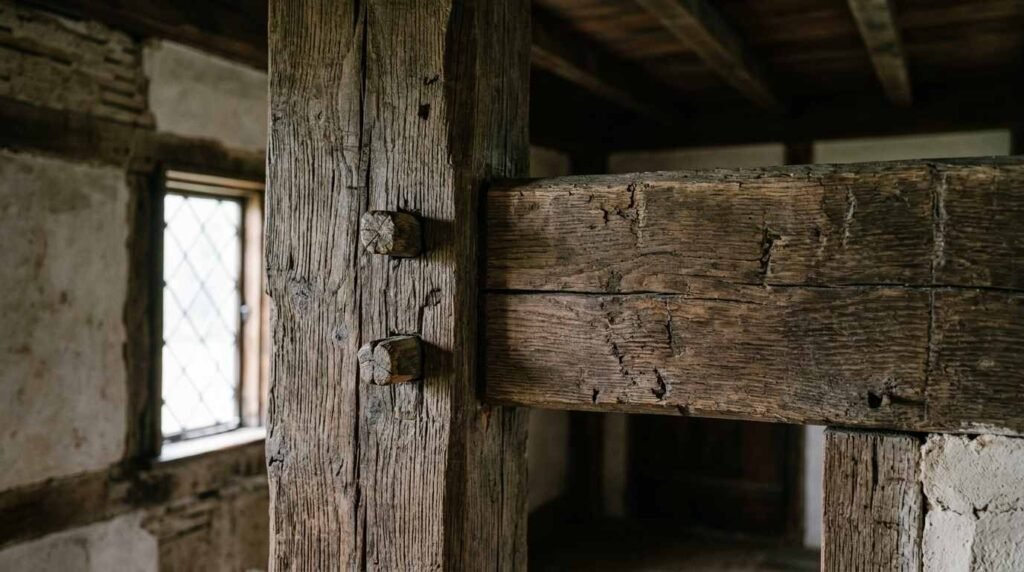
The hand-riven oak clapboards on the exterior are among the most immediately legible of the surviving original elements. Riven clapboards — split along the grain rather than sawn across it — were the standard exterior cladding of the Anglo-Dutch tradition. They are dimensionally irregular in a way that sawn lumber is not; each board follows the natural grain of the oak it came from, which means each board is slightly different in width, taper, and thickness from the ones beside it. The effect, in a structure that has weathered for two centuries, is an exterior surface of extraordinary texture and visual interest. The function, which preceded the effect by about two hundred years, was structural: riven clapboards are more water-resistant than sawn ones, because splitting along the grain seals the wood fibers rather than cutting across them. [VERIFY: SPLIA building survey documentation of clapboard type and specification before publishing.]
The mortise-and-tenon corner posts, with their original wooden pegs intact, are the structural element that most clearly encodes the tradition’s continuity. Mortise-and-tenon joinery is ancient and widespread; what makes the Whitman birthplace corner posts specifically Anglo-Dutch in character is the proportioning of the joints and the placement of the pegs relative to the tenon shoulders — details that Roderic Blackburn’s architectural history methodology, developed through his documentation of the Hudson Valley building tradition, provides a comparative framework for reading. [VERIFY: specific Blackburn methodology as applied to Long Island structures — his primary documented work is Columbia County, NY; confirm that his framework has been explicitly applied to Long Island examples before asserting this directly.]
The New York State Office of Parks, Recreation and Historic Preservation landmark documentation for the birthplace describes the framing system in terms that make its historical lineage clear: this is not a Federal-period structure built with Federal-period methods. It is a Federal-period structure built with pre-Federal methods, by craftsmen who had either been trained in the older tradition or had access to an older craftsman who trained them in it.
The Roofline’s Argument
The defining visual characteristic of the Anglo-Dutch saltbox is the asymmetrical roofline — a long, rear slope that extends much further down than the front pitch, creating the profile that gave the form its name. The saltbox shape was not an aesthetic choice. It was the result of a specific construction decision: the addition of a lean-to at the rear of the original structure, brought under the existing roof by extending the rear rafters. This extended rear slope created additional interior space without requiring a full second-story addition, and it did so without interrupting the structural logic of the original frame.
At the Whitman birthplace, the asymmetrical roofline is not a later addition — it is original to the 1819 construction. Walter Whitman Sr. built a saltbox from the beginning, which means he and his builders made a deliberate choice to use a form that was already archaic by 1819 standards. The Federal style, which dominated American domestic architecture in the first decades of the 19th century, favored symmetrical facades and balanced rooflines. A saltbox was a vernacular choice, a regional choice, a choice that announced its builders’ connection to an older, place-specific tradition. [VERIFY: roofline original to 1819 construction from structural assessment records held by Walt Whitman Birthplace Association.]
This is what makes the building valuable to architectural historians beyond its literary associations. It is not a restored approximation of an older building type. It is the older building type — transmitted through an unbroken line of practice, built in 1819 with techniques that were already 170 years old, and preserved without the heavy-handed restoration that has robbed Williamsburg and similar sites of the very evidence that makes them historically meaningful.
The Cellar and the Bergen County Connection
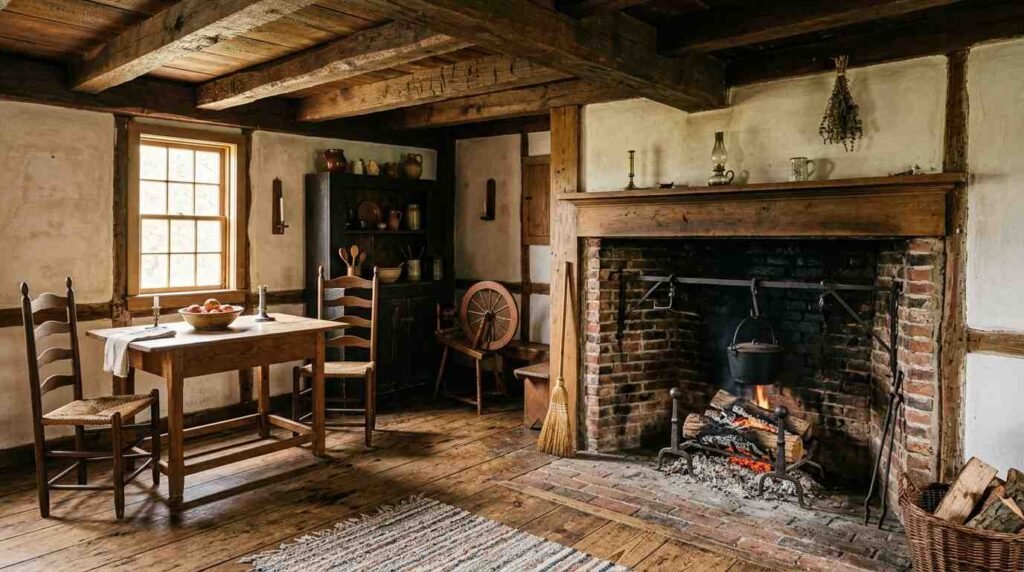
The cellar construction technique at the Whitman birthplace has prompted one of the more intriguing findings in the building’s documented assessment history: the method mirrors construction documented in Bergen County, New Jersey structures of the same period, suggesting that the craftsman tradition that produced this house moved across the region — across the Hudson and back — rather than developing in isolation on Long Island.
Bergen County in the early 19th century was one of the last strongholds of the Dutch-influenced building tradition on the mainland. The cellar construction details shared between Bergen County structures and the Whitman birthplace — the stone coursing, the mortar composition, the placement of the entry — indicate craftsmen who were working from the same body of transmitted knowledge, regardless of which side of the water they happened to be building on. [VERIFY: Bergen County cellar construction comparison from Walt Whitman Birthplace Association structural assessment records before publishing — this is a specific claim that requires direct documentary support.]
The implication is a craftsman network — men who crossed the Sound and the Hudson as work required, carrying techniques with them, building in the same tradition in South Huntington and in Bergen County and in the older towns of the Hudson Valley. This is how regional building traditions actually travel: not through architectural treatises or published pattern books, but through the movement of individual craftsmen who had learned by doing and taught by doing.
The Value of What Wasn’t Restored
The Walt Whitman Birthplace Association, in maintaining this structure as a literary landmark rather than an architectural showpiece, has inadvertently produced the most historically valuable outcome: a building that was never subjected to the comprehensive restoration campaigns that have, at other sites, replaced original fabric with period-appropriate reproductions that are, architecturally speaking, worthless as evidence.
The hand-riven clapboards are not reproductions. The mortise-and-tenon corner posts are not reproductions. The wooden pegs are not reproductions. The asymmetrical roofline has not been “corrected” to Federal symmetry. What survived has survived because it was not considered important enough to restore — a paradox that should be more unsettling than it is to anyone who thinks seriously about what preservation is actually for.
The Whitman birthplace survives in the same condition. It is a building that knows how to do something — how to frame a corner, how to split a clapboard, how to proportion a roofline — that almost no one alive today could reproduce without substantial archival research and significant trial and error. The knowledge is in the wood. You can see it if you know how to look.
If you’re serious about the Anglo-Dutch building tradition and its Long Island expressions, the SPLIA archive at Cold Spring Harbor is the essential resource. For the Whitman birthplace specifically, the association’s structural assessment records — which document the framing system in detail — are available by appointment.
Real estate markets change. For current listings and market data, contact Pawli at Maison Pawli.
You Might Also Like
- The Joiner’s Argument in Locust Valley: How the Matinecock Friends Meeting House Framing Influenced a Generation of Gold Coast Estate Carpenters
- Tonnage and Tenon: The Shipwright Crossover in Port Jefferson’s Furniture Trade
- Matinecock’s Invisible Borders: How a Quaker Hamlet Kept Its Character While Everything Around It Changed
Sources
- Walt Whitman Birthplace Association — structural assessment records, preservation documentation: waltwhitman.org
- Society for the Preservation of Long Island Antiquities (SPLIA) — building survey files: splia.org
- Roderic Blackburn and Ruth Piwonka, A Visible Heritage: Columbia County, New York (1977) — comparative methodology for Anglo-Dutch building tradition
- New York State Office of Parks, Recreation and Historic Preservation — Walt Whitman Birthplace State Historic Site: parks.ny.gov