Wabi-Sabi in the Kitchen: The Case for Ceramics That Show Every Scar
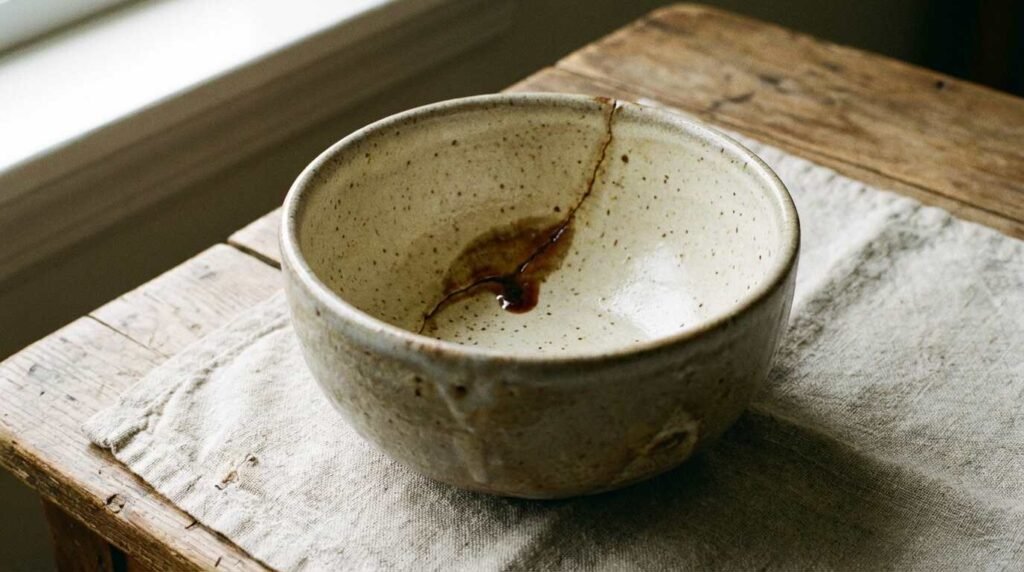
There is a bowl in my kitchen that I have been using for fifteen years. It was thrown on a wheel by someone I don’t know, purchased at a craft fair for a modest sum, and at some point in its life dropped — not shattered, but cracked along the inside surface in a way that the glaze has since filled, slightly differently colored, a visible seam in the clay. I have used it for everything: soup, oatmeal, the occasional late-night cereal. It is, by any objective measure, imperfect. And it is the most beautiful thing in the room.
I couldn’t have told you exactly why for years. Now I think I understand it. The bowl has accumulated time. Not wear in the negative sense — not damage, not deterioration — but evidence of use, of handling, of existing in a specific life. The crack is a record. The glaze variation is a consequence of the fire and the clay, not a designer’s specification. The slight asymmetry in the lip means it was made by a human hand working at a wheel with variables the potter was managing but not controlling. All of this is present in the object, visible if you look, and it is precisely this presence that makes the bowl irreplaceable in a way that its injection-molded counterparts are not.
The Japanese have a name for this quality and the philosophy that values it. Wabi-sabi. And it is having a significant moment in how the West thinks about kitchens.
What Wabi-Sabi Actually Means
Like ma, wabi-sabi is a concept that resists clean translation. It is built from two aesthetic values — wabi, the beauty found in imperfection and simplicity, particularly in natural or handmade things; and sabi, the beauty that comes with age and use, the patina of time on an object. Together they describe an aesthetic orientation toward the world that privileges the authentic, the impermanent, and the honestly made over the perfected, the permanent, and the produced.
In the context of domestic objects — ceramics in particular — wabi-sabi is the argument that the bowl with the slight wobble is more beautiful than the bowl without it. That the glaze that broke unexpectedly in the firing and ran in a direction the potter didn’t intend produces something more interesting than the glaze applied in uniform coverage. That the coffee cup you’ve used every morning for five years is more yours — more present as an object in your life — than the set of twelve bought at retail, identical, stored in a cabinet until needed.
This is a philosophical position, not an aesthetic preference, and it matters to say so because the kitchen is one of the few rooms in the house where the objects are genuinely used, genuinely tested, genuinely aged. A perfectly designed kitchen full of identical white plates from a European design brand is also perfectly impersonal — a kitchen that hasn’t happened yet. A kitchen built around handmade ceramics that show their history is a kitchen that has already begun.
East Fork and the American Studio Ceramics Moment
In Asheville, North Carolina, the pottery East Fork has spent the better part of the past decade making the wabi-sabi argument through its production work — and doing it at a scale and a quality that has moved the conversation from craft-fair niche to mainstream design culture reference.
East Fork was founded by Alex Matisse and others with a commitment to making functional ceramics that were genuinely beautiful, honestly priced, and designed for daily use rather than for display. Their production — plates, bowls, mugs, serving pieces — is wheel-thrown and hand-finished, which means no two pieces are identical. Their glazes are developed in-house and fired in a way that produces intentional variation: the same glaze looks different at the center and the edge, different on a bowl than on a plate, different depending on where in the kiln the piece was positioned.
Their philosophy, documented across their brand communications, is explicit about wabi-sabi as a reference point. They make ceramics that are meant to be used daily, to build up a history of meals and seasons, to become the particular set of objects in a specific kitchen rather than a specification executed uniformly. The crack that develops after years of use is not a failure. It is the object becoming what it is.
The American Craft Council has documented a significant expansion in the artisan ceramics market over the past several years — driven partly by consumer appetite for handmade goods as a counterweight to mass production, but also by a genuine shift in how people are styling kitchens. The perfectly matched set, long a benchmark of kitchen completion, is giving way to the assembled collection: pieces from different potters, different traditions, different moments of a kitchen’s life, that cohere around a shared quality of making rather than a shared manufacturer’s number.
Jono Smart and the International Register
In New Zealand, the ceramicist Jono Smart has built an international reputation on work that sits at the exact intersection of the functional and the considered — vessels and objects that are made to be used but carry an aesthetic weight that has placed them in gallery exhibitions internationally.
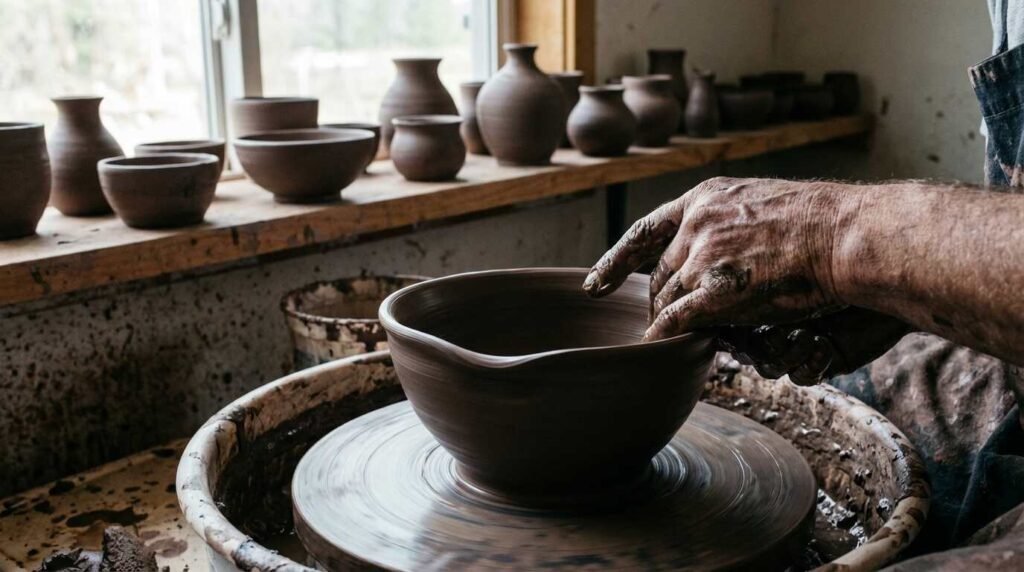
Smart’s work is notable for its engagement with the material itself: he is interested in what clay wants to do, in the marks that process leaves on surface, in the evidence of making that firing preserves. His exhibition record spans from New Zealand to the United States to Europe, and his work has been collected by institutions and private collectors who value it as much for its philosophical position as for its formal qualities.
The sensibility Smart brings to ceramics is the same one wabi-sabi describes: an orientation toward process over product, toward the evidence of time and making over the concealment of it. A Smart bowl shows you how it was made. The marks of the hand are there in the surface. The glaze pools slightly at the base where gravity worked on it during firing. These are not imperfections. They are the object’s autobiography.
What makes Smart’s work relevant to the kitchen conversation specifically is that the most interesting ceramicists working in this tradition are making functional objects, not decorative ones. The aim is not a beautiful bowl for a shelf. It is a beautiful bowl for breakfast, used daily, aged over years, increasingly yours.
Kinfolk and the Visual Language of the Living Kitchen
The design magazine Kinfolk, which has done more than any other publication to establish the visual language of wabi-sabi in Western domestic interiors, has returned repeatedly to the kitchen as the room where this philosophy is most legible and most consequential. Their kitchen features consistently prioritize handmade ceramics, worn wooden surfaces, visible use — the patina of a kitchen where cooking actually happens over the staging of a kitchen that has never been touched.
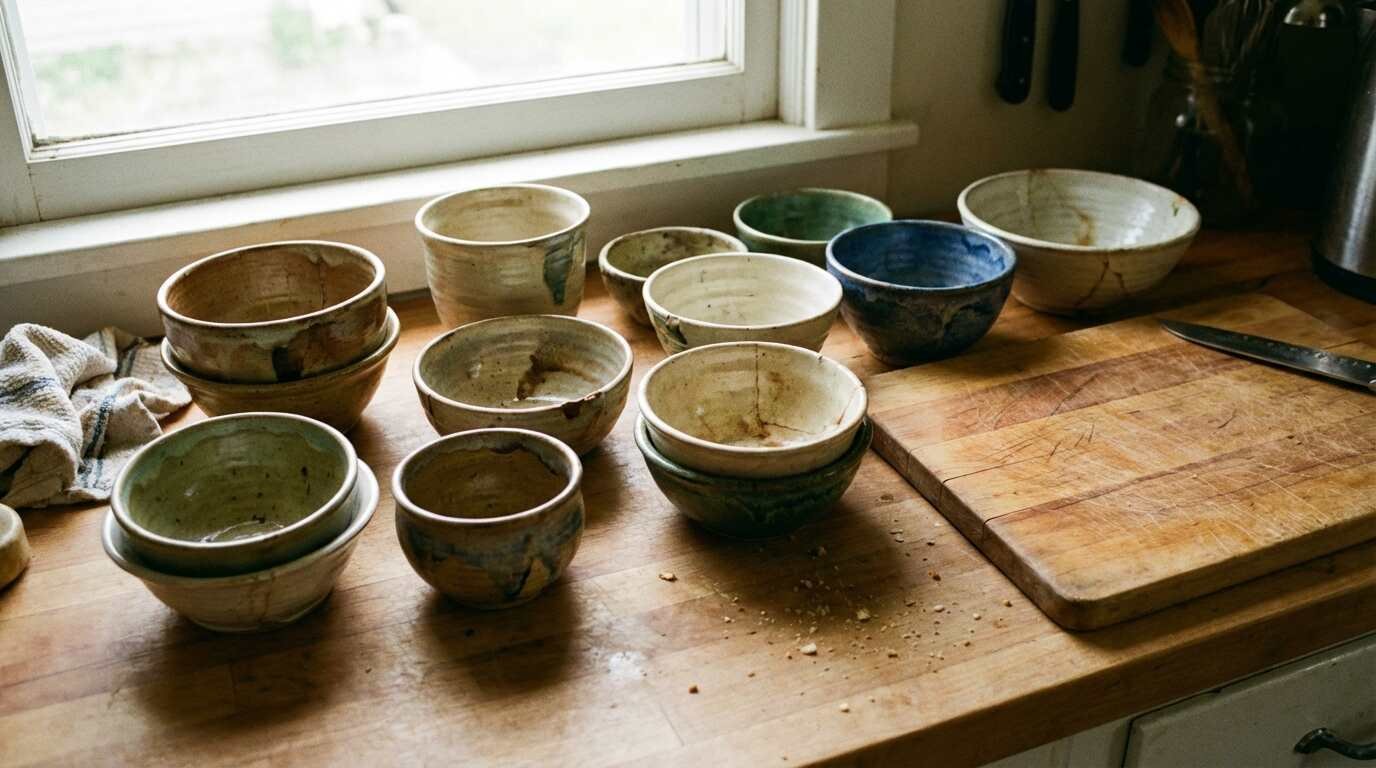
The specific grammar is consistent: mismatched ceramic pieces that cohere through material quality rather than visual uniformity; wooden chopping boards with knife marks; copper pans with the darkening that comes from years over a flame; a stack of bowls that includes several different heights and foot rings because they were made by different hands at different times. The kitchen that looks like someone actually lives in it, has lived in it, will go on living in it.
This is a harder thing to achieve than it looks. The wabi-sabi kitchen isn’t a styled kitchen that has been made to look un-styled. It is the product of real decisions, made over time, about which objects to keep and which to replace and why. It requires an actual relationship with the objects in the room — knowing which bowl you reach for on a difficult morning and why, which mug you give to a guest you want to impress — rather than a curatorial relationship with a matched set.
The Practice of It
Starting is simpler than the philosophy suggests. One bowl from a potter whose work you understand. Used every day. Not saved. Not placed. Used. The relationship develops from there, and the kitchen develops with it — one object at a time, each one carrying the record of a specific choice, a specific maker, a specific moment.
I still use the cracked bowl. I use it most mornings. The crack has stabilized, the glaze has settled into it, and the bowl is more itself than it was the day I bought it. That is the argument. Not that imperfection is beautiful in principle. That this bowl, with this history, is more present in my kitchen — and in my life — than any ten perfect bowls stacked in a cabinet.
The kitchens I find myself returning to, in photographs and in person, are the ones where that argument has been accepted and lived with. Where the ceramics show every scar. Where something has happened in that room, and the objects in it are willing to say so.
You Might Also Like
- The Bent Wood Secret of Sagamore Hill: How Roosevelt’s Craftsmen Steam-Curved White Ash for the North Room’s Hidden Chair Rail
- Coopered and Forgotten: The Barrel-Stave Furniture of Centerport’s Vanderbilt Marine Museum and the Cooper’s Trade That Built It
- Riven or Sawn: The Chestnut Question in the Fire Island Life-Saving Stations and What the Planks Remember
Sources
- East Fork Pottery — brand documentation and philosophy: https://www.eastfork.com/
- Jono Smart Studio — exhibition records: https://www.jonosmart.com/
- American Craft Council — market data: https://craftcouncil.org/
- Kinfolk Magazine — kitchen feature archive: https://www.kinfolk.com/
- Leonard Koren, Wabi-Sabi for Artists, Designers, Poets & Philosophers — Imperfect Publishing, 2008