The Quiet Power of Undyed Textiles: Why Natural Fibers in Their Raw State Are Dominating Interiors
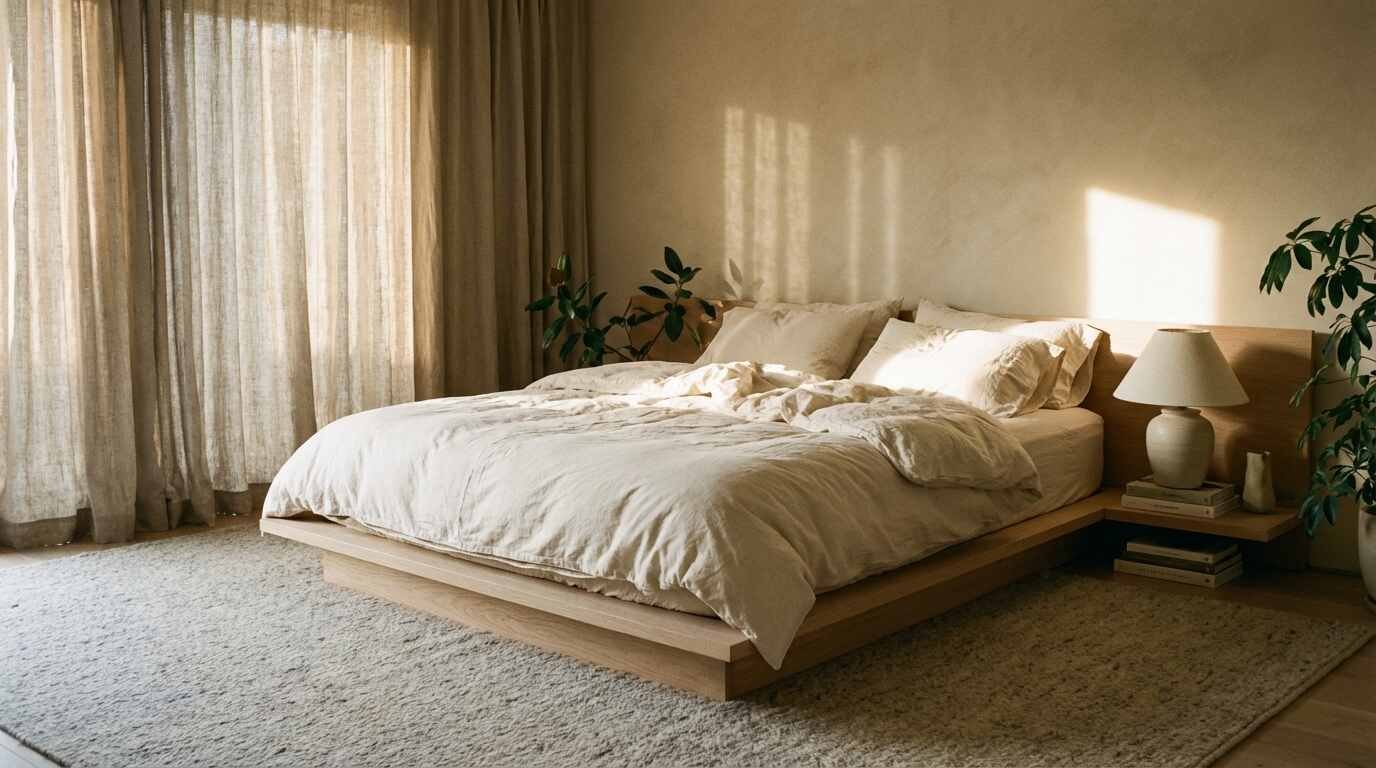
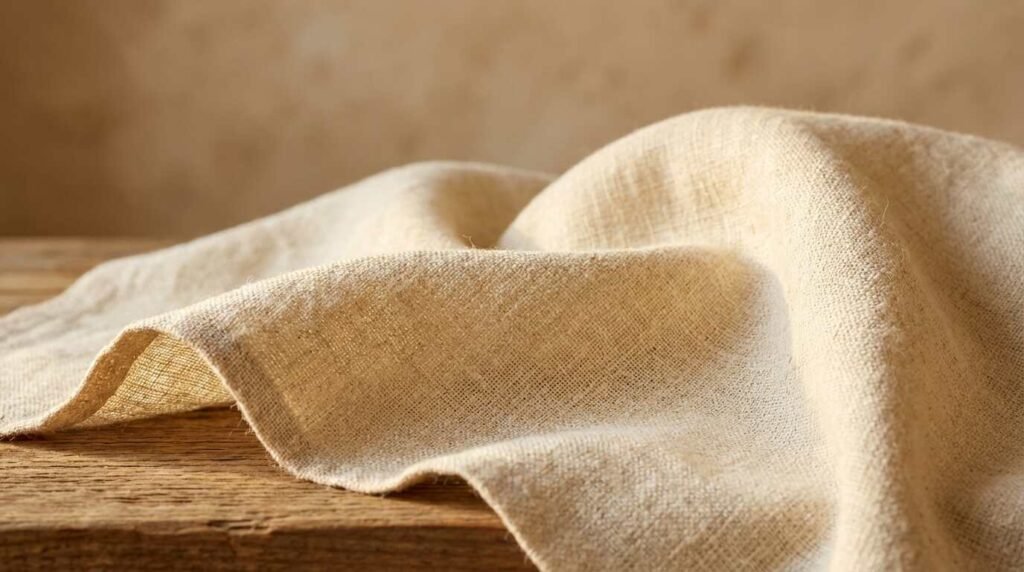
Pick up a length of unbleached linen — not the linen from a big-box duvet set, not the pre-washed, pre-softened, pre-stonewashed version sold as “lived-in” — but raw linen, straight from the mill. It has a weight to it. A particular color, neither beige nor grey nor gold but something in between, the color of dried grass in late September, or of the inside of a wooden box that hasn’t been opened in years. It smells faintly of itself. And when you put it down on a white surface, the white surface suddenly looks aggressive, almost violent, by comparison.
This is the thing that designers working with undyed textiles are trying to say: the dye was never the point. The fiber was the point. And for decades, Western interiors treated that fiber as a substrate — something to be transformed into a color, treated into a finish, processed into compliance with whatever palette was current. The movement now pressing back against that is small, deliberate, and producing some of the most considered rooms being finished anywhere.
The Case That Libeco Has Been Making for Thirty Years
The Belgian linen company Libeco has been producing undyed and minimally processed linen from Flanders flax since the mid-twentieth century, long before “natural” became a marketing category. Their argument has always been consistent: linen processed as little as possible is stronger, more durable, more beautiful over time, and more honest to the material than linen that has been bleached, dyed, and softened into something easier to sell.
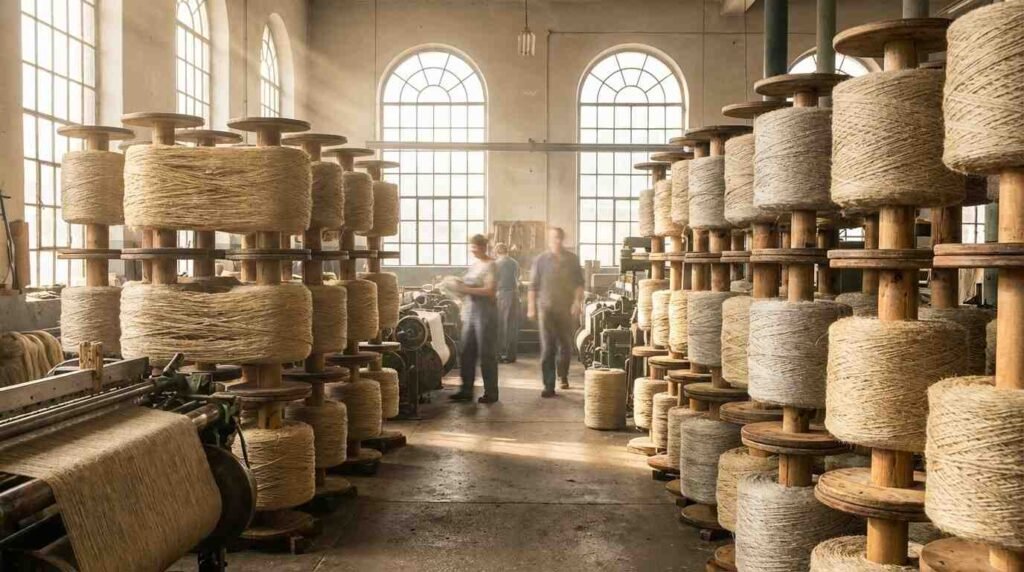
Their production documentation describes a wet-spinning process — spinning flax fibers in warm water to draw them out and align them — that is one of the oldest textile technologies still in use. The resulting yarn has a tensile strength that synthetic analogs have never matched and a surface quality that changes with use, growing softer and more lustrous over years of washing without losing structural integrity. Their natural linen — undyed, with only the botanical processing required to separate fiber from plant — carries a color range determined entirely by the specific flax harvest: warmer in dry summers, cooler in wet ones. A record of a season, not a specification.
This is the pitch for undyed textiles that goes beyond sustainability (though the environmental case is real: dyeing is one of the most chemically intensive processes in textile manufacturing, consuming significant water and generating effluent). The pitch is that the material, left to be itself, is more interesting than the material processed into something it isn’t.
Ilse Crawford and the Philosophy of the Unmediated
The British designer Ilse Crawford, through her studio Studioilse, has made this argument at the level of philosophy. Her practice — which spans interiors, products, and the theoretical field she calls “human-centered design” — proceeds from the premise that materials should be chosen for how they affect the people who live with them, not for how they photograph.
Her work on the Aesop store interiors — a long-running series of commissions that positioned Aesop as an authority on material culture as much as skin care — returned repeatedly to natural, undyed, and minimally processed textiles as a way of establishing a particular register of sensory experience. The texture underfoot, the weight of fabric at a door, the color of a curtain: these were not decorative decisions but atmospheric ones. The rooms were designed to feel a specific way, and that feeling depended on materials being allowed to communicate directly rather than through the mediation of dye and finish.
Crawford has described this approach in terms of “the intelligence of materials” — the idea that a material like raw linen or natural wool carries information about its origin, its process, and its durability that processed materials have been stripped of. A piece of undyed wool is in a conversation with its source. A piece of solution-dyed acrylic is not.
The practical application of this philosophy in residential interiors is becoming more widely visible. Curtains in raw linen that read differently at different hours of the day as the light changes angle. Upholstery in natural wool that wears in rather than wearing out. Bed linens in unbleached cotton that get better — visually richer, softer to the touch — with each wash. These are not bargain choices. They require more confidence than buying something in a specified color that will look the same next year as it does today. They are a commitment to letting the material do something over time.
Brita Sweden and the Natural Wool Argument
Brita Sweden, the Scandinavian textile brand, has built a catalog around natural-colored wools that makes the case visually with unusual clarity. Their rugs and textiles are produced in the colors that Nordic sheep actually are: the creamy off-white of one breed, the warm grey of another, the deep charcoal-brown of a third. Not dyed to match those colors. Actually those colors, from those animals.
The aesthetic effect in an interior is difficult to achieve by any other means. Natural wool colors have a depth — a slight variation within the overall tone that you can see when the light catches it at an angle — that dyed wool doesn’t replicate because the dye saturates the fiber uniformly in a way that the animal’s natural pigmentation never does. You can produce a dyed wool that is nominally the same color as a natural one and the two will read differently in a room because they are structurally different at the fiber level.
For rooms built around a restrained palette — the current luxury direction, particularly in Scandinavian-influenced and Japanese-influenced interiors — this kind of material fidelity produces something that staging cannot. The room feels like it was built, not arranged. The textiles feel chosen for what they are, not for what they represent.
The Sustainable Textiles Market and the Shift in Demand
The Textile Exchange, which tracks global fiber and materials markets, has documented consistent growth in demand for natural and undyed textiles across the interior design sector. Their market reporting shows particular acceleration in the undyed and low-intervention processing segment — driven partly by environmental awareness, but also by a shift in design culture away from the aggressively trend-driven palette and toward materials whose color and texture aren’t defined by this year’s color forecast.
The brands responding to this shift are not exclusively high-end. The accessible natural textiles market has grown alongside the design-culture one, producing affordable undyed linen bedding, natural cotton towels, and minimally processed wool throws at price points that don’t require a design budget. The philosophical argument — that the material in its natural state is more interesting than the material processed into compliance — has reached a wide enough audience that it’s driving volume.
But the interiors where this argument is being made most compellingly are still the ones where the commitment is total. Where the curtains and the upholstery and the rug and the bedding are all working from the same palette of what-things-actually-are, and the room that results doesn’t need to be photographed at a specific time of day or from a specific angle. It looks like itself. Always.
What It Asks of a Room
Working with undyed textiles requires a different kind of decisiveness than working with color. Color does a lot of work in a room — it creates mood, defines zones, announces itself. A raw linen curtain doesn’t announce itself. It arrives. And for that arrival to be legible as a choice rather than an oversight, everything else in the room has to be working at the same level of material consciousness.
This is why the most successful rooms built around natural, undyed textiles tend also to be rooms where the furniture is real wood rather than wood-effect, where the floor is stone or worn hardwood rather than tile, where the hardware is aged brass or blackened iron rather than brushed nickel. The undyed textile is the most honest thing in the room, and it has a way of making everything less honest around it look like what it is.
I find this clarifying rather than demanding. A room that can’t accommodate the honesty of a raw linen curtain is telling you something about itself.
You Might Also Like
- The Bent Wood Secret of Sagamore Hill: How Roosevelt’s Craftsmen Steam-Curved White Ash for the North Room’s Hidden Chair Rail
- Riven or Sawn: The Chestnut Question in the Fire Island Life-Saving Stations and What the Planks Remember
- The Servant Stair and the Service Wing: What the Hidden Architecture of Gold Coast Estates Reveals About Today’s Luxury Floor Plans
Sources
- Libeco — Belgian linen production: https://www.libeco.com/
- Studioilse — project documentation: https://www.studioilse.com/
- Brita Sweden — natural wool textiles: https://www.britasweden.se/en/
- Textile Exchange — Preferred Fiber & Materials Market Report: https://textileexchange.org/preferred-fiber-materials-market-report/