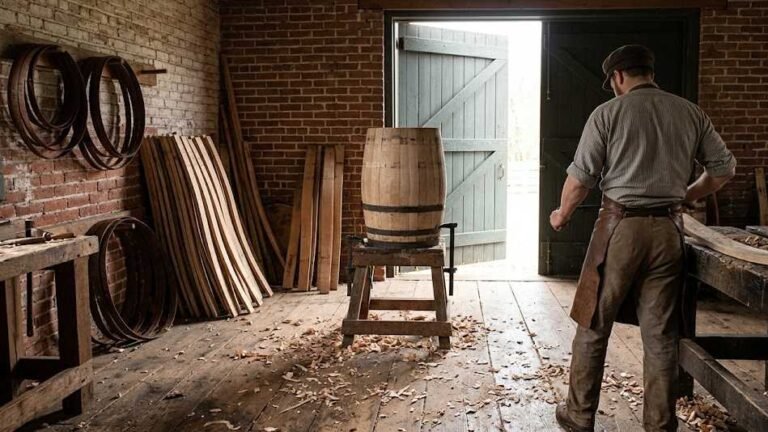
Tonnage and Tenon: The Shipwright Crossover in Port Jefferson’s Furniture Trade and the Joiners Who Built Both Hulls and Highboys
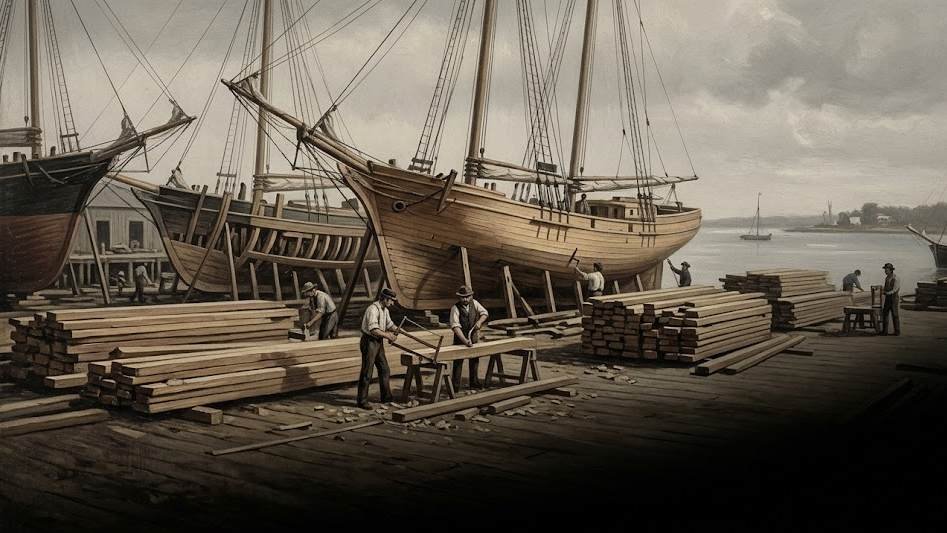
The harbor at Port Jefferson is not large. Standing at the water’s edge in the mid-19th century, you could see across it. You could see the Bayles yard on one side, where Charles and James Bayles had been building vessels since 1835 — eventually 155 ships between the two brothers, primarily schooners suited to the coastal freighting trade. You could see the Mather yard, where John T. Mather had established his own operation after apprenticing under William R. Jones. And if you looked inland, up the slope toward the streets where the shipbuilders and their workers lived, you could see the houses those same craftsmen had built, furnished in part from the same workshops that cut mortises for hull cabinetry in the morning.
This is the thing that Port Jefferson’s maritime history rarely addresses directly: the men who worked wood for ships also worked wood for houses. In a 19th-century maritime town of this scale, the joiner who fitted out a schooner’s interior — the sleeping berths, the captain’s chest, the cabin table — was drawing on the same training, the same tools, and the same material logic as the man who built a corner cupboard for a parlor on East Main Street. The crossover was not incidental. It was the structure of the trade.
The Scope of the Industry
The numbers are instructive. In the 19th century, Port Jefferson was the leading shipbuilding center in Suffolk County, accounting for upwards of 40% of the county’s total production. Between the Bayles shipyard alone — not counting the Mather yard, the Jones yard, the Harris yard, or the other smaller operations working the waterfront at various points — James Bayles built at least 135 ships, with his brother Charles accounting for roughly 20 more. These were not small craft. These were working coastal schooners, some capable of carrying substantial tonnage, fitted out with the interior carpentry appropriate to a vessel that would be at sea for weeks at a time.
The Mather House Museum, now operated by the Historical Society of Greater Port Jefferson, houses ship models, half-hull models, and period furniture alongside paintings by William Moore Davis and Leon Foster Jones — the two painters who documented the working harbor in the late 19th century. The museum’s collection itself enacts the crossover: the ship objects and the household objects share a display, because they shared a moment, a workforce, and in many cases a maker’s hand.
Port Jefferson’s first shipyard was built around 1797. By the 1840s, when John R. Mather had established his own operation and the Bayles yard was producing steadily, the village had transformed from a rural settlement — originally called Drowned Meadow, for the tidal flooding that covered downtown at high water — into an economic hub organized entirely around the construction and maintenance of wooden vessels. The craftsmen who built them lived locally, worked in multiple capacities, and when there was no vessel to fit out, they built furniture.
The Treenail as Signature
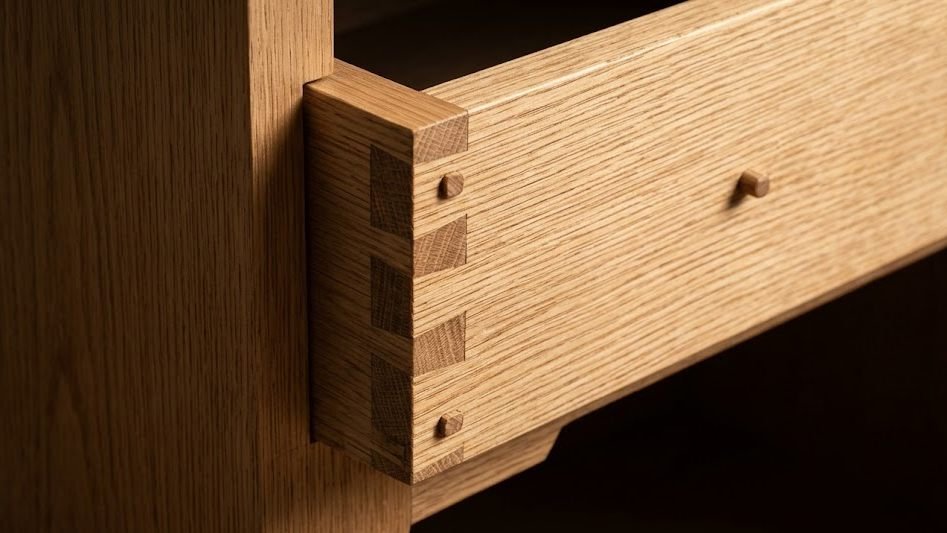
The most immediately identifiable technical crossover between ship and furniture joinery in this period and region is the use of treenails — wooden pegs, pronounced and sometimes spelled “trunnels” — as fasteners. In ship construction, treenails were the standard method of securing planking to frames, and of fastening structural members to one another, in an era before reliable iron fasteners were manufactured at scale. A treenail was typically cut from a close-grained hardwood — locust, oak, or cherry in the northeastern United States — turned to a consistent diameter, and driven into a bored hole that was slightly undersized. As the treenail absorbed moisture, it expanded, locking the joint with a force that no metal nail of the period could reliably replicate in a wet environment.
The preference for treenails over cut nails in maritime joinery was so pronounced that craftsmen trained in the shipyards brought the preference with them when they built for dry land. Period case pieces from the Port Jefferson area — corner cupboards, blanket chests, storage pieces of the utilitarian working-household type — can be identified by the presence of wooden peg fasteners in locations where a piece made to the fashionable conventions of Philadelphia or New York would have used cut or wrought iron nails. The peg is not decorative; it is functional. It is the choice of a man who learned to fasten wood in conditions where the alternative would eventually fail.
White oak was the ship timber par excellence in the northeastern United States — dense, strong, long-grained, resistant to rot in wet conditions. Its use in furniture from maritime communities is well documented, appearing in case piece frames, drawer construction, and structural elements in regions where the fashionable cabinet woods of the period were cherry and walnut. A craftsman trained in a shipyard who reached for his framing stock to build a blanket chest reached for white oak, not because it was the prettiest choice or the most fashionable one, but because it was the wood he knew best and trusted most. That white oak drawer bottom — far heavier than cherry, resistant to the effects of moisture in a damp cellar — was not a stylistic statement. It was ship logic applied to household storage.
Hull Geometry in Domestic Form
The more subtle transfer is geometric. Ship framing — the system of curved timbers that gave a wooden hull its form and its strength — required joints cut to accommodate compound angles. A knee brace, for instance, the structural element that transfers force between a vessel’s frame and its deck beams, was cut to the specific angle of the hull at that point, not to a standard ninety degrees. Shipwrights developed tools and methods for reading and replicating compound angles with a precision that flat-land carpenters of the same period rarely needed. A chair back cut at the wrong angle failed immediately and obviously; a knee brace cut at the wrong angle might not fail until the vessel was under load at sea, which was catastrophic in a different register entirely.
The carryover of this angular precision into domestic furniture from the Port Jefferson area is visible — to an attentive eye — in the joinery of corner cupboards, where the angle at which the door frame meets the body of the case is handled with a sureness that goes beyond the ordinary cabinetmaker’s practice. The ship knee brace, transferred to the back corner of a case piece, produced a triangulated structure that was technically unnecessary for a static piece of furniture standing on a parlor floor, but that reflected the builder’s instinct for structural redundancy in the face of forces he could not entirely predict. It is overbuilding by household standards. By ship standards, it is simply how you build.
The Workshop as Organizing Unit
Port Jefferson in the mid-19th century did not have a clear institutional separation between ship joinery and furniture making. The workshop — whether associated with a specific yard or operating independently on the periphery of the shipbuilding economy — was the unit of production, and that workshop served multiple markets simultaneously. Probate records from Suffolk County in the 1840s through 1870s document craftsmen identified as “joiner” or “carpenter” whose inventories include both ship-related tools — adzes, caulking mallets, frame saws — and the bench planes, mortise chisels, and panel-raising planes of the furniture maker. The occupational categories that seem distinct in retrospect were not always distinct in practice.
The schooner captains and shipyard owners who dominated Port Jefferson’s economy in its peak decades lived in houses that were furnished, at least in part, by the craftsmen who also built their vessels. The Mather House itself — now a museum, dating to the period between 1840 and 1860 — contains furniture that the Historical Society attributes to the local tradition. What that tradition produced was not fine cabinetry in the Philadelphia or Boston sense; it was furniture built by men who thought structurally, who chose materials for their behavior under stress, who fastened joints for permanence rather than appearance. It was the furniture of people who understood what failure looked like and had decided to build against it.
What Survives and What It Says
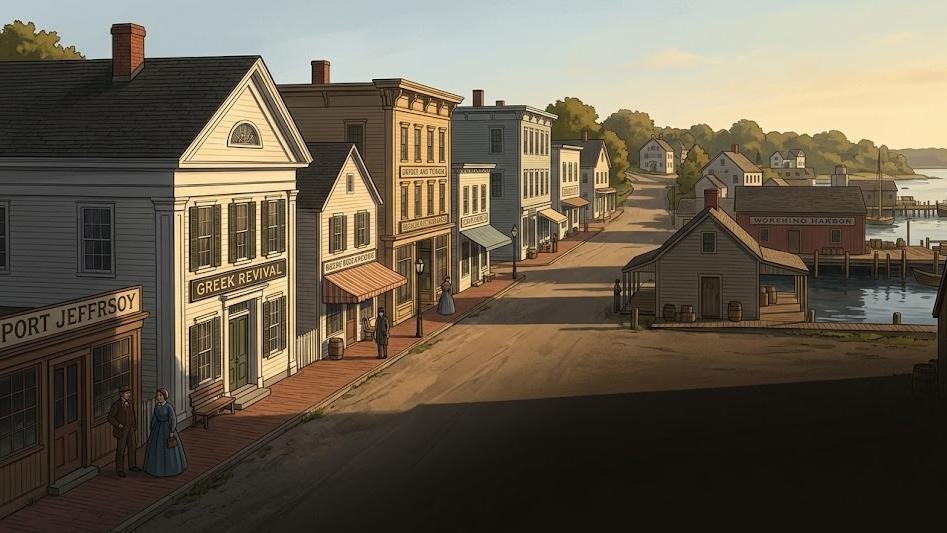
The Mather House Museum’s collection — half-hull models alongside period furniture and local paintings — is one of the more direct visual arguments for the crossover thesis. The ship objects and the household objects occupy the same space not merely for institutional convenience but because they were, in the original context, produced by the same community of practice. A half-hull model is itself a furniture-scaled object: it requires fine surface work, precise joinery at the hull plank joins, and an understanding of how to shape a curved form from flat stock — all skills that transfer directly to the construction of a curved apron on a chair or the bow front of a chest.
Port Jefferson’s shipbuilding industry ran from approximately 1797 to its close in the 1920s, when the Bayles Shipyard transitioned to steel and ultimately dissolved. In those 120-plus years, the transfer of maritime craft logic into domestic material culture was continuous, uninterrupted, and largely undocumented in the formal sense. It left its record in the wood itself — in treenails where cut nails would have served, in white oak where cherry was fashionable, in corner joints triangulated against forces that never came, in the over-engineered permanence of things built by men who knew what the sea could do to a joint that was only good enough.
The harbor is still there. The yards are not. But the furniture that came from those workshops is, in some cases, still in use — heavier than it needs to be, stronger than the room requires, built to the logic of another medium entirely by men who could not entirely leave it behind.
Sources
- Port Jefferson Historical Society — History and Mather House Museum: portjeffhistorical.org
- Bayles Shipyard documentation, Naval Marine Archive: navalmarinearchive.com
- Shipbuilding History — Other Port Jefferson Yards: shipbuildinghistory.com
- Untapped New York — “10 Places to Discover in Port Jefferson”: untappedcities.com
- Port Jefferson, New York, Wikipedia: wikipedia.org
- Fine Woodworking — “Understanding Wood Grain”: finewoodworking.com