The Forgotten Millionaires’ Row: How Sands Point Became Long Island’s Most Secretive Gold Coast Enclave
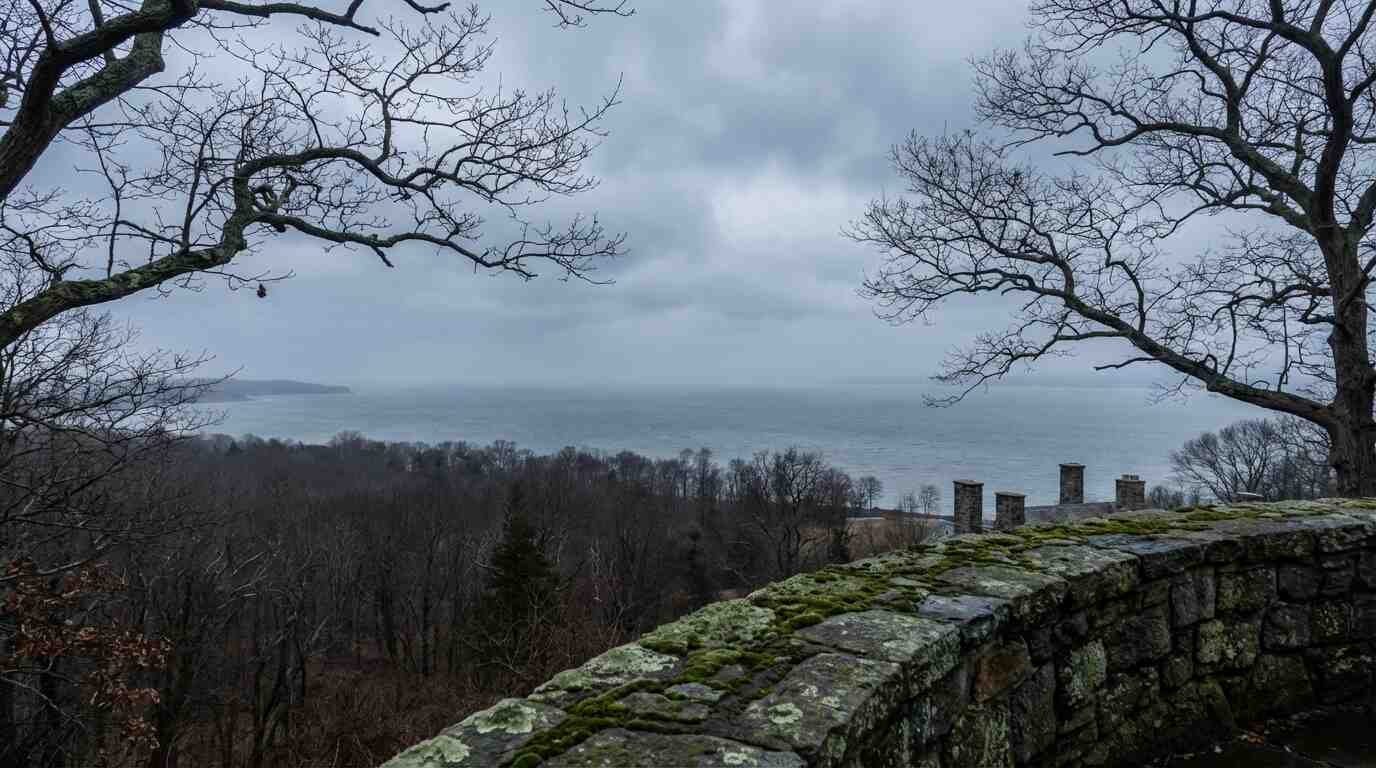
There is a particular kind of privacy that money can’t manufacture — it has to be built over generations, sealed into the land deed, embedded in the architecture itself. Drive out to Sands Point on a grey November morning, when the Sound goes pewter and the trees have dropped their cover, and you begin to understand what the Goulds and the Guggenheims were actually constructing here in the early decades of the last century. It wasn’t a summer retreat. It was a disappearing act.
I’ve shown property across the North Shore long enough to know that different communities attract buyers for different reasons. Oyster Bay buyers want history with good bones. Huntington Harbor buyers want water with walkability. But the buyers who come looking in Sands Point are chasing something harder to quantify — a quality of remove that the other peninsula villages haven’t managed to replicate, because no other North Shore enclave had the architectural ambition, or the peculiar restraint, that defined what was built here.
The Gold Coast mythology, as most people have absorbed it, runs through the Hamptons and the Great Gatsby fever dream of East Egg. What tends to get overlooked is that Fitzgerald almost certainly modeled East Egg on Sands Point itself — the Sands Point Preserve Conservancy notes the identification plainly on its About page — and that the peninsula’s deliberate obscurity is precisely what made it the template. The showpieces were elsewhere. Sands Point was the real thing.
Howard Gould’s Stone Folly
The story begins, as so many Gold Coast stories do, in a divorce.
Howard Gould, third son of railroad robber baron Jay Gould, purchased undeveloped land at Sands Point in 1900 and 1901 with one clear objective: to build something grand enough to impress his wife, the actress Katherine Clemmons. What he built first was Castle Gould — a 100,000-square-foot medieval fortress modeled directly on Kilkenny Castle in Ireland, complete with an 80-foot clock tower, gargoyle detailing, and interiors that attempted to out-spectacle every Gold Coast rival on the North Shore.
Katherine Clemmons was not impressed. Howard built her a second mansion — Hempstead House, a Tudor-style structure that ultimately ran to 50,000 square feet, 40 rooms, a 60-foot entry foyer, and a sunken Palm Court stocked with 150 varieties of rare orchids. She was still not impressed. The marriage dissolved, with Buffalo Bill Cody rumored somewhere in the middle of it, and Howard sold the whole estate — 300 acres, two enormous buildings, every carved-oak panel and medieval tapestry — to silver mining magnate Daniel Guggenheim in 1917 for $600,000.
That transfer is the hinge on which Sands Point’s entire subsequent character turns. The Guggenheims did not raze what the Goulds had built and start over, as so many Gold Coast newcomers did. They absorbed it, added to it, and quietly made it permanent. Daniel and Florence Guggenheim became the defining presence on the peninsula through the 1920s. Their son Harry received 90 acres as a wedding gift and built his own estate — Falaise, a 26-room Norman manor where Charles Lindbergh was a frequent houseguest and still has a station wagon parked in the garage to prove it.
What the Guggenheims built at Sands Point was not a showpiece in the Great Neck or Kings Point sense. It was a compound. A world unto itself. The scale was staggering — Hempstead House required 17 domestic servants and more than 200 groundskeepers at its peak — but the orientation was always inward, toward the Sound, toward the family’s own acreage, away from the road.
That orientation is still the defining characteristic of Sands Point real estate today.
The Architecture of Studied Invisibility
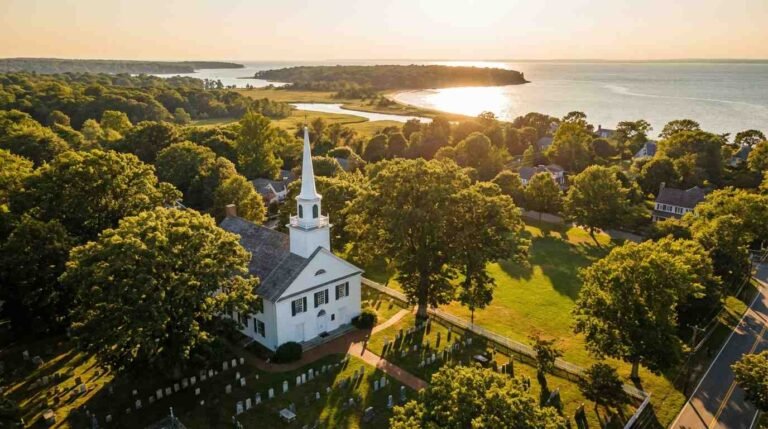
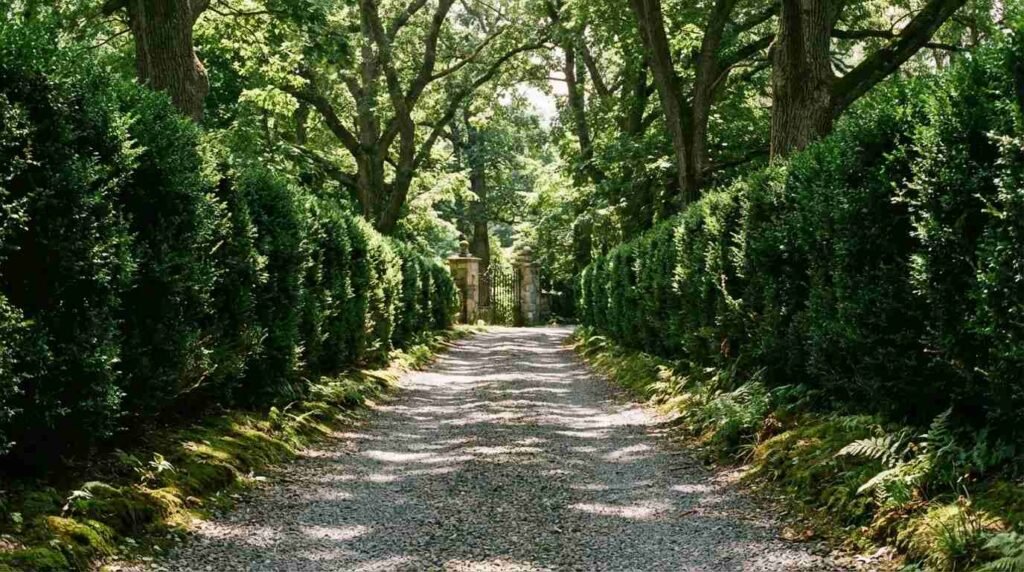
Drive through the village on a summer afternoon and you will notice something immediately: you cannot see the houses. The hedgerows are eight feet tall. The driveways are gravel-paved and curve out of sight. The signage, where it exists at all, is minimal and deliberate. A few gates. A few stone pillars. A sense that the real business of the place is conducted well back from the road.
This is not accidental, and it is not merely the product of abundant landscaping budget. It was a design philosophy that the Gould-Guggenheim era embedded into the peninsula’s DNA. Where Great Neck Gold Coast estates were positioned to be seen from the water — from passing yachts, from the boats of people who needed to know that this sort of wealth existed — the Sands Point estates were positioned to see the water. The perspective was turned inward. The point was not to display. The point was to inhabit.
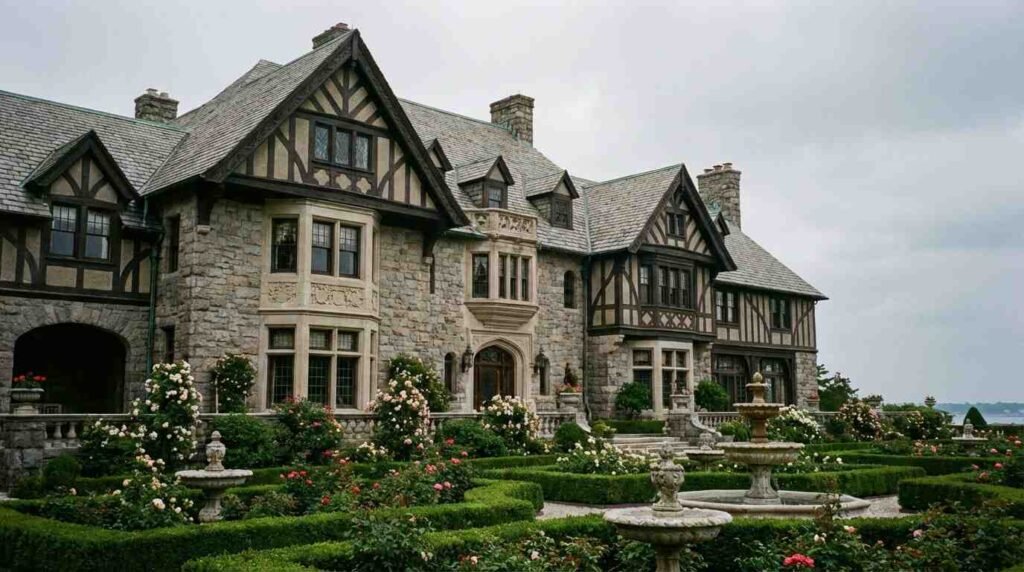
The architectural vocabulary across the estate-era properties reflects this. The Gould-era construction drew on Irish medieval and English Tudor traditions — both of which prized mass over ornament, stone over stucco, the fortress over the pavilion. Hempstead House’s exterior of granite and Indiana limestone was chosen not for elegance but for permanence. The Hunt & Hunt–designed structure was meant to look as though it had always been there, as though it had grown from the moraine itself.
Harry Guggenheim’s Falaise took the philosophy further still, adopting a 13th-century Normandy manor aesthetic that could plausibly have been lifted from the French countryside and set down on the bluff overlooking the Sound. The interiors were filled with medieval architectural salvage — actual artifacts, not reproductions. The effect was of a house that made no concession to its American context, that simply insisted on being somewhere else entirely.
I’ve written before about how the hidden architecture of Gold Coast estates shaped today’s luxury floor plans, and the Sands Point properties represent perhaps the purest expression of that lineage. The service wing logic, the separation of the family’s world from the household’s operational machinery, the way the main rooms orient relentlessly toward landscape and water — all of it has seeped into what North Shore luxury buyers now consider baseline requirements.
What the Navy Left Behind
The Guggenheim era at Sands Point ended not with a sale but with a gift. Florence Guggenheim, after her husband Daniel’s death in 1930, eventually donated 162 acres — including Hempstead House and Castle Gould — to the Institute of Aeronautical Sciences in 1942. The institute sold the property to the United States Navy in 1946, and for the next two decades, Hempstead House and Castle Gould were renovated to accommodate the Naval Training Device Center, which designed and tested flight simulators and trained over 500,000 pilots via the Link Trainer during World War II.
The Navy’s presence is the least-known chapter in Sands Point’s history, and it matters for buyers in ways that aren’t immediately obvious. The estate’s conversion to institutional use — followed by Harry Guggenheim’s death in 1971 and the subsequent deeding of his Falaise property to Nassau County — is precisely what preserved the 216-acre core of the peninsula as public land rather than subdivision lots. Nassau County acquired the government surplus property in 1971, and what is now the Sands Point Preserve has operated ever since as a nature preserve and event venue, maintained by the Sands Point Preserve Conservancy.
The effect on surrounding real estate is profound. The preserve functions as a permanent open-space buffer on a peninsula that might otherwise have been carved into the same lot-by-lot pattern that consumed much of the Gold Coast after World War II. In real estate terms, the Navy’s Cold War presence at Sands Point inadvertently guaranteed that the village’s character would survive into the 21st century more or less intact. The water views from adjacent properties remain unobstructed. The tree canopy is continuous. The sense of remove is structural, not just atmospheric.
What Buyers Are Actually Paying For
The current Sands Point market is, by any North Shore measure, extraordinary. Median list prices have ranged from roughly $3.7 million to nearly $5 million in recent listing cycles, with waterfront properties carrying premiums that push well beyond that range. (Verify current figures with OneKey MLS before publication — market data fluctuates.)
But the buyers I’ve worked with — and the conversations I’ve had with colleagues who specialize in the Nassau Gold Coast — aren’t primarily driven by price-per-square-foot calculations. They’re buying a guarantee. Sands Point’s combination of the preserve’s open-space buffer, the village’s self-governing structure, the lot sizes that date to the estate-era subdivisions, and the architectural culture of studied privacy adds up to something you cannot replicate by building elsewhere.
The village is incorporated, which means it controls its own zoning and building code within Nassau County. The permitted lot coverages and setback requirements effectively prevent the kind of dense new construction that has transformed other formerly prestigious North Shore addresses. When a Sands Point property sells — and they sell slowly, spending well above the North Shore median on market — the buyer is not acquiring a house. They are acquiring admission into an organizational logic that has been operating continuously since Howard Gould’s stone folly went up in 1902.
I’ve been fascinated, in the years I’ve been watching this market, by how consistently that logic holds. Properties in the village don’t trade on square footage or bedroom count the way comparable homes in adjacent communities do. They trade on acreage, on water orientation, on privacy tier. A buyer who understands the difference between a Sands Point address and a Port Washington address — and there is a significant one, historically and practically — isn’t comparison shopping on Zillow. They’ve already decided.
This also shows up in what buyers accept. Where elsewhere on the North Shore you see significant demand for gut-renovated turnkeys, Sands Point buyers are notably more tolerant of dated interiors in houses with the right bones, the right lot, the right relationship to the water. The house is almost secondary. What they’ve come for is the land, and the agreement embedded in that land about what can be done with the surrounding land.
It’s the same calculation the Guggenheims made in 1917 when they paid $600,000 for Howard Gould’s stone castle and its 300 surrounding acres. Not a good price for a house. An extraordinary price for a world.
Visiting the Preserve — and What It Tells You
If you haven’t been to the Sands Point Preserve Conservancy’s 216-acre public grounds, go. Walk the beach along the Sound. Stand at the Rose Garden behind Hempstead House and look out at the water. The formal garden still has its fountains; the stone gargoyles still peer from the Summer Living Room ceiling; the Wurlitzer Opus 445 Theatre Organ in the entry foyer has been fully restored.
What you’re experiencing isn’t nostalgia, exactly. It’s geology. This is what the North Shore looked like before the subdivisions came — open, bluff-edged, wooded right to the water, the Sound making its particular grey-green light in every direction. The preserve exists, in a sense, to make the argument for what the surrounding village is. Stand inside it and you understand what the private properties adjacent to its tree line are worth.
Tours of Hempstead House and Falaise are available through the Conservancy. Falaise in particular — still fully furnished, Charles Lindbergh’s station wagon still in the garage — is worth an afternoon. You won’t find another Gold Coast estate preserved this completely anywhere on the North Shore.
You Might Also Like
- The Servant Stair and the Service Wing: What the Hidden Architecture of Gold Coast Estates Reveals About Today’s Luxury Floor Plans
- The Cold Spring Harbor Phoenix: Buying and Saving Gold Coast Ruins
- Matinecock’s Invisible Borders: How a Quaker Hamlet Kept Its Character While Everything Around It Changed
Real estate markets change. For current listings and market data, contact Pawli at Maison Pawli.
Sources
- Sands Point Preserve Conservancy — Mission & History
- Sands Point Preserve Conservancy — Hempstead House
- Wikipedia — Hempstead House
- Sands Point Preserve Conservancy — About
- Rocket Homes — Sands Point Market Report, December 2024
- Movoto — Sands Point listings, March 2026
- American Aristocracy — Hempstead House