Sagamore Hill’s Kitchen Midden: The Roosevelt Estate’s Refuse Deposits and What a Century of Discarded Objects Says About Presidential Domesticity
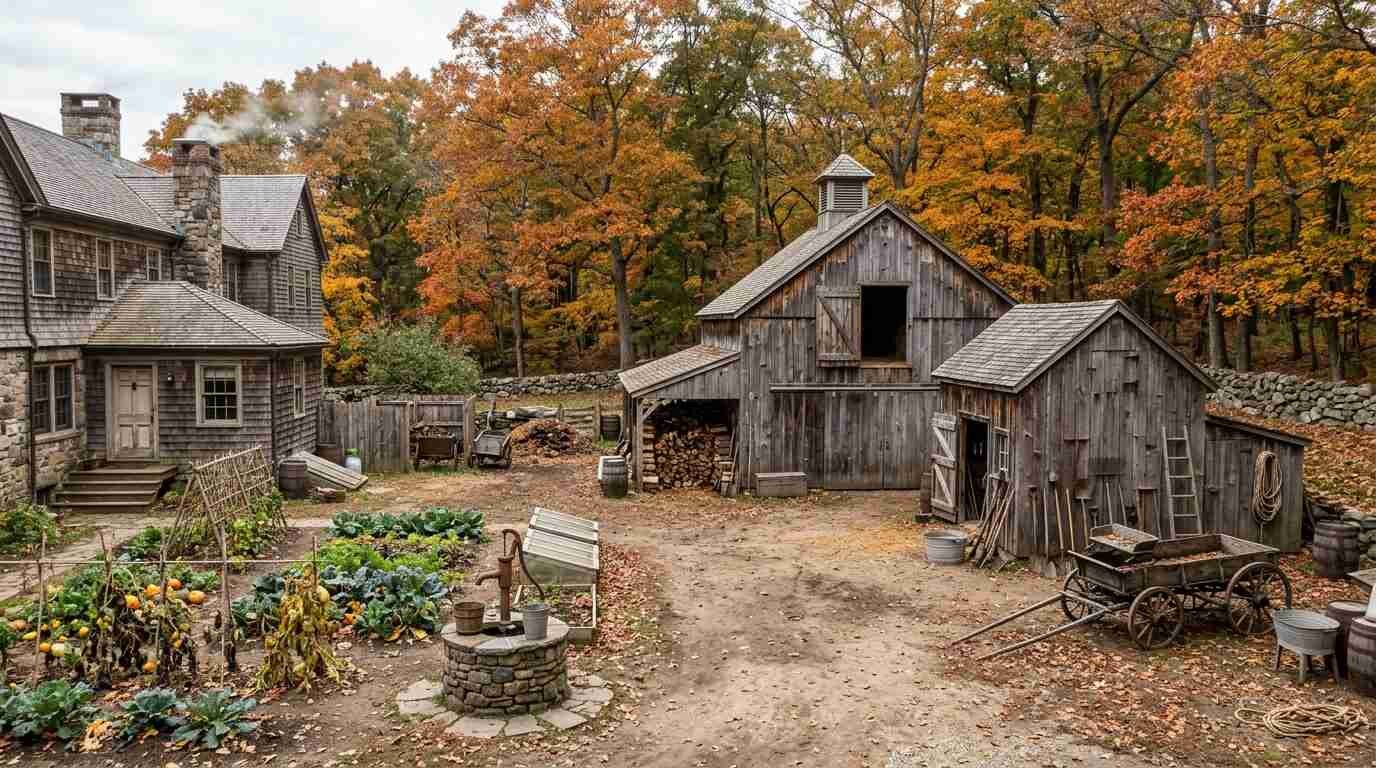
Theodore Roosevelt built his image carefully. Hunting trophies, big-game photographs, the famous library bristling with books and animal heads, the strenuous life performed at every available opportunity for a watching public. Sagamore Hill was the stage set, and Roosevelt was its most meticulous designer. He chose what went on the walls. He chose what was displayed in the cases. He managed what visitors saw, what stories were told, what the house was allowed to mean.
The ground outside was less manageable.
What the National Park Service’s archaeological investigations at Sagamore Hill National Historic Site have recovered from the subsurface — around the estate’s service areas, in the refuse deposits behind the kitchen wing, in the scatter zones that accumulate wherever a large household operates for decades — is a material record of the Roosevelt domestic life that no press secretary ever shaped. Archaeologists have always known that what people throw away tells more truth than what they keep on display. Sagamore Hill’s grounds have been hiding that truth in layers.
The Archaeological Record at Sagamore Hill
The NPS Archeology Program has conducted multiple investigations at Sagamore Hill over the decades, with reports filed through the NPS site files. The 2015 restoration of Sagamore Hill — a comprehensive project that involved significant interior work and some subsurface investigation around the structure — generated additional documentation under the National Historic Preservation Act’s Section 106 consultation process. The NPS Cultural Landscapes Inventory for Sagamore Hill provides the broader landscape framework within which specific archaeological findings are interpreted.
The museum collection catalog at Sagamore Hill National Historic Site includes domestic artifacts recovered from the grounds — objects that did not make it into the house’s formal interpretive program but that constitute, in aggregate, a significant supplementary record of estate life. These are not the trophies. They are the things that broke, wore out, went out of fashion, or were simply used up — the material evidence of a household that, whatever its public image, ran on consumption like any other.
The Myth of Rugged Simplicity
Roosevelt’s public persona was built on the rhetoric of physical vigor and democratic simplicity. The strenuous life. The ranch experience in the Badlands. The rough rider. The contrast with Gilded Age effeteness was constant and calculated.
Sagamore Hill complicated that image in ways that the house itself makes visible — the scale of the structure, the elaboration of the library, the quantity of domestic staff required to operate a house of this size. But the archaeological record complicates it further, because it documents the actual consumption patterns of the Roosevelt household in material terms that rhetoric cannot reach.
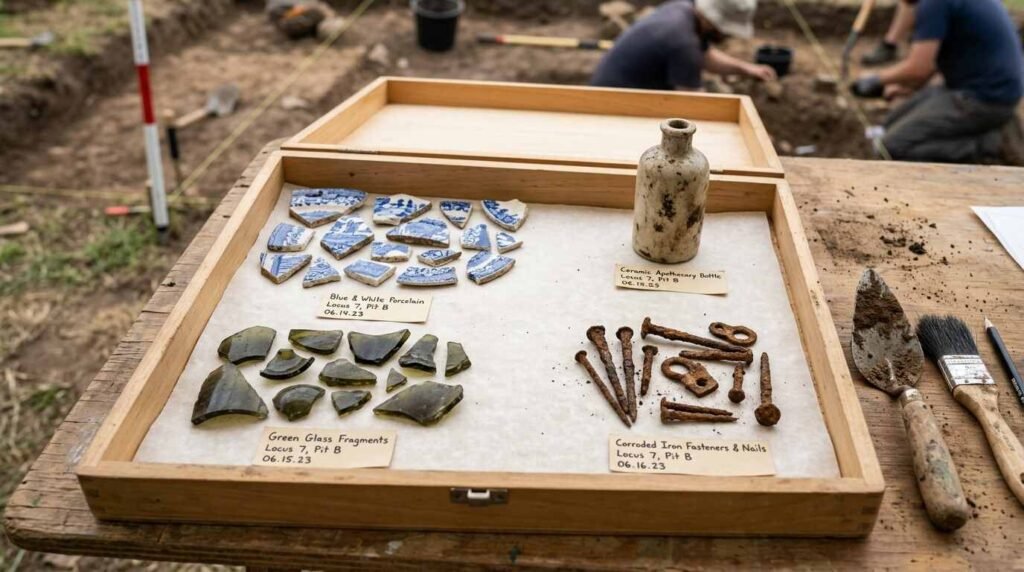
Refuse deposits associated with the kitchen service area — the kind of accumulation zones that form wherever a household discards its daily waste — contain the ceramic, glass, and metal fragments of a well-provisioned upper-class domestic economy. Fine imported porcelain alongside utilitarian kitchen wares. Cut crystal and pressed glass. Pharmaceutical bottles in quantity. Canned goods labels and tinware from a household that, despite its owner’s taste for wild game, was fully engaged with the consumer economy of late 19th and early 20th century America.
The gap between the public mythology and the material reality is not a scandal. It is an archaeological observation. What people project and what they consume are always in some tension, and that tension is most legible in what they throw away.
The Service Area as Archaeological Zone
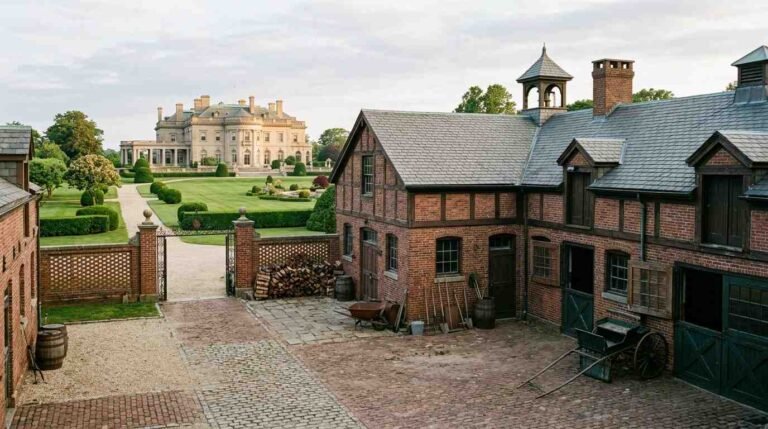
The most archaeologically productive zones at any historic estate are not the formal rooms. They are the service areas — the kitchen, the laundry, the carriage house, the outbuildings where the household’s actual labor was performed and where the waste of daily operation accumulated.
At Sagamore Hill, the service infrastructure — documented in the NPS Cultural Landscapes Inventory and in the historical records of the estate — was substantial. The house required a permanent staff for its year-round operation: cook, housemaids, gardeners, grooms, and the rotating domestic labor that a family of Roosevelt’s social position maintained as a matter of course. These workers are present in the documentary record primarily as names in payroll accounts. They are present in the archaeological record through the material environment in which they worked.
The refuse deposits adjacent to the kitchen service area contain their material signature alongside the Roosevelts’: the everyday ceramics of working domestic life, the personal objects that migrate into kitchen waste deposits, the evidence of the actual physical conditions in which household labor was performed. Archaeology levels, at least partially, the hierarchy between the employer and the employed — because the ground does not distinguish between whose hands discarded something.
The Roosevelt connection to Oyster Bay runs through the Sagamore Hill estate in ways that shaped the broader social geography of the North Shore. The estate was not an isolated phenomenon but a node in a network of elite land ownership that, over several generations, produced the landscape character that survives in fragments today.
What the 2015 Restoration Found
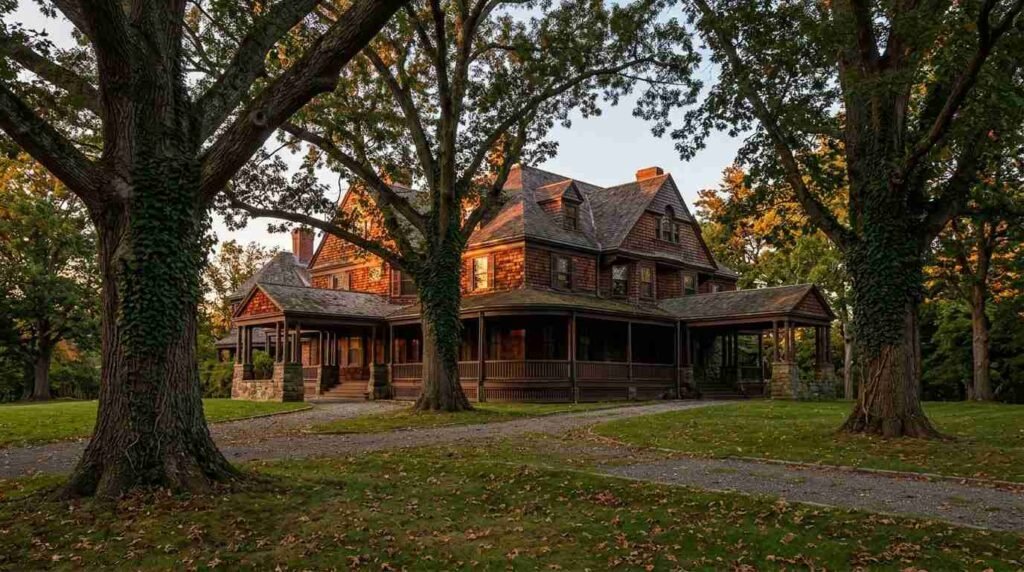
The 2015 restoration of Sagamore Hill was the most comprehensive intervention at the site in decades. It involved interior conservation work, exterior stabilization, and — as required by the National Historic Preservation Act — archaeological assessment of areas where ground disturbance was planned.
The Section 106 reports filed through that process are public records, and they document what subsurface testing around the structure revealed: the stratigraphy of the estate’s occupation history, the locations and character of refuse deposits, and the presence of earlier landscape features — paths, planting beds, structural footings — that preceded or post-dated Roosevelt’s occupation of the house.
What the restoration archaeology confirmed is that Sagamore Hill’s grounds contain a layered record of continuous use from the estate’s construction in 1885 through its NPS acquisition in 1963. That record is not comprehensively excavated — most of it remains in the ground, preserved in the kind of undisturbed context that makes archaeological interpretation possible. The investigations conducted have been targeted and selective, focused on areas of planned ground disturbance rather than systematic excavation of the entire estate.
Which means most of what Sagamore Hill’s ground knows is still unread. What has been read is enough to confirm that the estate’s subsurface is a document of the same period it commemorates — and a more candid one than the house’s formal interpretive program has ever been.
The Biography of a Discard
There is a specific kind of attention that archaeology teaches, and I find myself applying it constantly in this work. Not to archaeological sites — though the North Shore has more of those than most people realize — but to properties. To houses. To the material evidence of the lives that have been lived in a given place, and what that evidence reveals about those lives when you learn to read it.
A house that has been occupied for a century carries its history in exactly the way an archaeological site does: in what survives in good condition, in what has been repaired and covered over, in what has been discarded and what has been carefully maintained. The assessment is stratigraphic even when no digging is involved. You read the layers.
Sagamore Hill makes that methodology explicit, because it has been subjected to actual archaeological investigation and because the gap between its public presentation and its material record is so instructive. The trophies are real. The rhetoric is documented. And underneath the kitchen wing, in the refuse deposits that no one managed and no one curated, the ground has been keeping a different account all along.
Sources
- NPS Archeology Program site reports for Sagamore Hill NHS: https://www.nps.gov/subjects/archeology/sagamore-hill.htm
- Sagamore Hill National Historic Site — NPS museum collection: https://www.nps.gov/sahi/index.htm
- NPS Cultural Landscapes Inventory for Sagamore Hill: https://irma.nps.gov/DataStore/Reference/Profile/2186742
- Section 106 National Historic Preservation Act consultation process — Advisory Council on Historic Preservation: https://www.achp.gov/section106