Port Jefferson’s Second Act: How a Shipbuilding Ghost Town Became the North Shore’s Most Contested Real Estate Market
Stand at the corner of Main Street and East Broadway on a Tuesday morning, before the ferry crowd arrives and the antique shops have propped open their doors, and Port Jefferson shows you a version of itself that it doesn’t always advertise. The harbor catches light in a particular way at this hour — flat, silver, the kind of light that makes you understand why people kept building things here. Why they kept coming back, even after the industry left.
Port Jefferson has been several towns in sequence. The version most people know — the ferry terminal, the Victorian storefronts, the restaurants filling up on summer weekends — is the most recent iteration, and possibly not the last. A transit-oriented development proposal near the LIRR terminal is now working its way through the village planning process, and the conversation it’s generating is the loudest this market has had in decades. Whether you’re a buyer trying to understand where Port Jefferson is headed, or simply someone who cares about what happens when a place reinvents itself, this moment is worth paying attention to.
The Yards That Built Ships
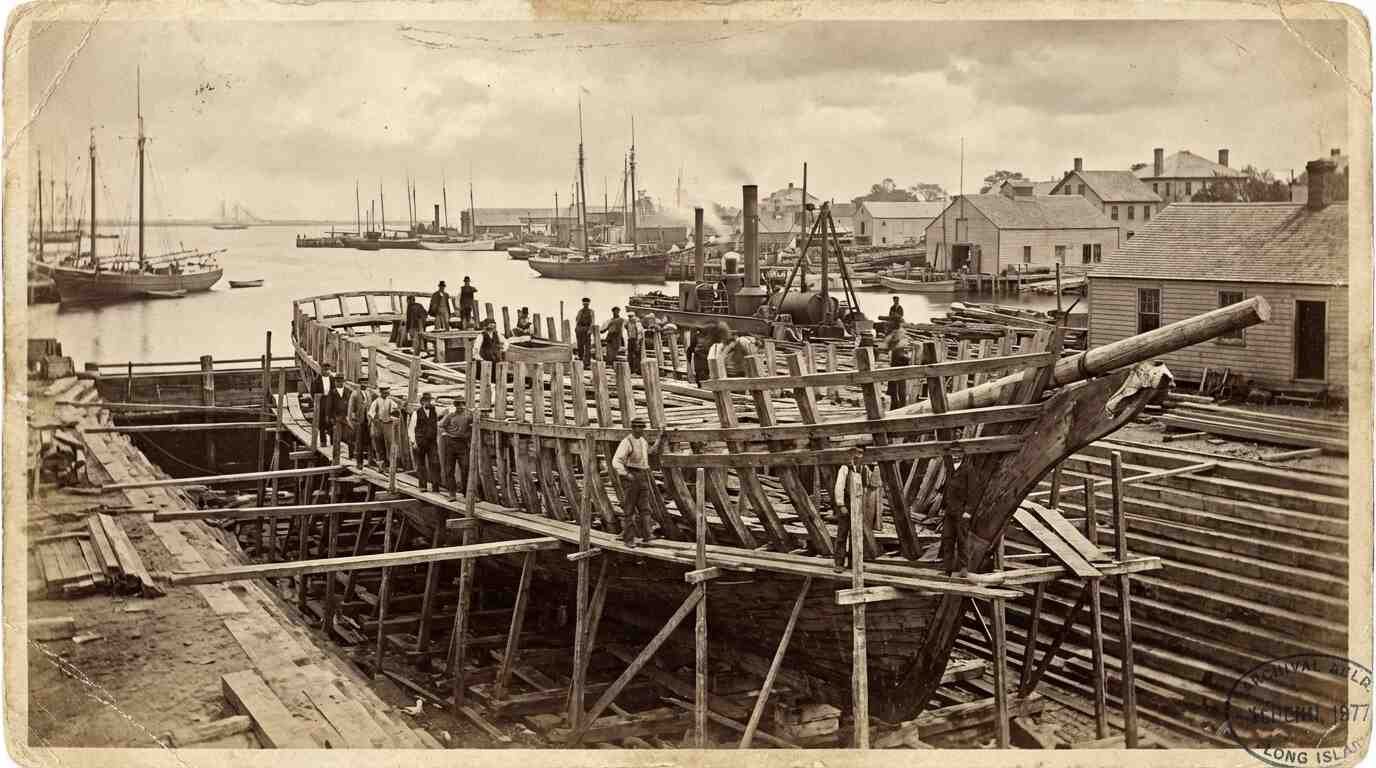
In the 1870s, Port Jefferson was a serious industrial place. The Mather shipyard and the Bayles yard together launched vessels that worked Atlantic trade routes — not charming artisanal crafts, but working schooners, sloops, and brigs built by tradespeople who understood the relationship between timber grain and water pressure. The Port Jefferson Free Library local history collection holds the documentation: ledger books, labor records, hull specifications. The scale of output from this single village on the Long Island Sound was, at its peak, nationally significant.
What made Port Jefferson viable as a shipbuilding center was the same thing that makes it complicated today: geography. The harbor is deep enough to float finished vessels. The surrounding forests — the same white oak that found its way into furniture and framing across the North Shore — supplied the raw material. And the Sound provided direct access to maritime trade routes without the detours required of south shore producers.
The timber ran out. The trade routes changed. By the early twentieth century, the yards were quiet.
I wrote about the joinery tradition that came out of this shipbuilding culture in an earlier piece — the crossover between Port Jefferson’s hull builders and its furniture makers — and it’s one of those connections that makes North Shore history feel less like a series of unrelated episodes and more like a coherent argument about craft and place.
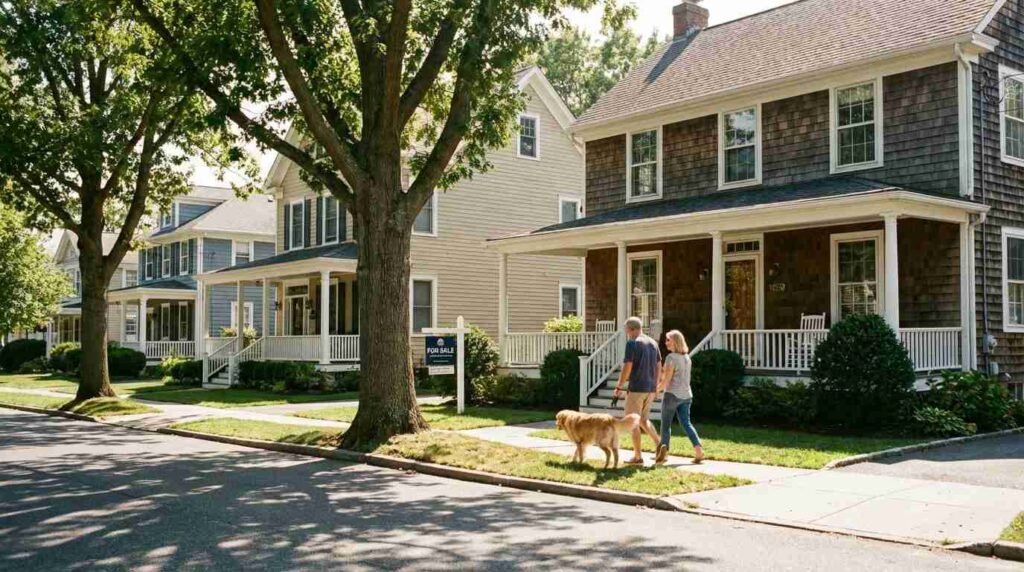
The Tourist Village Interlude
What followed the shipbuilding decline was something that doesn’t get enough credit: a successful reinvention. Port Jefferson leaned into its harbor, its Victorian architecture, and its position on the Cross Sound Ferry route to Connecticut, and it built a functioning tourist economy. The Cross Sound Ferry has operated service to New London since 1965 and has become an economic anchor that most North Shore villages can’t claim. On a summer Friday afternoon, the cars lined up for the ferry are a legitimate economic event.
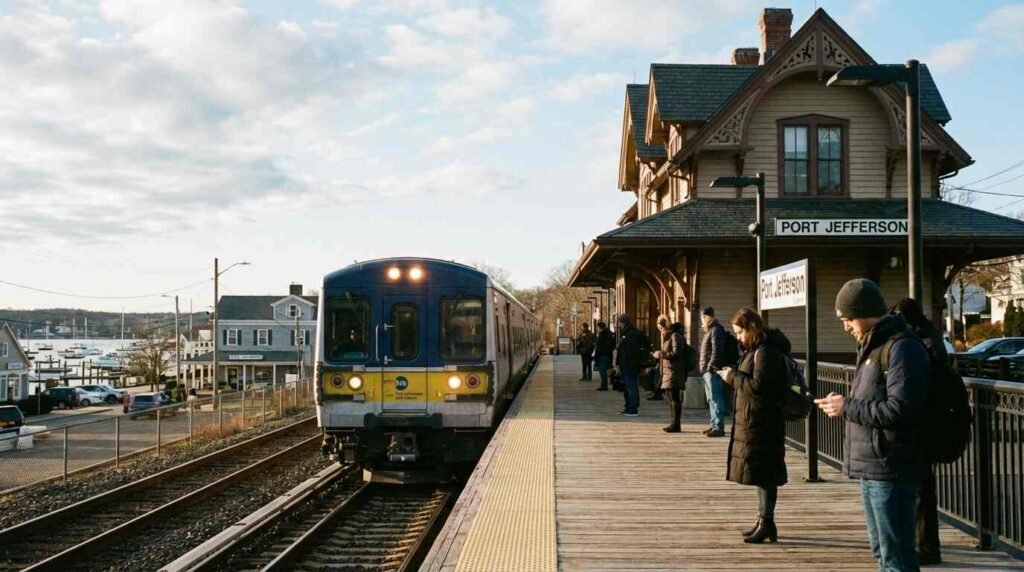
The LIRR’s Port Jefferson Branch provides another anchor. The end-of-line status that once felt like a geographic dead end now functions as a selling point: riders going to Penn Station get on here, which means there’s a captive commuter market that generates daily foot traffic in a way that mid-line stops don’t.
Together, the ferry and the LIRR create something rare on the North Shore: a village that draws visitors, serves commuters, and maintains a working harbor all at once. That three-way proposition is why the real estate market here has dynamics unlike anything you’ll find in Setauket or Miller Place.
The Market Today
Port Jefferson’s current real estate picture is one of the more contested on the North Shore, and contested in a specific way: the inventory is genuinely limited, the buyer pool skews toward people who want a place they can walk from, and the price points have moved up sharply in the past several years as remote and hybrid work made commuter-adjacent villages more attractive to people who don’t commute every day.
As I’ve written about elsewhere, the lock-in effect keeping North Shore inventory tight hits transit-adjacent villages particularly hard. Owners who bought in Port Jefferson at lower price points and locked in sub-4% mortgage rates have very little financial incentive to sell — and nowhere obvious to move if they did. The result is a market where demand is real and supply is thin, and where bidding wars on renovated Victorians are not the exception.
The mix of housing stock is part of the complexity. The Victorian-era commercial blocks and the late-19th-century residences on the eastern slopes above the harbor are attractive and often well-maintained. But the village also has significant postwar housing, and the valuation spread between a turnkey Victorian two blocks from the harbor and a 1960s cape on a street further from the water is substantial. Buyers who haven’t spent time here sometimes treat Port Jefferson as a single market. It isn’t.
School district performance is another variable. The Port Jefferson Union Free School District serves the village proper and has maintained strong ratings — a factor that genuinely moves prices and that Stony Brook University families, in particular, follow closely. Stony Brook University’s economic impact reports document the university’s reach into the surrounding housing market, and Port Jefferson captures a meaningful share of faculty and administrative housing demand.
The Transit-Oriented Development Question
The proposal that’s generating the most conversation in village planning circles involves higher-density mixed-use development near the LIRR terminal — the kind of transit-oriented development that has reshaped station areas in Huntington, Babylon, and other Long Island communities with meaningful rail access.
The Village of Port Jefferson Planning and Zoning Board meeting minutes document the ongoing debate. The arguments for higher density near the station are familiar: more housing supply, walkable density, activation of an underutilized zone adjacent to an existing transit node. The arguments against are equally familiar: scale, character, parking, the permanent alteration of a village that has managed to stay a village through forty years of development pressure elsewhere on the Island.
What comparable transit-adjacent villages reveal is instructive, if not entirely reassuring. Huntington Village — another North Shore LIRR stop with a walkable downtown — accepted significant downtown density in the form of apartment buildings near its station area and has seen property values in adjacent residential blocks hold and appreciate. Northport, which has resisted similar density, has lower overall transaction volume but extremely strong single-family price stability. The tradeoffs are real. There’s no version of this decision that’s without consequence.
The Three Village Historical Society has been active in preservation conversations adjacent to the Port Jefferson planning process, particularly around structures in the harbor commercial district. Their archives provide useful historical context on what earlier development transitions actually altered versus preserved.
What This Means for Buyers Right Now
If you’re looking at Port Jefferson as a buyer in 2026, the honest answer is that you’re buying into a moment of genuine uncertainty about what the village becomes in the next decade — and that uncertainty cuts both ways.
The case for buying now: the fundamentals are strong. The ferry, the LIRR, the harbor, the walkability, the school district. These aren’t speculative. They’re documented, durable, and difficult to replicate elsewhere on the North Shore. As I explored in a piece on why Port Jefferson’s walking culture has survived when towns around it didn’t, the physical infrastructure of this village — its compressed street grid, its harbor orientation, its mixed-use commercial blocks — is genuinely rare on the Island.
The case for caution: the transit-oriented development proposal, if it moves forward at significant density, will change the character of the blocks nearest the station. That change may ultimately support property values. It may create a period of construction disruption and neighbor friction. It’s worth reading the planning board minutes before you make an offer on anything within three blocks of the LIRR terminal.
What I tell buyers who ask about Port Jefferson is the same thing I tell buyers who ask about any North Shore village in active transition: understand the specific block you’re buying, not just the zip code. A renovated Victorian on a quiet residential street above the harbor is a different investment than a fixer-upper two blocks from a proposed five-story mixed-use building. Both might be the right purchase. They’re not the same purchase.
The shipbuilders who set up yards here in the 1850s weren’t making a sentimental choice. They were reading geography — the depth of the harbor, the proximity of timber, the access to water routes. The buyers who do best here now are making a similar calculation: not just responding to the romance of the place, which is genuine, but understanding the specific conditions that make this harbor town what it is, and what the plans filed at village hall say it’s about to become.
This is for informational purposes only — consult a licensed attorney or financial advisor for your specific situation. Real estate markets change. For current listings and market data, contact Pawli at Maison Pawli.
You Might Also Like
- The Block That Time-Locked: Why Port Jefferson Village’s Walking Culture Survived When Every Town Around It Didn’t
- Matinecock’s Invisible Borders: How a Quaker Hamlet Kept Its Character While Everything Around It Changed
- The Lock-In Effect: Why North Shore Inventory Is So Tight Right Now