What Old Westbury Gardens Does Not Show You: The Below-Grade Infrastructure of the Phipps Estate and What It Reveals About How Gilded Age Wealth Was Literally Built
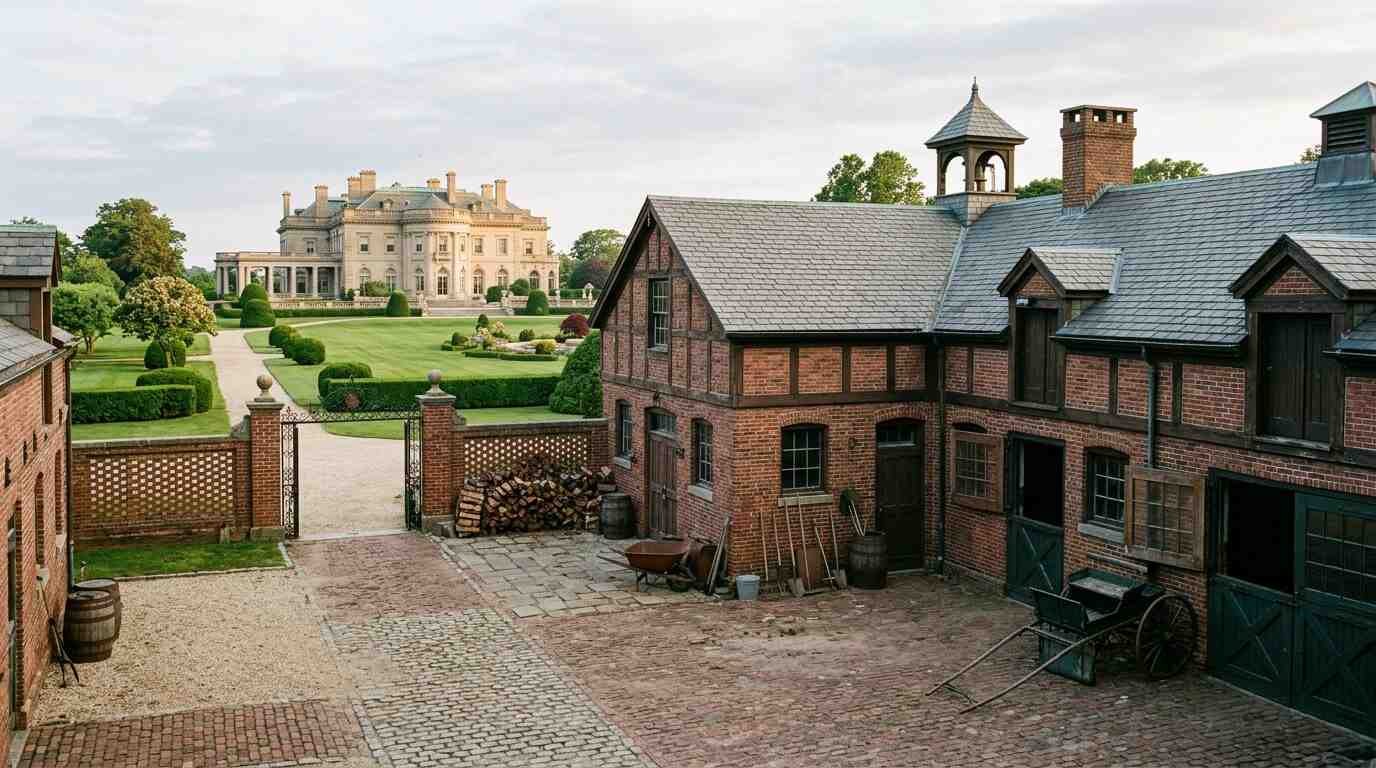
Old Westbury Gardens has been presenting itself for decades as one of the most beautiful historic house museums on the East Coast, and the presentation is not wrong. The Charles II–style manor house designed by George Crawley is graceful in a way that few surviving Gold Coast structures manage. The formal gardens — the Walled Garden, the Box Garden, the Lilac Walk — are among the most carefully maintained historic designed landscapes in the region. Every season, the Foundation produces from this estate an image of Edwardian country life that is so polished it requires effort to remember it is a managed illusion.
The effort is worth making. Because what Old Westbury Gardens does not show you is how the illusion was constructed — not aesthetically, but physically. Below the impeccable lawn, beneath the gravel paths, under the icehouse mound and the service court and the walled kitchen garden, there is an engineering substrate that made the visible estate possible. It is not beautiful. It is not shown. And it is one of the most revealing documents of Gilded Age material culture surviving on Long Island.
The Site and Its Documentation
Old Westbury Gardens was the country estate of John Shaffer Phipps — son of Henry Phipps Jr., Andrew Carnegie’s steel partner — and his wife Margarita Grace Phipps. Construction began in 1906, and the estate was designed by George Crawley, an English architect who had worked extensively for English aristocracy. The house and landscape were conceived together as a unified English country estate in miniature — or rather, in the considerably amplified scale that Phipps family resources permitted.
The National Register of Historic Places nomination for Old Westbury Gardens is a detailed document. It addresses the house, the landscape framework, and the supporting structures — including the surviving outbuildings, the icehouse, and the service court — with the thoroughness appropriate to a site of this significance. The Old Westbury Gardens Foundation’s restoration documentation records what has been found, repaired, and preserved in the estate’s ongoing maintenance and conservation program.
The Nassau County Museum of Art’s archival collections on Gold Coast estates provide additional context for interpreting Old Westbury Gardens within the broader pattern of north shore elite land development. And published scholarship from Columbia University’s Historic Preservation program has addressed the infrastructure typology of Gilded Age estates — the engineering systems that sustained their operations — in terms applicable to this site.
The Icehouse as Archaeological Feature
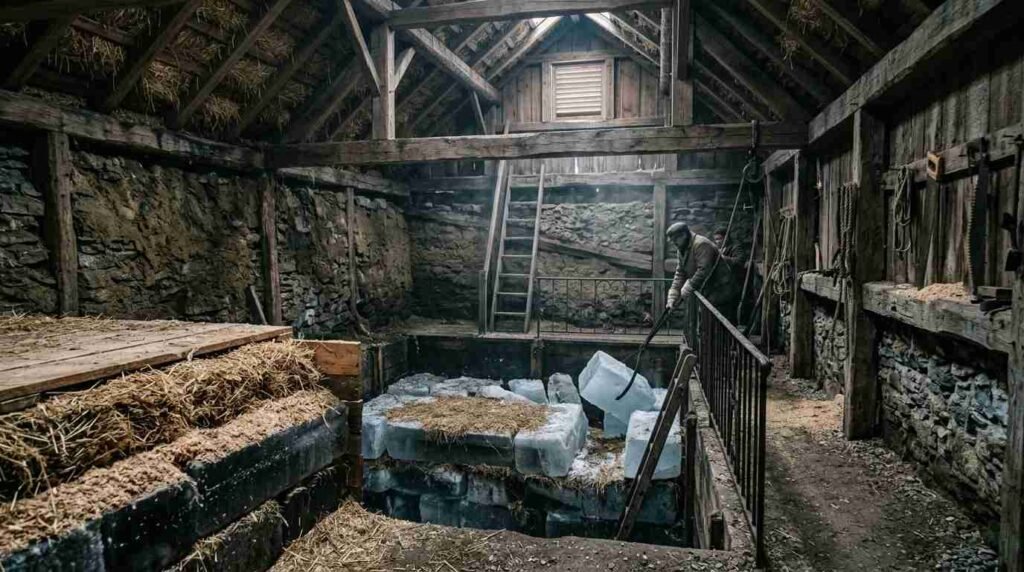
The icehouse at Old Westbury Gardens is still standing. It is not prominently featured in the estate’s visitor experience — it is one of those structures that exists at the edge of the curated landscape, functional and slightly unglamorous, which is precisely what makes it interesting.
Icehouses at this scale were not passive storage structures. They were active elements of an estate-wide cold chain — a pre-mechanical refrigeration system that required year-round management. In winter, ice was harvested from the estate’s pond and packed into the insulated icehouse structure with layered straw or sawdust insulation. Through the spring, summer, and fall, that stored ice supply was drawn down to cool the house’s larders, produce box, and wine cellar. The labor of maintaining this system — the harvest, the packing, the periodic replenishment from commercial ice suppliers as the estate’s own supply diminished — was continuous and largely invisible to the house’s occupants.
The icehouse foundation and its below-grade storage pit represent a material type that appears in Gilded Age estate inventories with regularity but survives in physical form at very few sites. Old Westbury Gardens is among them. The structure’s documented form — its thick earthen berm construction, its below-grade pit depth, its ventilation provisions — encodes the engineering knowledge of a pre-mechanical cold storage industry that was already becoming obsolete when the estate was built. By the time the Phipps family was settled in Old Westbury, mechanical refrigeration was advancing rapidly. The icehouse was a gesture toward the established aristocratic form even as the technology it represented was being superseded.
Drainage, Utility Corridors, and the Labor Topology
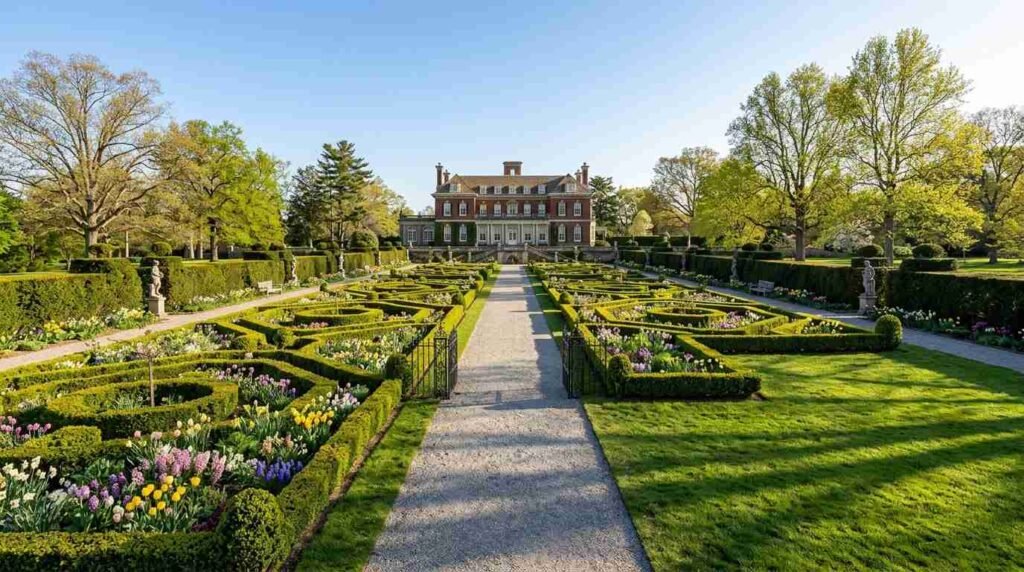
The visible landscape of Old Westbury Gardens is immaculate in a way that reveals nothing about the engineering required to sustain it. The lawns drain perfectly after heavy rain. The walled garden’s soil stays workable. The paths remain firm. None of this happens by accident, and none of it is produced by the landscape alone.
The original Phipps-era drainage system — an extensive network of subsurface agricultural tile drains — is documented in the Foundation’s restoration records. Installing this system in 1906–1910 would have required significant earthwork across the entire estate grounds: trenching, laying ceramic tile drain lines, backfilling, and grading to direct surface water to the drain network. The engineering drawings for this work, where they survive, constitute a detailed map of the estate’s below-grade infrastructure.
The service corridors — the covered walkways and underground passages that allowed domestic staff to move materials between the kitchen, the service yard, the laundry, and the formal house without crossing the visible lawn or path network — are documented both in the architectural drawings and in the physical fabric of the estate’s surviving service buildings. These passages were not luxuries. They were operational necessities in a household that required the continuous movement of food, linen, fuel, and waste without that movement being visible to the estate’s social life.
The Gold Coast service wing typology — the planning principle that separates the servant world from the employer world even within a shared physical structure — is one of the most consistent features of estate architecture in this period. Old Westbury Gardens expresses that typology not just in the house plan but in the landscape: the service court is positioned so that the movement of delivery wagons, garbage removal, and staff circulation was screened from the formal garden approach.
The Utility Infrastructure of Elegance
The published scholarship on Gilded Age estate infrastructure makes a point that the Old Westbury Gardens Foundation’s own restoration work confirms: the sophistication of the below-grade utility systems at estates of this class was, in its period, at the absolute frontier of residential engineering.
The Phipps estate’s water supply and pressure system, its heating infrastructure, and its nascent electrical installation were contemporary with — and in some cases more advanced than — the public utility systems serving the surrounding communities. The estate was, in effect, a self-contained utility district: generating its own power, managing its own water supply, processing its own waste. The equipment required for those functions — boiler rooms, pump houses, electrical switchgear, sewage disposal fields — was housed in the service zone and is largely invisible from the formal landscape.
What archaeologists and architectural historians find in that service zone is not the polished presentation Old Westbury Gardens offers to its visitors. It is the working guts of the operation — the coal storage, the ash pits, the equipment maintenance areas, the spaces where the physical labor that produced the estate’s social life was performed. The elegance was real. The infrastructure that produced it was brutal in its scale and its demands on the people who maintained it.
What Buying Near Here Means
I’ve shown properties in and around Old Westbury — on the estate periphery, in the adjacent communities — and the question buyers ask most often is about what has survived and what it does to property values. The short answer: the survival of Old Westbury Gardens as a functioning historic landscape is an asset to the surrounding area that is genuinely difficult to quantify but real in the market.
What Old Westbury Gardens does for the communities around it is provide a fixed point of landscape stability — a large, maintained, historically significant open space that will not be subdivided and will not change in character within any buyer’s planning horizon. That is worth something substantial in a market where open space is finite and development pressure is constant.
The below-grade infrastructure I’ve been describing is not part of that calculation. But it should inform anyone’s understanding of what this estate actually is — not a preserved tableau but a working system, maintained by a foundation that has been managing its hidden engineering as carefully as its visible gardens. The icehouse still stands. The drainage system still functions. What the Phipps family built underground is still doing its job.
That is a specific kind of permanence. Gold Coast estates that have survived in this condition are rare enough that each surviving example repays sustained attention — including the kind of attention that looks past the lawn to what is holding it up.
Sources
- National Register of Historic Places nomination for Old Westbury Gardens: https://npgallery.nps.gov/
- Old Westbury Gardens Foundation: https://www.oldwestburygardens.org
- Nassau County Museum of Art archival collections on Gold Coast estates: https://www.nassaumuseum.org
- Columbia University Graduate School of Architecture, Preservation, and Planning — historic preservation scholarship: https://www.arch.columbia.edu/programs/historic-preservation