The Hidden Clause: What Survives in Nassau County Deed Records — and Why First-Time Buyers Rarely Hear About It

The deed arrives toward the end of a closing — a stack of paper that everyone has already been briefed on, summarized, and reassured about. Most buyers barely read it. The attorney explains what matters, the title company has done its search, the lender has signed off, and the wire transfer is happening in about forty minutes. Nobody, at that moment, is looking for a covenant from 1949.
Which is precisely the problem.
I’ve been brokering on Long Island long enough to understand that the paper trail behind a property often runs much deeper than the listing, the comps, or even the title commitment suggest. What I’ve watched play out — quietly, in title review meetings and attorney conversations that buyers are rarely part of — is a phenomenon that gets almost no public attention: the survival of old deed restrictions in Nassau and Suffolk County records, restrictions that predate the Fair Housing Act, that were never formally removed, and that can surface at exactly the wrong moment for a first-time buyer relying on an FHA loan.
This isn’t a fringe issue. It is a structural reality of Long Island’s postwar property history, hiding in plain sight inside a publicly searchable archive.
What Levitt Built Into the Paper
To understand how we got here, it helps to know what William Levitt was actually doing when he built 17,000 homes on Nassau County potato fields between 1947 and 1951.
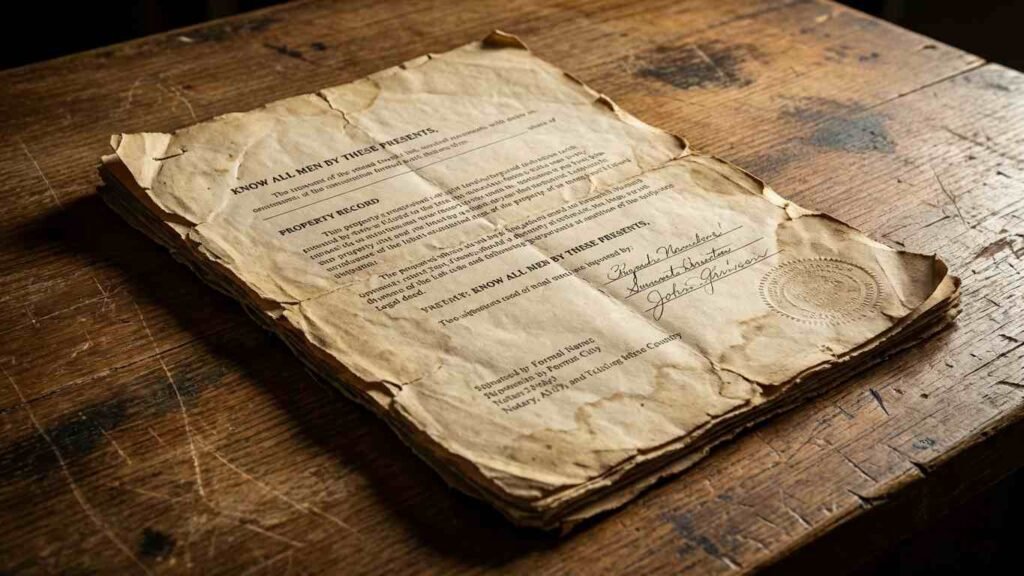
Levittown — the first mass-produced suburb in American history — was built on a standardized model that extended well beyond construction. Every house came with a covenant. The original leases and deeds included a list of behavioral and property conditions that residents were required to observe: cut the lawn at least once a week, do not hang laundry on weekends, do not install a fence above a certain height. These were the mundane restrictions. Buried among them, as Timothy Keogh, an assistant professor of history at Queensborough Community College, has described it, was the racial covenant — clause 25, requiring that the property not “be used or occupied by any person other than members of the Caucasian race.”
The U.S. Supreme Court declared such racial covenants judicially unenforceable in 1948, in Shelley v. Kraemer. The Fair Housing Act of 1968 made them explicitly illegal. But here is what matters for buyers today: the language was never erased from the deeds themselves.
Tessa Hultz, then of the Long Island Board of Realtors, confirmed what housing researchers and Nassau legislators have been saying for years: “They have been removed in some places, but they do still linger in others.” When Nassau County residents in Levittown were asked to pull their original deeds in 2020, a number of them found the covenants still there — “boilerplate language,” as one resident put it, “in there, buried — pages you’re not looking at, you’re just signing.”
Nassau County lawmakers have proposed building a searchable database to expose these surviving clauses. Suffolk County passed legislation to enable property owners to formally disclaim them. But the deeds themselves — the actual recorded documents in the Nassau County Clerk’s archive — have not been altered. They are what they are. And what they are is the foundation on which every subsequent property transfer stands.
The Archive Is Open. Almost No One Uses It.
The Nassau County Clerk’s Office maintains a public deed archive, searchable online. Any buyer, any attorney, any curious homeowner can access recorded documents going back generations. The same is true in Suffolk County.
These records are not hidden. They are simply unread.
A standard title search, the kind performed for every residential purchase on Long Island, is designed to establish a clean chain of ownership — to confirm that the seller has the right to sell, that there are no undisclosed liens, and that the buyer will receive marketable title. It is not specifically designed to flag old covenant language for review. Most title companies are looking for encumbrances that affect transfer, not residual conditions that were legally rendered unenforceable sixty years ago. The result is that covenant language can pass through a title search without being surfaced in a way that prompts any conversation.

Where FHA Enters the Picture
Here is where this becomes a live issue for first-time buyers, not just a historical curiosity.
FHA loans — the federally insured mortgages that allow buyers to put as little as 3.5 percent down and qualify with more flexible credit standards — are governed by HUD’s Single Family Housing Policy Handbook, known as HUD 4000.1. That handbook contains extensive property eligibility requirements. Among them is the anti-flipping rule: a property that is being resold within 90 days of the seller’s acquisition date is not eligible for FHA-insured financing. No exceptions are granted on a case-by-case basis.
But there’s a less-discussed dimension to FHA property eligibility that involves the deed chain itself. FHA requires that the property be free of legal encumbrances that would impair the mortgagee’s ability to foreclose or the buyer’s ability to receive clear title. When deed review surfaces covenant language — particularly covenant language that purports to restrict use or transfer, even if legally unenforceable — it can, depending on the lender’s underwriting overlay, trigger an additional title review or a requirement for a legal opinion from a real estate attorney.
In practical terms: a surviving Levittown-era covenant clause, surfaced during FHA underwriting, doesn’t automatically kill a transaction. But it can delay it, add cost, and — if the lender’s underwriting policies are more conservative than the HUD minimum standard — create an obstacle that the buyer has to navigate without warning, often within days of a scheduled closing.
The families who encounter this aren’t wealthy buyers with legal teams on retainer. They are, almost by definition, first-time buyers: the people for whom FHA loans exist, for whom the 3.5 percent threshold was the difference between owning and renting. They are also the people least likely to have the background to know what they’re looking at when it happens.
Beyond Levittown: The Broader Covenant Landscape
Levittown is the most famous example because it is the largest and most documented. But restrictive covenants were not unique to Levitt developments. The National Association of Real Estate Boards advocated for their use as standard practice beginning in 1927. Many planned communities across Nassau County — and smaller developments across Suffolk — incorporated covenant structures into their original deed documents as a matter of course.
Some of these covenants contained only property maintenance and use restrictions: lawn standards, fence height limits, prohibitions on certain commercial activities. These are less legally complex than racial covenants but can still affect how a title search reads, particularly when a property’s deed history includes multiple transfers, each of which carries the original covenant chain forward.
For buyers purchasing older homes — anything built before 1970 in Nassau or western Suffolk — the question worth asking is a simple one: has anyone pulled and reviewed the original deed language? Not just confirmed a clean chain of title, but actually read the document that founded the property’s ownership record?
In my experience, the answer is usually no. And in most cases, it doesn’t matter. But in the cases where it does matter, the discovery almost always happens at exactly the wrong moment.
What Buyers Can Do
The Nassau County Clerk’s Office deed archive is searchable at nassaucountyny.gov. Suffolk County deed records are maintained through the individual town clerk offices and are similarly accessible. If you are purchasing a home built before 1970 — particularly in communities developed in the postwar era — asking your attorney to pull and review the original deed document is a reasonable and low-cost step.
If you’re using an FHA loan, the additional question worth raising with your lender early: what is their specific underwriting policy if covenant language is surfaced during title review? “Legal but unenforceable” and “clear for FHA underwriting” are not always the same answer from the same lender. Know that before you’re three days from closing.
Your real estate attorney should be the first person you ask. The New York State Bar Association’s Real Property Law Section has published guidance on restrictive covenants in New York deeds; any attorney practicing residential real estate in Nassau or Suffolk should be familiar with the landscape. If yours isn’t, that’s itself useful information.
None of this is a reason to avoid older homes on Long Island. The North Shore’s housing stock is full of properties with character, craftsmanship, and history that newer construction simply can’t match. I show them regularly, and I love showing them. But the paper behind them deserves the same scrutiny as the structure on top of them. That’s not pessimism. That’s how you get to a closing that actually closes.
If you’re beginning your search on the North Shore and want someone who takes the paperwork as seriously as the property, I’d welcome the conversation. You can learn more about how I work at maisonpawli.com/about.
This is for informational purposes only. Nothing in this post constitutes legal or financial advice. Restrictive covenant law is complex and jurisdiction-specific. Consult a licensed New York real estate attorney for guidance specific to your transaction.
Real estate markets change. This post reflects conditions as of spring 2026. For current listings and market data, contact Pawli at Maison Pawli.
You Might Also Like
- The Covenant in the Deed: How Restrictive Covenants Shaped Long Island Neighborhoods
- Beyond the 30-Year Fixed: Mortgage Options First-Time Buyers on Long Island Rarely Hear About
- What the Suffolk County Tax Grievance Deadline Actually Means for You
Sources
- Nassau County Clerk’s Office deed archive: nassaucountyny.gov
- HUD 4000.1 Single Family Housing Policy Handbook, Section II.A.1.b
- Federal Register, Vol. 68, No. 83, May 1, 2003 — Final Rule: Prohibition of Property Flipping
- CBS New York, “Deeds to Land in Levittown, Nation’s First Suburb, Rooted in Systemic Racism,” July 2020
- LI Herald, “Levitt Homes: Built on Restriction and Corruption,” August 2019
- Untapped New York, “The Controversial History of Levittown, America’s First Suburb,” March 2024
- Hofstra Law Review, “Housing Discrimination’s Impact on Long Island,” Vol. 50 (2022)
- Suffolk County Democratic Committee, “Suffolk Passes Bill to Remove Racist Covenants from Property Deeds,” May 2021
- New York State Bar Association Real Property Law Section: nysba.org