The Montauk Paradox: Why the East End’s Most Rugged Address Is Now Its Most Competitive Luxury Market
It was once the fisherman’s endgame — a place where land ended and the Atlantic began, where the streets stayed empty past Columbus Day and the best restaurant in town was the one that still had heat. I have watched Montauk for years from behind the desk of every Hamptons deal that crossed my path, and I can tell you that what has happened to this hamlet over the past decade is not a real estate story. It is a reckoning with geography.
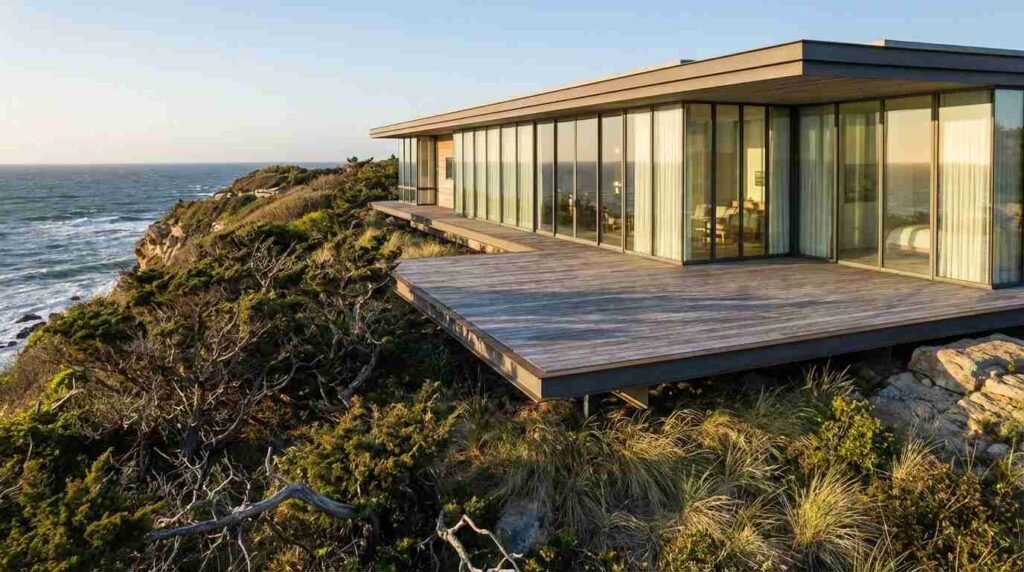
The bluffs are the beginning of the explanation. Montauk’s Old Montauk Highway traces the spine of a glacial moraine that drops sharply toward the ocean — a topography so particular, so resistant to the flat-lot conventions that define most of the Hamptons, that the homes perched along it occupy a category unto themselves. You cannot replicate a Montauk bluff in Southampton. You cannot manufacture that combination of elevation, exposure, and the kind of light that happens when morning hits open water from three sides. Buyers who have spent years moving through the established Hamptons villages have begun to understand this. And they are coming.
What Changed, and When
The transformation did not arrive overnight. But there are fixed points in the timeline that hold.
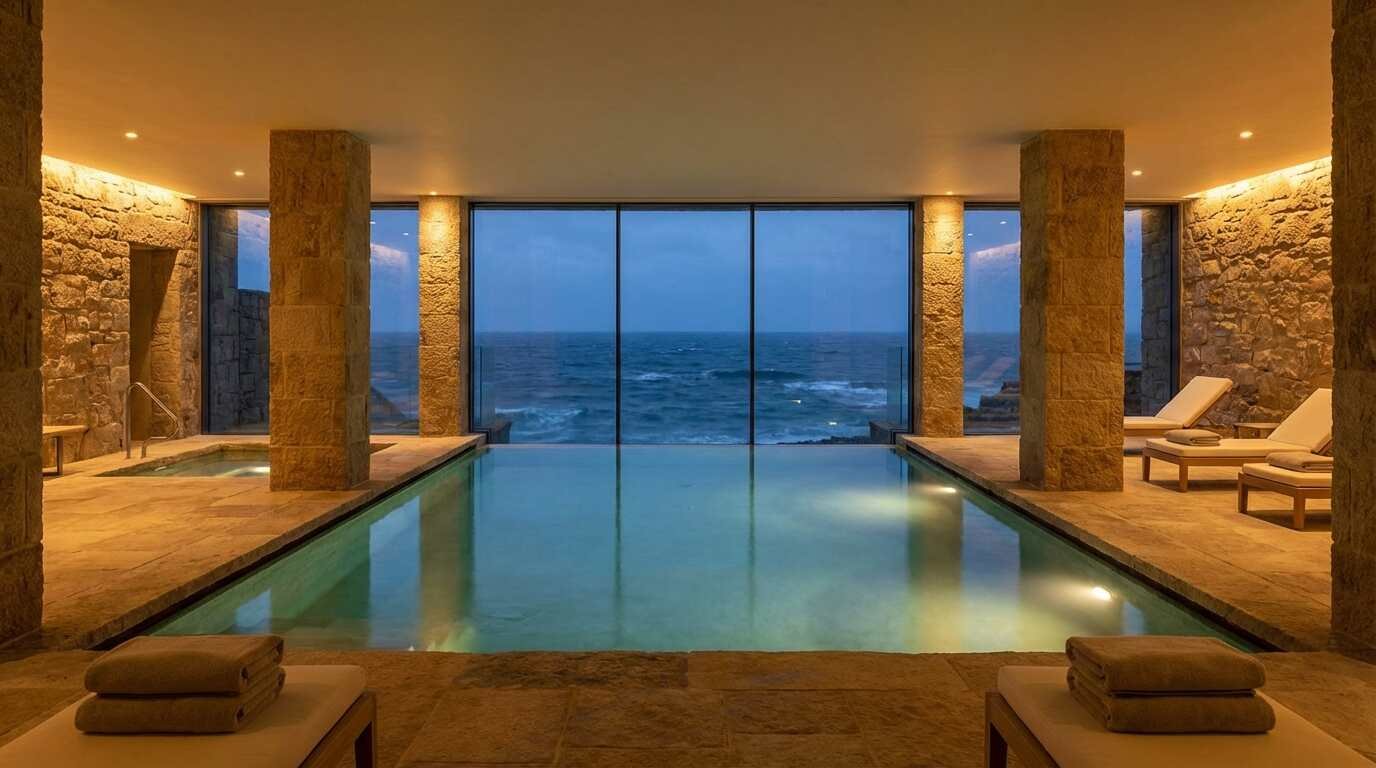
Gurney’s Montauk Resort & Seawater Spa — the hamlet’s only four-season oceanfront resort — has undergone a comprehensive renovation spanning recent years, including a full redesign of the 30,000-square-foot Seawater Spa in partnership with AIRE Ancient Baths designer Alonso Balaguer, and most recently a lobby and restaurant overhaul backed by a newly secured $235 million refinancing. The resort emerged with a new flagship restaurant, gigi’s montauk — a Mediterranean coastal concept — replacing the previous dining program and signaling an explicit repositioning toward the year-round luxury traveler. When a property like Gurney’s refinances at that scale and invests in the quality of its food-and-beverage experience, it is not doing so for the summer weekend crowd. It is bidding on permanence.
The Crow’s Nest boutique hotel on Lake Montauk underwent its own quieter renovation during the same period — a design-conscious repositioning that brought the kind of calibrated, editorial aesthetic more often associated with Hudson Valley getaways than the eastern tip of Long Island. Taken together, these moves reframed the hospitality infrastructure of Montauk: not as a seasonal overflow valve for the rest of the Hamptons but as a destination that functions on its own terms.
The residential market has tracked this shift with some precision. According to Town & Country Real Estate’s Hamptons market reporting, the median home price in Montauk reached $2 million — a figure that had once seemed improbable for a hamlet that prided itself on its resistance to the Southampton playbook. Zillow’s most recent home value index places the average Montauk home at approximately $1.7 million. The upper end of the market tells a more dramatic story: architect-designed homes on Old Montauk Highway, some with direct bluff-top ocean frontage, have traded in ranges that challenge what is achievable in far more established luxury corridors.
The Topography Premium
Here is what I want buyers to understand — and what the Montauk market has spent years quietly proving: when land has a physical character that cannot be engineered elsewhere, it commands a premium that pure comp analysis will perpetually undervalue.
The lots along the Montauk bluffs are geologically irreplaceable. The moraine geography that creates that drop to the ocean — that particular marriage of elevation and exposure — exists in only a handful of places on the entire East End. Lighthouse adjacency matters here in a way it simply doesn’t in other markets: the Montauk Point Lighthouse, commissioned by George Washington in 1796, is not a backdrop amenity. It is an architectural and historical fact that anchors the entire eastern terminus of Long Island in a specific, unrepeatable identity. Buyers who have toured enough of the Hamptons come to understand this on a cellular level. There is no substitute location.
The scarcity argument is compounded by Hither Hills State Park, which buffers Montauk from the rest of East Hampton to the west. The park functions as a natural inventory constraint — thousands of acres of preserved land that prevent the westward march of development from diluting what Montauk is. You cannot build between Montauk and East Hampton because the state of New York already owns that land. What exists is what there will ever be.
This is the configuration luxury buyers with geological patience have come to recognize.
The Architect-Designed Premium
The spec home market in Montauk has matured in ways that mirror, with some lag, what happened in Bridgehampton and Water Mill a decade ago. A cluster of architect-designed homes — some on record through Compass and Town & Country Real Estate, others handled by Hedgerow Exclusive Properties — have set new price benchmarks along the bluffs and at Ditch Plains. In late 2025, a Farrell Custom Home at 165 Surfside Drive in neighboring Bridgehampton closed at $58 million. In Montauk itself, an oceanfront parcel at Ditch Plains traded at a record for the neighborhood. These are data points, not anomalies.
What they signal is an appetite that has caught up with the geography. The buyers arriving at Montauk now are not the buyers who bought here twenty years ago. They are buyers who have already owned in the Hamptons — who know the distinctions between oceanfront markets and have made a deliberate decision that the Montauk bluffs offer something the established villages cannot.

What It Means for the Market Right Now
Montauk remains, in certain respects, genuinely competitive — which is to say, not uniformly liquid at every price point. Homes linger longer here than in the most active South Fork markets. The hamlet’s year-round population is measured in thousands rather than tens of thousands, and the infrastructure, while improving, is still calibrated to seasonal peaks. These are not disqualifying facts. They are facts that a sophisticated buyer accounts for in offer strategy — and that a sophisticated seller accounts for in positioning.
What has changed, irreversibly, is the ceiling. The question for Montauk is no longer whether the luxury market exists here. It is how quickly it consolidates. In my reading of the East End, the pattern is consistent: resort-quality hospitality investment precedes residential price escalation by a few years, the architectural commission market follows, and then the comp structure recalibrates permanently. Montauk is somewhere in the middle of that arc right now.
The lighthouse has been standing since 1796. The bluffs are not going anywhere. The buyers who understand that are already here.
Real estate markets change. For current listings and market data, contact Pawli at Maison Pawli.
You Might Also Like
The Hampton Bays Marina That Became a Cold War Listening Post
The Montauk Lighthouse Keeper Who Moonlighted as a Wreck Salvager
North Shore Bluff Homes and the Erosion Question: What Buyers Need to Know
Sources
Town & Country Real Estate Hamptons market reports: townandcountry-hamptons.com
Gurney’s Montauk Resort renovation and refinancing: hotelmanagement.net
Zillow Home Value Index — Montauk, NY: zillow.com
Farrell Building Company / Bridgehampton record sale: behindthehedges.com
East Hampton Star — 2025 Hamptons year-end sales report: easthamptonstar.com
Dan’s Papers — Gurney’s Montauk closure and renovations: danspapers.com