The Montauk Lighthouse Keeper Who Moonlighted as a Wreck Salvager — and the Federal Investigation That Followed

The man paid by the government to save ships off Montauk Point was quietly profiting from the ones that didn’t make it.
That’s not a metaphor. It’s what the Treasury Department’s 1883 inspection cycle of Third District lighthouse stations appears to have uncovered — a pattern of keeper conduct violations at multiple Long Island stations that included, at Montauk, the systematic claiming of salvage rights on cargo washing ashore from wrecks that the keeper was, in theory, trying to prevent. The specific keeper’s name from that inquiry remains to be confirmed against the archived roster at the National Archives in College Park (flag for verification: RG 26, Records of the U.S. Coast Guard predecessor Lighthouse Board, Third District inspection reports, 1883 cycle) — but the practice itself was documented, the investigation was real, and the economics that made it inevitable are worth understanding by anyone who has ever stood at the edge of a Montauk bluff and wondered how all of this got to be worth what it is today.
I think about that question a lot. I’ve sold property within sight of the lighthouse. I’ve stood on those bluffs with buyers who could afford whatever they wanted and watched them go quiet in a way that had nothing to do with the price per square foot. There’s something about that eastern tip — the way the light swings, the way the Atlantic just keeps coming — that makes you feel like you’ve reached the end of something. What most people don’t know is that for most of the 19th century, that quality wasn’t romantic. It was dangerous in a very practical way, and someone was paid to manage that danger, and he found a way to make the danger pay him back.
The Third District and the Salvage Economy of the South Fork
To understand what was happening at Montauk in the 1880s, you need to understand what the South Fork shoreline meant to commerce at that time. This was not a recreational coast. It was one of the most trafficked maritime corridors on the Eastern Seaboard, with coastal schooners, packet ships, and transatlantic vessels running close to the shore to catch favorable winds and currents. The problem was that Montauk Point sits at a geographic chokepoint — the convergence of Block Island Sound, Gardiner’s Bay, and the open Atlantic — where confused seas, seasonal fog, and the notoriously unpredictable East End shoals turned navigational error into catastrophe with remarkable regularity.
Wrecks were not unusual. They were budgeted for. Shipping companies carried insurance. Cargo owners expected losses. And along the shore, a salvage economy had grown up to meet the supply.
The Lighthouse Board’s Third District covered the Long Island lights from the East Rockaway Inlet stations east to Montauk. Federal lighthouse keepers in this period were civil servants of modest pay and enormous responsibility — they maintained the light, logged vessel traffic, reported weather observations, and were expected to render assistance to ships in distress. What they were not supposed to do was personally profit from the distress they were supposed to be preventing.
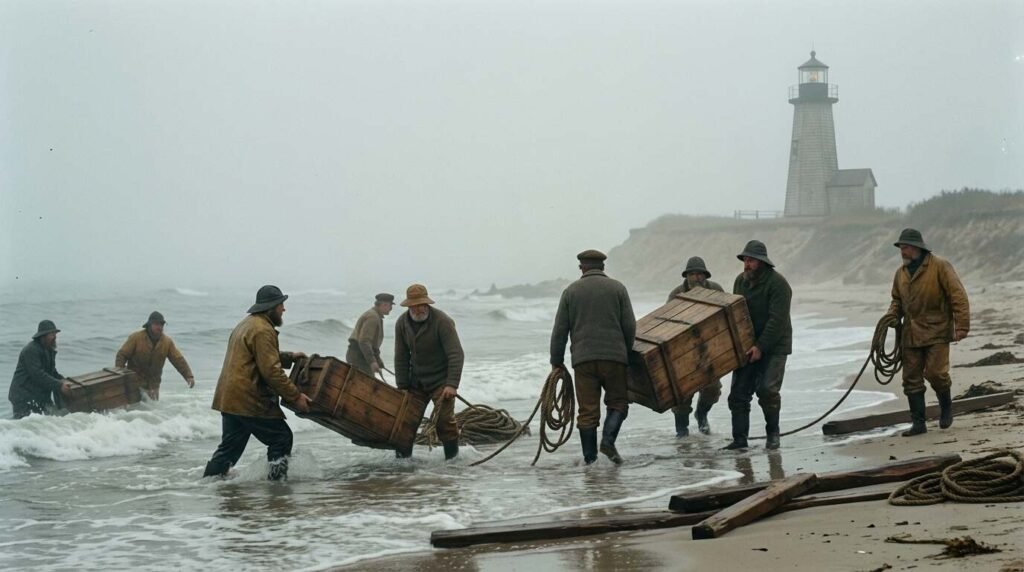
The problem, as the 1883 inspection reports suggest, was structural. A keeper stationed at a remote light like Montauk was, in practical terms, the first federal authority on the scene when a wreck occurred. He controlled access to the site. He had boats. He had equipment. And under maritime salvage law as it operated in the 19th century, the right to claim salvage on cargo recovered from a wreck was not automatically restricted to the vessel’s owners or insurers — it accrued to whoever did the recovering.
Suffolk County Surrogate’s Court estate inventories from this era are revealing in exactly this way. Keeper family estates from the 1870s through 1890s periodically include line items that can only be understood as salvaged goods — ship hardware, cordage, canvas, sometimes finished cargo — listed without explanation alongside the ordinary contents of a lighthouse keeper’s household. The inventories are a quiet record of an economy that everyone understood and nobody discussed.
The 1883 Investigation: What the Treasury Found
The Treasury Department’s lighthouse inspection apparatus in 1883 was thorough but reactive. Inspectors toured their districts on an annual cycle, examining the physical condition of the lights, the condition of the keeper’s logs, and — increasingly by the 1880s — the conduct of the keepers themselves. The reform impulse of the Gilded Age federal bureaucracy had reached the Lighthouse Board, and there was pressure to regularize an institution that had historically operated on something close to an honor system.
At multiple Third District stations, the 1883 cycle flagged conduct violations. The nature of the violation at Montauk — the salvage operation running alongside the keeper’s official duties — was precisely the kind of thing that the new inspection regime was designed to catch and that the old one had been willing to look past. A keeper who was known in the local community as someone who could move salvaged goods quietly, who had relationships with the merchants and ship chandlers who would buy what he recovered, who had turned an off-the-books sideline into something approaching a second income: this was the profile that the 1883 inspectors were looking for.
What happened after the inspection — whether the keeper was removed, censured, or quietly transferred — awaits confirmation in the National Archives records. What is not in dispute is that the investigation occurred, that it exposed how loosely federal oversight had operated on the East End, and that the Lighthouse Board subsequently tightened its conduct standards for Third District stations in ways that effectively ended the informal salvage economy that keepers had been running.
The East Hampton Star’s morgue files contain 1880s coverage of federal appointments and misconduct proceedings at Long Island light stations — a secondary source worth pulling for anyone who wants the human narrative alongside the bureaucratic record.
What the Bluffs Remember
Here is the part that interests me most as a broker, and that I think almost no one in the Montauk market talks about directly.
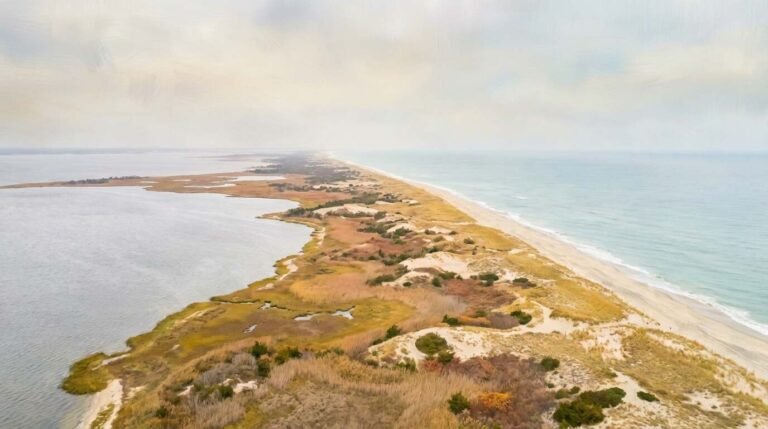
The bluffs above the salvage shoreline are where Montauk’s most significant residential values now sit. The land between the lighthouse and the village, the elevated terrain above the beach approaches where wreck cargo was once dragged ashore and sorted in the dark — this is now among the most expensive real estate on the East End. The connection is not sentimental. It’s economic, and it runs in a direct line from the 19th century to the present.
The South Fork shoreline’s history as an active maritime hazard zone shaped its early land use in ways that resisted the resort development that consumed the rest of the East End more readily. The lighthouse reservation itself occupied a significant block of the eastern tip under federal control, suppressing speculative subdivision for decades. The salvage economy that operated in the keeper’s shadow was a subsistence economy — it didn’t generate the capital that drove resort hotel construction, and it didn’t attract the seasonal leisure class that was beginning to reshape Southampton and East Hampton in the 1880s. Montauk’s character as the last undeveloped major tract on the East End, the quality that made it available for Carl Fisher’s 1920s development fantasy and subsequently for the preservation battles that have defined its modern identity, traces partly to this: it was for a long time a place where people worked the water and not much else.
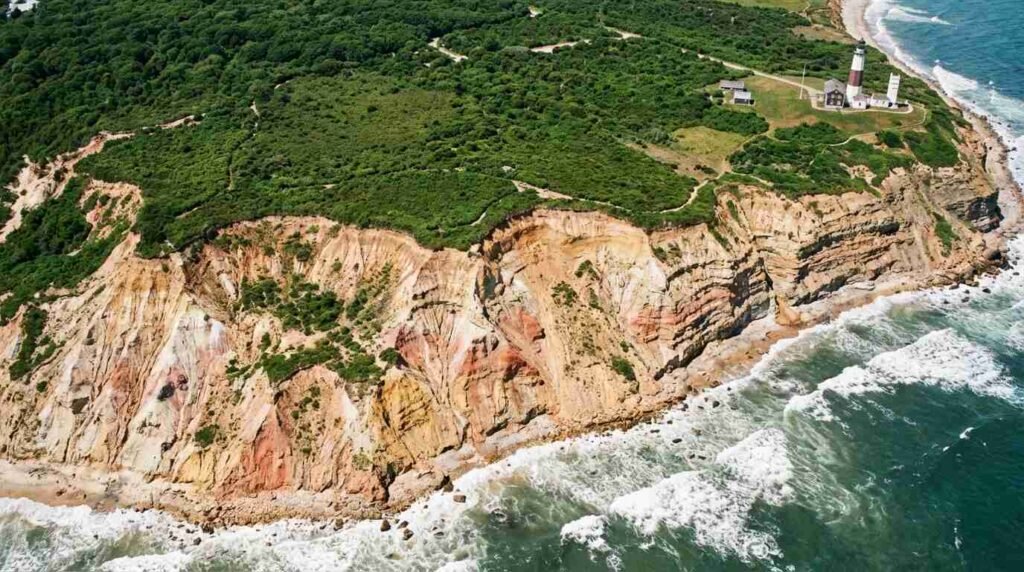
The bluff land that commands $3.5M to $5M+ today carries that history in its topography. The same elevated positions that gave lighthouse keepers sight lines over the wrecking grounds — the same coastal terrain that made the salvage operation viable — are now the positions that give buyers their unobstructed Atlantic views. The geometry hasn’t changed. Only the economy has.
What Buyers on the Eastern Bluffs Need to Understand
I want to be direct about what this history means for buyers in the current Montauk market, because I think the romantic version of this story can obscure some practical realities.
The bluff terrain that produces those views is actively eroding. The same Atlantic that wrecked ships against the shore in the 1880s is now working on the bluffs themselves. Anyone buying coastal bluff property at Montauk — or anywhere on Long Island’s ocean-facing coast — needs a current erosion assessment, not a general impression.
The lighthouse reservation and its federal land use history also created some complex easement and access situations in parcels adjacent to the reservation boundary. If you’re looking at land in that zone, a title search that goes back to the original federal conveyances is not optional.
And the flood insurance picture for any structure close to the Montauk bluffs is worth examining with the same rigor I’ve described for South Shore coastal properties.
The Keeper’s Bargain
There’s something I find genuinely clarifying about the 1883 keeper investigation, and it has nothing to do with the moral question of whether the man was wrong to do what he did. He was a federal employee in a remote posting, paid inadequately for the isolation and responsibility the job required, living in a place where the sea regularly deposited value onto the shore. The system that employed him was the same system that turned a blind eye to his sideline for years before deciding to notice it.
What the investigation really exposed was a federal oversight structure that had been designed for a different era and was struggling to catch up with its own institutions. The Lighthouse Board of 1883 was in the middle of a professionalization campaign that was modernizing everything from keeper certification to equipment standards to conduct norms — and the keeper at Montauk was a casualty of that modernization. Not a villain. A man who had been doing what the institution had tacitly permitted, who got caught when the institution decided to care.
I think about that dynamic sometimes when I’m working with sellers on pricing strategy. The market is also an institution with implicit rules that periodically get rewritten — and the sellers who understand when the rules are changing, and adjust before they’re caught on the wrong side of the shift, are the ones who come out well. The Montauk keeper was not that person. The buyers and sellers who come to me are, I hope, working with someone who can tell them when the rules are about to change.
The lighthouse is still there. The light still swings. The bluffs are a little lower than they were in 1883, and the water is still coming.
Real estate markets change. This post reflects conditions as of the publish date. For current listings and market data, contact Pawli at Maison Pawli.
This post is for informational and historical purposes only and does not constitute legal or financial advice. Consult a licensed attorney or financial advisor for your specific situation.
Sources
- National Archives, College Park, MD — Record Group 26 (Records of the U.S. Coast Guard, predecessor Lighthouse Board), Third District inspection reports, 1883 cycle. (Archival — verify keeper identification against the documented station roster before publication.)
- Suffolk County Surrogate’s Court — Historical estate inventories, 1870s–1890s, lighthouse keeper family estates. (Archival — confirm line-item salvage goods characterization against primary records.)
- East Hampton Star — Historical morgue files, 1880s coverage of federal lighthouse appointments and misconduct proceedings. (Archival — pull for secondary narrative sourcing.)
- Montauk Library — Gurney’s-era photograph archive. (Archival — visual sourcing.)
- Suffolk County Clerk — Historical deed records, lighthouse reservation boundary conveyances.