Matinecock’s Invisible Borders: How a Quaker Hamlet Kept Its Character While Everything Around It Changed
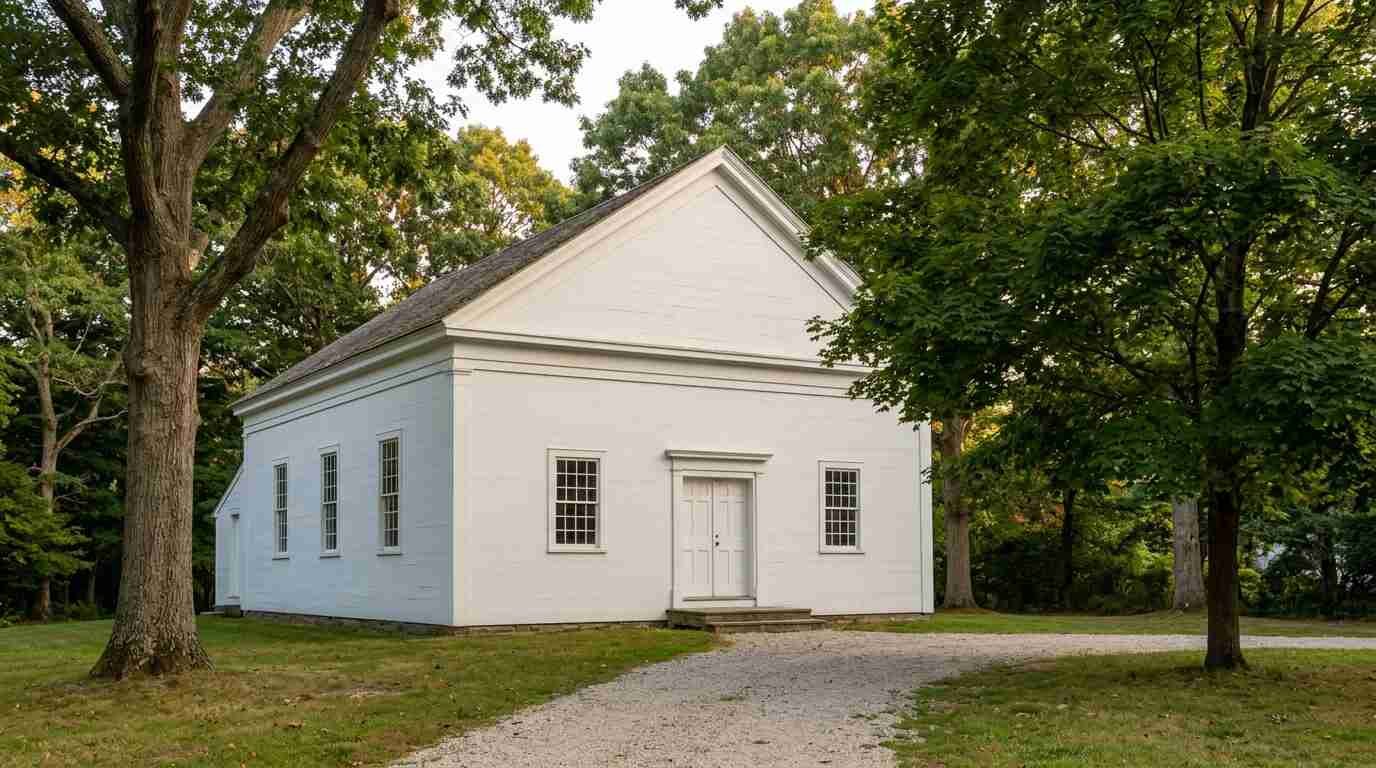
There is a road in Matinecock that has no name on any official map, or rather, it has a name that no one outside the hamlet uses. The people who live along it know it by the family that maintained its drainage for four generations. That is not a quaint anachronism. It is a precise description of how community governance actually functioned here for the better part of three centuries — through obligation, memory, and trust, rather than ordinance and enforcement. Matinecock didn’t need a village hall because it had something older and more durable: a social contract underwritten by a congregation.
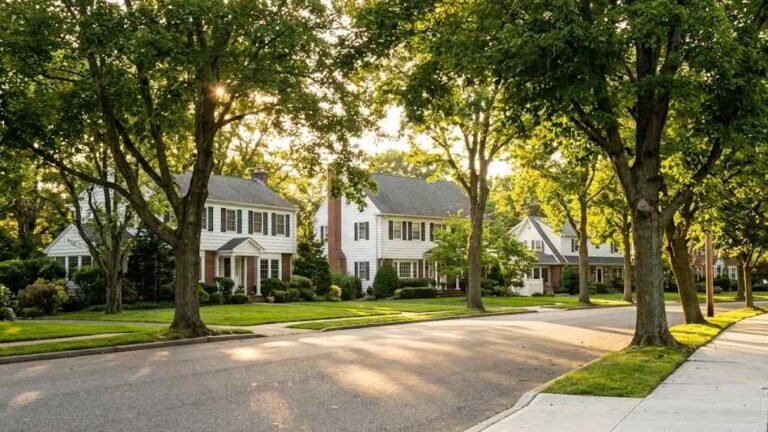
The hamlet sits tucked between Locust Valley to the east and Glen Cove to the west, unincorporated, without a commercial center, without a mayor, without most of the institutional infrastructure that defines a municipality. From the outside it looks like a gap in the map — a few hundred acres of wooded residential land that never quite became anything. From the inside, it has been something specific and deliberate since 1671, when the Matinecock Friends Meeting was formally established on land the local Quaker community had already been gathering on for years. That meeting is still active. Its records — some of the oldest continuous institutional documents on Long Island — trace a community that understood, almost from the beginning, that its survival depended not on law but on norms.
What Quaker Community Governance Actually Looked Like
Jane Jacobs wrote that the first requirement of a healthy street is that there be eyes on it — people with a stake in what happens, who notice what changes, who enforce informal standards through presence rather than prohibition. She was writing about Greenwich Village in 1961. She could have been writing about Matinecock in 1761. The Friends Meeting at Matinecock functioned as exactly the kind of anchor institution Jacobs describes: a place that generated regular gathering, stable membership over generations, and a shared set of expectations about how neighbors behaved toward one another and toward the land.
The meeting’s records, held in part at the Friends Historical Library at Swarthmore College and maintained by the active congregation in Locust Valley, document not just spiritual matters but the practical texture of community life: land transfers conducted within the meeting community, disputes over boundaries resolved through meeting arbitration rather than court, road maintenance agreements between neighboring families that carried the weight of recorded covenant. Nassau County didn’t have formal zoning until well into the twentieth century. Matinecock had something that functioned as zoning — a set of expectations about lot size, use, and neighbor conduct — that was enforced entirely through social consequence. You did not subdivide your land in ways the community considered unsuitable if you cared about your standing in the meeting. And most people cared.
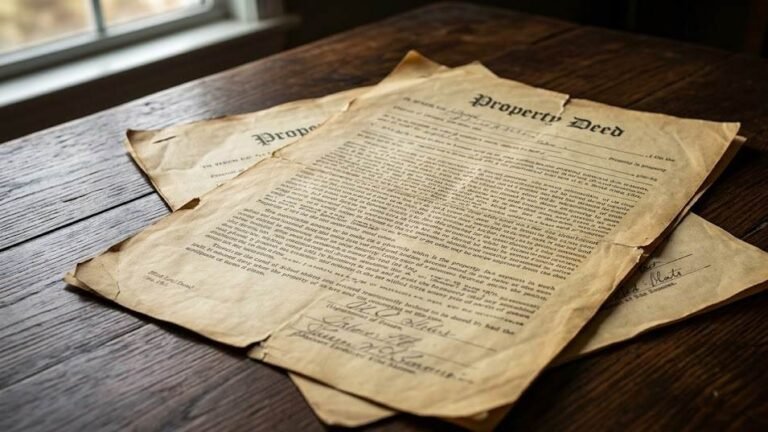
This is not romantic. It was also, at times, exclusionary in the ways that tight community governance always risks being. The same social cohesion that preserved open land and maintained road agreements also made it difficult for anyone outside the established network to integrate easily. Nassau County deed records from the late nineteenth and early twentieth century show land transfers within Matinecock moving through a remarkably consistent set of family names across multiple generations — the Underhills, the Titus family, networks of Quaker-adjacent households whose intermarriage and proximity created overlapping obligations. The community held together partly because it was, for a long time, genuinely held together: the same families, the same roads, the same meeting.
The Development Pressure That Never Quite Arrived
Long Island’s postwar suburban expansion reshaped nearly everything within commuting distance of New York City. The Levittown model — mass-produced housing on large subdivided tracts — moved east through Nassau County in the late 1940s and 1950s with astonishing speed. Communities that had been rural or semi-rural for generations were absorbed almost overnight. Matinecock was not. The question worth asking is why.
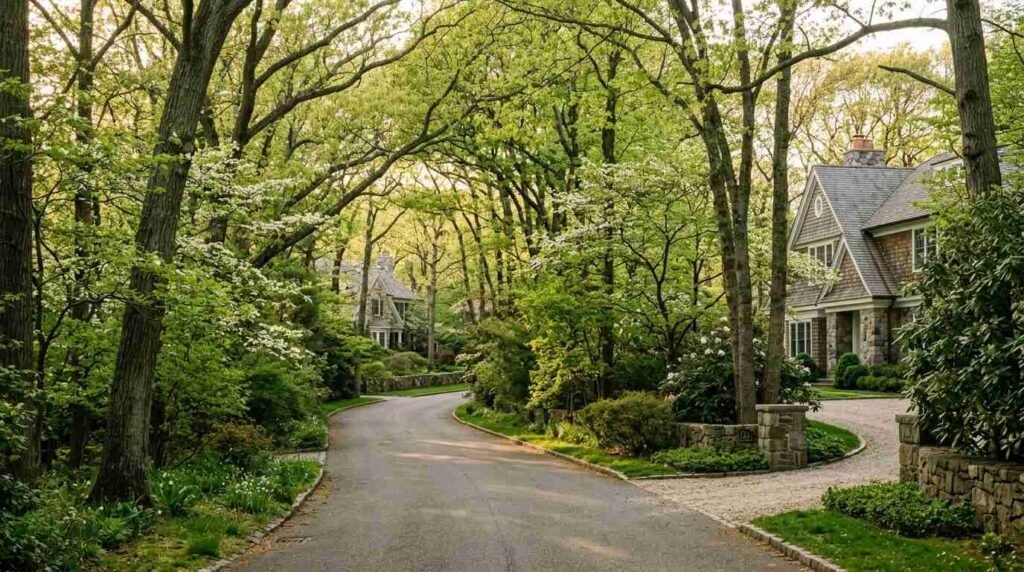
Part of the answer is simply money: the land was expensive, held in large parcels by owners who did not need to sell and who had every social incentive not to subdivide in ways that would alter the hamlet’s character. But the more interesting part of the answer is structural. Matinecock’s lack of incorporation — no village, no board, no official mechanism for approving or blocking development — might have made it vulnerable. In practice, it made it resilient. There was no political process to capture, no zoning variance to petition for, no board that could be persuaded to approve a subdivision that the community opposed. What there was, instead, was a dense network of private deed restrictions, neighbor agreements, and social expectations that made unwelcome development practically difficult even when it was legally permissible.
The Seawanhaka Corinthian Yacht Club, established in Oyster Bay in 1871, reinforced this social network through the late nineteenth and early twentieth century. Its membership overlapped significantly with Matinecock’s established families and with the broader Locust Valley social world that the hamlet bordered. This was not a formal governance relationship, but it was a real one: the same people who gathered at the meeting house on Sunday were racing sailboats on Saturday, and the social obligations that ran through both institutions were not easily separated. A developer with no standing in either community faced not legal obstacles but social ones, which in a community of this kind amounted to the same thing.
What Survives — and What It Costs
Matinecock today remains unincorporated, lightly developed relative to its neighbors, and expensive. The median home value is among the highest in Nassau County — a reflection partly of lot size, partly of architectural quality, and partly of what the market assigns to the specific combination of privacy, canopy, and community character that the hamlet has maintained. When I work with buyers who are drawn to this part of the North Shore, the conversation eventually arrives at what Matinecock is actually selling, which is not primarily a house. It is a position within a community that has decided, across many generations, what it wants to be.
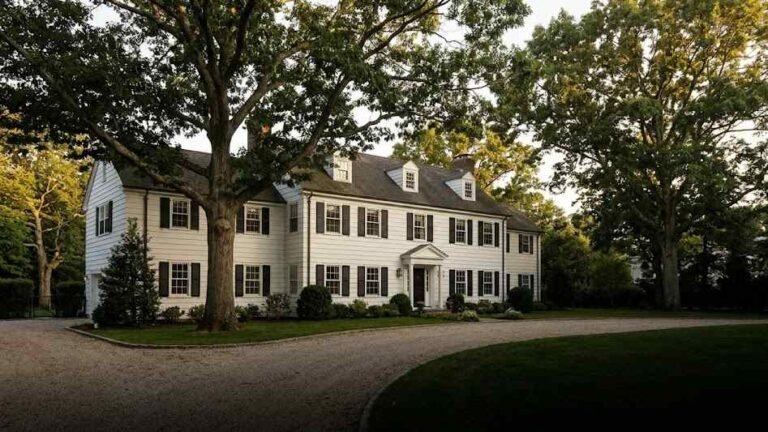
That has real implications for buyers. Matinecock is not a place where you arrive, renovate aggressively, and flip in eighteen months. The community notices what happens to its houses, and it has mechanisms — informal but effective — for making its preferences known. This is not hostility to change; the hamlet’s architectural record shows genuine variety across two centuries of building. It is hostility to the particular kind of development that treats a property as an isolated investment rather than as part of a shared landscape. Buyers who understand that distinction tend to find Matinecock one of the most satisfying places on the North Shore to own. Buyers who don’t tend to find it frustrating in ways they can’t quite name.
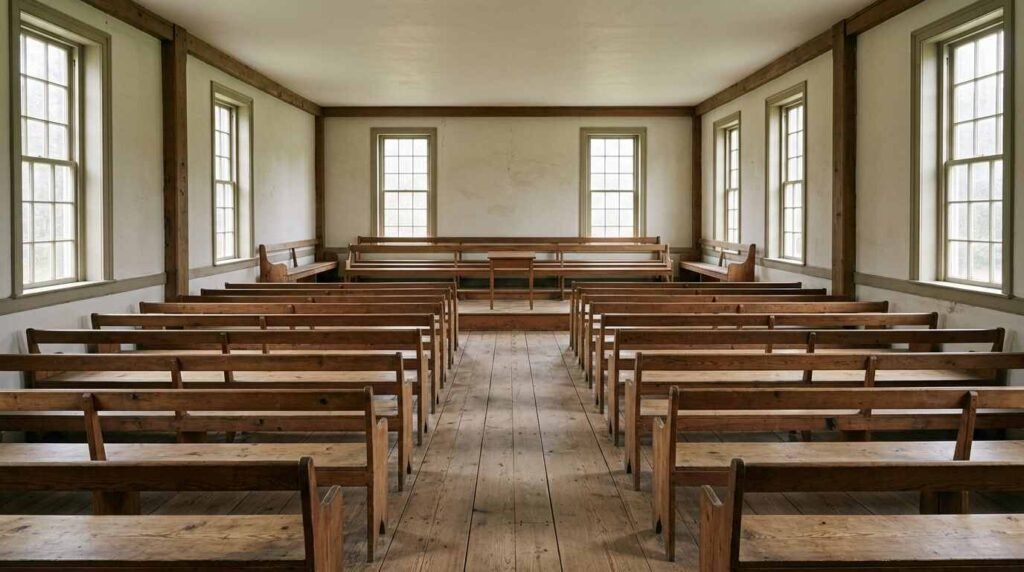
The Friends Meeting still holds worship on Sundays. Its membership is smaller than in the nineteenth century, as it is at most historic rural meetings. But the meeting house itself — a modest structure that has occupied essentially the same site since the seventeenth century — remains the oldest continuous institutional presence in the hamlet, and in some ways the most honest explanation for why Matinecock looks the way it does. Not zoning. Not incorporation. A congregation that decided, a very long time ago, that how you treated your neighbor’s land was a matter of moral consequence, and that built a community around that conviction with enough durability to outlast three and a half centuries of Long Island history.
What This Means If You’re Buying Here
I want to be direct about the practical real estate dimensions, because the history is genuinely interesting but the purchase decision is what it is. Matinecock properties come to market infrequently — turnover is low, partly by temperament and partly because the community norm runs against quick resale. When they do come to market, they tend to move quickly among buyers who already know the hamlet, which means the window for due diligence is compressed. Anyone seriously interested should have financing in order and should have done enough research to move confidently when something appears.
Deed restrictions are real here and worth examining carefully before any offer. Some date to the early twentieth century, some to earlier transfers within the meeting community, and not all of them have been formally released even where they may no longer be legally enforceable. A real estate attorney with Nassau County deed experience is not optional; it is the first call you make. My piece on how restrictive covenants have shaped Long Island neighborhoods covers the legal landscape in more detail — Matinecock is one of the places where that history is most consequential for current buyers.
The commute to Manhattan is real — Locust Valley station on the Port Washington branch of the LIRR is the closest rail connection, and the drive adds time on top of that. Buyers for whom the train is primary should calibrate accordingly. Buyers for whom the North Shore itself is the destination — who are moving toward something rather than away from something — tend to find the commute a reasonable price for what Matinecock offers in return.
If Matinecock is on your list, or if you’re interested in the broader Locust Valley corridor and want to understand how the different communities in that pocket of Nassau County compare in character and market dynamics, I’m happy to walk through it at Maison Pawli. This is exactly the kind of hyper-local knowledge that doesn’t show up in Zillow’s neighborhood descriptions — and in a place like Matinecock, it’s the knowledge that matters most.
Real estate markets change. This post reflects conditions as of April 2026. For current listings and market data, contact Pawli at Maison Pawli. This is for informational purposes only — consult a licensed attorney or financial advisor for your specific situation.
You Might Also Like
- The Covenant in the Deed: How Restrictive Covenants Shaped Long Island Neighborhoods
- The Servant Stair and the Service Wing: What Gold Coast Estate Architecture Reveals About Today’s Luxury Floor Plans
- The Joiner’s Argument in Locust Valley: How the Matinecock Friends Meeting House Framing Influenced a Generation of Gold Coast Estate Carpenters
Sources
- Matinecock Friends Meeting — active congregation, Locust Valley, NY
- Friends Historical Library, Swarthmore College — early Matinecock Meeting records: swarthmore.edu/friends-historical-library
- Nassau County Clerk’s Office — historical deed index: nassaucountyny.gov/agencies/CountyClerk
- Oyster Bay Town Historian’s Office
- Seawanhaka Corinthian Yacht Club — est. 1871, Oyster Bay: seawanhaka.org
- Jane Jacobs, The Death and Life of Great American Cities (Random House, 1961)
—